AP Art History
Institution: MIT
53 study materials · 42 sections
AP Art History students working the current College Board Course and Exam Description, including first-time students with no prior background, plus teachers reviewing the page for CED alignment.; Teach every official CED unit and every numbered topic at topic granularity.; Develop every AP skill / science-practice code explicitly and by name.; Replace description with teaching: worked contextual examples, named misconceptions, and in-flow retrieval checks.; Build an exam-practice unit covering every task type on the current exam.
Course Sections
Course Framework, Skills and Reasoning Processes
Key concepts: AP course expectations and informed choice · Validation of AP scores for college credit · Big Idea 5: Purpose and Audience · Influence of purpose, intended audience, and patron on art and art making · Course at a Glance organization · Spiraling of big ideas and skills throughout the course · Unit and topic progression · Teacher adaptation to student needs, block schedules, and academic calendars · Unit 1: Global Prehistory · Skill 1.A: Identifying a work of art or group of related works
AP Art History asks a deceptively powerful question: what can an artwork reveal when you examine its appearance, historical setting, making, purpose, and interpretation together?
Course Framework, Skills and Reasoning Processes
AP Art History asks a deceptively powerful question: what can an artwork reveal when you examine its appearance, historical setting, making, purpose, and interpretation together? A carved figure, temple, portrait, or installation is never only an object to identify. It is also evidence of cultural values, artistic choices, relationships among communities, and the expectations of a patron or intended audience.
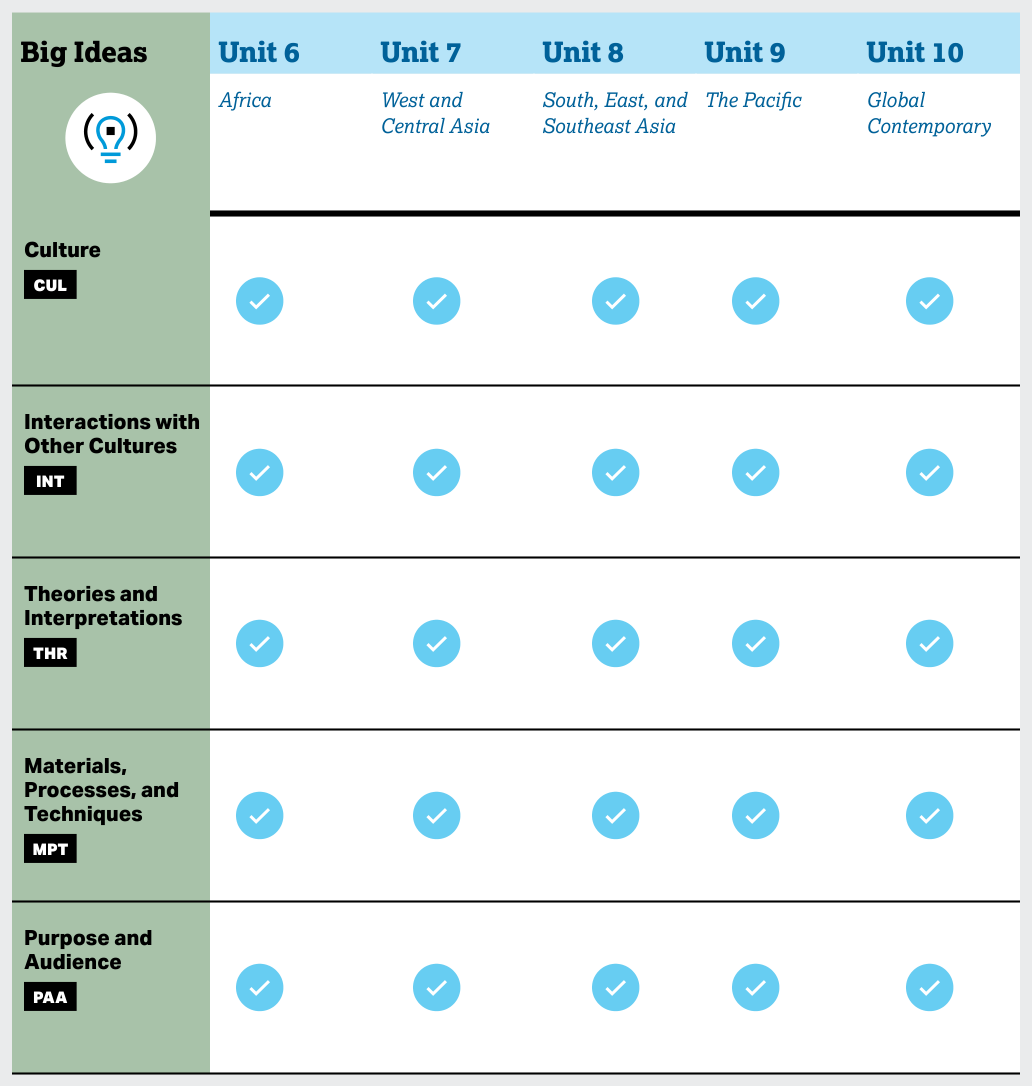
The course framework organizes that investigation around five recurring Big Ideas. These are not isolated chapters; they are lenses that return throughout the course:
| Big Idea | Code | Central concern |
|---|---|---|
| Culture | CUL | How beliefs, values, and social systems shape art |
| Interactions with Other Cultures | INT | How cultural contact, exchange, conflict, and influence appear in art |
| Theories and Interpretations | THR | How art-historical explanations are built and revised |
| Materials, Processes, and Techniques | MPT | How substances, tools, methods, and technology shape form |
| Purpose and Audience | PAA | How function, patronage, intended viewers, and reception affect art making |
Big Idea 5: Purpose and Audience
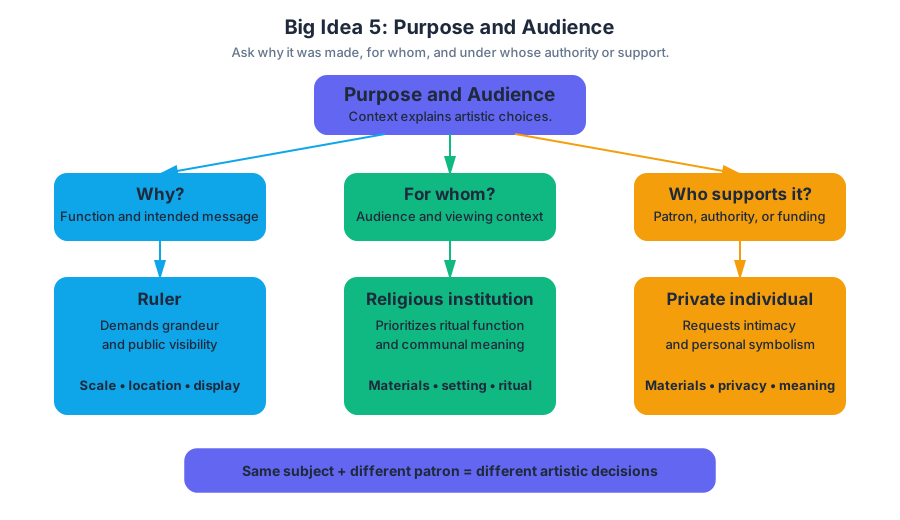
Purpose and Audience (PAA) means asking why a work was made, for whom, and under whose authority or financial support. A patron—a person or institution that commissions or funds art—can influence its subject, scale, materials, location, and message. A work made for private devotion may operate differently from one designed for public ceremony, political display, or commercial circulation.
A useful visual test is to imagine the same subject commissioned by three different patrons: a ruler may demand grandeur and public visibility; a religious institution may prioritize ritual function; a private individual may request intimacy and personal symbolism. The subject alone does not explain the artwork. Purpose, audience, and patron help explain why those artistic decisions made sense in context.
The eight art-historical thinking skills
The course repeatedly spirals eight official skills. “Spiraling” means that a skill returns in later units with more complex works and contexts rather than disappearing after its first introduction.
- Skill 1: Visual Analysis — identify and explain visible features such as form, style, materials, technique, and content. In Unit 1, Skill 1.A requires identifying a work of art or group of related works; 1.B develops description and analysis of visual evidence.
- Skill 2: Contextual Analysis — connect a work to historical, cultural, religious, political, or social circumstances.
- Skill 3: Comparison of Works of Art — explain meaningful similarities and differences, not merely list them.
- Skill 4: Artistic Traditions — recognize how artists inherit, adapt, challenge, or transform established conventions.
- Skill 5: Visual Analysis of Unknown Works — use observable evidence to analyze an unfamiliar work rather than relying on memory alone.
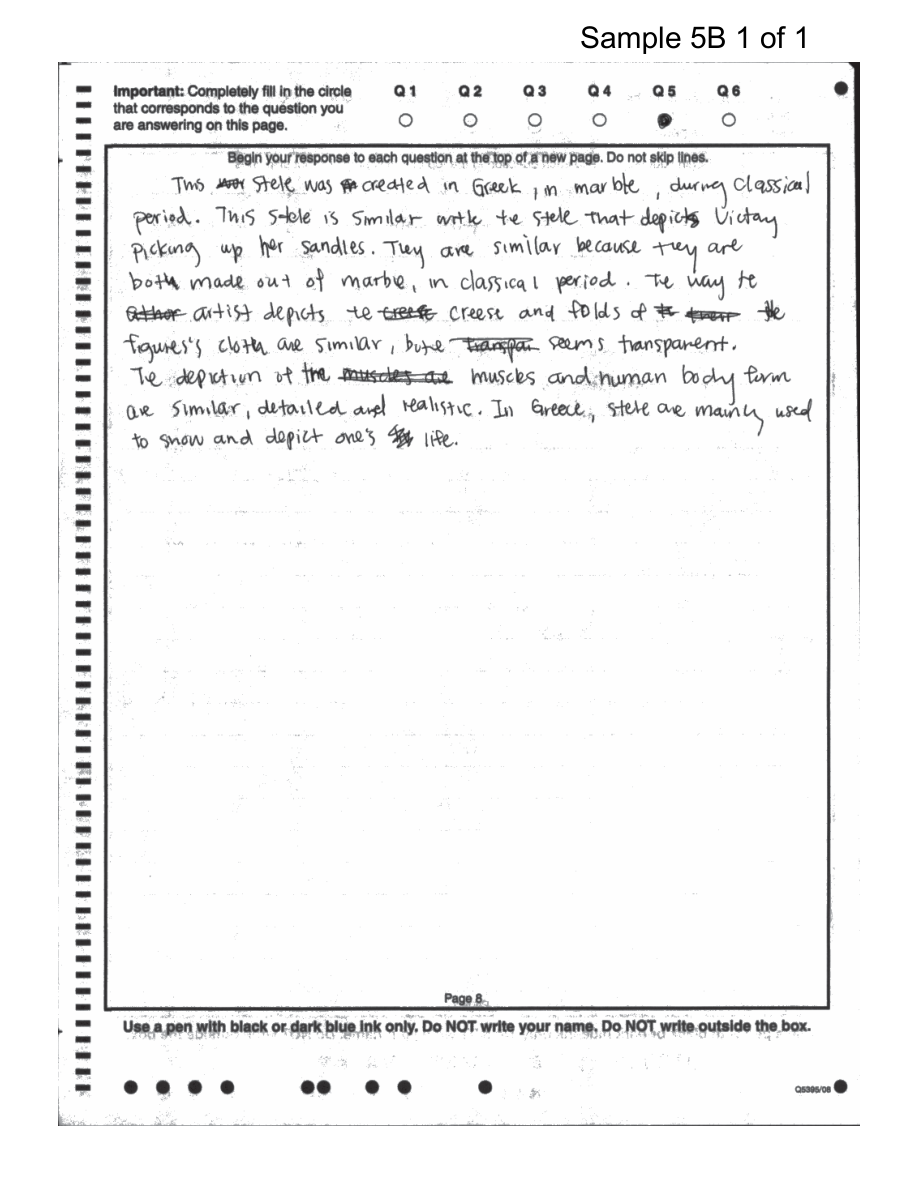
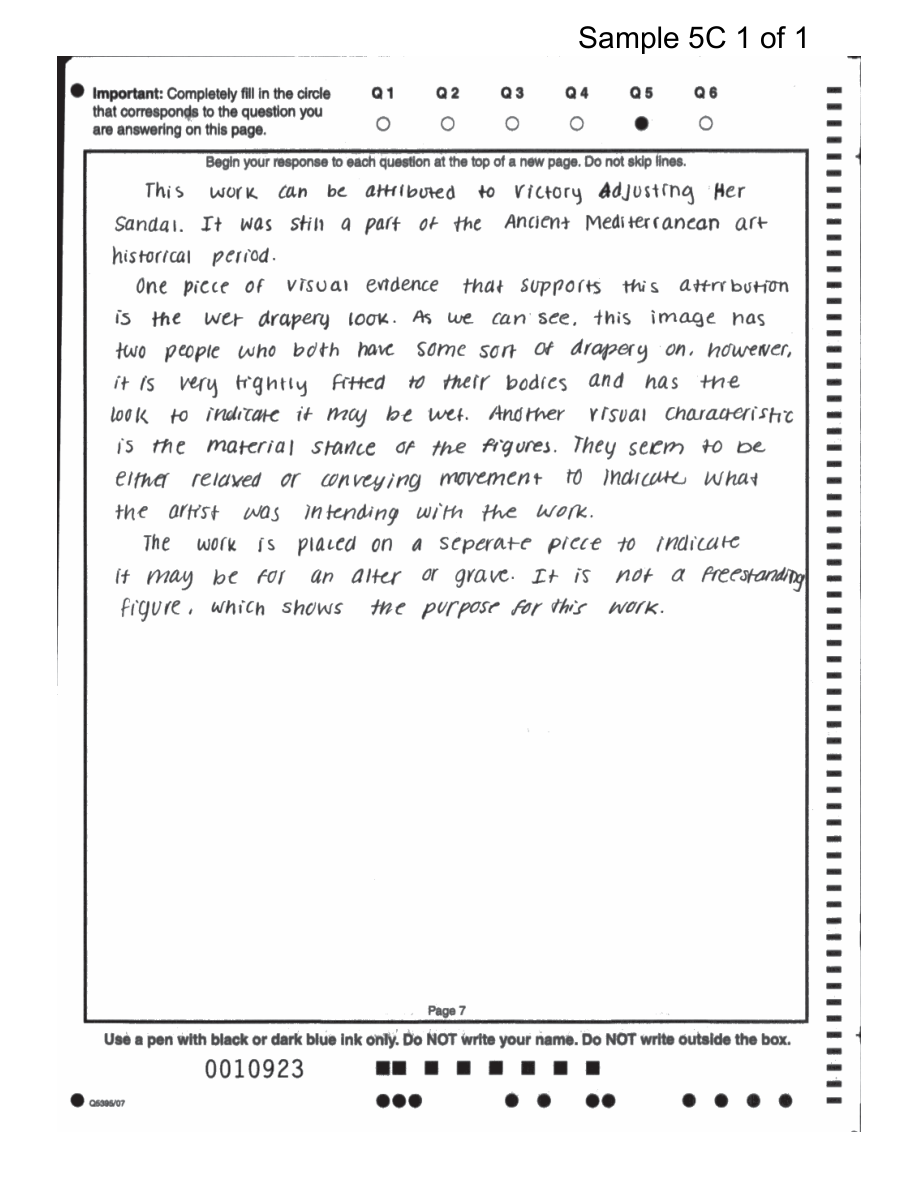
- Skill 6: Attribution of Unknown Works — assign a work to an artist, culture, style, or object type and justify the attribution. Skill 6.A identifies a possible attribution; 6.B justifies it through similarities with a known comparison.
- Skill 7: Art Historical Interpretations — evaluate how interpretations arise from form, style, materials, content, function, context, reception, or meaning. Skill 7.A concerns identifying or describing interpretations; 7.B explains how valid interpretations are derived from evidence.
- Skill 8: Argumentation — make a defensible claim and support it with relevant visual and contextual evidence.
On the exam, these skills appear through both sections: multiple-choice questions often require rapid identification, comparison, attribution, or contextual reasoning, while free-response questions require organized explanations and evidence-based arguments. A correct name without analysis demonstrates less than a precise observation connected to a defensible claim.
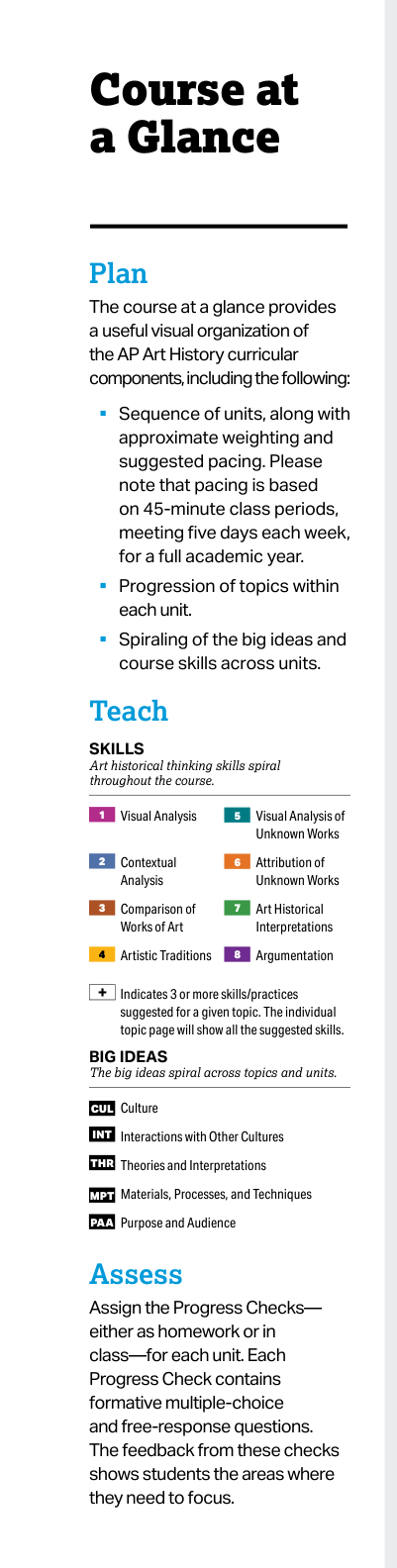
Course at a Glance: the visual architecture
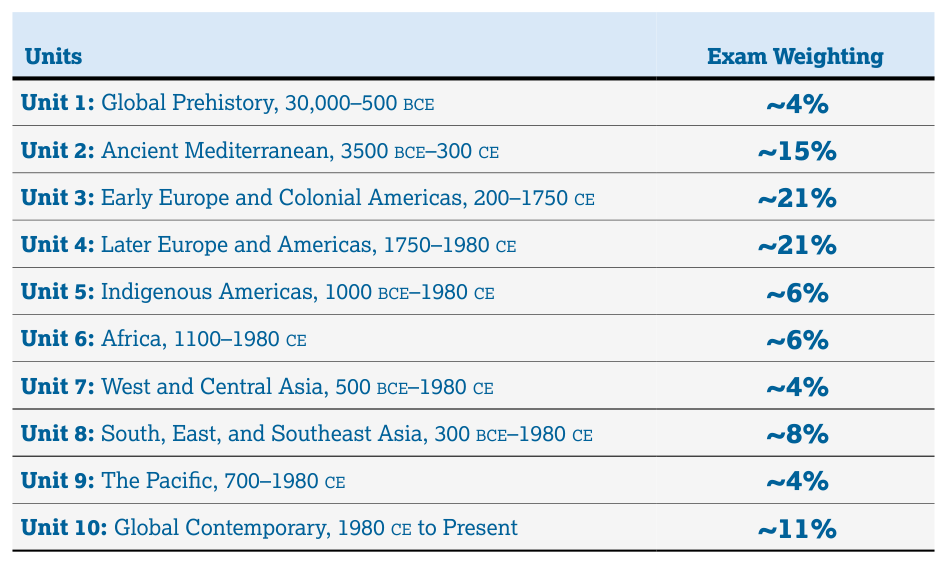
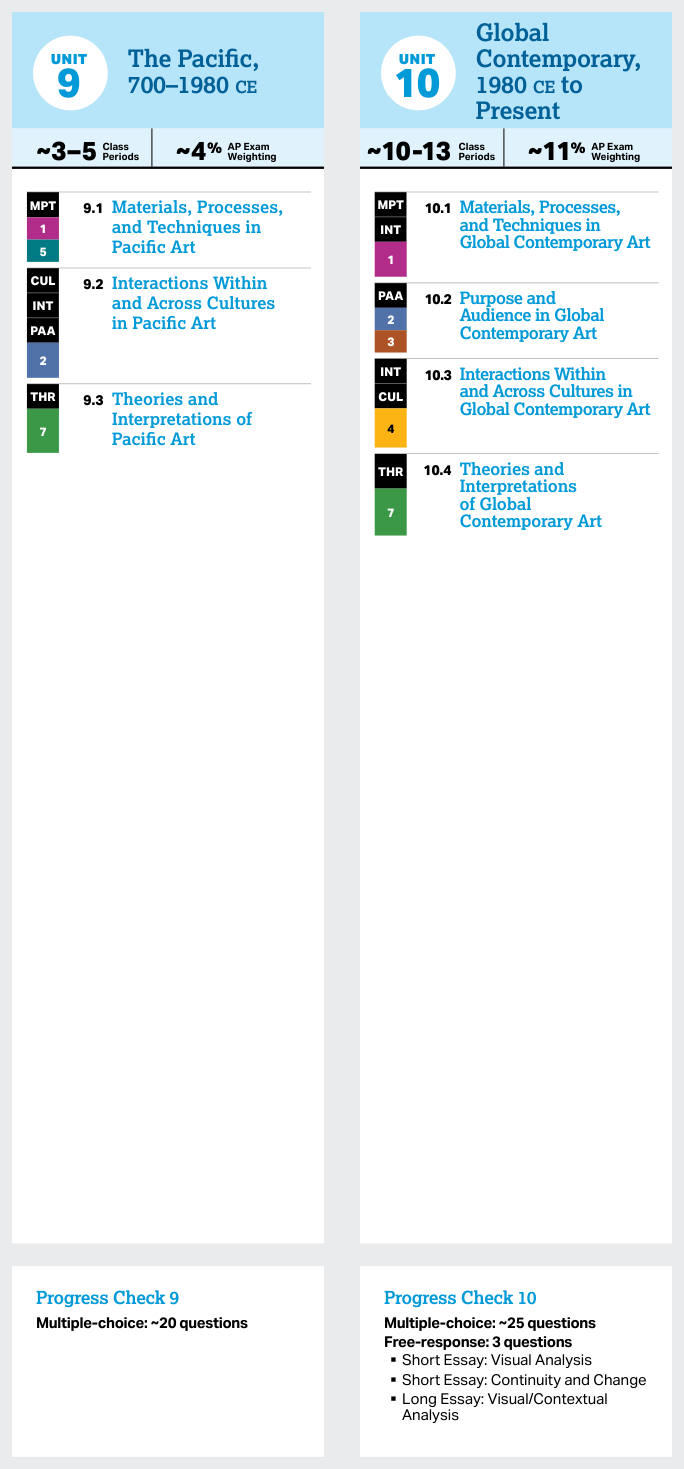
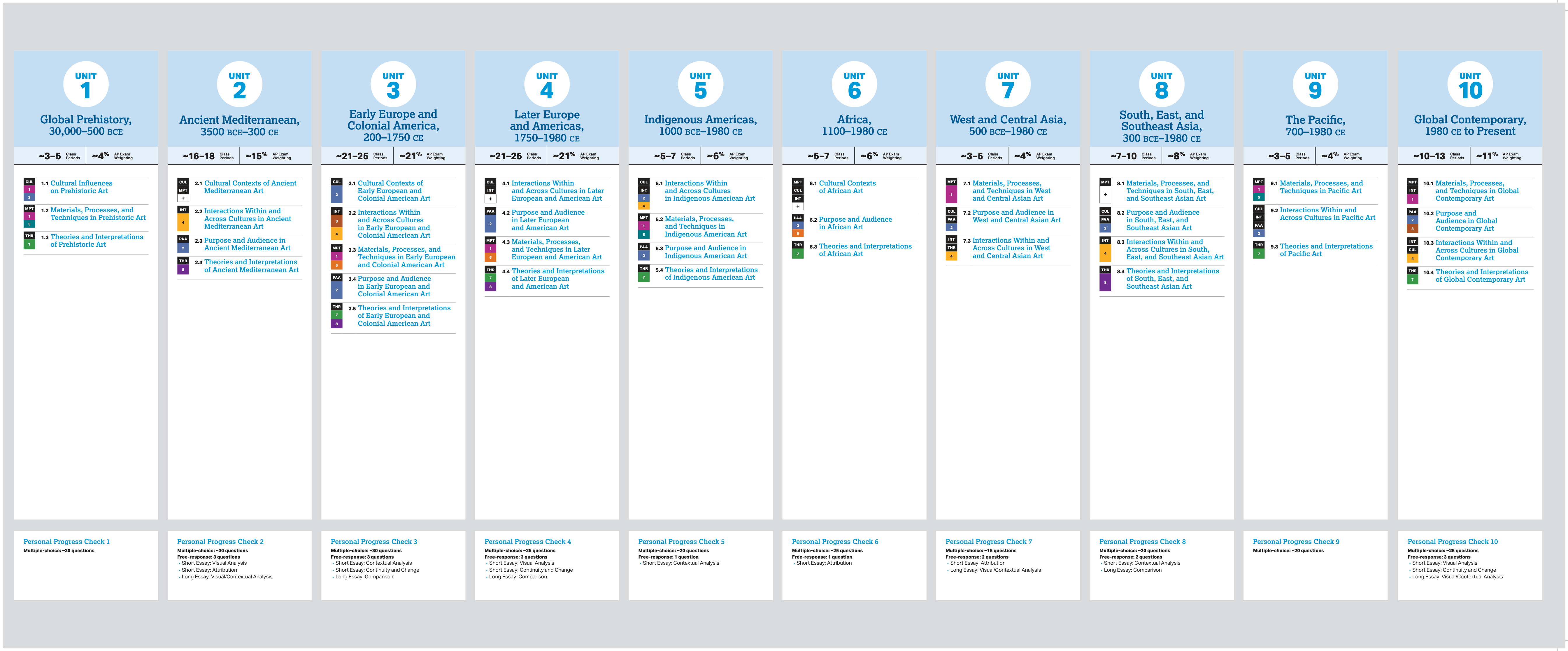
The Course at a Glance is a curriculum map showing each unit’s chronology and geography, suggested class periods, approximate AP Exam weighting, topics, Big Ideas, skills, and Personal Progress Checks. It is a planning guide rather than an inflexible calendar; teachers may adapt pacing for student needs, block scheduling, and the school’s academic calendar.
| Unit | Scope | Suggested periods | Approximate weighting |
|---|---|---|---|
| 1 | Global Prehistory, $30{,}000$–$500$ BCE | $3$–$5$ | $4%$ |
| 2 | Ancient Mediterranean, $3500$ BCE–$300$ CE | $16$–$18$ | $15%$ |
| 3 | Early Europe and Colonial America, $200$–$1750$ CE | $21$–$25$ | $21%$ |
| 4 | Later Europe and the Americas, $1750$–$1980$ CE | $21$–$25$ | $21%$ |
| 5 | Indigenous Americas, $1000$ BCE–$1980$ CE | $5$–$7$ | $6%$ |
| 6 | Africa, $1100$–$1980$ CE | $5$–$7$ | $6%$ |
| 7 | West and Central Asia, $500$ BCE–$1980$ CE | $3$–$5$ | $4%$ |
| 8 | South, East, and Southeast Asia, $300$ BCE–$1980$ CE | $7$–$10$ | $8%$ |
| 9 | The Pacific, $700$–$1980$ CE | $3$–$5$ | $4%$ |
| 10 | Global Contemporary, $1980$ CE to present | $10$–$13$ | $11%$ |
Why spiraling matters
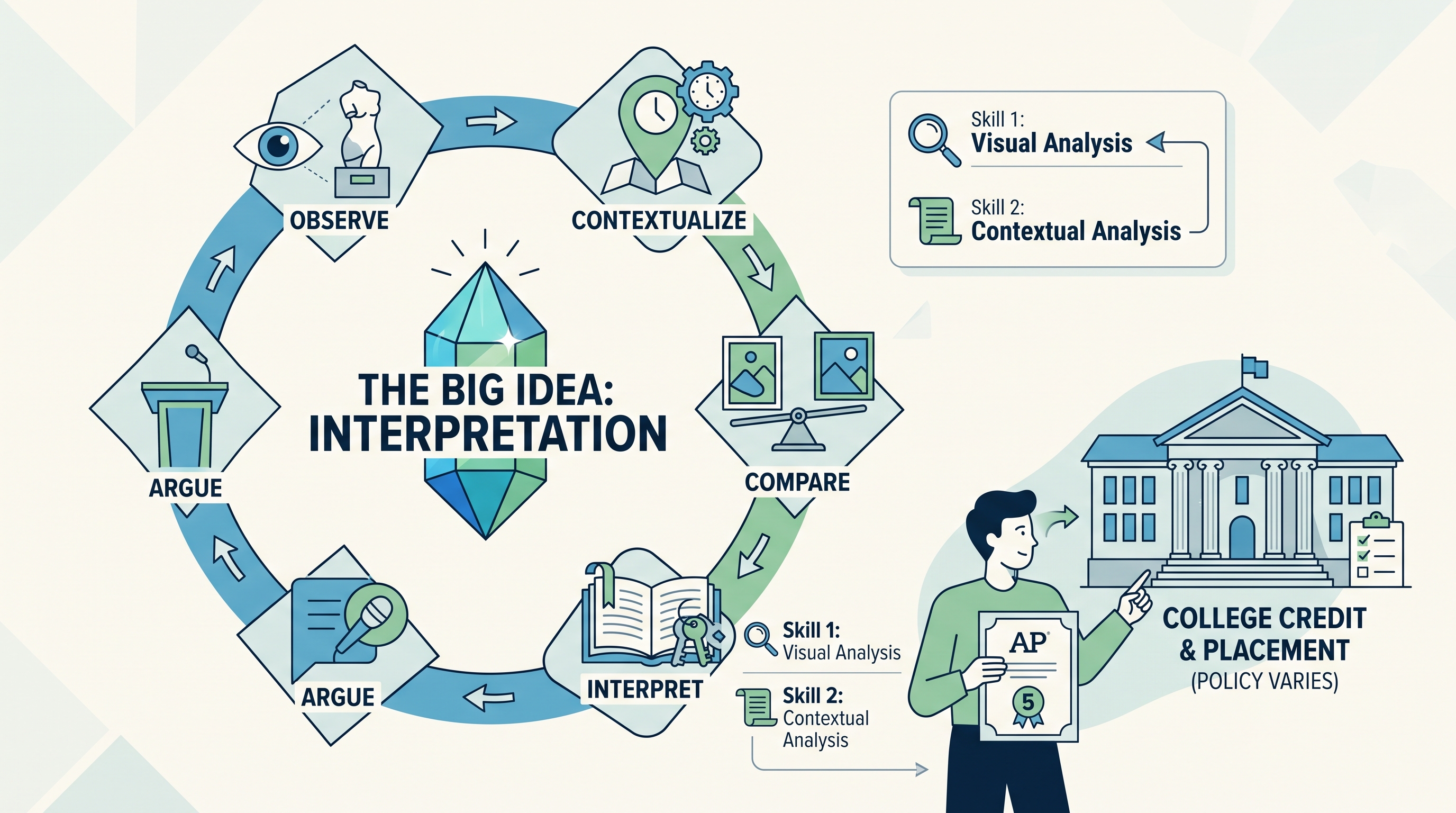
A prehistoric cave image may first prompt Skill 1: Visual Analysis: What lines, pigments, scale, and placement are visible? Later, an unfamiliar work may require Skill 5: Visual Analysis of Unknown Works, followed by Skill 6: Attribution of Unknown Works and Skill 8: Argumentation. The same habits become more demanding: observe, contextualize, compare, interpret, and defend.
Unit 1 illustrates this design clearly. Unit 1: Global Prehistory, $30{,}000$–$500$ BCE connects CUL to Skill 1: Visual Analysis and Skill 2: Contextual Analysis; MPT to visual analysis of known and unknown works; and THR to Skill 7: Art Historical Interpretations. The course therefore begins with identification and description but does not remain there—it builds toward interpretation and evidence-based argument.
Informed choice and college recognition
Advanced Placement is a choice that should be informed. The AP Program encourages educators to review course principles and expectations with students and parents so that workload, college-level analysis, and assessment demands are clear before enrollment.
A qualifying AP score may allow college credit, placement into advanced courses, or both, although each college determines its own policy. AP scores receive further validation through the American Council on Education and studies involving thousands of colleges and universities nationwide; students should still verify the specific policy of each institution.
Key insight: The framework is not a checklist of facts. It is a repeated reasoning cycle: observe → contextualize → compare → interpret → argue.
Retrieval check: A work depicts a ruler, but the prompt asks why its scale, materials, and location matter. Which Big Idea should guide the first response, and which two skills would most naturally support it? A strong answer begins with PAA, then uses Skill 1: Visual Analysis to identify evidence and Skill 2: Contextual Analysis to explain the patron’s intended effect.

1.1 Cultural Influences on Prehistoric Art
Key concepts: Cultural practices · Belief systems · Physical setting · Art making · Art reception · Stylistic conventions · Cultural influences on prehistoric art · Artistic traditions · Historical context · Dynastic Egyptian art
A painted bison deep inside a cave is not simply an ancient picture; its location, subject, style, and survival all record decisions made within a culture.
1.1 Cultural Influences on Prehistoric Art
A painted bison deep inside a cave is not simply an ancient picture; its location, subject, style, and survival all record decisions made within a culture. Cultural influences are the practices, belief systems, and physical settings that shape both the making of art and the ways later communities receive or interpret it. The central question is therefore not only What does this object look like? but also Why was it made there, in that form, for those people?
CUL-1 — Enduring Understanding: Cultural practices, belief systems, and physical setting constitute an important part of art and art making and are often communicated in various stylistic conventions and forms.
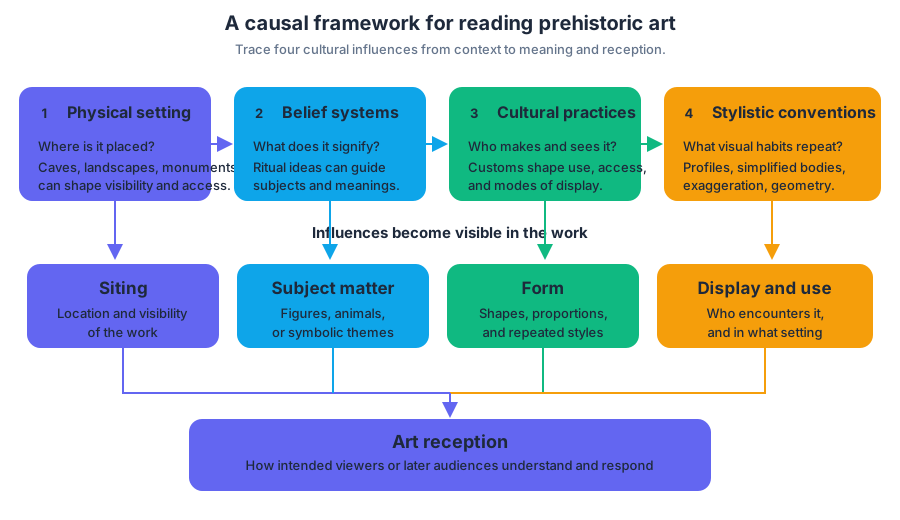
A causal framework for reading prehistoric art
Use this chain when analyzing an unfamiliar work:
Physical setting can determine where an image or monument is placed; belief systems can influence its subject and meaning; cultural practices can establish who makes it, who sees it, and how it is used; and stylistic conventions—repeated visual habits such as simplified bodies, profile views, exaggeration, or geometric pattern—communicate those influences. These factors may affect siting, subject matter, form, and modes of display. They also shape art reception, meaning the way intended viewers or later audiences understand and respond to a work.
Worked example: Paleolithic cave painting
Consider the animal paintings at Chauvet Cave or Lascaux in present-day France. Their deep, difficult-to-reach locations suggest that the physical setting mattered: these images were not created as ordinary outdoor decoration or as art meant for constant public viewing. The cave’s darkness, narrow passages, and uneven surfaces became part of the experience, so the setting may have supported ritual activity, restricted access, or a culturally important encounter with animal imagery.
The repeated presence of bison, horses, aurochs, and other animals connects the images to the lifeways and belief systems of Paleolithic communities. It is tempting to call them “hunting magic,” but that explanation is only one hypothesis, not a proven fact. A stronger contextual claim says that the animals’ prominence reflects a culture in which human survival, animals, and unseen forces were closely connected.
The artists used stylistic conventions that made animals recognizable and energetic: bodies are often shown in profile, contours follow the cave wall, and movement is suggested through overlapping forms or multiple legs. These choices are not evidence of inability. They are cultural and visual decisions that made the animals powerful within their setting. The original reception may have involved torchlight, sound, movement, and selected viewers—conditions very different from a modern museum display.
Other prehistoric forms: monument, figurine, and community
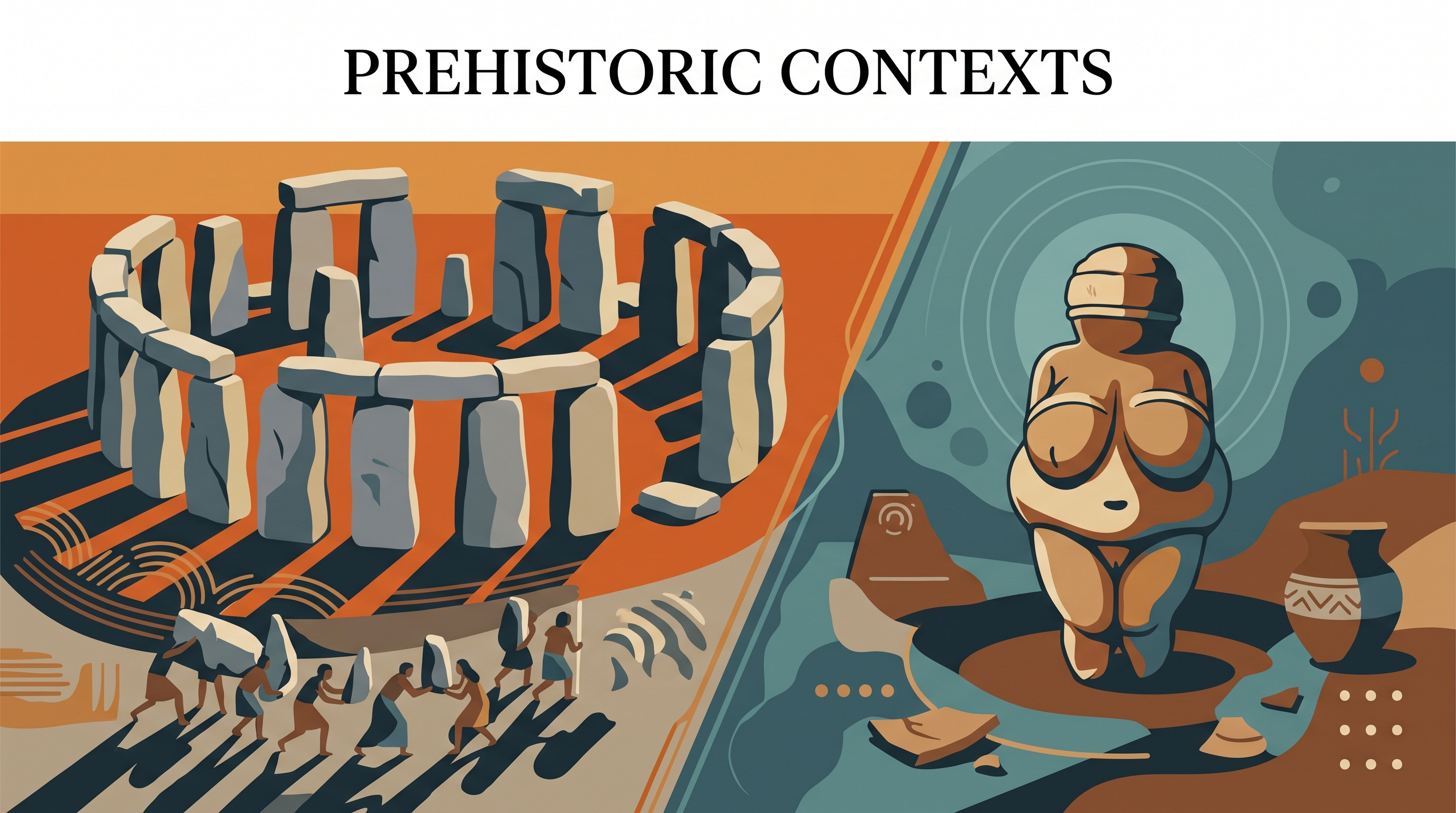
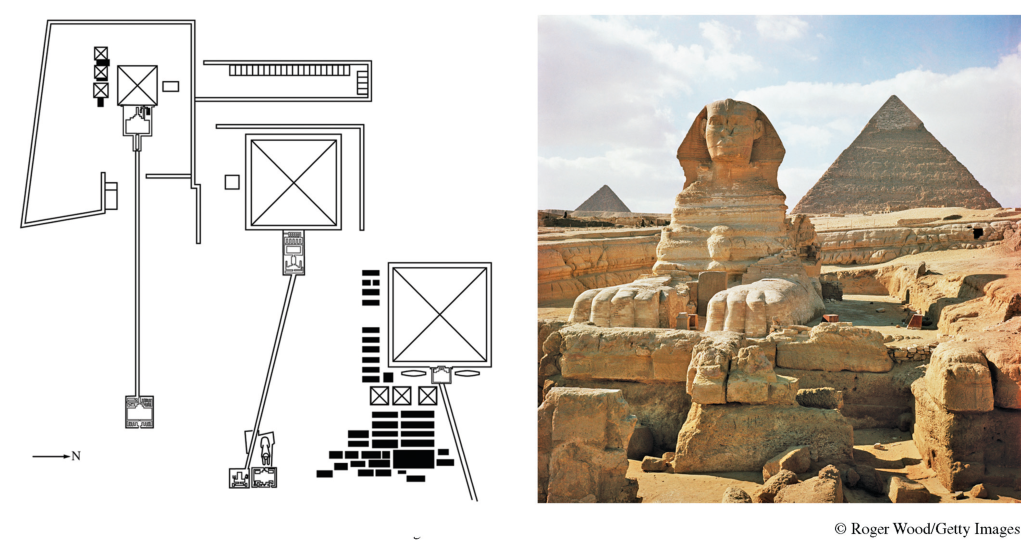
Prehistoric cultural influence is not limited to painting. Stonehenge, a Neolithic and Bronze Age monument in present-day England, demonstrates how physical setting and collective practice can merge. Its enormous stones required coordinated labor, planning, and transport; its circular arrangement created a controlled ceremonial space. The monument’s alignment and changing uses invite connections to seasonal cycles, ancestors, ceremony, or social authority, although its exact meanings remain debated.
A small Neolithic figurine such as the Vessel or a female figurine from prehistoric Europe also shows why interpretation must remain contextual. Its exaggerated body or simplified features may relate to fertility, identity, domestic practice, or another cultural purpose, but the object’s meaning cannot be securely determined from appearance alone. Ask instead how its scale, material, findspot, and repeated form might have affected its use and reception.
Style communicates culture—but not mechanically
A stylistic convention is a recurring way of representing something. Conventions can signal shared cultural values: Egyptian figures often follow established proportions and poses; prehistoric cave artists repeatedly emphasize animal bodies; Neolithic builders use geometry, repetition, and massive scale. Style is therefore not a decorative “look” added after meaning. It can encode ideas about permanence, identity, order, animals, ancestors, or the relationship between humans and the environment.
The art of dynastic Egypt—covering present-day Egypt and Sudan from approximately $3000$ to $30$ BCE—offers a later comparison. Its emphasis on permanence served a culture focused on preserving a cycle of rebirth; the Amarna period’s cultural reform produced a striking stylistic revolution. Likewise, Chartres Cathedral connects architecture to medieval theology, music, and literary and poetic invention; the Alhambra reflects the cultural context of Islamic courtly architecture; The Annunciation with Two Angels and The Birth of Venus show how subject and style depend on Christian and Renaissance cultural settings. These comparisons clarify the prehistoric principle without replacing prehistoric evidence.
Misconception check
Misconception: “Prehistoric art was primitive because it is old.” Age does not measure artistic complexity. The cave paintings’ selective placement, visual conventions, and integration with rock surfaces demonstrate deliberate choices. Also avoid the opposite error—claiming certainty about ritual meaning. Art history distinguishes observable evidence from interpretation.
AP reasoning in action
This topic directly develops CUL-1.A and CUL-1.A.6, which require explaining how cultural practices, belief systems, and/or physical setting affect art and art making. It also activates Skill 2.B, Explain how and/or why context influences artistic decisions about form, style, materials, content, and/or function in the creation or meaning of a work of art, and Skill 4.A, Explain how a specific work of art demonstrates continuity and/or change within an artistic tradition, style, or practice. Begin with visible evidence, connect it to a specific cultural factor, and avoid unsupported certainty.
Retrieval check
A cave animal, a stone circle, and a Neolithic figurine are all prehistoric, but they do not automatically have the same function. Choose one and complete the sentence: “Its physical setting and stylistic conventions suggest __________ because __________.” A defensible answer names visual evidence, identifies a cultural practice or belief system, and distinguishes a plausible interpretation from a proven fact.
1.2 Materials, Processes, and Techniques in Prehistoric Art
Key concepts: Materials · Technique · Artistic decisions about form, style, materials, technique, and/or content · Visual analysis of works of art · Cultural influences on prehistoric art · Contextual elements of a work of art · Attribution of works of art · Art-historical interpretations · Developing art-historically valid arguments · Prehistoric Art unit (30,000–500 BCE)
A prehistoric artist’s material is never merely a neutral container: ocher, stone, bone, and charcoal each impose different possibilities on the image, just as watercolor, oil paint, and photography produce different kinds of marks today.
1.2 Materials, Processes, and Techniques in Prehistoric Art
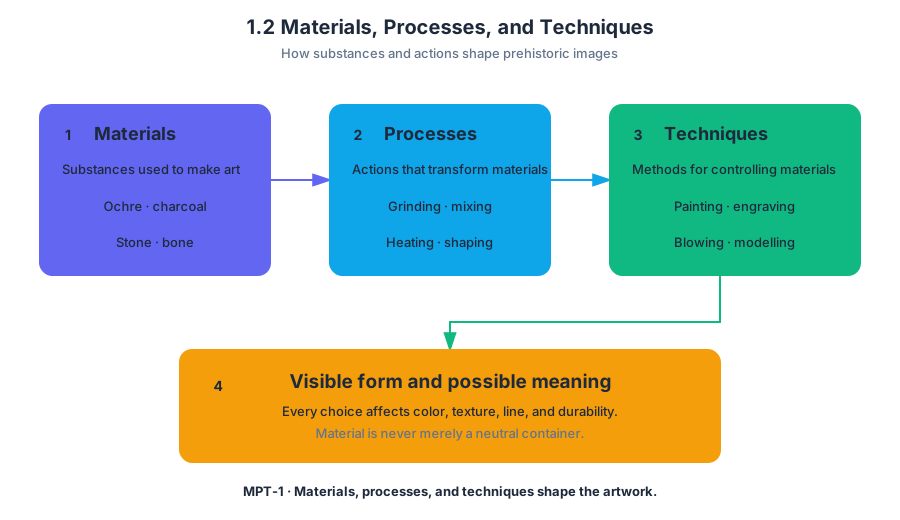
A prehistoric artist’s material is never merely a neutral container: ocher, stone, bone, and charcoal each impose different possibilities on the image, just as watercolor, oil paint, and photography produce different kinds of marks today. Materials are the substances used to make an artwork; processes are the actions that transform those substances; and techniques are the specific methods used to control them.
MPT-1: Materials, processes, and techniques shape both the visible form and the possible meaning of a work of art.
Material becomes meaning through artistic decisions
Consider a prehistoric image made with mineral pigment on a cave wall. The artist must select a pigment, grind or prepare it, mix it with a binding substance or water, apply it with a finger, tool, or spray-like breath, and choose whether to paint on a smooth or uneven section of stone. Each decision affects the result: a dry pigment may create a powdery surface, a liquid mixture may produce a stronger contour, and the wall’s natural bulges may become part of the depicted animal’s body.
The work’s form—its shape, line, color, texture, spatial organization, and degree of realism—therefore records the making process. A powerful contour can clarify the animal’s silhouette; layered pigment can suggest volume; a natural ridge can make a body appear to project from the wall. Technique is not an afterthought added after an image has been conceived. It is one of the means by which the image exists.
MPT-1.A connects material choice to interpretation: the physical substance and method of making influence what viewers see and how they understand it. A small carved object made from bone communicates through portability, tactile handling, and three-dimensional form differently from a large image fixed to a cave surface.
Worked visual analysis: from observation to argument
Imagine an image of a bison painted with dark outlines and selectively filled areas of red and brown pigment. Begin with Skill 1.B: Describe visual elements of a work of art (or group of related works of art). An accurate description identifies the animal’s profile, the emphatic contour, the limited palette, the uneven surface, and the relationship between painted areas and the wall’s natural contours. Do not begin by asserting what the image “means”; first establish what is visibly present.
Next apply Skill 1.C: Explain how artistic decisions about form, style, materials, technique, and/or content shape a work of art (or group of related works of art). A strong analysis links evidence to effect: the dark contour separates the animal from the stone; restricted color focuses attention on its body; and the use of the wall’s relief gives the figure a sense of volume. The conclusion should remain appropriately careful: these choices may have encouraged viewers to experience the animal as physically present, but the visual evidence alone does not prove a single ritual purpose.
This is the difference between description and analysis:
| Level | Evidence-based move |
|---|---|
| Description | “The animal has a dark outline and areas of red pigment.” |
| Analysis | “The dark outline increases legibility against the wall, while the red areas emphasize the body’s mass.” |
| Contextual argument | “Because the image is fixed to a cave surface rather than made as a portable object, its experience depended on location, movement, and access.” |
Attribution and unknown works
Skill 5.A: Describe visual elements of a work of art (or group of related works of art) beyond the image set supports analysis of unfamiliar prehistoric objects. Attribution means identifying a work or connecting it to a culture, period, object type, or related group. Do not rely on one clue. Combine material, technique, scale, surface, subject, and setting.
For example, a compact carved animal with incised lines and a polished surface is more plausibly a portable object than a wall painting. That attribution remains a reasoned proposal, not certainty: similar techniques can appear in different cultures, and prehistoric works often lack written records. Contextual evidence—location, archaeological association, date, and comparison with related works—must support the visual evidence.
Misconception check: “simple materials mean simple art”
Named misconception — primitivist simplicity: prehistoric art is not artistically unsophisticated because it uses earth pigments, stone, or bone. Limited materials can demand sophisticated decisions about contour, proportion, surface, and motion. A work may look spontaneous while depending on extensive preparation and technical knowledge.
Interpretation must also remain historically responsible. The preceding cultural analysis supplies possible contextual influences, but material analysis tests how those influences became visible. Avoid claiming that a pigment automatically proves a ritual, hunting, or religious function; instead, develop an art-historical argument using both visual evidence and context.
Retrieval check
A previously unknown prehistoric image shows a deeply incised animal on a portable stone, with polished edges and no surviving pigment. Identify two visual elements, explain one effect of the technique, and propose one contextual question that would help attribute or interpret the object. A complete response might connect incision to linear emphasis and portability to possible movement or handling—while clearly distinguishing evidence from speculation.

1.3 Theories and Interpretations of Prehistoric Art
Key concepts: Theories and interpretations of prehistoric art · Function and meaning of prehistoric art · Artistic expression prior to written records · Art historical interpretation of works of art · Visual analysis of prehistoric artworks · Collaboration between art historians and social and physical scientists · Influence of other disciplines on art-historical scholarship · Impact of available technology on interpretation · Importance of available evidence · Great Hall of the Bulls at Lascaux and Stonehenge as suggested works
A painted animal on a cave wall cannot explain itself in words, yet it can preserve evidence of what mattered to people who left no written records.
1.3 Theories and Interpretations of Prehistoric Art
A painted animal on a cave wall cannot explain itself in words, yet it can preserve evidence of what mattered to people who left no written records. Prehistoric art therefore demands a special kind of reasoning: interpretation built from visible form, archaeological context, scientific evidence, and carefully stated uncertainty.
Enduring Understanding (THR-1): The study of art history is shaped by different theories and interpretations of art and art making that change over time. These interpretations arise from visual analysis and from scholarship influenced by other disciplines, available technology, and the availability of evidence.
The evidence problem: interpreting art without written records
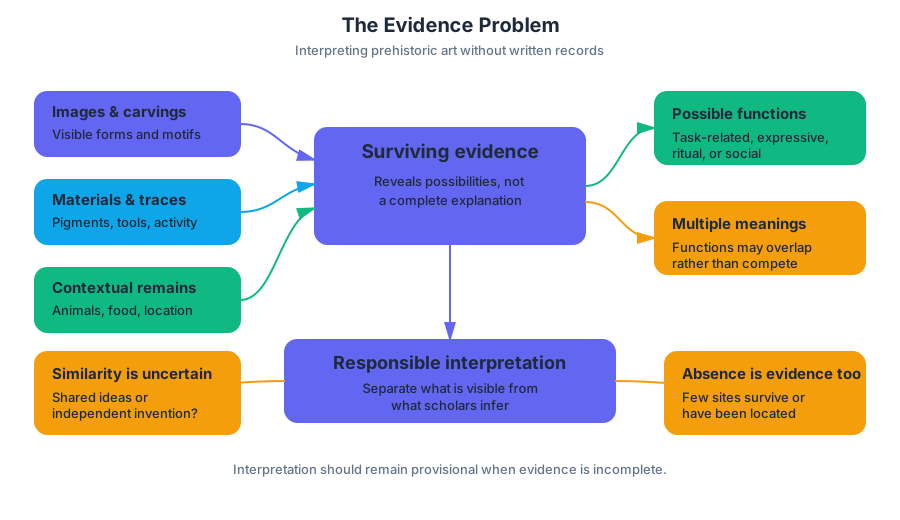
Artistic expression prior to written records survives unevenly. Paintings, carvings, monuments, tools, pigments, animal remains, food sources, and traces of human activity can reveal possibilities, but they rarely provide a complete explanation of function or meaning. The function of an image may have been task-related, expressive, ritual, social, or several of these at once.
The small number of surviving and located prehistoric monuments creates a major limitation: similarity or difference in form may result from shared ideas, independent invention, environmental conditions, or missing evidence. A responsible interpretation distinguishes between what the work visibly demonstrates and what scholars infer from it.
A collaborative method
THR-1.A.1: Over time, knowledge of global prehistoric art has developed through collaboration between art historians and social and physical scientists. Archaeologists study excavation contexts and human activity; physical scientists analyze materials, dates, residues, and environmental evidence; social scientists contribute models for understanding behavior, community, ritual, and cultural transmission.
THR-1.A.2: Ongoing archaeological excavations and the use of carbon-14 dating have illuminated interconnections among prehistoric artworks across the world. Carbon-14 dating estimates the age of once-living organic material, such as charcoal, but it does not automatically explain an image’s meaning. Scientific dating can establish when something was made; visual and contextual analysis must still address why it may have been made.
THR-1.A.3: The function of prehistoric artistic expression can be inferred from evidence of technology, survival strategies, available food sources, cultural development, and humans’ capacity to shape and manage their environment. These clues become more useful when combined rather than treated as isolated proof.
THR-1.A.4: Art historians apply familiar methods to prehistoric art by comparing imagery, materials, and techniques to identify patterns—for example, the recurrence of transformational animal-human imagery—and then considering ethnographic approaches. Ethnography compares cultural practices, but comparisons must be used cautiously: no living society can be treated as a direct, unchanged substitute for a prehistoric one.
Worked interpretation: the Great Hall of the Bulls at Lascaux
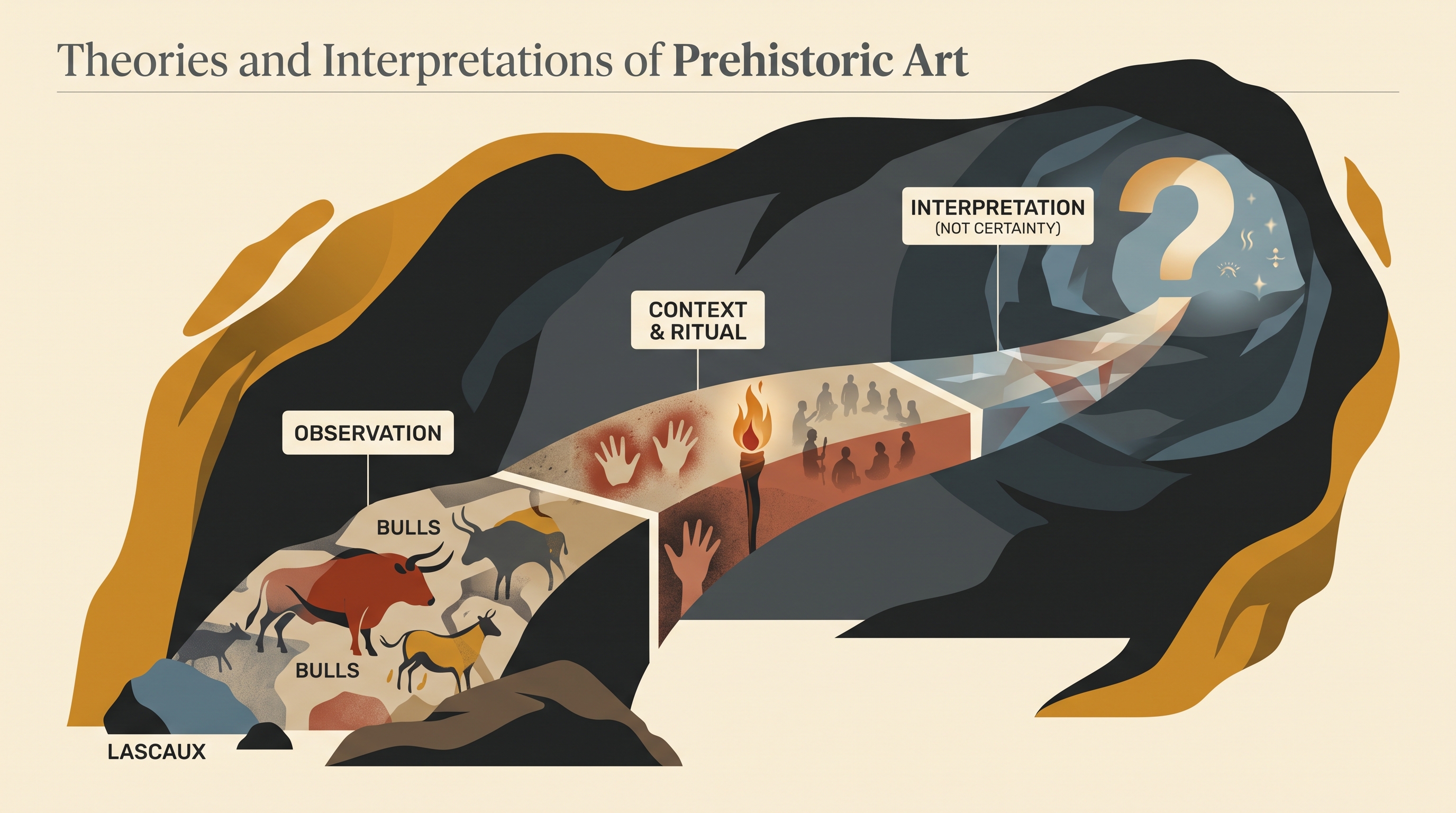
The Great Hall of the Bulls (Lascaux) contains large, overlapping animal images arranged across a cave surface. Visual analysis identifies the dominant content—animals—along with their scale, placement, movement, and relationship to the irregular wall. These features support interpretation, but they do not prove a single purpose.
A scholar might argue that the cave images had expressive or ritual significance because the underground setting, difficult access, and concentration of imagery distinguish them from ordinary task-related marks. Another interpretation might emphasize teaching, storytelling, social identity, or repeated ceremonial use. The strongest claim connects evidence to inference: the setting and visual concentration suggest that the images were more than casual decoration, while the absence of written explanation prevents certainty about the exact ritual or narrative meaning.
This is the complete reasoning chain: observation—large animal figures occupy a cave environment; context—the images survived in a non-domestic underground space; interpretation—the setting may have encouraged collective, ceremonial, or expressive activity; qualification—the evidence cannot establish one universally correct explanation.
Worked interpretation: Stonehenge
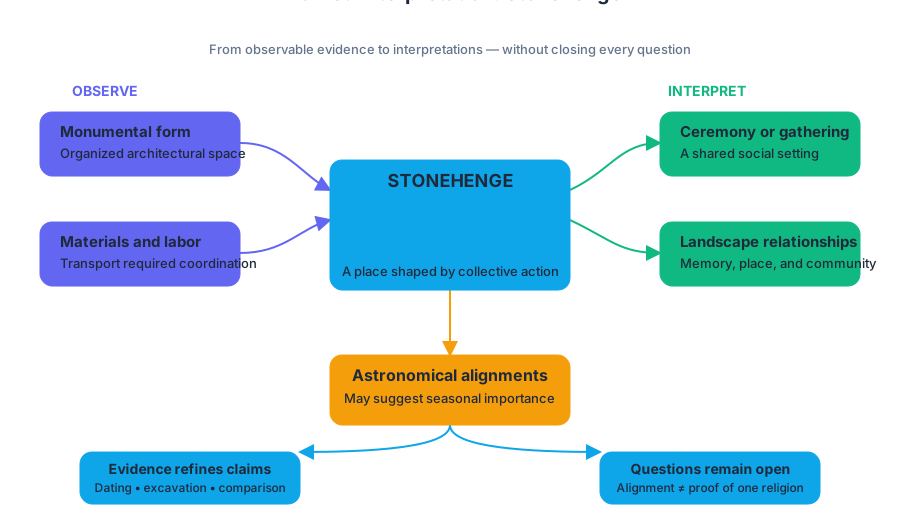
Stonehenge demonstrates why a prehistoric work can be interpreted through form, materials, function, context, reception, and meaning. Its monumental arrangement of stones creates a carefully organized architectural space rather than a portable object. The labor required to transport and position the stones indicates collective planning and social coordination.
Those observations support interpretations involving ceremony, gathering, commemoration, or relationships between communities and the landscape. Astronomical alignments may contribute to interpretations of seasonal or calendrical importance, but alignment alone does not prove a specific religious system. Archaeological evidence, dating, excavation, and comparison with related monuments can refine the argument while leaving some questions unresolved.
The skills that make an interpretation defensible
This topic most directly activates the following official skills: Skill 1: Visual Analysis, identifying form, style, materials, technique, and content; Skill 2: Contextual Analysis, connecting a work to technology, environment, survival, and cultural conditions; Skill 3: Comparison of Works of Art, recognizing patterns and differences among prehistoric works; Skill 7: Art Historical Interpretations, explaining how scholars construct and revise interpretations; and Skill 8: Argumentation, supporting a claim with specific, relevant evidence and acknowledging limits.
A high-quality response does not merely label Lascaux “ritual” or Stonehenge “religious.” It explains which visual or contextual evidence makes that interpretation plausible, identifies what another discipline contributes, and recognizes how new technology or newly discovered evidence could change the conclusion.
Misconception check
Misconception: “If a prehistoric image shows an animal, its meaning is obvious.” Correction: recognizable subject matter is only one part of interpretation. Meaning depends on placement, scale, repetition, materials, access, surrounding evidence, cultural comparison, and the limits of surviving information.
Retrieval check: Explain one interpretation of the Great Hall of the Bulls or Stonehenge. Name two specific pieces of visual or contextual evidence supporting it, then state one reason the interpretation remains conjectural.
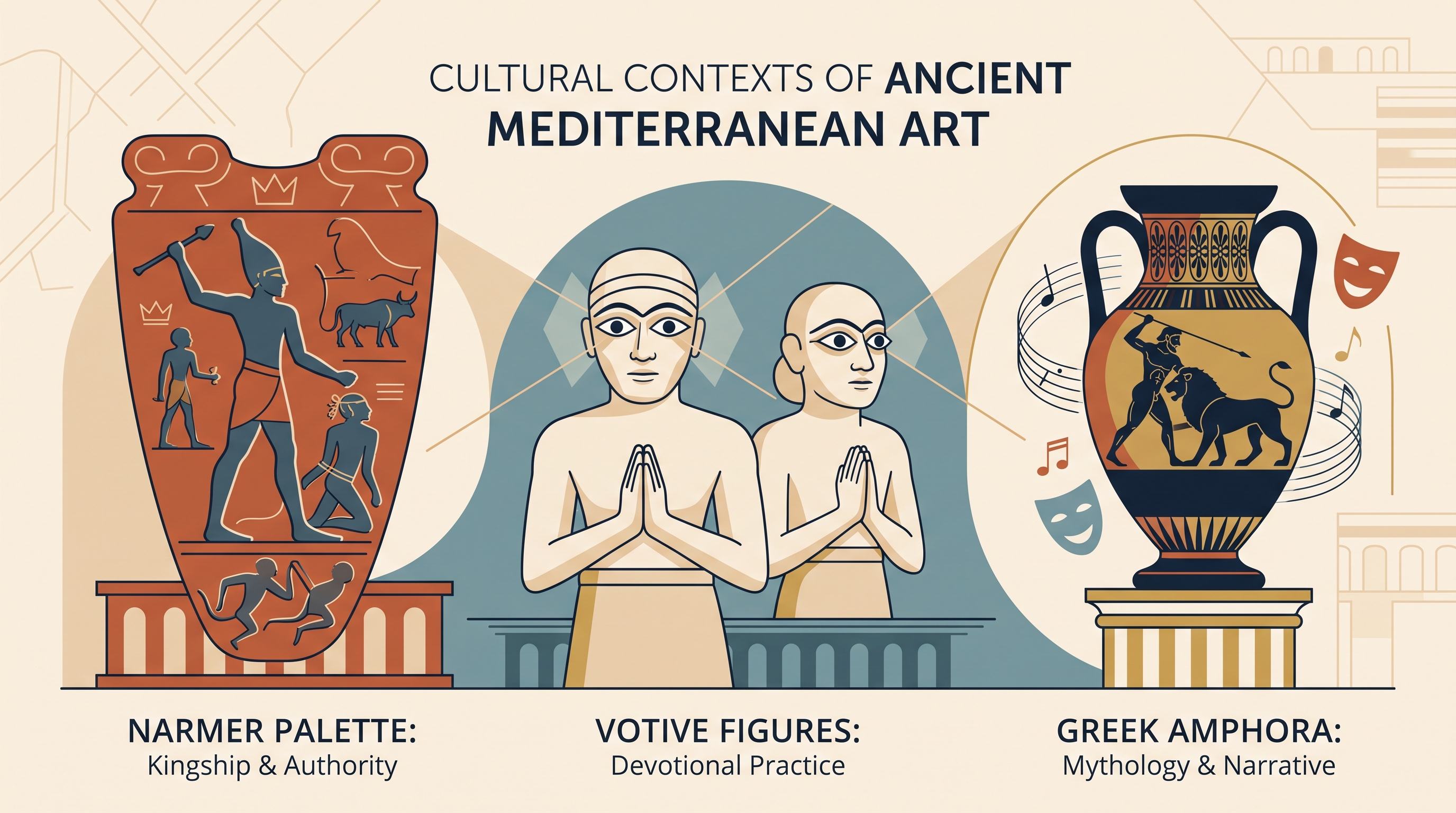
2.1 Cultural Contexts of Ancient Mediterranean Art
Key concepts: Cultural contexts of Ancient Mediterranean art · How available evidence, technology, materials, and other disciplines influence art historical analysis · Contextual analysis of artworks · Visual analysis using style, materials, technique, and content · Comparing similarities and differences in form across artworks · Attribution to a specific artist, culture, style, or object type · Ancient Near Eastern cultural powers and traditions · The relationship between artistic permanence and beliefs about rebirth · Greek, Etruscan, and Roman values of harmony and order · Cultural and political distinctions among Etruscan and Roman art
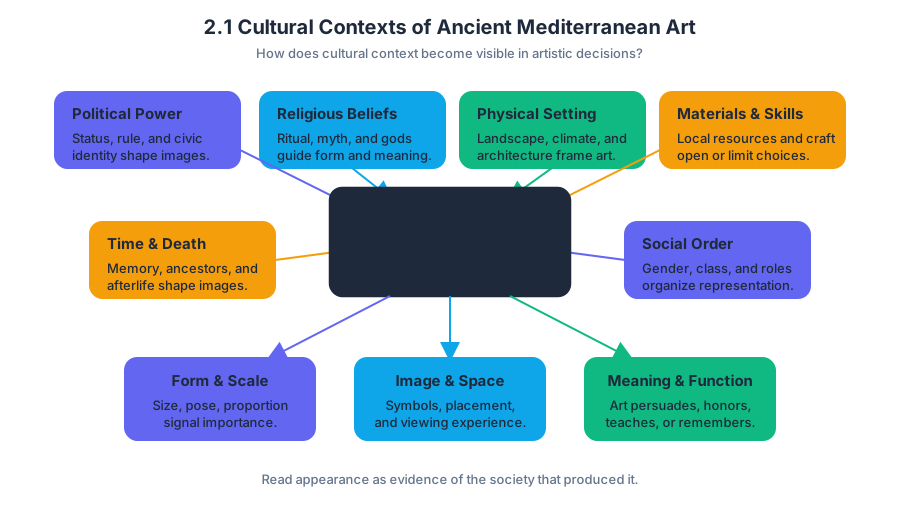
Ancient Mediterranean art cannot be understood from appearance alone: its forms respond to political power, religious beliefs, physical setting, available materials, and ideas about time, death, and social order.
2.1 Cultural Contexts of Ancient Mediterranean Art
Ancient Mediterranean art cannot be understood from appearance alone: its forms respond to political power, religious beliefs, physical setting, available materials, and ideas about time, death, and social order. The central question is therefore: how does cultural context become visible in artistic decisions?
A cultural-context map
The Ancient Mediterranean includes several overlapping traditions rather than one unified culture. The ancient Near East includes present-day Iraq and successive cultural powers such as the Sumerian, Akkadian, Neo-Sumerian, Babylonian, Assyrian, and Neo-Babylonian traditions. Greek, Etruscan, and Roman cultures developed in different physical and political settings, yet all were shaped by values associated with harmony and order, together with distinctive belief systems.
| Contextual factor | Artistic decision it can influence | Ancient Mediterranean example |
|---|---|---|
| Political structure | Scale, imagery, placement, and audience | Monumental architecture can project the authority of rulers or religious institutions |
| Belief system | Subject matter, repetition, permanence, and ritual use | Art may preserve a cycle of rebirth or serve divine and funerary purposes |
| Physical setting | Materials, construction, and visual form | Local resources and landscape affect what can be built or carved |
| Social organization | Access, function, and representation | Images may distinguish rulers, worshippers, elites, or communities |
| Available technology | Construction methods and surface treatment | Technical possibilities shape the size, durability, and finish of a work |
Evidence controls interpretation
Art historical conclusions depend on evidence, and evidence is uneven. Only a small number of ancient monuments and artworks survive and remain located; many objects have been damaged, displaced, excavated incompletely, or separated from their original surroundings. A confident interpretation must therefore distinguish between what the object visibly demonstrates, what its context makes plausible, and what remains uncertain.
Contextual analysis describes the historical, social, religious, political, and physical circumstances surrounding a work, then explains how those circumstances influence its form, style, materials, technique, content, or function.
For example, the White Temple and its ziggurat should not be treated simply as an impressive building. Its elevated architectural setting and relationship to a temple complex support an interpretation connected to organized religious and civic life. The evidence does not allow every detail of ancient experience to be reconstructed, but it does justify linking architecture, elevation, ritual visibility, and institutional power.
Three visual anchors
The Palette of King Narmer demonstrates how visual analysis and cultural context work together. A viewer can first identify formal elements—organized registers, differentiated scale, symbolic imagery, and a ruler presented as dominant—and then connect those decisions to kingship and political authority. The contextual claim becomes strong only when the visual evidence and historical explanation reinforce one another.
The votive figures from the Square Temple at Eshnunna provide a different case. Their frontal presentation, simplified geometric bodies, and large attentive eyes can be described visually before being interpreted in relation to devotional practice. The figures’ appearance supports the idea of continual worship or presence, but the interpretation must remain anchored in the objects’ temple context rather than in the modern assumption that they are merely “portraits.”
Comparing and attributing works
Comparison is more precise when it uses the same categories for both works: pose, scale, composition, material, technique, surface, subject, and function. Saying that two works are “similar because they are ancient” earns little analytical force; saying that both use frontal, hieratic presentation to communicate presence or authority identifies a relevant formal similarity and begins to explain its meaning.
Attribution means connecting a work to a specific artist, culture, art-historical style, or object type. Attribution is not a guess based on resemblance alone. It requires justification: identify a relevant visual feature, compare it with known examples, and explain why that similarity supports the proposed attribution. For an unknown work, a useful chain is:
- Describe the visible feature.
- Compare it with a known work or cultural tradition.
- Connect the similarity to a specific attribution.
- Qualify the claim if the surviving evidence is limited.
Permanence, periods, and misconceptions
Some ancient art was created for permanence or eternity, especially within cultures focused on preserving a cycle of rebirth. Permanence is therefore not simply a technical achievement; it can express a religious or cultural priority. A common misconception is that all ancient art had the same purpose because it survives in stone. Survival reflects material durability, while original intent must be inferred from context, function, and evidence.
Another misconception treats Etruscan art as the product of one centralized culture. Etruria consisted of separate city-states, even though art historians often discuss Etruscan art as one cultural unit. Likewise, Roman art is organized into Republican, early Imperial, late Imperial, and late Antique periods according to governmental structures and dynasties—not primarily according to stylistic change.
Skill check
Look at an unfamiliar ancient work and write four sentences: one using 1.B to describe visual elements; one using 2.A to identify context; one using 2.C to explain how context shaped form, material, technique, content, or function; and one using 6.A and 6.B to attribute the work and justify that attribution. Then compare it with the White Temple, Palette of King Narmer, or Eshnunna votive figures using 3.A. This sequence turns observation into evidence-based interpretation rather than unsupported identification.

2.2 Interactions Within and Across Cultures in Ancient Mediterranean Art
Key concepts: Cross-cultural interaction and influence in ancient Mediterranean art · Artistic conventions and innovations across cultures · Ancient Near Eastern and dynastic Egyptian art as foundations for later Mediterranean traditions · Greek, Etruscan, and Roman artistic relationships · Visual analysis compared with contextual analysis · The influence of function, context, religion, and social hierarchy on art · Hierarchical proportion and idealization versus naturalism · Attribution through artists, cultures, and styles · Continuity and change within artistic traditions · Using archaeological and historical evidence to interpret art
Ancient Mediterranean art is not a sequence of isolated “styles”; it is a record of ideas moving through travel, trade, conquest, imitation, adaptation, and technical invention.
2.2 Interactions Within and Across Cultures in Ancient Mediterranean Art
Ancient Mediterranean art is not a sequence of isolated “styles”; it is a record of ideas moving through travel, trade, conquest, imitation, adaptation, and technical invention. A Roman building could therefore look Greek, use an Etruscan structural idea, display objects taken from conquered territories, and still communicate specifically Roman power.
Enduring Understanding INT-1: A variety of factors leads to and motivates interaction between and among cultures, and this interaction may influence art and art making.
Learning Objective INT-1.A: Explain how artistic traditions and cultural interactions influence works of art and art making.
From foundation to adaptation
The ancient Near East and dynastic Egypt provide an essential foundation for comparing later Mediterranean traditions. Their innovations and conventions were preserved not only in surviving objects but also through recorded information from their own time. This evidence allows historians to ask not merely whether a later culture “copied” an earlier one, but which visual decisions it retained, transformed, or rejected.
Hierarchical proportion—a system in which a figure’s size reflects social or divine importance—offers a clear Egyptian example. In dynastic Egyptian art, the deified pharaoh could appear larger than attendants or subjects of lower rank. Idealization, or presenting a figure according to an established image of perfection rather than ordinary appearance, reinforced the ruler’s timeless and sacred status.
Egyptian artistic conventions formed a remarkably strict canon, meaning an established set of rules governing representation, materials, and treatment. The canon supported permanence: images of rulers and gods were meant to preserve an ordered world rather than record a fleeting personal moment. Portraiture consequently depended on rank; posture, scale, costume, materials, and degree of naturalism communicated status before a viewer knew the figure’s name.
Greek, Etruscan, and Roman relationships
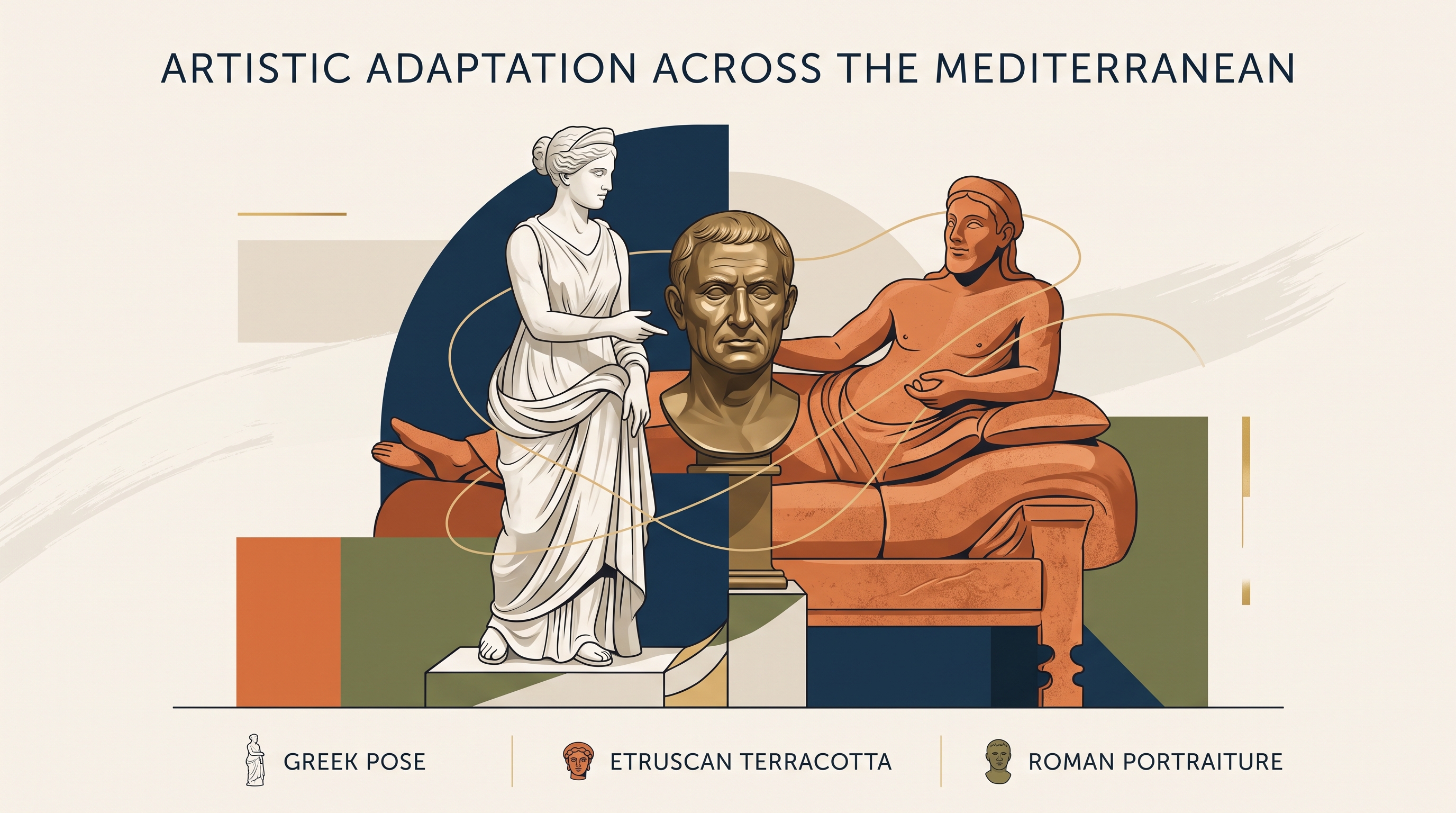
Greek, Etruscan, and Roman artists participated in an active exchange rather than a one-way chain of influence. Etruscan and Roman artists accumulated Greek objects and forms, then creatively adapted them to local tastes for eclecticism—the combination of elements from different sources—and historicism—the deliberate use of earlier styles to evoke authority, prestige, or memory.
The Temple of Minerva at Veii demonstrates this process. Its terracotta sculpture and architectural decoration reveal contact with Greek artistic traditions, but the building is not simply Greek. Etruscan materials, religious practices, roofline, and modes of display shaped the result. The useful comparison is therefore: Greek influence supplied visual resources; Etruscan context determined how those resources functioned.
Roman art generated from Greek and Etruscan techniques as well as from Roman technical innovation. Roman artists might reproduce Greek sculptural types, commission copies of admired works, or combine Greek bodies with Roman portraits. Many works identified as Hellenistic in appearance are Roman in origin, making attribution—the process of connecting a work to a particular artist, culture, or style—especially important.
How to analyze interaction
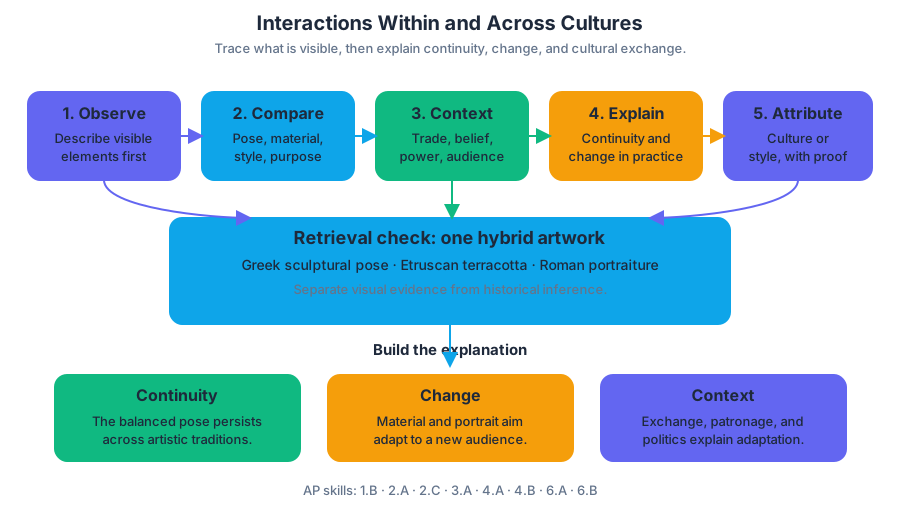
Begin with visual evidence: what can be directly observed in the work. Record pose, proportion, scale, materials, construction, surface treatment, clothing, facial style, spatial organization, and placement. Then add contextual evidence: information about political systems, religion, law, economics, excavation, patronage, or historical contact. Do not treat a contextual claim as if it were visible in the object itself.
| Evidence type | Question to ask | Example |
|---|---|---|
| Visual analysis | What do the forms actually show? | A ruler is larger than attendants; figures use idealized proportions. |
| Contextual analysis | What historical conditions help explain those choices? | Hierarchy and divine kingship made unequal scale meaningful. |
| Comparative analysis | What continues, and what changes? | A Roman work retains a Greek body type but adds an individualized Roman head. |
| Attribution | Which culture or tradition best explains the evidence? | Terracotta roof sculpture and temple form support an Etruscan attribution. |
Greek and Roman art can be studied through literary, political, legal, and economic records as well as archaeological excavations. These sources can reveal who commissioned a work, where it was displayed, how objects moved, and which audiences encountered them. They cannot replace visual analysis: historical records explain circumstances, while the object supplies material and formal evidence.
Worked comparison: continuity and change
Suppose a Roman portrait combines an idealized, muscular body associated with Greek sculpture with the lined face of a recognizable Roman statesman. The visual continuity is the borrowed Greek body type. The visual change is the insertion of individualized features and possibly signs of age. Contextually, the combination could communicate both cultural refinement and Roman civic authority.
A strong explanation would not say simply, “Rome copied Greece.” It would argue: Roman artists adapted Greek idealized forms to serve Roman portraiture, allowing the work to express participation in a prestigious Mediterranean tradition while emphasizing the sitter’s rank, identity, and public role. The claim connects form, cultural interaction, and social hierarchy.
Misconception check — “Influence means imitation.”
Influence does not require exact copying. Adaptation, selective borrowing, technical improvement, and intentional contrast are all forms of interaction. Ask what changed when a form entered a new religious, political, or social setting.
AP skills in action
This topic most directly develops 4.A: Explain how a specific work of art (or group of related works of art) demonstrates continuity and/or change within an artistic tradition, style, or practice and 4.B: Explain why a specific work of art (or group of related works of art) demonstrates continuity and/or change within an artistic tradition, style, or practice. It also relies on 1.B: Describe visual elements, 2.A: Describe contextual elements, 2.C: Explain how and/or why context influences artistic decisions, 3.A: Describe similarities and/or differences between works using points of comparison, 6.A: Attribute a work of art to a specific artist, culture, or style, and 6.B: Justify an attribution by explaining similarities to known styles/cultures.
Retrieval check: An artwork uses a Greek sculptural pose, Etruscan terracotta techniques, and Roman political portraiture. Identify one continuity, one change, and one contextual factor that could explain the adaptation. A complete response must distinguish what is visible from what is historically inferred.

2.3 Purpose and Audience in Ancient Mediterranean Art
Key concepts: Purpose and audience · Artistic intention · Intended audience · Patronage · Function of funerary art · Context and artistic decision-making · Civic ideals · Polytheism and divinities · Continuity and change within artistic traditions · Relationships between works of art and related artistic traditions, styles, or practices
A temple can be a house for a god, a monument to a city, a stage for civic identity, and a political advertisement at the same time.
2.3 Purpose and Audience in Ancient Mediterranean Art
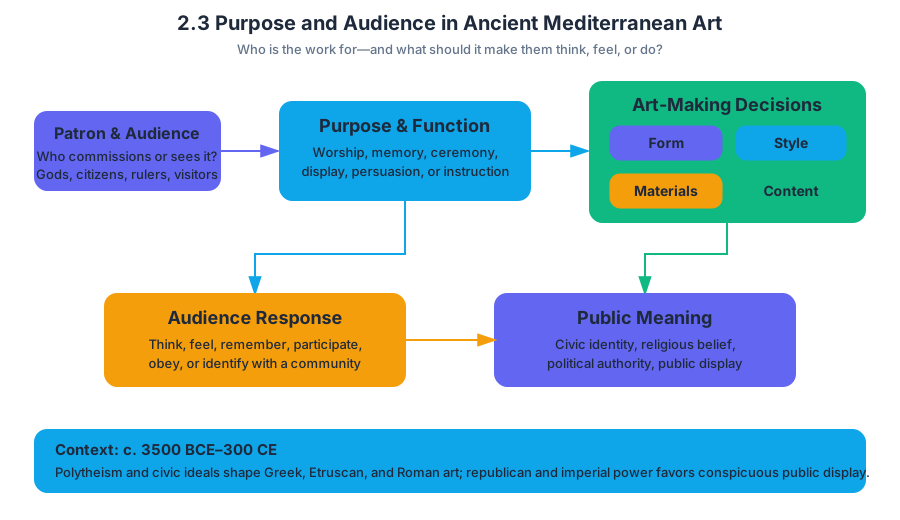
A temple can be a house for a god, a monument to a city, a stage for civic identity, and a political advertisement at the same time. Ancient Mediterranean artists and patrons therefore made decisions about form, style, materials, content, and function in response to a basic question: Who is this work for, and what should it make that audience think, feel, or do?
PAA-1.A — Learning Objective: Explain how purpose, intended audience, or patron affect art and art making.
The period addressed here extends approximately from $3500$ BCE to $300$ CE. Ancient Greek and Roman art is grounded in civic ideals—beliefs about the responsibilities and identity of the community—and polytheism, the worship of multiple gods. Etruscan and Roman works additionally express republican or imperial values, political authority, civic identity, and a preference for conspicuous public display.
A purpose is rarely “just one thing”
A work’s purpose is the goal or job it was meant to serve. Its possible functions include funerary, civic, religious, political, and commemorative purposes. Artistic intention refers to what the maker or patron wanted the work to communicate or accomplish; intended audience means the people expected to see, use, or respond to it; and patronage is the financial, political, or institutional support that makes its production possible.
These variables work together rather than forming a checklist. A patron may commission a monument for religious reasons while also using it to display wealth and civic power. The audience may include ordinary residents, priests, visiting allies, foreign diplomats, or the gods themselves, depending on the work’s setting and cultural assumptions.
| Question | What to investigate | Evidence to use |
|---|---|---|
| Purpose | What job does the work perform? | Location, ritual use, inscription, subject |
| Audience | Who encounters it, and under what conditions? | Scale, access, viewpoint, placement |
| Patron | Who ordered or financed it? | Political setting, dedication, resources |
| Intention | What response seems desired? | Symbolism, style, emphasis, visual rhetoric |
| Changing function | Has its role shifted over time? | Reuse, preservation, relocation, reinterpretation |
Worked example: the Acropolis
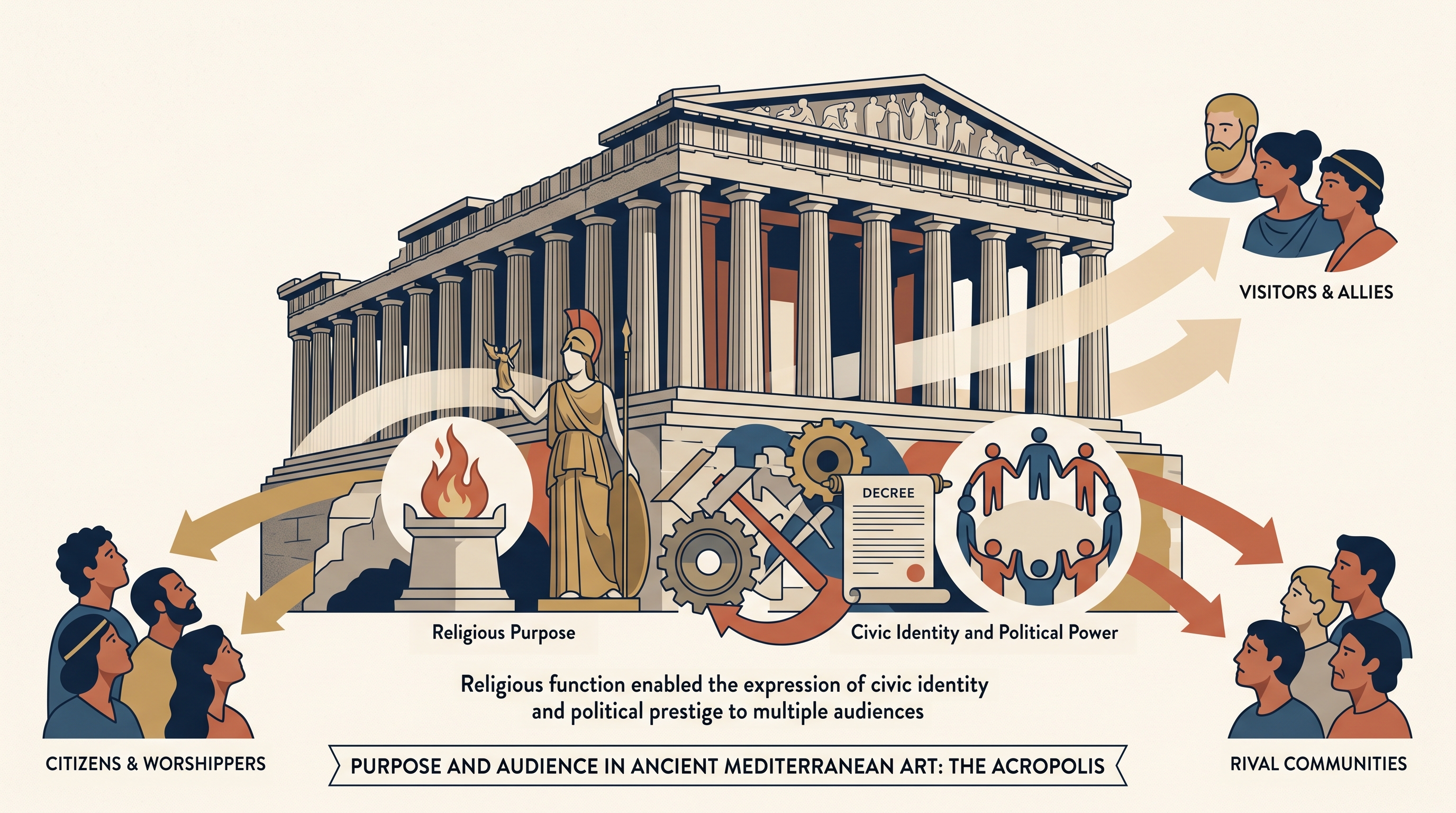
The Acropolis demonstrates how context and artistic decision-making converge. Its monumental buildings served religious purposes connected to the gods, especially Athena, but the elevated and highly visible site also communicated the importance, wealth, and collective identity of Athens. Marble construction, carefully ordered architectural forms, sculptural decoration, and the commanding hilltop location were not neutral choices: they shaped how worshippers, citizens, visitors, and rival communities encountered Athenian power.
A strong analysis connects each visual feature to a contextual reason. The costly materials suggest substantial civic investment; the monumental scale creates an experience of authority; the religious setting connects political identity to divine protection; and public visibility turns sacred architecture into a statement about the city itself. The conclusion should not be “the Acropolis was religious or political,” but rather: its religious function enabled it to express civic identity and political prestige to multiple audiences.
Funerary art: remembrance, ritual, and social identity
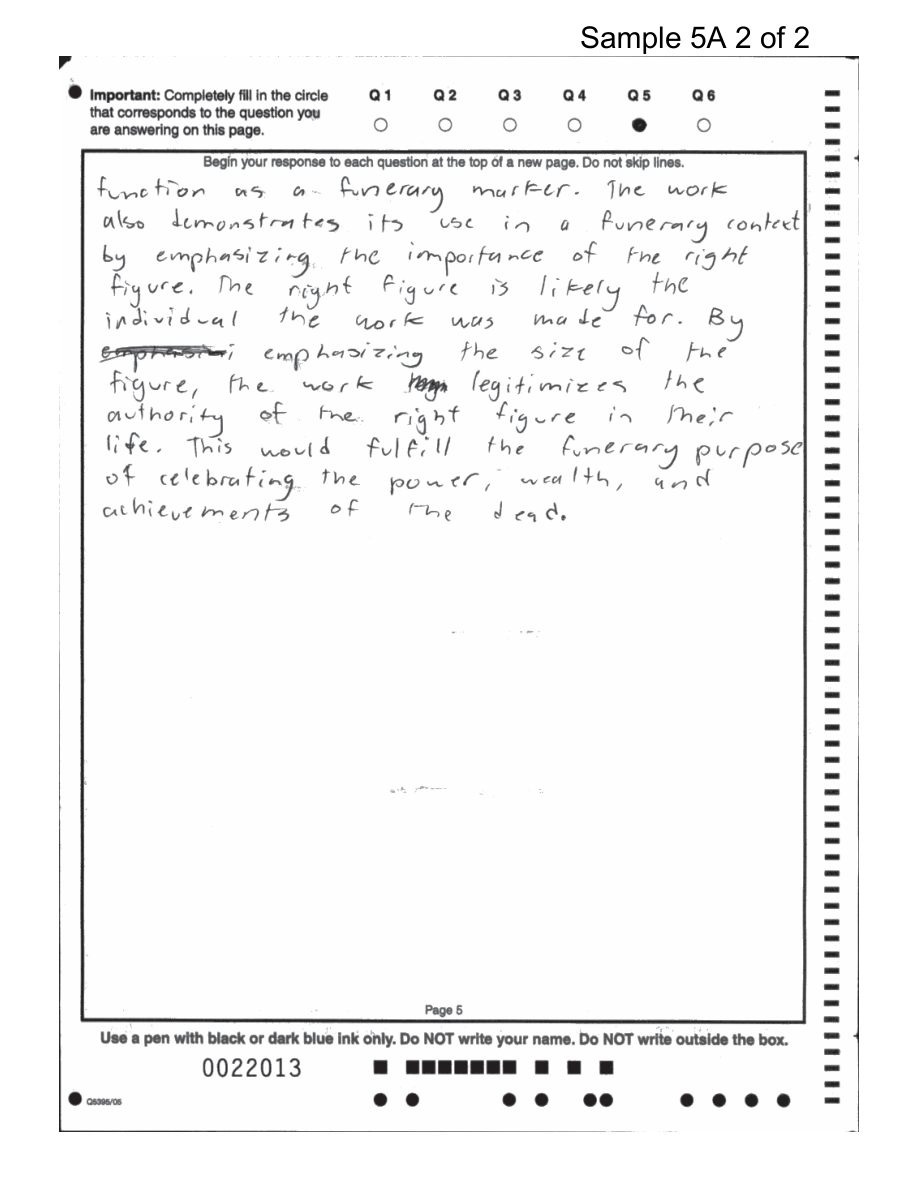
Funerary art often preserves memory, supports rituals, marks a burial place, and presents the deceased according to social expectations. A portrait or tomb monument may therefore function simultaneously as a memorial for family members, a public declaration of status, and a visual claim about the person’s virtues or identity.
The intended audience matters because the same image can communicate differently to different viewers. Family members may read a funerary portrait through personal memory; passersby may read it as evidence of rank, citizenship, military service, or moral character. The work’s meaning is consequently shaped not only by what it depicts but also by where it is placed and who can encounter it.
Context changes artistic decisions—and sometimes meaning
Historical context means the political, social, religious, economic, and cultural circumstances surrounding a work. Context can influence the selection of materials, the scale of a monument, the visibility of an image, the style considered appropriate, and the content chosen for representation.
Function can also change over time. A building originally created for worship might later become a civic landmark, museum, ruin, or symbol of national identity. That change does not erase its original purpose; instead, it adds new layers of reception and meaning. Always distinguish what a work was made to do from what later viewers used it to mean.
Misconception check — “The artist alone determines meaning.”
Ancient art was often shaped by patrons, religious institutions, civic authorities, available resources, and audience expectations. Artistic intention matters, but it is only one part of a larger system of art making and reception.
AP reasoning in action
2.B: Explain how the possible intent, purpose, and/or function shape the creation or meaning of a work of art (or group of related works of art). Do more than label a work “religious” or “political.” Explain how that purpose accounts for a specific choice—such as monumental scale, durable material, public placement, idealized form, or commemorative imagery.
2.D: Explain how artistic decisions about form, style, materials, content, function, and/or context of a work of art (or group of related works of art) elicit a response or shape its reception. A complete response identifies a visual decision, names the likely audience response, and links that response to historical context. This skill also connects with PAA-1.A.4, which identifies Greek and Roman art with civic ideals, polytheism, republican and imperial values, and investment in public architectural works.
A useful sentence pattern is: “Because the patron intended ___ for the audience of ___, the artist used ___, which encouraged viewers to ___.” For the Acropolis: “Because Athenian patrons intended a sacred complex that also embodied civic identity for worshippers and the wider public, they invested in monumental architecture and visible sculpture, encouraging viewers to associate Athens with divine favor, wealth, and collective power.”
Retrieval check
Choose one work such as the Acropolis, the House of the Vettii, the Head of a Roman patrician, or the Forum of Trajan. Identify one purpose, one intended audience, and one artistic decision. Then explain the causal link among them: how did the audience and purpose help produce the work’s form, style, materials, content, or placement?
2.4 Theories and Interpretations of Ancient Mediterranean Art
Key concepts: Theories and interpretations of Ancient Mediterranean art · Visual analysis as a basis for art-historical interpretation · The influence of other academic disciplines on art history · The role of technology in shaping interpretations · The availability of evidence and its effect on scholarship · The changing nature of theories and interpretations over time · Using, adapting, and manipulating interpretations to make art-historical arguments · Art of the Ancient Mediterranean as challenging for audiences · Argumentation supported by specific and relevant evidence · Ancient Greek and Roman art as a foundation for later European and Mediterranean artistic traditions
A single monument can support several defensible interpretations because art-historical meaning depends not only on what viewers see, but also on the evidence, technologies, and scholarly questions brought to that evidence.
2.4 Theories and Interpretations of Ancient Mediterranean Art
A single monument can support several defensible interpretations because art-historical meaning depends not only on what viewers see, but also on the evidence, technologies, and scholarly questions brought to that evidence. THR-1.A asks us to explain how theories and interpretations of works of art are shaped by visual analysis as well as by other disciplines, technology, and the availability of evidence.
From visual observation to interpretation
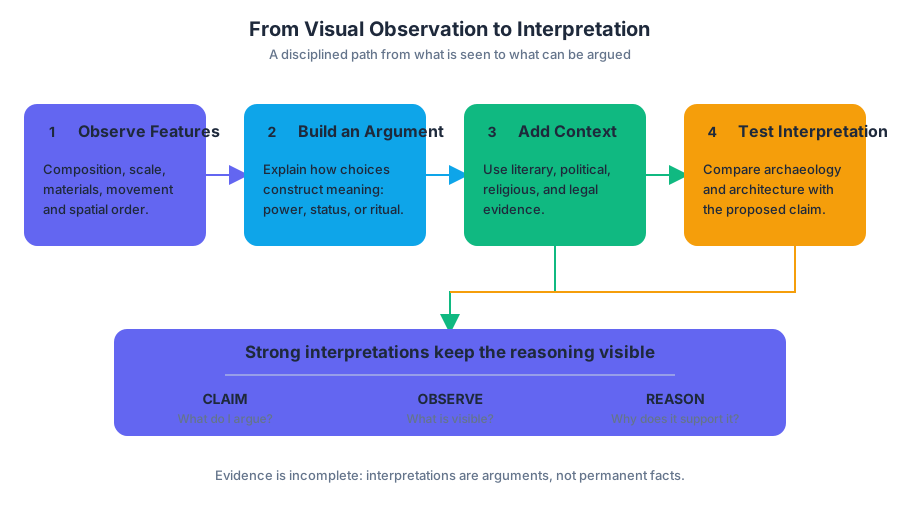
Visual analysis means making a disciplined argument from observable features: composition, scale, materials, movement, figures, spatial organization, and the relationship between parts. It is not simply saying that a work “looks powerful.” A stronger interpretation identifies how power is constructed—for example, through monumental scale, controlled processions, costly materials, or a commanding viewpoint.
Interpretation becomes art history when visual evidence is connected to historical evidence. Literary, political, legal, and religious sources can clarify what an image or building meant, while archaeology and architectural study can reveal how people encountered it. Because evidence is incomplete, interpretations remain arguments rather than permanent facts.
Key insight: An interpretation is strongest when its claim, evidence, and reasoning remain visible: what do I claim, what do I observe, and why does that observation support the claim?
Three monuments, three interpretive problems
The Apadana, Audience Hall of Persepolis can be interpreted through its vast columned space and reliefs of delegations bringing gifts. Visual analysis suggests ordered imperial unity: different peoples remain visually distinct, yet all participate in a carefully controlled procession toward the ruler. Comparative study of political history and architecture can therefore support the claim that the monument represented the Persian Empire as diverse but coordinated.
The House of the Vettii in Pompeii demonstrates how domestic architecture can generate competing interpretations. Its frescoes, mythological imagery, elaborate gardens, and reception spaces may be read as evidence of elite cultural display. Yet the house’s owners were formerly enslaved, reminding scholars that Roman social identity cannot be inferred from decoration alone. Combining wall painting, architecture, inscriptions, and social history produces a more precise argument: the house used expensive visual culture to construct status in a society where status could be acquired, performed, and contested.
The Forum of Trajan invites interpretation at the scale of urban design. Its basilica, libraries, monumental column, and extensive relief program linked military achievement to civic administration and imperial memory. A scholar might argue that the complex transformed conquest into public history: viewers did not encounter war as an isolated event, but as part of an architectural environment presenting the emperor as builder, administrator, and victorious leader.
How scholarship changes what counts as important
Ancient Greek and Roman art later became a foundation for European and Mediterranean artistic traditions. From the eighteenth century onward, European and American observers particularly admired ancient Greek and Roman ethical and governmental systems. That admiration helped prioritize works associated with political elites and cultural capitals such as Rome, while art made for or by provincial populations received less attention.
This history illustrates THR-1.A.6: theories change when scholars change their questions. Earlier scholarship might treat the Forum of Trajan as the central expression of Roman civilization; newer scholarship may also ask how provincial communities, enslaved people, women, artisans, and non-elite viewers experienced Roman visual culture. The shift does not make earlier observations useless, but it exposes the limits of an elite-centered framework.
THR-1.A.7 adds an evidence problem. Some of the earliest surviving written statements about artists and art making come from ancient Greek and Roman worlds, but little survives of the rich Etruscan literary tradition documented by Roman sources. As a result, Etruscan art is often interpreted through objects, excavation, and Roman testimony rather than through Etruscan voices themselves.
Technology and the changing archive
Technology can expand or redirect interpretation. Digital mapping can reconstruct the movement of a viewer through the Forum of Trajan; imaging technologies can reveal damaged or repainted surfaces at Pompeii; databases can compare motifs across distant sites. These tools do not automatically produce meaning. They make new evidence visible, which scholars must still evaluate historically.
Adapting an interpretation without distorting it
A scholar may use, harness, manipulate, or adapt an interpretation as part of an art-historical argument. Consider a traditional claim that the House of the Vettii represents straightforward elite luxury. A defensible revision selects the useful observation—lavish decoration—and reframes it through social history: because the owners were formerly enslaved, the decoration may have functioned not merely as luxury but as a deliberate performance of newly acquired status.
That is legitimate adaptation because the revised claim preserves relevant evidence and adds support from inscriptions, architecture, and social context. Distortion would occur if someone ignored the house’s decoration, invented an owner’s intention, or claimed that every visitor interpreted the paintings identically. Skill 8.A, “Articulate a defensible claim about one or more works of art,” requires specific and relevant evidence—not a clever interpretation detached from the record.
Retrieval check
Choose one monument above and complete the chain: visual feature → outside evidence or discipline → interpretation → defensible claim. Then ask: what new evidence or technology could cause that interpretation to change?
3.1 Course placement
Key concepts: Interaction with work · Restricted access · Growing up · Those that are considered
Art does not exist outside time, place, or systems of access: a work’s meaning changes when it moves from a ritual setting into a museum, from a private collection into public view, or from one culture into another interpretive framework.
3.1 Course placement
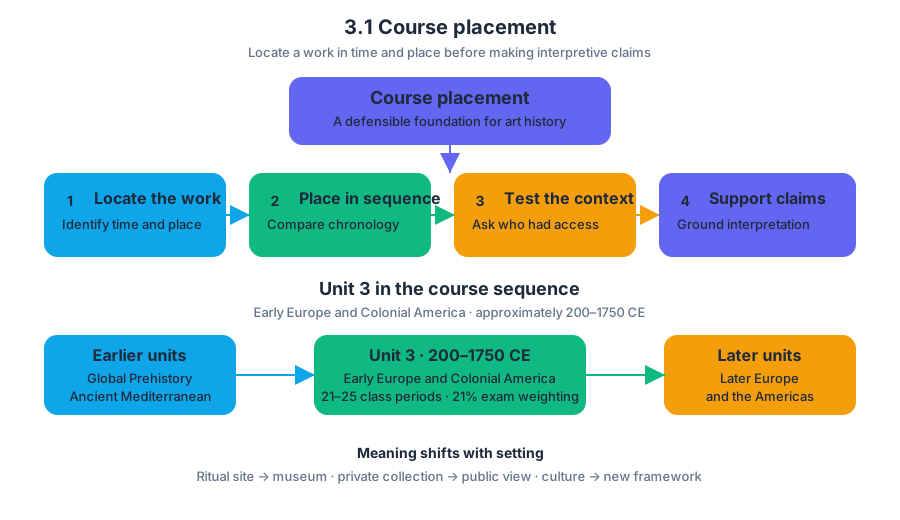
Art does not exist outside time, place, or systems of access: a work’s meaning changes when it moves from a ritual setting into a museum, from a private collection into public view, or from one culture into another interpretive framework. Course placement is the act of locating a work within the chronological and geographic structure of art history so that later claims about its culture, purpose, materials, and interpretation have a defensible foundation.
Unit 3 places Early Europe and Colonial America between approximately $200$ and $1750$ CE. In the larger sequence, it follows Global Prehistory and the Ancient Mediterranean and precedes Later Europe and the Americas. Its published guidance is approximately $21$–$25$ class periods and about $21%$ of the AP Exam weighting, making it one of the course’s most substantial units.
What “placement” actually establishes
Placement answers four basic questions before interpretation begins:
- When was the work made? A date prevents anachronism—the mistake of explaining an earlier work through ideas, technologies, or identities that developed later.
- Where was it made or used? Geographic placement identifies the cultural networks, political structures, religions, and artistic traditions that shaped it.
- Which historical unit contains it? Unit 3 emphasizes Europe and the colonial Americas during a period of religious transformation, imperial expansion, global exchange, and changing systems of patronage.
- What evidence supports the placement? Style, materials, inscriptions, provenance, architectural setting, and historical records can all contribute.
This is not merely memorizing a date. It is more like placing a puzzle piece before deciding what image it forms: the surrounding historical conditions limit which interpretations are plausible.
Placement is not the same as meaning
A work’s placement provides context, but it does not automatically reveal its purpose. Two objects made in the same century and region may have completely different audiences or functions. Likewise, an object can interact with several cultures without belonging equally to all of them.
For example, when analyzing a work associated with colonial America, a strong response should distinguish between its location of production, its intended audience, and the communities that later encountered it. Access may have been restricted by class, gender, race, religious status, or physical location. A work displayed in a church, palace, court, or private household did not communicate identically to everyone who could—or could not—enter that space.
Key distinction: Context explains the conditions surrounding a work; visual evidence explains how the work itself communicates within those conditions.
Interaction, access, and the “outsider” problem
The surviving notes associated with this topic emphasize interaction with the work, restricted access, growing up, and those considered outsiders. These ideas matter because art history studies not only objects but also the people permitted to see, handle, commission, inherit, interpret, or reject them.
Interaction with the work can mean physical contact, ritual use, movement around an architectural space, or intellectual interpretation. A sculpture intended to be approached from multiple sides functions differently from a painting designed for a distant altar. A work’s original placement therefore matters: moving it after the first week, especially because of dust or safety concerns, could alter viewing conditions and audience behavior even if the object itself remained unchanged.
Restricted access is evidence, not a minor logistical detail. If only priests, monarchs, initiates, household members, or selected viewers could encounter a work, that limitation helps explain its scale, imagery, materials, and message. The phrase “outsiders” must also be handled carefully: it may describe a community’s social boundary, but it should not be treated as a neutral or universal label. Ask who created the boundary, who benefited from it, and who was excluded?
A worked placement example
Imagine an unfamiliar European work dated near $1600$ and originally installed in a religious interior. Begin with observable evidence: its subject, scale, materials, viewpoint, and relationship to surrounding architecture. Then establish placement: the date places it within Unit 3, while the religious setting suggests that patronage, ritual practice, and audience access may be central contextual questions.
Next, separate evidence from inference. You can claim that the original placement shaped viewing because the work was designed for a particular architectural environment. You should not claim that every person in the society experienced it identically unless evidence supports that conclusion. This movement—from visual observation to historically bounded interpretation—is the core habit of course placement.
Misconception check
Misconception: “Course placement means labeling a work with a date and region.” Correction: placement is the beginning of reasoning, not the endpoint. A precise answer connects chronology and geography to access, interaction, audience, cultural contact, and the evidence visible in the work.
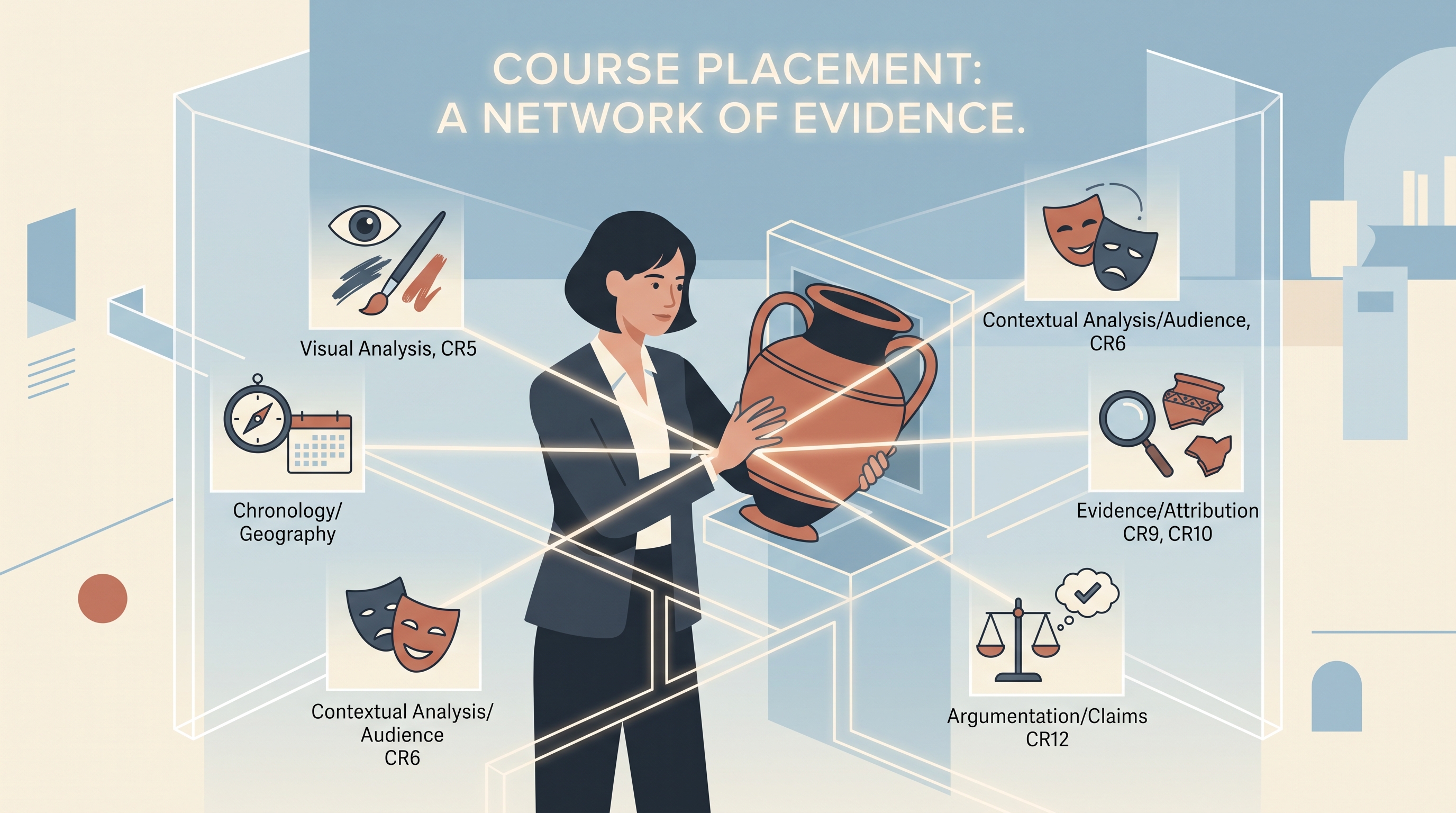
This topic activates CR5: Visual analysis, CR6: Contextual analysis, CR7: Comparison of works of art, CR8: Artistic traditions, CR9: Visual analysis of unknown works, CR10: Attribution of unknown works, CR11: Art historical interpretations, and CR12: Argumentation using claims and evidence. In practice, the most immediate skills are visual analysis, contextual analysis, attribution, and argumentation: identify what you see, locate it historically, test competing explanations, and support the strongest claim with evidence.
Retrieval check: If a work was moved from its original setting because of dust or safety concerns, what might change even if its materials and imagery stayed the same? Name one change in audience interaction and one contextual question that would follow.
3.2 3.1 Cultural Contexts of Early European and Colonial American Art
Key concepts: Cultural contexts of art and art making · Cultural practices, belief systems, and physical setting · Stylistic conventions · Early European and Colonial American art, 200–1750 CE · Medieval figurative and aniconic two- and three-dimensional art · Classical models and enhanced naturalism · Christianity and Catholic Counter-Reformation · Formalized artistic training · Change within an artistic tradition, style, or practice · Baroque architecture and painting
Between $200$ and $1750$ CE, European and Colonial American art changed as belief systems, political structures, physical settings, and artistic training changed. A church image, a palace interior, and a still-life painting are not simply different subjects: each reflects the cultural conditions in which it was…
3.2 3.1 Cultural Contexts of Early European and Colonial American Art
Between $200$ and $1750$ CE, European and Colonial American art changed as belief systems, political structures, physical settings, and artistic training changed. A church image, a palace interior, and a still-life painting are not simply different subjects: each reflects the cultural conditions in which it was made and viewed.
The cultural context of art making
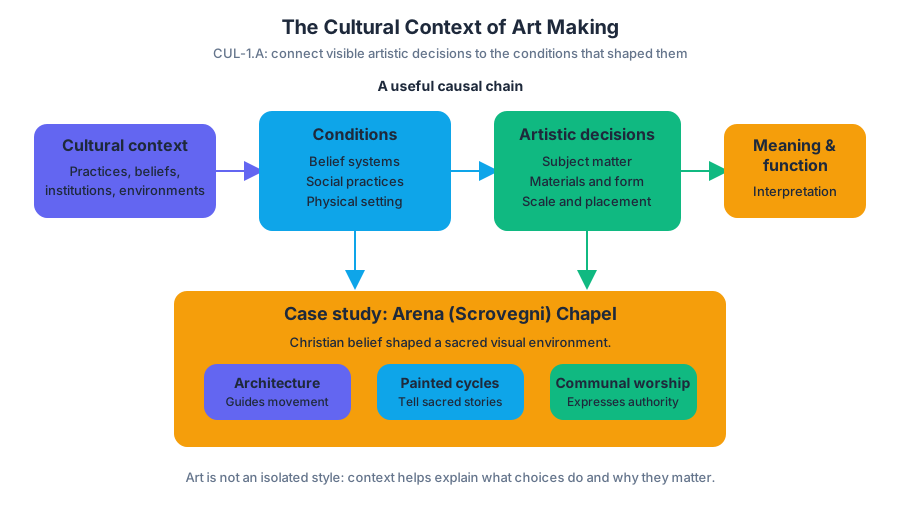
Cultural context means the network of practices, beliefs, institutions, and environments that shapes both the making and interpretation of art. The CED learning objective CUL-1.A: Explain how cultural practices, belief systems, and/or physical setting affect art and art making asks you to connect visible decisions to those conditions rather than treating style as an isolated vocabulary.
A useful causal chain is:
For example, Christianity was a major belief system influencing European art. Religious images, buildings, sculpture, and narrative cycles could communicate sacred stories, support worship, organize communal experience, or express institutional authority. The Arena (Scrovegni) Chapel demonstrates how architecture, painting, religious subject matter, and the movement of viewers through a physical setting work together rather than functioning as separate artistic choices.
Medieval traditions: figurative and aniconic approaches
Medieval artistic traditions include late antique and early Medieval art in Europe, approximately $300$–$1400$ CE, as well as Islamic traditions. These traditions produced both figurative works, which represent recognizable people, animals, or events, and aniconic works, which avoid or minimize figural representation. Aniconism does not mean “no art”; it can redirect visual attention toward geometry, calligraphy, pattern, architecture, or symbolic design.
The key comparison is not “figurative art is advanced, aniconic art is limited.” That is the progress misconception: it imposes a modern hierarchy on traditions with different religious and cultural priorities. Instead, ask what a community considered appropriate, powerful, or meaningful in a particular setting.
| Cultural condition | Possible artistic consequence |
|---|---|
| Christian worship and narrative teaching | Figurative images and cycles of sacred stories |
| Religious traditions favoring nonfigural imagery | Calligraphy, geometry, pattern, and architectural emphasis |
| Monumental or processional settings | Art organized around movement, ritual, and collective viewing |
Stylistic conventions communicate ideas
A stylistic convention is a recurring visual formula that viewers learn to recognize as meaningful. Conventions may include how figures are posed, how space is organized, how bodies are proportioned, or how movement and emotion are represented. Because conventions carry cultural meaning, a work’s style can communicate ideas even before its subject is identified.
From the fifteenth century onward, classical models continued to shape European painting and sculpture. Artists increasingly pursued naturalism, the convincing representation of bodies, space, materials, and human experience. This was not a simple replacement of medieval art: classical principles continued, while artists developed greater attention to observation, narrative complexity, emotional impact, and the relationship between figures and space.
From classical models to theatricality
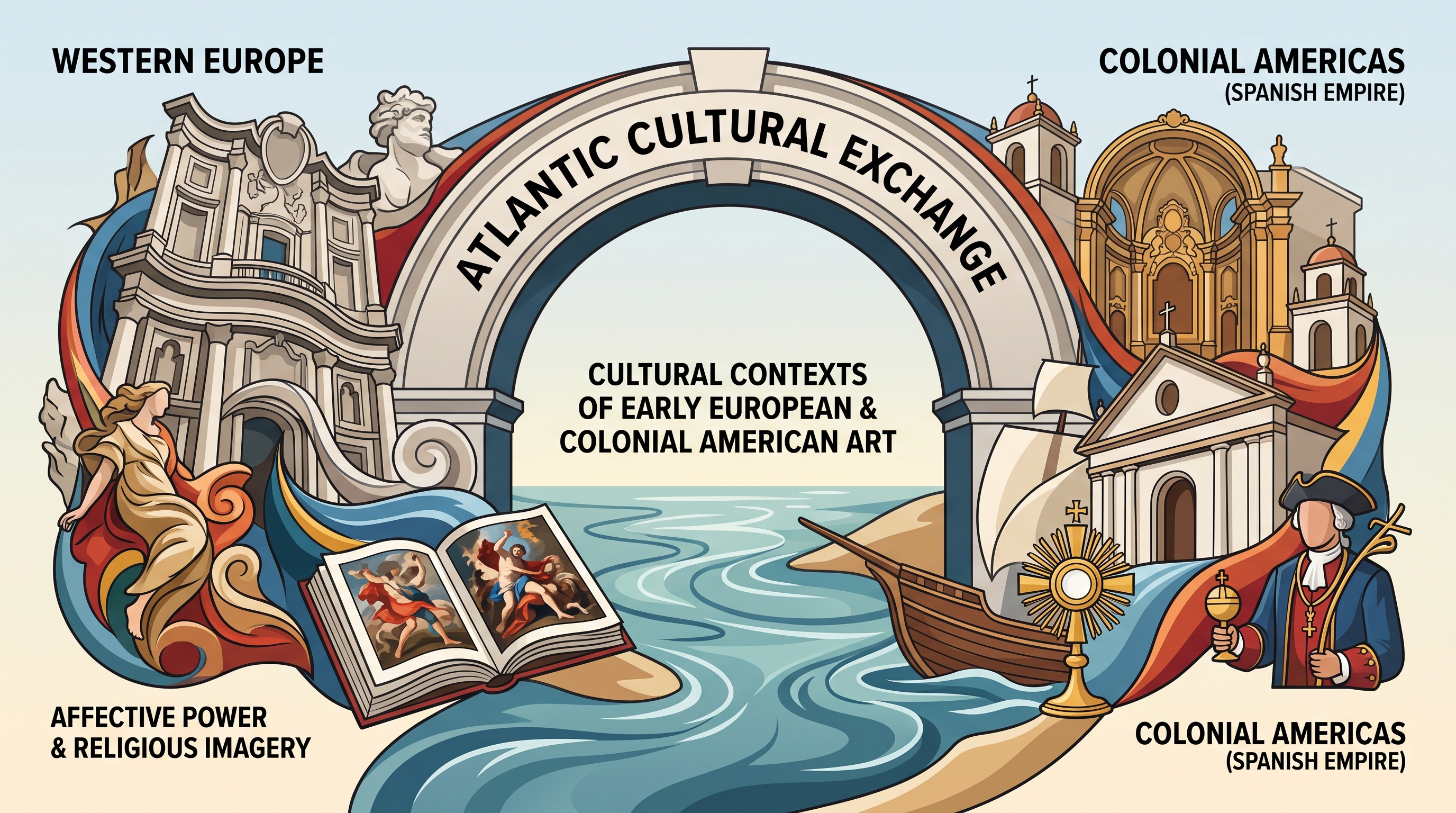
Within the required period of $200$–$1750$ CE, the early modern Atlantic World—especially from approximately $1400$ to $1750$—included Western Europe and territories in the Americas controlled by the Spanish Empire. This setting connected European artistic traditions with colonial institutions, religious missions, political power, and new audiences. The period often called Renaissance and Baroque is therefore best understood through historical conditions, not as a purely European sequence of stylistic “improvements.”
In southern Europe, especially after the Catholic Counter-Reformation, artistic production increasingly emphasized religious imagery and political authority. Painting and sculpture favored heightened naturalism, bold color, dynamic compositions, complex movement, theatricality, and affective power—the capacity to produce an intense emotional response. San Carlo alle Quattro Fontane exemplifies how architectural form can create visual motion and emotional drama.
In northern Europe, the Protestant Reformation and related religious changes contributed to a decline in some forms of religious imagery. Nonreligious genres flourished, including landscape, still life, genre scenes, history, mythology, and portraiture. Fruit and Insects is therefore not merely a collection of attractive objects: still-life imagery belongs to a cultural environment in which artists and patrons valued close observation, material display, and subjects outside traditional religious narrative.
Training and artistic production
Artistic training became increasingly formalized during this period. Organized instruction helped transmit classical principles, technical procedures, compositional formulas, and professional standards. This matters because stylistic change was not only the result of individual creativity; it also emerged through institutions that taught artists what counted as skill, tradition, innovation, and appropriate subject matter.
Misconception check — “style causes culture.” A stronger explanation reverses the direction: cultural practices and beliefs help produce stylistic conventions, while those conventions then reinforce cultural values. For instance, the dramatic movement and emotional intensity associated with Counter-Reformation art can be interpreted as a response to religious and political circumstances, not simply as an artist’s preference for visual excitement.
Retrieval check
Choose one work—The Arena (Scrovegni) Chapel, San Carlo alle Quattro Fontane, or Fruit and Insects. In two sentences, identify one cultural condition, one stylistic convention, and the visible evidence connecting them. A complete response should explain not only what the work looks like, but why those choices made sense in its historical setting.
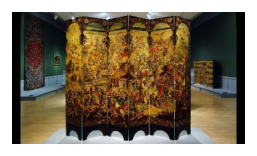
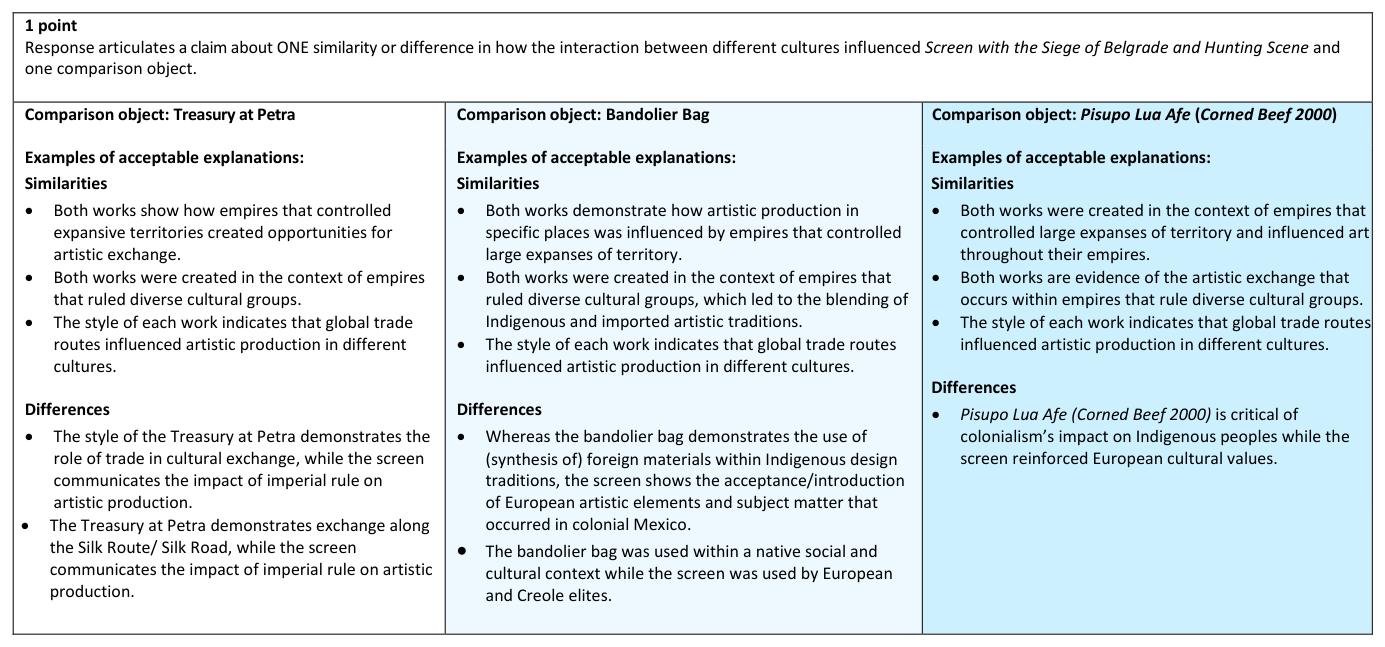
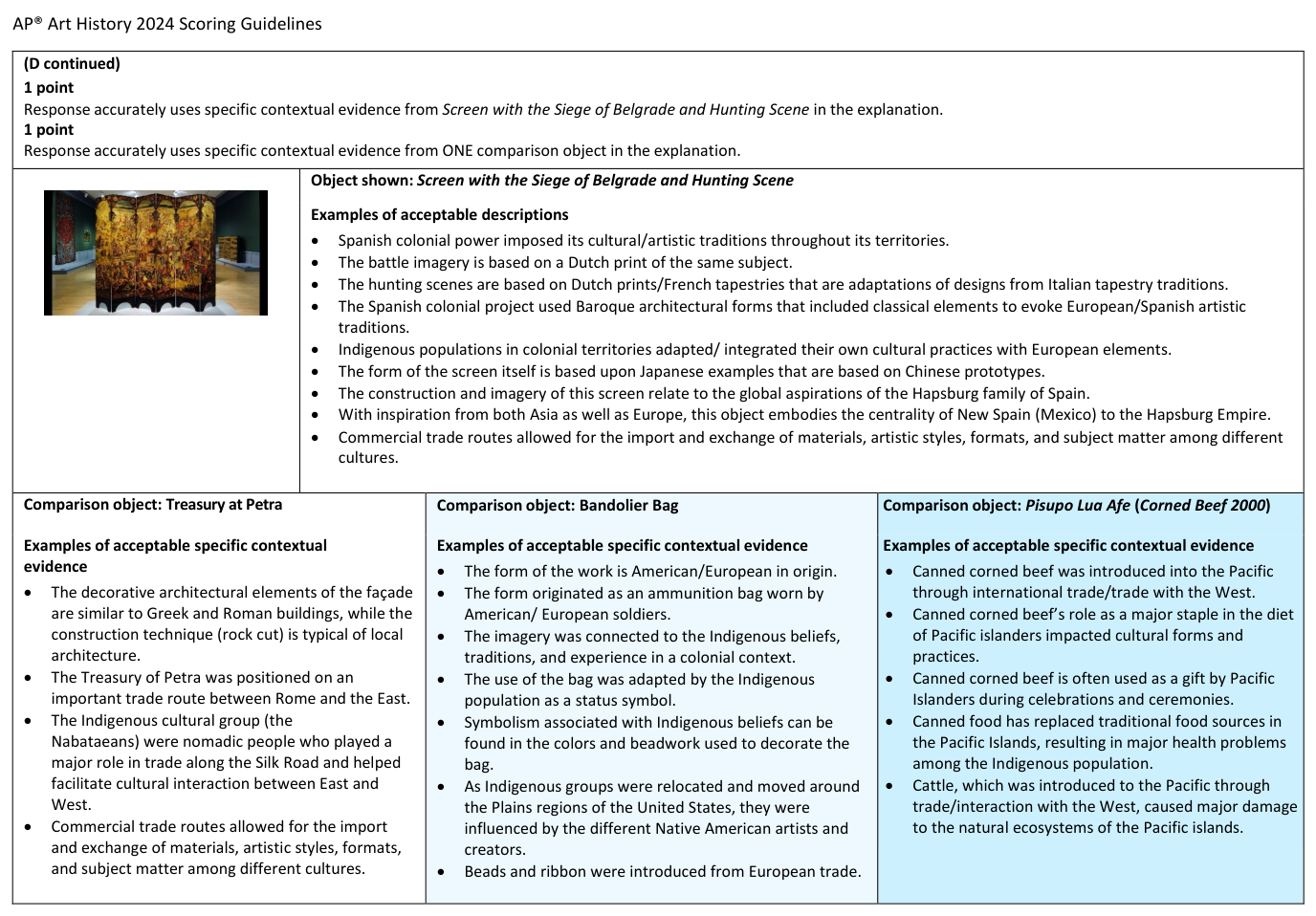
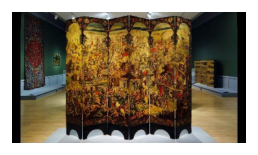
3.3 3.2 Interactions Within and Across Cultures in Early European and Colonial American Art
Key concepts: Cultural interaction shapes artistic forms, functions, techniques, and traditions. · Medieval European art was influenced by Roman, Islamic, and migratory cultures. · European Islamic art was influenced by Roman, migratory, African, and Asian cultures. · Commerce, colonialism, missionary activity, and migration disseminated artistic ideas and practices. · European ideas, forms, and practices spread worldwide through colonization. · Spanish colonial art developed within a Spanish Catholic context. · Colonial art reflects both religious and nonreligious subjects, including portraiture. · Native American participation in global artmaking continued through self-taught and academically trained artists. · Artists may revive ancient traditions or use art for political commentary on racism and injustice. · Long-distance ocean migration enabled the movement of families, communities, and cultural practices across vast distances.
Artistic traditions rarely travel unchanged: they are carried by conquest, commerce, migration, pilgrimage, missionary activity, and materials, then reshaped for new patrons and purposes. Cultural interaction means that contact among peoples changes artistic forms, functions, techniques, subjects, and…
3.3 3.2 Interactions Within and Across Cultures in Early European and Colonial American Art
Artistic traditions rarely travel unchanged: they are carried by conquest, commerce, migration, pilgrimage, missionary activity, and materials, then reshaped for new patrons and purposes. Cultural interaction means that contact among peoples changes artistic forms, functions, techniques, subjects, and ideas—sometimes through willing exchange, sometimes through unequal colonial power.
INT-1.A — Explain how interactions with other cultures affect art and art making. The most useful exam habit is to trace a visible feature backward through its networks: What was borrowed? Who adapted it? For what new audience or purpose?
A connected medieval world
The Hagia Sophia in Constantinople, built under the Byzantine emperor Justinian in the sixth century and later converted into a mosque, demonstrates how one monument can accumulate several cultural histories. Its enormous dome and centralized interior belong to Roman engineering traditions; after the Ottoman conquest, Islamic calligraphy, furnishings, and minarets transformed its function and appearance. The building is therefore not simply “Byzantine” or “Islamic”: it records changing political authority, religious use, and artistic adaptation across European, Roman, and Islamic contexts.
Islamic art in Europe also developed through contact among Roman, migratory, African, and Asian cultures. In al-Andalus, the Islamic-ruled Iberian Peninsula, builders reused Roman and Visigothic columns and adapted the horseshoe arch. North African and other migratory communities brought architectural practices across the western Mediterranean, while connections to the eastern Islamic world carried Umayyad, Byzantine, and Asian luxury traditions westward.
The Great Mosque of Córdoba makes this process visible. Its prayer hall uses rows of reused Roman and Visigothic columns, topped by distinctive double-tiered arches: lower horseshoe arches support upper semicircular arches, allowing greater height and visual rhythm. Red-and-white voussoirs, or wedge-shaped arch stones, create a strong surface pattern. Later expansions and the cathedral inserted into the mosque further reveal how architecture can become a record of Islamic, Christian, Roman, North African, and migratory interaction rather than a sealed expression of one culture.
Roman spolia—architectural fragments reused in a later building—was not merely convenient recycling. Reused columns connected Córdoba to the prestige of antiquity, while the mosque’s orientation, prayer function, inscriptions, and decorative program made those inherited materials meaningful within Islamic worship. Borrowing does not erase difference; adaptation creates new meaning.
Networks move materials and styles
Intercultural exchange often begins with an apparently ordinary material. Paper-making traveled westward from China through Central and Islamic Asian networks, making manuscripts and paintings easier to produce and circulate than many earlier writing surfaces. In Islamic lands, paper supported extensive manuscript cultures; through trade, conquest, and scholarly exchange, related practices influenced European book production.
The Mughal courts of South Asia offer another clear example of adaptation. Hindu court architecture, painting, and fashion adopted and reshaped Mughal styles, including imperial forms of court display, manuscript painting, textiles, and ornamental vocabulary. This was not a one-way replacement of Hindu traditions by an “outside” style: court artists and patrons selected, combined, and redirected forms within local religious and political settings.
From the late fifteenth century, ocean-going vessels created transoceanic networks. Families and whole communities could cross vast distances, and passengers could sometimes return to their places of departure. These movements carried artistic ideas, religious images, craft methods, pigments, textiles, metalwork, and decorative motifs. Commerce, colonization, missionary activity, and migration therefore disseminated both objects and skills.
Spanish colonial art: hybrid production under Catholic power
INT-1.A.6 identifies the Age of Exploration as the beginning of global commercial and cultural networks formed through transoceanic trade and colonization. European ideas, forms, and practices spread worldwide through exploration, trade, conquest, and colonization—but the resulting art was not simply European art copied elsewhere.
In the Spanish viceroyalties, INT-1.A.7 describes a hybridization of European and Indigenous ideas, forms, and materials, with African and Asian influences as well. Spanish colonial art developed within a strongly Spanish Catholic context, so religious images, churches, altarpieces, and devotional objects were central. Yet colonial production also included portraiture, allegory, genre scenes, history painting, and decorative arts; “colonial art” does not mean only religious art.
INT-1.A.8 adds an important qualification: Spanish American art paralleled European practice in themes, materials, formal vocabulary, display, and reception, but its Catholic setting made it correspond especially closely to southern European art. A painting or sculpture may therefore show European composition while using Indigenous labor, local materials, African or Asian design influences, and a colonial audience’s specific needs.
Native American art: tradition is not frozen
INT-1.A.14 emphasizes that European invasion, disease, genocide, suppression, and forced assimilation devastated Native communities, yet Native American artists maintained cultural identity, renewed ancient traditions, and created new forms within global contemporary art. Self-taught and academically trained artists both sustain Native participation in global artmaking, from the self-conscious revival of ancient arts such as Puebloan pottery to direct political commentary on racism and injustice.
INT-1.A.15 challenges the misconception that “traditional” means untouched by outside influence. Glass beads, machine-made cloth, and ribbon—imported through colonial and migrant contact—can now be traditional materials. The Spanish-introduced horse became an artistic and cultural staple alongside Indigenous buffalo, raven, and bear. Tradition is living and selective, not a timeless category of “authentic” purity.
Misconception check: Cultural interaction does not mean that the less powerful culture disappeared or that every hybrid artwork represents equal exchange. Identify the agents, power relations, materials, and audience before claiming that a work is simply “influenced by another culture.”
Worked interpretation: A Puebloan vessel made in a revived ancestral style may use ancient visual forms, contemporary tools, and a modern political or cultural purpose. Its meaning comes from both continuity and change. The strongest claim is not “the tradition survived unchanged,” but “the artist deliberately reactivates an ancestral practice to assert identity within a globalized art world.”
Retrieval check: Explain one way the Great Mosque of Córdoba shows adaptation rather than simple copying. Then name one imported Native American material that became traditional. A complete answer should connect each example to cultural interaction, visible evidence, and changed meaning.
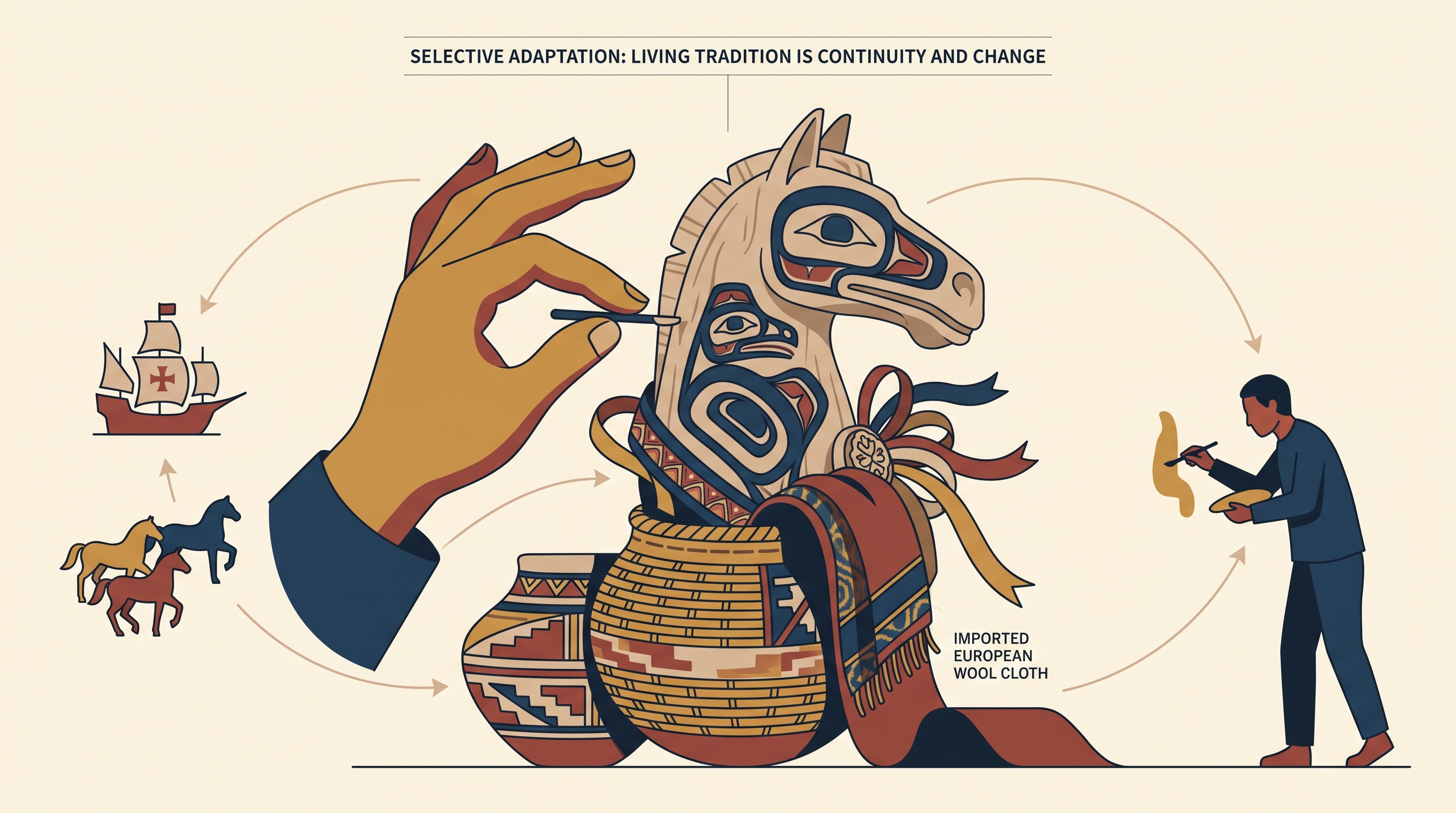
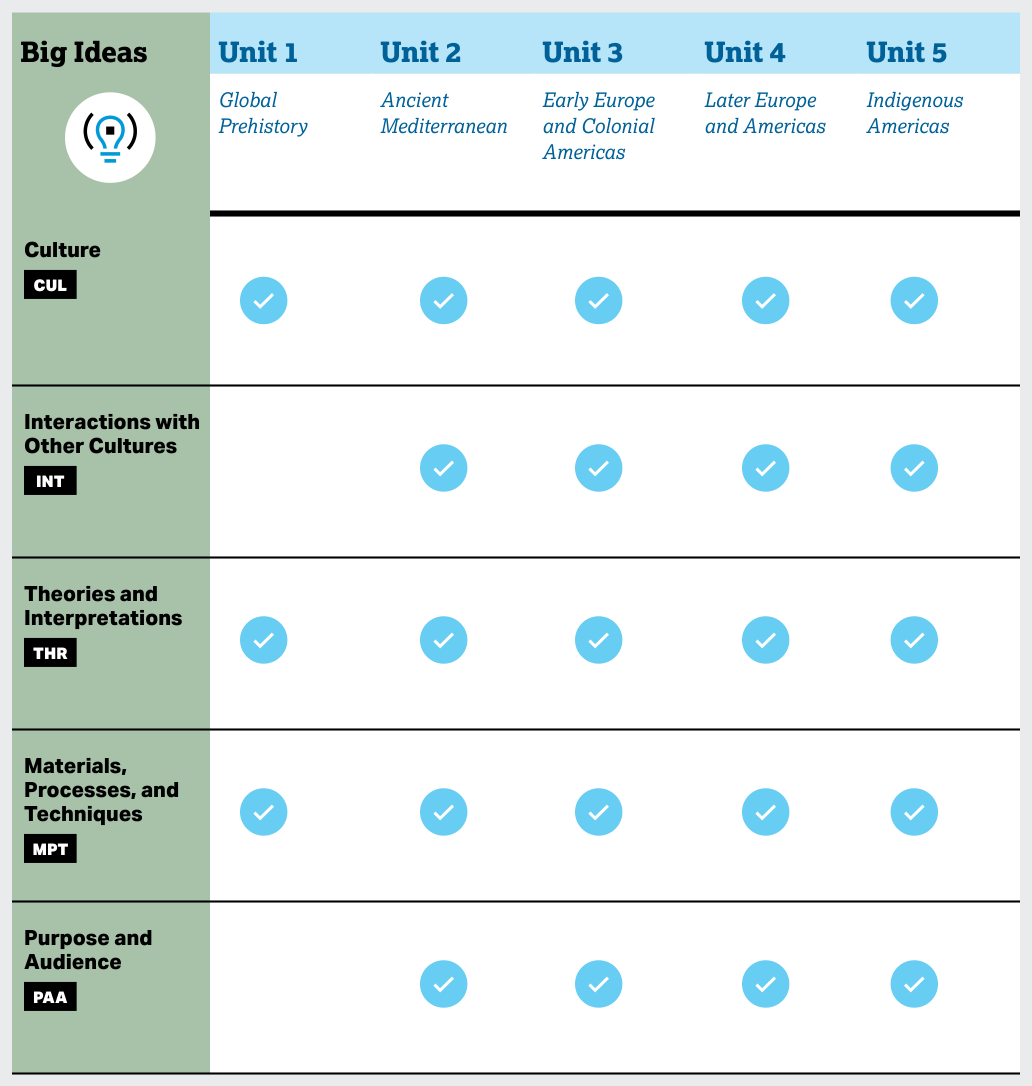
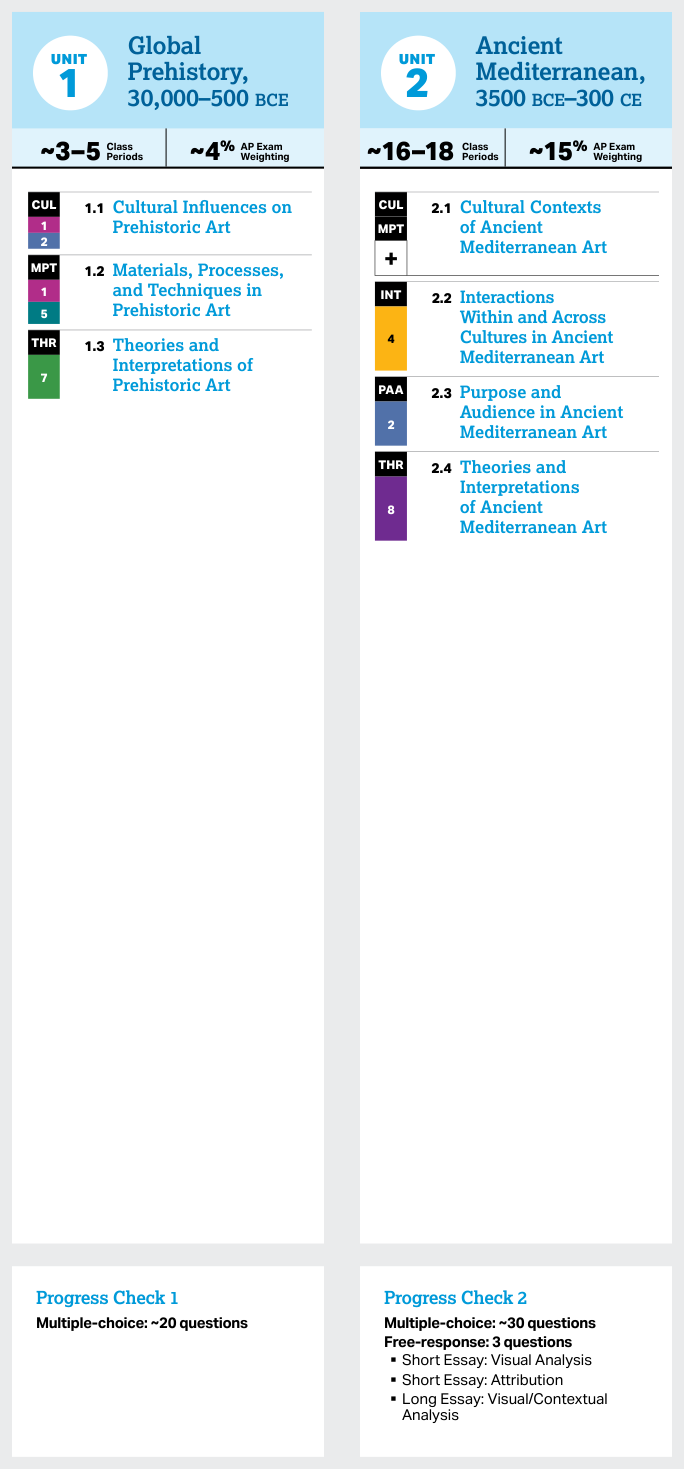
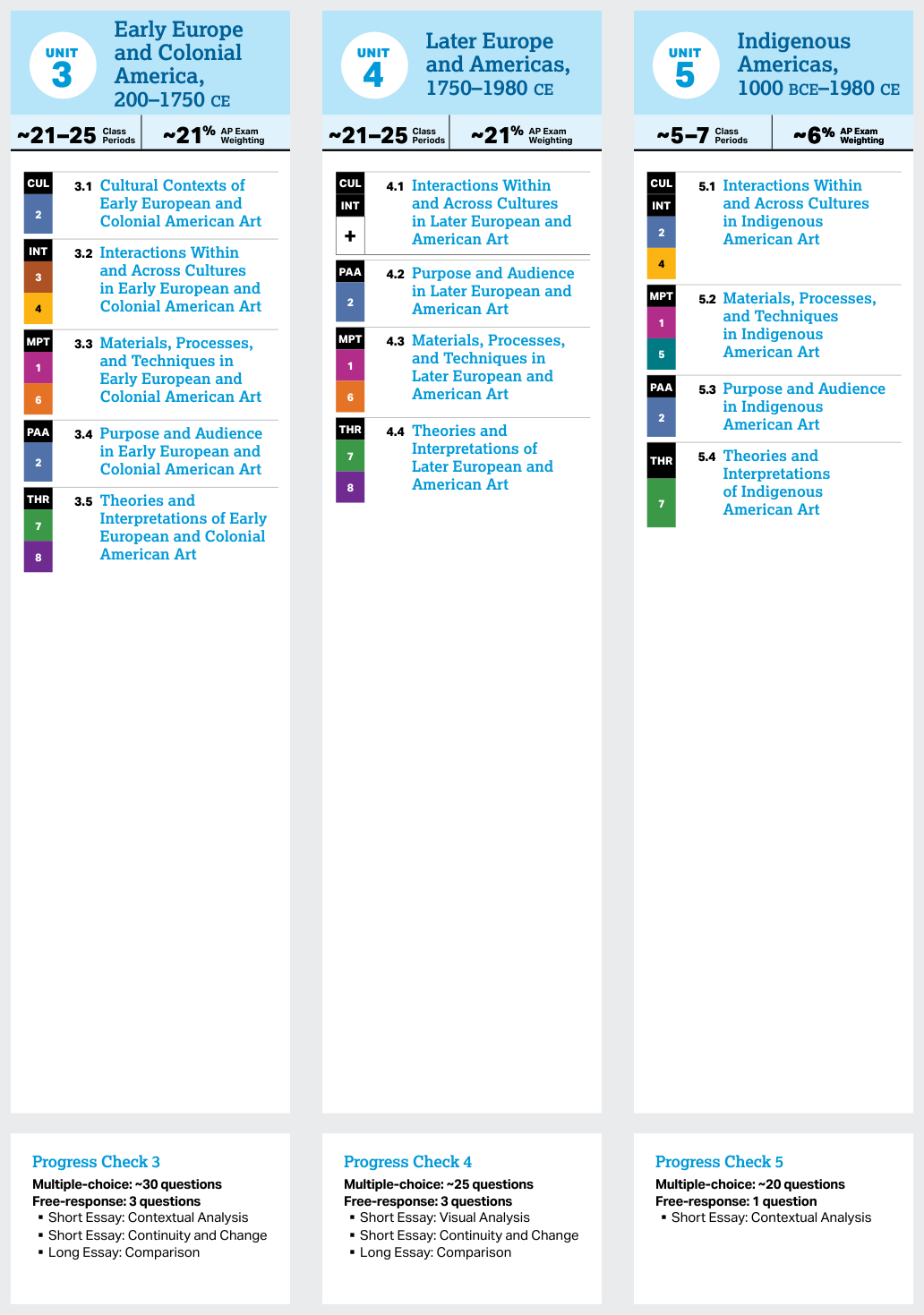
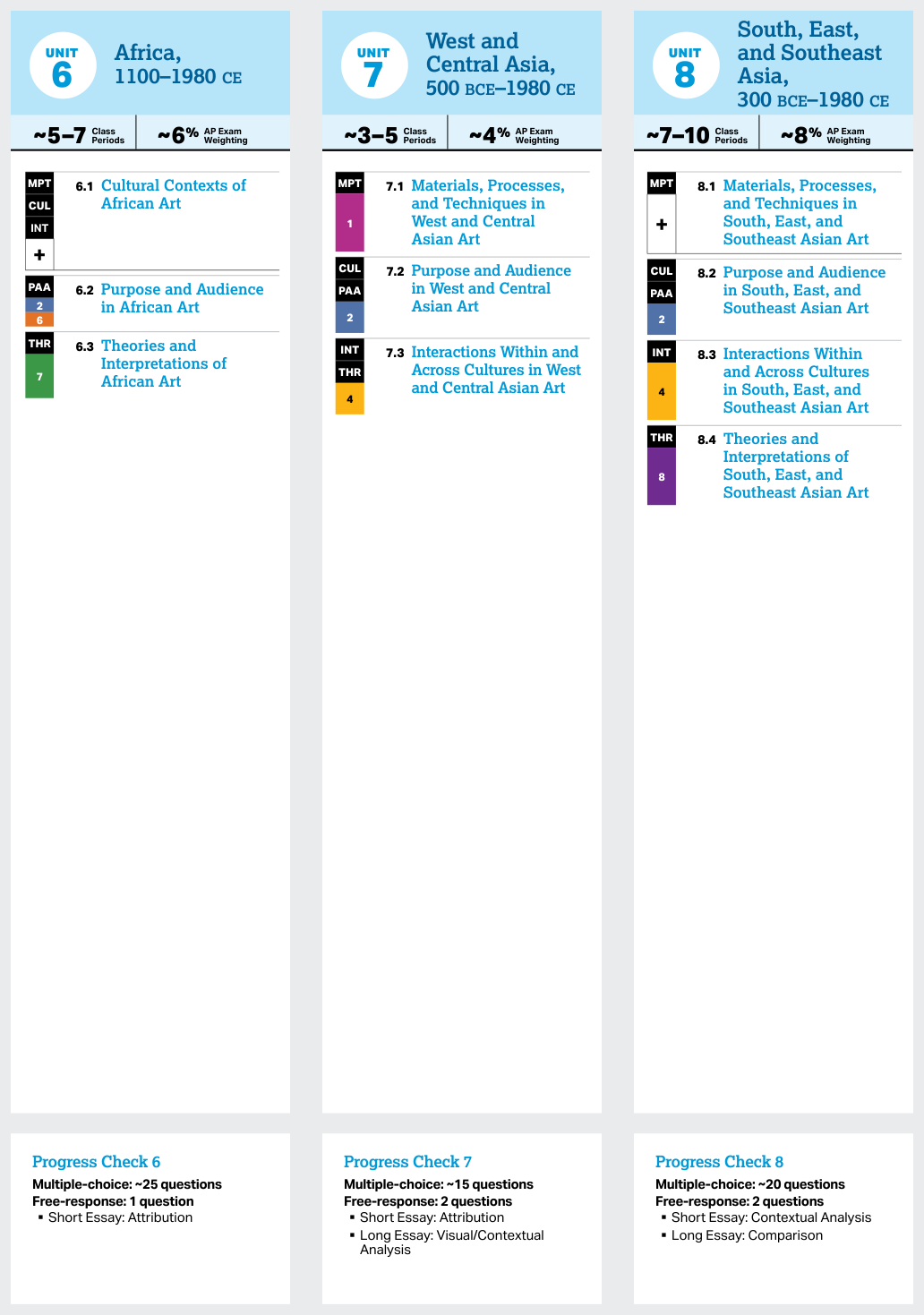
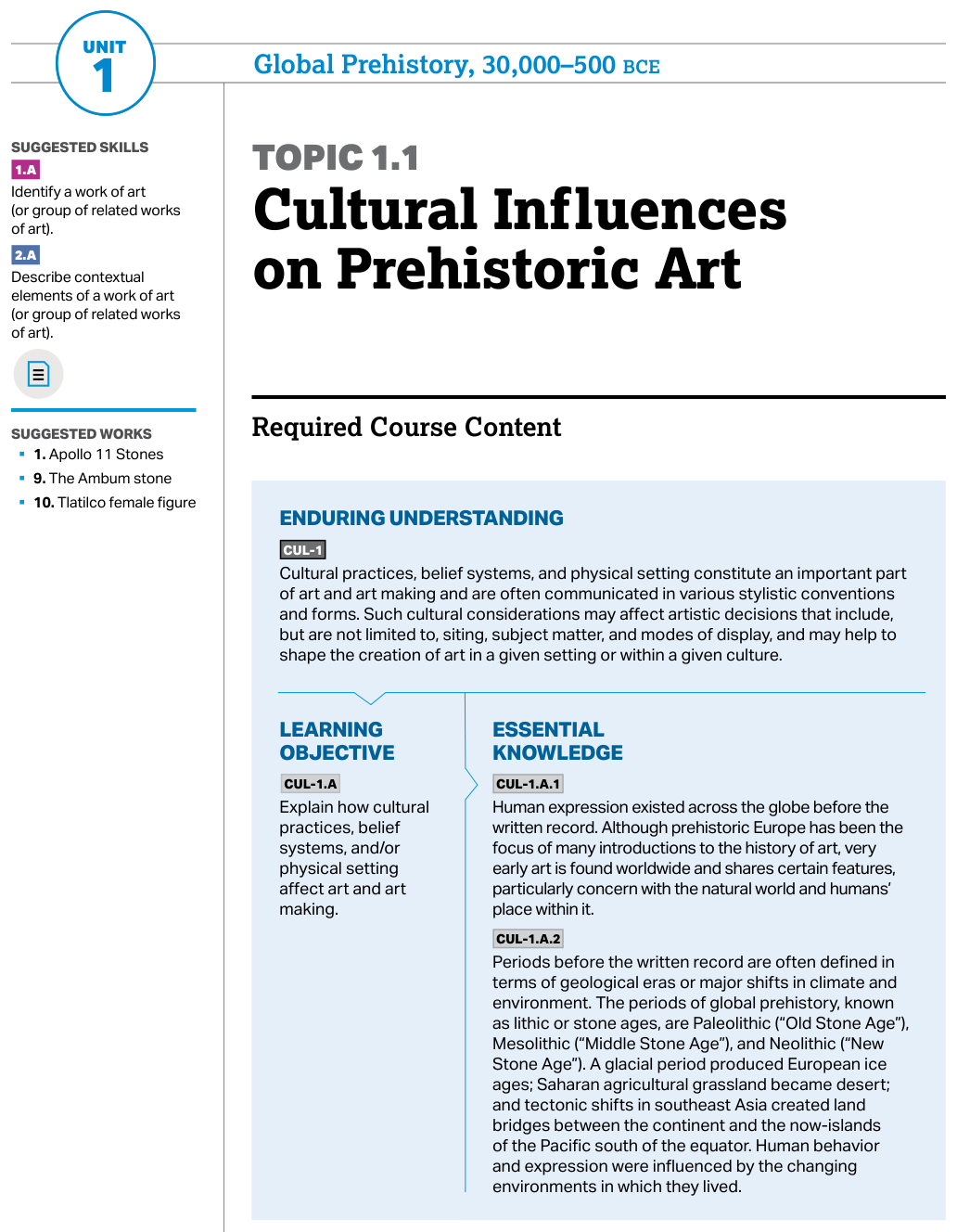
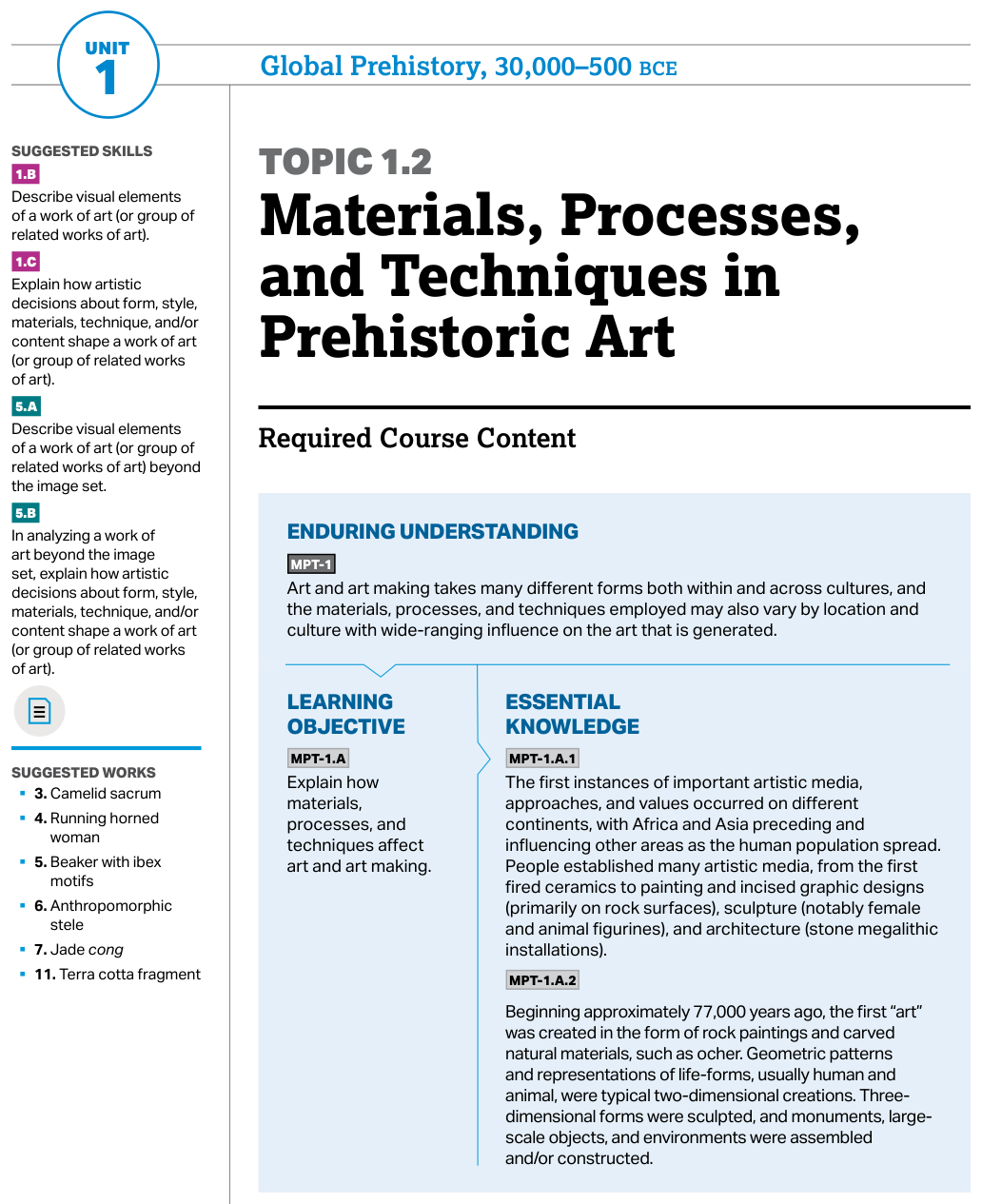
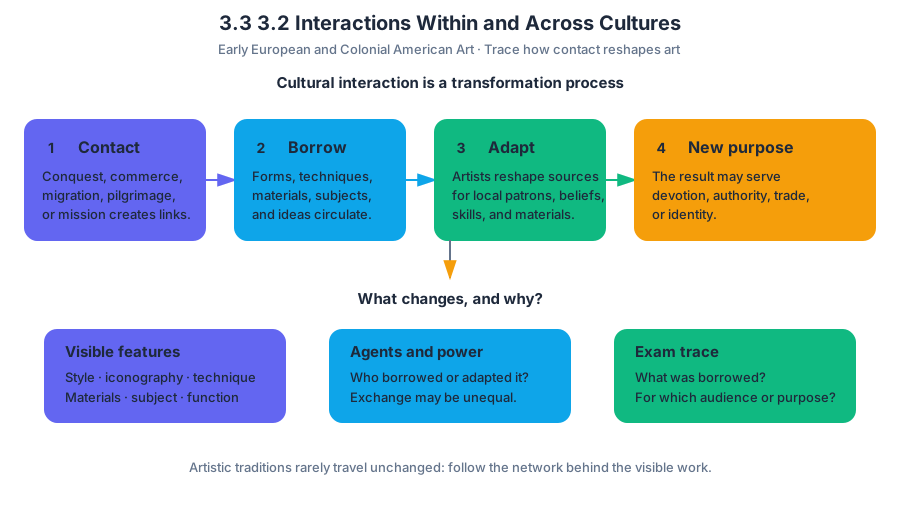
3.5 3.4 Purpose and Audience in Early European and Colonial American Art
Key concepts: Purpose, patron, and intended audience · Function and context of art · Reception of works of art · Artistic decisions about form, materials, content, and function · Changing functions over time · Influence of differing situations and contexts · Corporate and private patronage · Academies and centralized art training · Juried salons · Artist identity and professionalization
A work of art is never only an image: it is also a commissioned object, a functional object, a public statement, or a private encounter shaped by purpose, patron, and intended audience.
3.5 3.4 Purpose and Audience in Early European and Colonial American Art
A work of art is never only an image: it is also a commissioned object, a functional object, a public statement, or a private encounter shaped by purpose, patron, and intended audience. The same object can produce different responses when its location, users, or function changes.
Enduring Understanding PAA-1: A variety of purposes may affect art and art making, including intended audience, patron, artistic intention, and function. Differing situations and contexts may influence the artist, patron, or intended audience; functions may also change over time, altering a work’s interpretation and reception.
For Topic 3.4 Purpose and Audience in Early European and Colonial American Art, the central analytical tools are 2.B: Explain how the possible intent, purpose, and/or function shape the creation or meaning of a work of art (or group of related works of art) and 2.D: Explain how artistic decisions about form, style, materials, content, function, and/or context of a work of art (or group of related works of art) elicit a response or shape its reception. The relevant framework identifier is PAA-1.A, including PAA-1.A.35, which connects diverse art forms to their perceived purposes and functions.
The purpose–patron–audience triangle
A patron is the person, institution, or group that commissions, funds, owns, or otherwise supports a work. The intended audience is the group for whom the work is designed, while function means what the work is meant to do—such as inspire devotion, commemorate authority, teach doctrine, persuade viewers, or serve a ritual purpose.
Use the triangle as a chain of evidence:
- Purpose: What effect or action was desired?
- Patron: Who requested or financed the work?
- Audience: Who was expected to see, use, or interpret it?
- Artistic decisions: How do form, materials, content, scale, placement, and style serve those conditions?
- Reception: What response did the work invite, and how might later viewers respond differently?
The Röttgen Pietà demonstrates why analyzing an artwork requires more than identifying its subject. Its intensely wounded Christ and emotionally forceful form could support private devotional use by encouraging meditation on suffering. The work’s purpose helps explain why its exaggerated physical details are not simply “bad anatomy”: they are artistic decisions designed to elicit a powerful devotional response.
Function changes, and reception changes with it
The Isenheim altarpiece was made for the Antonine monastery at Isenheim and served a specialized religious and therapeutic context. Its imagery of Christ’s suffering could speak directly to patients suffering from disease, while its movable wings revealed different scenes for different liturgical occasions. Form, content, location, and changing display conditions worked together to shape the original audience’s experience.
A work’s reception is the way viewers respond to and interpret it. Reception is not fixed: when an object moves from a chapel, palace, or civic setting into a museum, its audience and function may change. The work may become an art-historical example rather than a devotional, political, or communal instrument.
Misconception check — “The subject determines the meaning.”
A painting of the Virgin, Christ, or a ruler does not have one automatic meaning. Ask who commissioned it, where it was displayed, what viewers were expected to do, and which material or formal choices directed their response.
Art, power, and political audiences
Leonardo’s The Last Supper was created for the refectory of the Dominican convent of Santa Maria delle Grazie in Milan. Its placement among the monks’ communal meals made the subject functionally immediate: the friars encountered Christ and the apostles in a space devoted to eating together. Leonardo’s arrangement of figures, gestures, and emotional reactions directs attention toward Christ while making the sacred narrative relevant to the viewers’ daily setting.
In Henri IV Receives the Portrait of Marie de’ Medici, Rubens presents dynastic marriage as a political achievement. The patron, Marie de’ Medici, needed a visual program that affirmed legitimacy and royal continuity; the intended audience included the French court and later political viewers. Allegory, lavish materials, theatrical movement, and imperial scale transform a personal marriage into a public statement about monarchy.
Institutions reshape the artist’s identity
The emergence of sanctioned academies changed how art was taught and how artists were understood. Academies organized artists within centralized educational institutions and provided structured, theoretical curricula, often emphasizing drawing, classical models, anatomy, perspective, and accepted hierarchies of subject matter. The artist increasingly appeared not merely as a craftsperson but as an educated intellectual whose status depended on institutional recognition.
Artists pursued inclusion in juried salons, official exhibitions in which committees selected works for public display. Salon systems could shape careers by determining visibility, reputation, sales, and critical reception. A work’s reception therefore depended not only on its visual qualities but also on institutional gatekeeping: who was allowed to exhibit, where the work appeared, and which audiences encountered it.
Patronage beyond the court
Corporate patronage comes from institutions such as churches, monasteries, guilds, governments, academies, or businesses. Private patronage comes from individuals or families. Both forms connect production to purpose and audience: a church commission may prioritize ritual and instruction, while a private commission may emphasize family identity, status, devotion, or collecting.
Worked interpretation: Suppose a question presents an altarpiece with dramatic religious imagery. A weak response says, “The artist used emotion to show Christianity.” A stronger 2.B and 2.D response explains that a religious patron commissioned the work for a devotional setting; the altarpiece’s subject, scale, placement, and emotional intensity addressed a particular audience and encouraged a specific response. If the work later enters a museum, its function changes, so its reception changes as well.
Retrieval check: For the Röttgen Pietà, identify one likely purpose, one audience, and one artistic decision that supports your claim. Then explain how moving the work from a devotional setting to a museum could alter its interpretation. A complete answer must connect purpose or function to visible form and then to audience response.
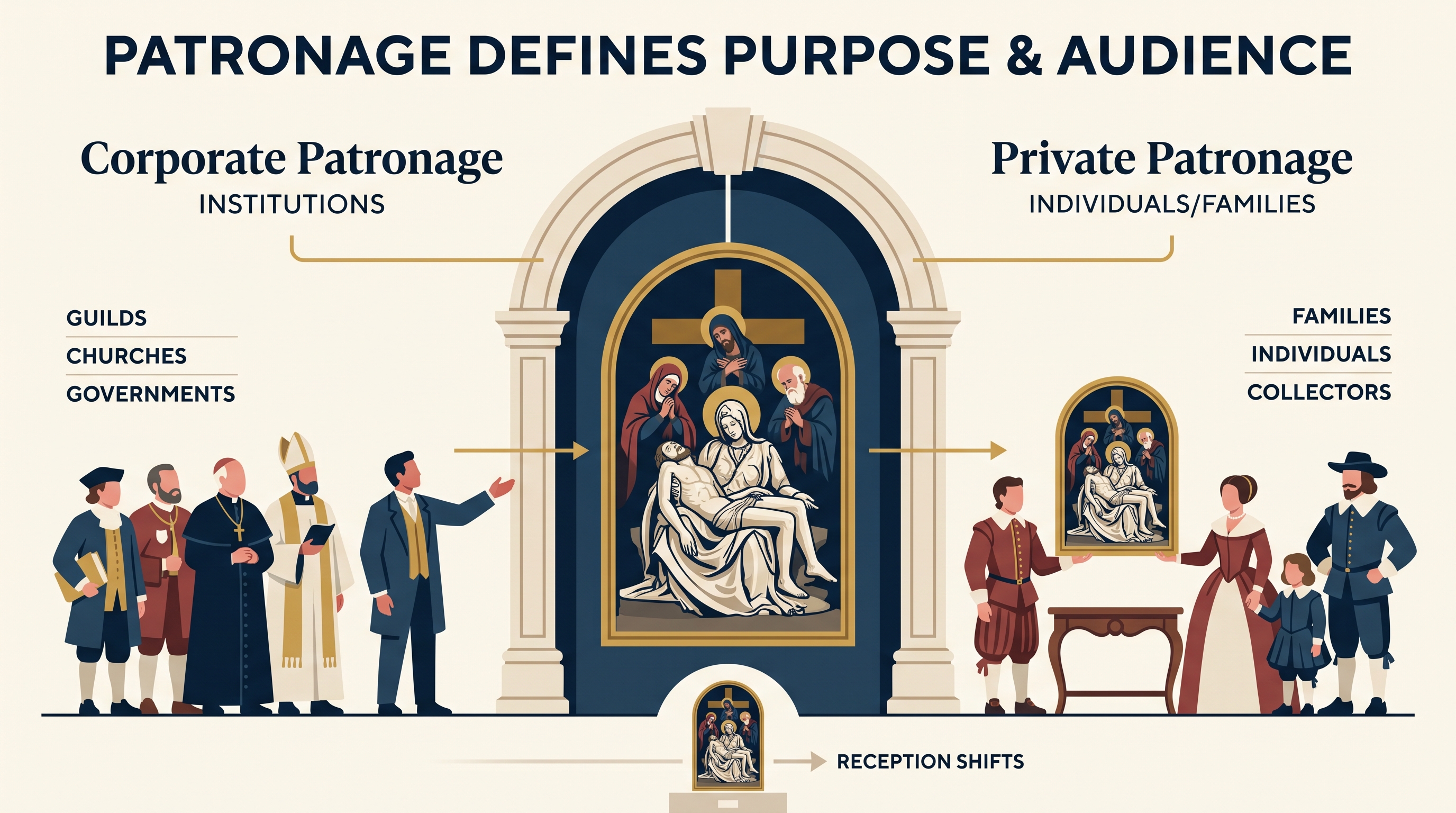
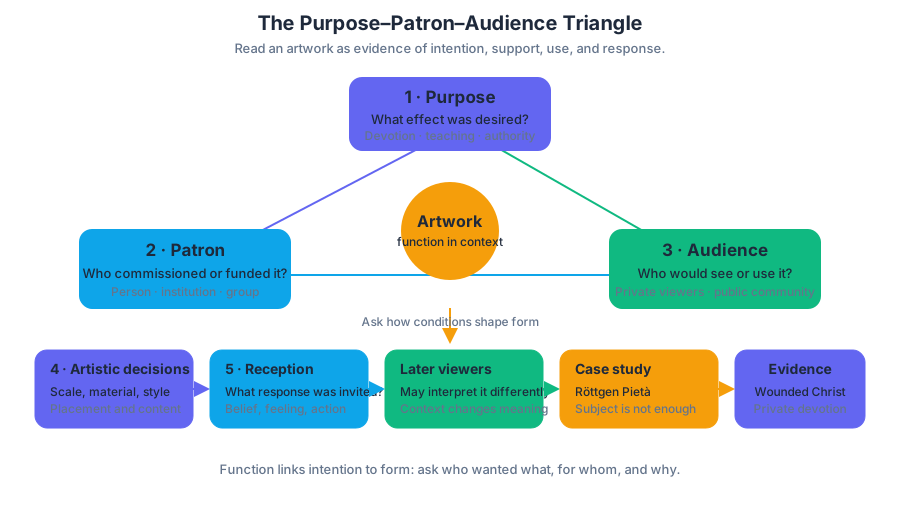
3.6 3.5 Theories and Interpretations of Early European and Colonial American Art
Key concepts: Theories and interpretations of works of art · Visual analysis as a basis for interpretation · The role of scholarship and other disciplines in shaping interpretations · The influence of technology and availability of evidence · How interpretations affect a work’s reception and meaning over time · Early European and Colonial American art, 200–1750 CE · Art-historical interpretations of related groups of works · Geographic, religious, and linguistic divisions in the study of European medieval art · The Arnolfini Portrait · Frontispiece of the Codex Mendoza
A single artwork can acquire new meanings when new evidence, technologies, or scholarly questions change how viewers see it. Interpretation is an art-historically supported explanation of a work’s meaning, significance, reception, or function—not merely a personal reaction.
3.6 3.5 Theories and Interpretations of Early European and Colonial American Art
A single artwork can acquire new meanings when new evidence, technologies, or scholarly questions change how viewers see it. Interpretation is an art-historically supported explanation of a work’s meaning, significance, reception, or function—not merely a personal reaction.
THR-1: The study of art history is shaped by theories and interpretations of art and art making that change over time. Interpretations may arise from visual analysis and from scholarship influenced by other disciplines, available technology, and the availability of evidence.
How an interpretation is built
A defensible interpretation begins with what can be observed: form (visual elements and composition), style, materials, content, function, context, reception, and meaning. The art historian then connects those observations to evidence about the work’s historical world.
The reasoning chain is:
Observation → historical question → evidence → interpretation → defensible claim
For example, The Arnolfini Portrait contains carefully rendered objects, a convex mirror, a small dog, elaborate clothing, and a controlled interior setting. These details do not automatically produce one certain meaning. They generate questions: Who are the figures? What social values do the objects communicate? Why might the mirror and its reflected figures matter? A strong interpretation identifies specific visual evidence and explains how that evidence supports a claim.
The painting’s reception demonstrates why interpretation is not fixed. Viewers and scholars have proposed different explanations of the scene, including interpretations centered on marriage, status, identity, or symbolic meaning. The important AP distinction is not choosing the most dramatic theory; it is explaining how a theory is derived from visible evidence and relevant context.
Scholarship changes what viewers can know
Art history is interdisciplinary: its interpretations may draw on religious studies, history, anthropology, language, architecture, social history, conservation science, and archaeology. Technology can enlarge details, reveal underdrawings, identify pigments, compare images across collections, or preserve evidence that is difficult to see with the naked eye. New evidence may strengthen an earlier interpretation, qualify it, or make it less persuasive.
European medieval art must therefore be studied with attention to geography, religion, and language. A medieval work may reflect the traditions of a particular region while also participating in broader Christian, Jewish, or Islamic visual and intellectual networks. Byzantine, Islamic, and Christian forms, motifs, texts, and religious traditions moved across medieval regions through travel, trade, pilgrimage, political contact, and translation. Language matters because an inscription, title, or textual source can change how an image is identified and understood.
The Frontispiece of the Codex Mendoza makes this problem especially visible. Its imagery belongs to a colonial context in which Indigenous Mexican history and systems of knowledge were recorded through a manuscript made after the Spanish conquest. Interpreting the page requires visual analysis, attention to Indigenous pictorial conventions, knowledge of colonial power, and sensitivity to the languages and translation systems through which its meanings were transmitted.
Interpretations shape reception
An interpretation does not simply describe a work’s meaning; it can influence how museums display it, how textbooks explain it, which histories receive attention, and how later audiences value or misunderstand it. A theory may be harnessed, manipulated, or adapted to make an art-historical argument. Because interpretations affect reception, scholars must distinguish between what the work visibly supports and what an audience has projected onto it.
Misconception check: “If scholars disagree, every interpretation is equally valid.”
Correction: Interpretations can differ while still being evaluated. An art-historically valid interpretation uses relevant visual and contextual evidence, acknowledges uncertainty, and explains its reasoning.
Formal discussion: turning evidence into argument
A precise discussion avoids unsupported phrases such as “the artist wanted” or “this symbolizes” unless evidence justifies them. Use a three-part structure:
- Claim: State an interpretation clearly.
- Evidence: Identify a specific formal, material, contextual, or historical feature.
- Reasoning: Explain why that feature supports the interpretation, while noting a limitation or alternative when appropriate.
This directly develops 7.B — Explain how one or more art historically valid interpretations of a work of art (or group of related works of art) are derived from an analysis of its form, style, materials, content, function, context, reception, and/or meaning. It also develops 8.A — Articulate a defensible claim about one or more works of art (or group of related works of art) and 8.B — Using specific and relevant evidence, support an argument about works of art.
In discussion, distinguish observation from inference: “The mirror reflects additional figures” is observation; “the mirror expands the social space of the scene” is interpretation. Invite corroboration—“Which detail supports that?”—and qualification—“What evidence might complicate it?”—rather than treating disagreement as a contest of opinions.
Retrieval check: Why might a new technical examination change an interpretation of The Arnolfini Portrait or the Frontispiece of the Codex Mendoza? Answer in one sentence using both evidence and interpretation. A strong answer explains that newly visible, newly identified, or newly contextualized evidence can support, revise, or challenge an existing art-historical claim.
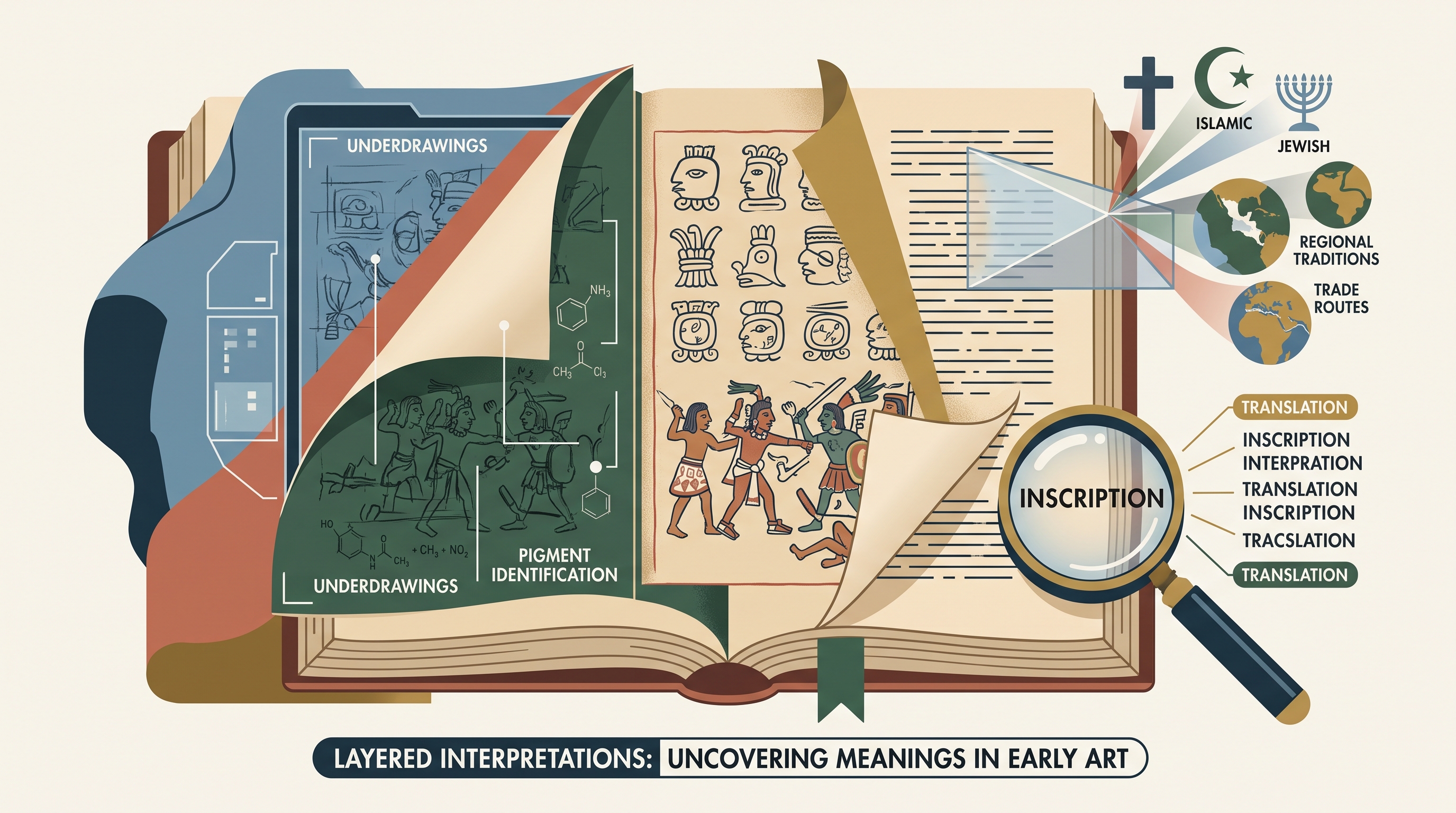
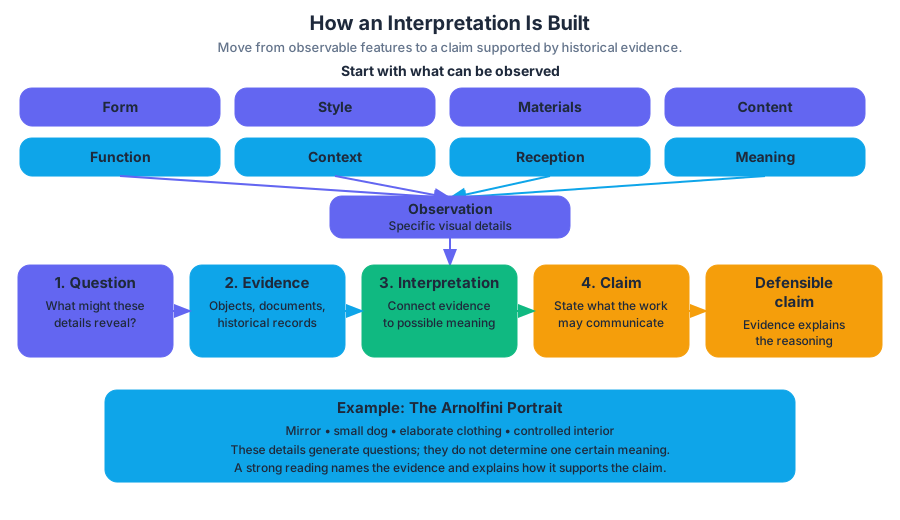
4.1 Interactions Within and Across Cultures in Later European and American Art
Key concepts: Cultural interactions within and across Europe and the Americas · Colonialism and European invasions · Indigenous Americas and Indigenous cultural continuity · Cultural exchange and artistic influence · Rapid change and innovation from the mid-1700s to 1980 CE · Influence of ancient Mesoamerican sculpture and architecture · European and American modernist art · Impressionist, Post-Impressionist, and Modernist movements
From the mid-1700s to 1980 CE, Europe and the Americas underwent rapid artistic change because industrialization, urbanization, economic upheaval, migration, war, colonialism, and cultural contact repeatedly altered how people lived and imagined the world.
4.1 Interactions Within and Across Cultures in Later European and American Art
From the mid-1700s to 1980 CE, Europe and the Americas underwent rapid artistic change because industrialization, urbanization, economic upheaval, migration, war, colonialism, and cultural contact repeatedly altered how people lived and imagined the world.
Investigative question: When artists borrow, adapt, or respond to another culture, is the result best understood as exchange, influence, appropriation, resistance—or several of these at once?
A period of accelerated interaction
Artistic change during this period did not happen in isolation. New technologies, expanding cities, political revolutions, imperial systems, and mass movement connected artists to unfamiliar objects, images, and ideas; those encounters could produce admiration, experimentation, unequal appropriation, or deliberate rejection.
The CED frames this through INT-1: A variety of factors leads to and motivates interaction between and among cultures, and this interaction may influence art and art making. Such interaction can result from travel, trade, war, conquest, and colonization, and may appear through artistic influence, spolia, appropriation, stylistic revival, or other forms of cultural exchange.
| Historical force | What it changes | Artistic consequence |
|---|---|---|
| Industrialization | Production, transportation, and urban life | New subjects, technologies, and visual experiments |
| Colonialism | Political power and access to other cultures | Unequal exchange, collecting, borrowing, and resistance |
| Migration | Where people, traditions, and objects circulate | Hybrid styles and new artistic communities |
| War and economic upheaval | Institutions, identities, and public life | Art that records, critiques, or responds to crisis |
Colonialism and Indigenous cultural continuity
The term Indigenous Americas emphasizes the priority of Indigenous peoples and cultures rather than treating the Americas as spaces defined only by European arrival. European invasions began in $1492$ and prevailed beginning in $1534$ CE, but conquest did not erase the descendants, languages, or cultural practices of ancient Indigenous peoples.
The continued use of Quechua demonstrates this distinction clearly: approximately eight to ten million people still speak the language of the Inka. Indigenous culture is therefore not merely a historical “influence” preserved in museums; it remains a living continuity carried by communities in the present.
Misconception check — “European invasion ended Indigenous culture.”
European invasion profoundly disrupted Indigenous societies and imposed colonial power, but disruption is not disappearance. The survival of Quechua-speaking communities shows why art history must distinguish colonial domination from cultural extinction.
Influence is not a one-way pipeline
European and American artists were affected by exposure to diverse cultures, but influence should be demonstrated through specific visual or formal connections rather than asserted from resemblance alone. A work may borrow a shape, spatial structure, material logic, motif, or abstract vocabulary while transforming its original meaning in a new setting.
Henry Moore and Frank Lloyd Wright were strongly influenced by the sculpture and architecture of ancient Mesoamerica. Their examples show that ancient Mesoamerican art affected both modern sculpture and modern architecture, expanding the usual narrative that artistic innovation flows only from Europe to the Americas.
Andean art was less familiar to early modern Europe and to later mainstream audiences than Mesoamerican art because of greater geographic and aesthetic distance. Nevertheless, Paul Gauguin, Josef and Anni Albers, and Paul Klee found inspiration in ancient Peruvian textiles and ceramics, while Joaquín Torres García of Uruguay blended Inka art and architecture with modernist theory and style to explore a shared abstract vocabulary.
Worked example: tracing influence through Monet
Claude Monet’s Gare Saint-Lazare offers a useful way to trace artistic influence across movements. Begin with visual evidence: the railway station presents modern industrial space through shifting light, atmospheric steam, fragmented color, and a subject associated with urban modernization rather than traditional heroic or religious history painting.
Next, trace what later artists could take from this approach. Impressionism’s attention to transient perception and modern life helped open possibilities for Post-Impressionist experiments with structure, color, and expression; those experiments, in turn, contributed to Modernist departures from naturalistic representation. The claim is not that Monet single-handedly caused Modernism, but that a specific artwork or related group of works can influence later artistic practices and artmaking.
A strong INT-1.A: Explain how interactions with other cultures affect art and art making response would connect visual evidence to context: the station’s subject reflects industrialization, while its method of depicting light and atmosphere demonstrates formal innovation that later artists could adapt. This is also 4.D: Explain how a specific work or group of related works of art can influence later artistic production within or across cultures.
How to build an AP-quality explanation
Use the sequence contact → transformation → evidence → consequence:
- Identify the interaction: invasion, migration, travel, collecting, trade, or artistic exposure.
- Name what changed: a motif, material, structure, technique, subject, or visual language.
- Cite visible evidence in the artwork.
- Explain the effect on later artmaking or cultural identity.
For example, “Wright was influenced by Mesoamerican architecture” is only an assertion. A stronger explanation identifies a Mesoamerican architectural feature, connects it to a formal decision in Wright’s work, and explains how that decision shows cultural interaction without pretending that the two traditions are identical.
Retrieval check
Why does Quechua matter to an explanation of cultural interaction in later European and American art? A complete answer should state that eight to ten million people still speak the Inka language, demonstrating Indigenous cultural continuity and challenging the misconception that European invasion erased Indigenous peoples and cultures.
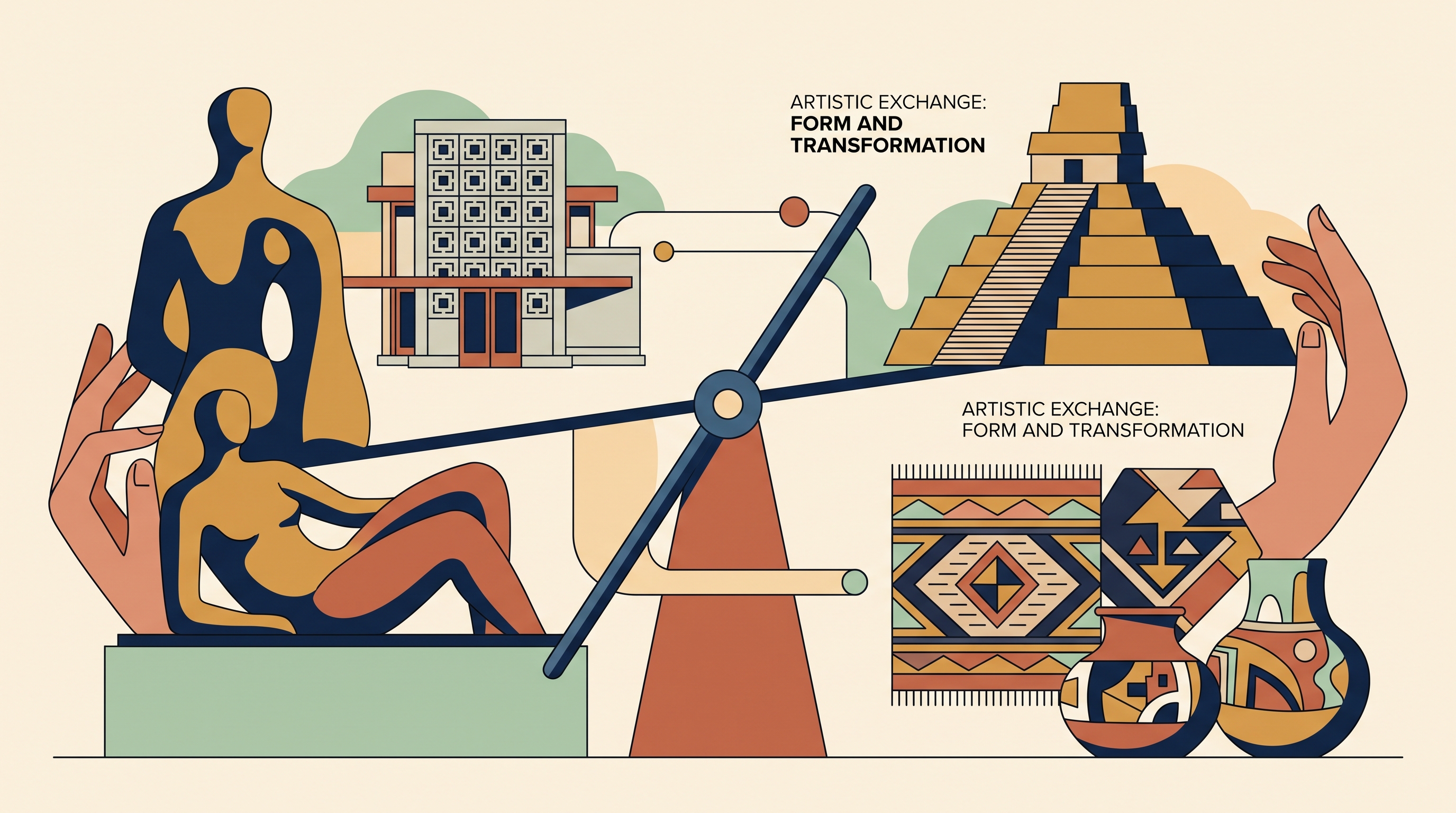
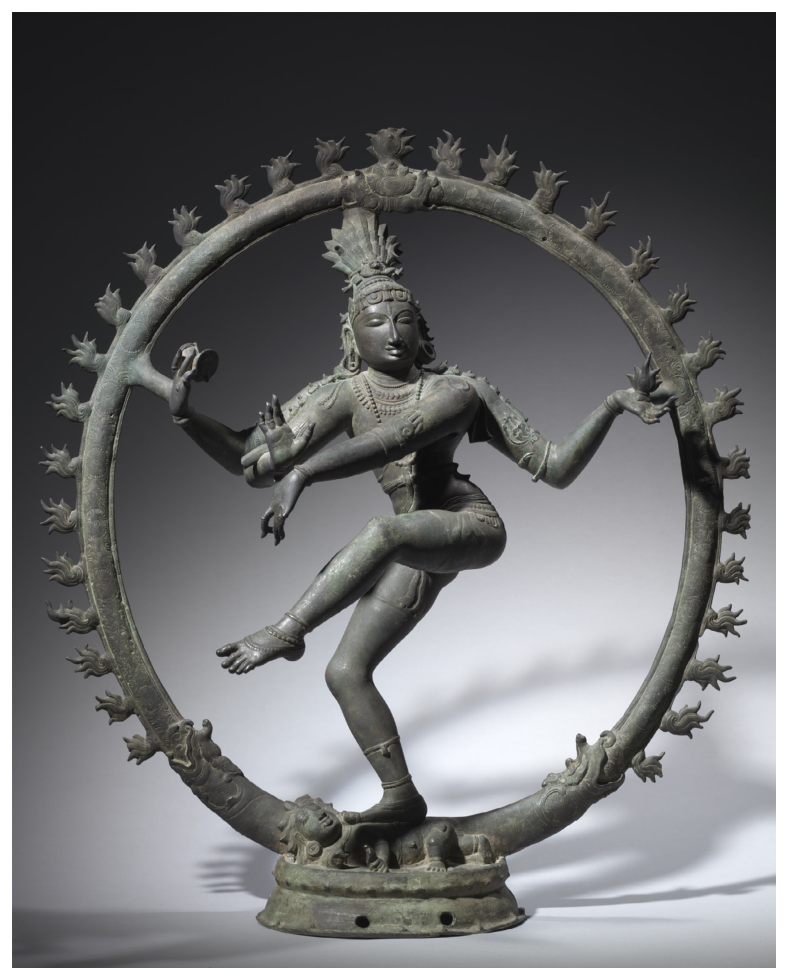
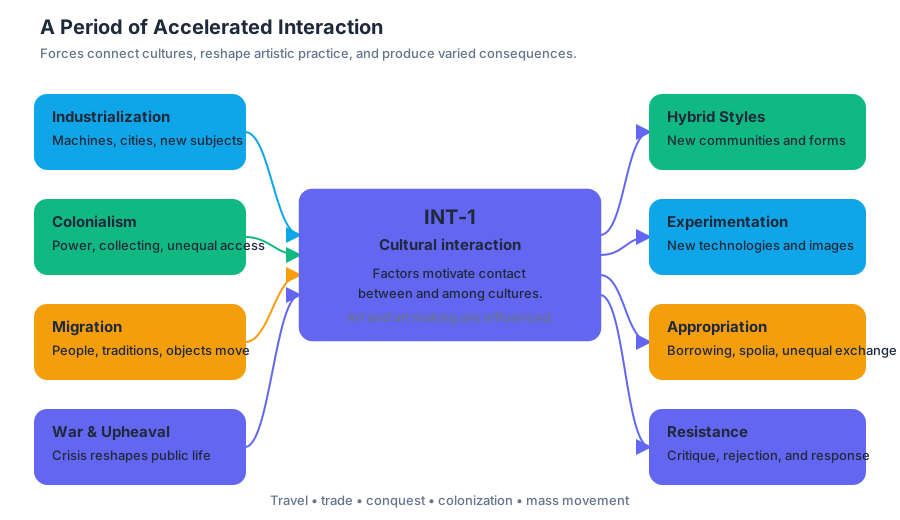
4.2 Purpose and Audience in Later European and American Art
Key concepts: artist intent and purpose · intended audience and patronage · how purpose and audience affect artmaking · changing social roles and functions of art · audience experience and reception · public exhibitions and commercial galleries · the Paris Salon · the avant-garde · artistic movements and “isms” · visual and contextual analysis
Why does one painting become a national symbol while another shocks its first viewers? Purpose, intended audience, patronage, and artistic intent shape not only what an artist makes, but also how people encounter, value, reject, or reinterpret it.
4.2 Purpose and Audience in Later European and American Art
Why does one painting become a national symbol while another shocks its first viewers? Purpose, intended audience, patronage, and artistic intent shape not only what an artist makes, but also how people encounter, value, reject, or reinterpret it. In Later European and American Art, from $1750$ to $1980$ CE, art moved through changing systems of religious, civic, political, and commercial support.
Enduring Understanding PAA-1: A variety of purposes may affect art and art making, including intended audience, patron, artistic intention, and function. Because contexts change, an artwork’s function and reception may change as well.
The purpose–audience–reception chain
A useful way to analyze an artwork is to follow a three-part chain:
Artist or patron decision $\rightarrow$ artistic choices $\rightarrow$ audience response
The patron is the person or institution that commissions, purchases, or supports an artwork. The intended audience is the group the work is designed to address, while reception means how viewers actually respond to it. Intended meaning and actual reception can diverge: a work meant to celebrate authority may later be criticized as propaganda, or a work initially rejected may become culturally important.
This directly develops Learning Objective PAA-1.A: Explain how purpose, intended audience, or patron affect art and art making. It is assessed especially through Skill 2.B (Blue): Explain how the possible intent, purpose, and/or function shape the creation or meaning of a work of art (or group of related works of art) and Skill 2.D (Blue): Explain how artistic decisions about form, style, materials, content, function, and/or context of a work of art (or group of related works of art) elicit a response or shape its reception.
New roles for art
PAA-1.A.9: Works of art took on new roles and functions in society, and were experienced by audiences in new ways. Church patronage declined, while corporate patronage emerged. Museums became important institutions of civic and national status and pride, and art increasingly circulated through public exhibitions and commercial galleries.
The economic structure changed with the audience. The sale of art to the public became a leading driver of production; collecting increased demand and prices, turning art into a commodity—an object bought and sold for financial as well as cultural value. After the devastation of Europe in World War II, artists in the United States dominated the international art market.
Public display transformed the viewing experience. The Salon in Paris presented art before a broad audience, while later commercial galleries connected artists to buyers, critics, collectors, and competing artists. Audiences therefore ranged from private patrons to the general public, which could be hostile toward art that broke with tradition (PAA-1.A.10; PAA-1.A.11).
The avant-garde and the problem of tradition
The avant-garde describes artists dedicated to innovation. Their purpose was often not simply to produce attractive objects, but to challenge inherited expectations about subject matter, technique, perspective, artistic authority, or the status of the art object itself.
Major movements associated with the avant-garde include neoclassicism, romanticism, realism, impressionism, post-impressionism, symbolism, expressionism, cubism, constructivism, abstraction, surrealism, abstract expressionism, pop art, performance art, and earth and environmental art. These movements do not share one visual style; they share an investment in testing what art can do and how it can address its audience.
Worked contextual example: Les Demoiselles d’Avignon
Pablo Picasso’s Les Demoiselles d’Avignon demonstrates how artistic decisions can provoke a new reception. Its fractured bodies, sharply angular planes, and multiple viewpoints create a radical break from traditional Western perspective and idealized human forms. Instead of presenting a unified, pleasing view of the human figure, the painting confronts viewers with instability and visual difficulty.
Using Skill 2.B, one can argue that its possible purpose was to challenge academic conventions and redefine modern painting. Using Skill 2.D, the visual evidence explains the reception: viewers accustomed to coherent perspective and idealized bodies could experience the work as aggressive, confusing, or even hostile. The painting’s meaning therefore depends not only on what appears in it, but also on the expectations it deliberately violates.
Compare purpose, audience, and function
| Work | Purpose or function to investigate | Audience or reception question |
|---|---|---|
| Oath of the Horatii | How might history and moral duty serve a civic purpose? | What values does its public address encourage viewers to admire? |
| George Washington | How does portraiture construct political identity and national authority? | Who benefits from seeing Washington represented as a public ideal? |
| The Starry Night | How might expressive form communicate personal or emotional experience? | How did later audiences transform the work into a widely recognized cultural image? |
| Where Do We Come From? What Are We? Where Are We Going? | How can an artwork address existential or cultural questions? | How might different audiences interpret its symbols and narrative? |
| Mont Sainte-Victoire | How can repeated observation transform a landscape into an artistic investigation? | What changes when landscape is viewed as modern formal exploration rather than simple description? |
The strongest interpretation combines art-historical knowledge with visual and contextual analysis. Do not claim an artist’s intention solely from appearance; connect a formal decision—such as composition, distortion, scale, or viewpoint—to a plausible purpose and then explain how a particular audience might have responded.
Misconception check
Misconception: “The artist’s intention determines the meaning permanently.” Correction: intention matters, but meaning and function can change as works move from private settings to museums, exhibitions, galleries, or mass culture. A public may reject innovation at first and later celebrate it, so critical and popular reception can become evidence when interpreting purpose and audience.
Retrieval check
A painting is commissioned by a government, displayed in a public museum, and later criticized by viewers who reject its unconventional style. Identify one factor related to PAA-1.A.10 or PAA-1.A.11, then explain how one artistic decision could shape reception using 2.D.

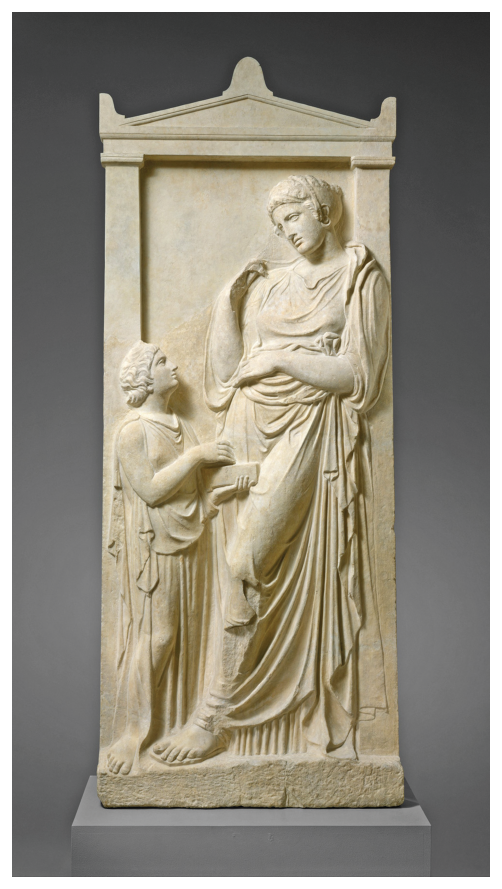
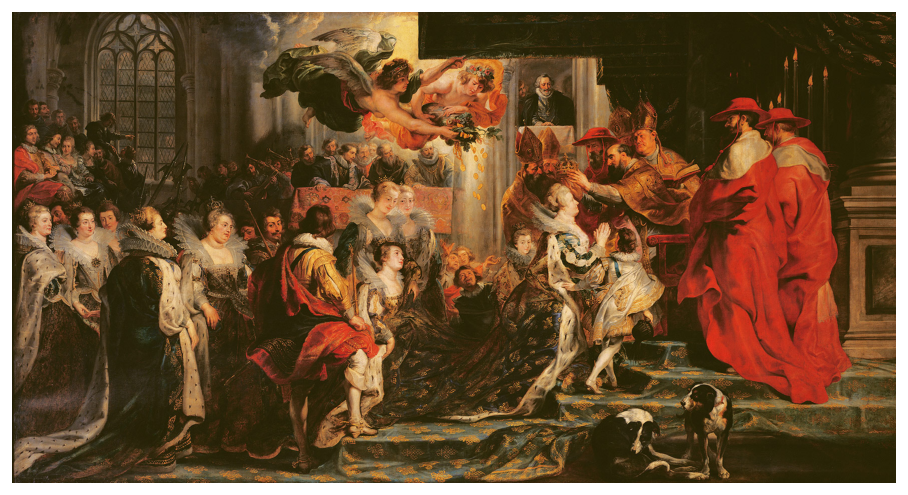
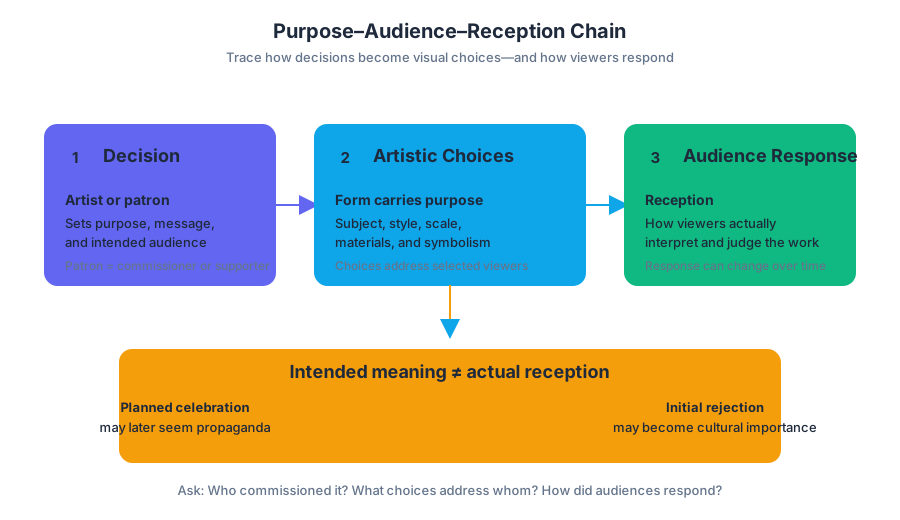
4.3 Materials, Processes, and Techniques in Later European and American Art
Key concepts: Materials, processes, and techniques · Artistic decisions about form and style · Visual elements, including linear and atmospheric perspective · The effects of technological advances on artmaking · Photography as an artistic medium · The use of new materials and techniques · Collaboration in artistic practice · The relationship between materials, technique, and meaning
A work of art’s material is never merely its substance: marble, steel, film, fiber, wood, and electronic circuitry each make some forms and meanings possible while resisting others.
4.3 Materials, Processes, and Techniques in Later European and American Art
A work of art’s material is never merely its substance: marble, steel, film, fiber, wood, and electronic circuitry each make some forms and meanings possible while resisting others.
MPT-1: Materials, processes, and techniques shape how art is made, what it looks like, and what it can communicate.
The official learning objective MPT-1.A asks you to explain how materials, processes, and techniques affect art and art making. The central AP skill is 1.C: Explain how artistic decisions about form, style, materials, technique, and/or content shape a work of art (or group of related works of art). Attribution also matters: 6.A: Attribute a work of art to a specific artist, culture, art historical style, or object type from the image set, and 6.B: Justify an attribution of a work of art by explaining similarities with work by a specific artist, culture, art historical style, or object type from the image set.
Perspective: technique turns space into an argument
Linear perspective constructs depth through lines that appear to converge toward one or more vanishing points. Atmospheric perspective suggests distance through optical changes: faraway forms become less distinct, less saturated, and often lighter or cooler in color.
Raphael’s School of Athens is a Renaissance precedent rather than a central later-European example, but it makes the technical principle visible: architectural lines organize the figures around a deep, coherent space, while the arrangement directs attention toward Plato and Aristotle. The technique is not decorative; it converts geometry into intellectual hierarchy.
In later European and American art, artists increasingly treated perspective as something to manipulate rather than simply obey. A useful comparison is a nineteenth-century academic image that stabilizes space through orderly recession versus a modern work that compresses, fragments, or flattens space. The exam-worthy claim is not “the artist used perspective,” but how the chosen spatial system changes the viewer’s experience and the work’s meaning.
Photography: technology changes what counts as a visible moment
Mid-nineteenth-century technological advances transformed photography by making images faster, more reproducible, and more capable of recording fleeting events. Photography could now investigate movement and modern life rather than merely imitate the stillness of conventional portraiture.
Eadweard Muybridge’s The Horse in Motion uses sequential photographic images to isolate phases of a gallop that the unaided eye cannot clearly separate. The process makes photography an instrument of evidence and analysis: the camera reveals movement by dividing time into visible units.
Alfred Stieglitz’s The Steerage demonstrates a different photographic possibility. Its crowded composition, strong diagonals, and contrasts between passengers on different levels make the arrangement of bodies, machinery, and space visually compelling. Photography here is not only mechanical recording; framing and selection create an artistic form.
Misconception check — “A photograph is objective because a camera made it.”
The camera records light, but the photographer determines position, timing, framing, focus, and what remains outside the image. The Horse in Motion emphasizes sequential analysis; The Steerage emphasizes formal organization and social observation.
Material determines form: sculpture and architecture
Auguste Rodin’s The Kiss shows how material and technique affect form. Carving requires the artist to remove material from a solid block, while the modeled and cast bronze process allows a surface to preserve gestures, textures, and the evidence of manipulation. The bodies’ interlocking forms and tactile surfaces make physical intimacy feel active rather than diagrammatically perfect.
A strong 1.C response connects the visible effect to the process: the treatment of the surface and the handling of the bodies intensify sensation, while the medium supports a sculptural emphasis on touch, volume, and movement. Do not stop at “it is made of bronze”; explain what the material and technique permit the viewer to see or feel.
Frank Lloyd Wright’s Fallingwater demonstrates the same principle in architecture. Its cantilevered concrete terraces extend over the waterfall, while stone, glass, and concrete coordinate the building with its rocky site. The structure is not simply placed in nature: its materials and construction techniques make the experience of inhabiting the landscape part of the design.
Essential knowledge MPT-1.A.11 connects technological change to architecture: advances such as the steel frame, ferroconcrete construction, and cantilevering hastened building construction, encouraged skyscrapers, and contributed to an international architectural style. The broader lesson is that new structural materials can change not only surface appearance but also the scale, height, and spatial possibilities of buildings.
Manipulated materials and new media
Artists carve, cast, weave, assemble, fire, bend, and otherwise manipulate wood, ivory, metals, ceramic, fiber, and elements of nature. Each process leaves clues: a carved surface records subtraction, a cast object records a mold, fired ceramic records heat, and woven fiber records repeated interlacing. These clues can support 6.A and 6.B attribution when they align with a known artist, culture, style, or object type.
Textiles are not automatically secondary to painting or sculpture. The Bayeux Tapestry is a useful earlier precedent for how fiber, stitching, sequence, and narrative can work together, but later European and American art continues this material logic in modern textile practices. Its inclusion is technical rather than chronological: the medium demonstrates that cloth can construct images, movement, memory, and historical claims.
Electronic media extend this question into the contemporary world. Nam June Paik’s Electronic Superhighway uses television monitors, video signals, electronic components, and spatial installation as artistic materials. The work’s meaning depends on the technology itself: electronic communication becomes both subject and medium, turning a networked image of the United States into an environment the viewer physically encounters.
Worked interpretation
Suppose an unknown work combines steel supports, projecting horizontal planes, glass walls, and a building integrated with a waterfall. Begin with observation, then connect observation to process: the projecting planes suggest cantilevering; the steel or reinforced concrete makes that extension possible; the glass and stone bind the structure to its environment. A defensible conclusion is that the materials and techniques shape an architectural experience of immersion in nature, supporting an attribution to Wright’s Fallingwater.
Retrieval check: Why is The Horse in Motion more than a record of a horse? Name one process-based feature and explain how it changes the meaning of movement. Then identify one material or technique in Fallingwater that directly affects its form.
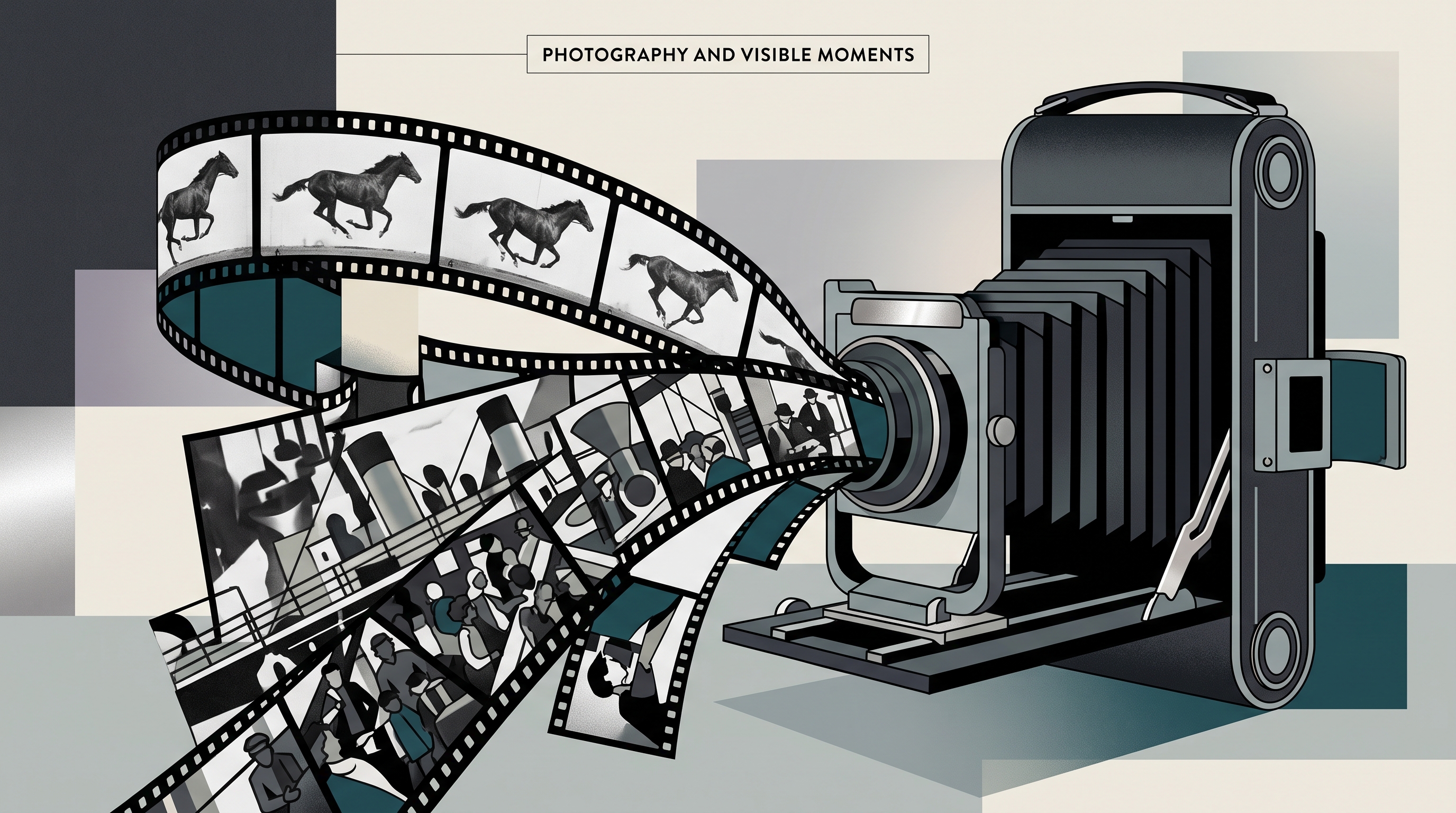
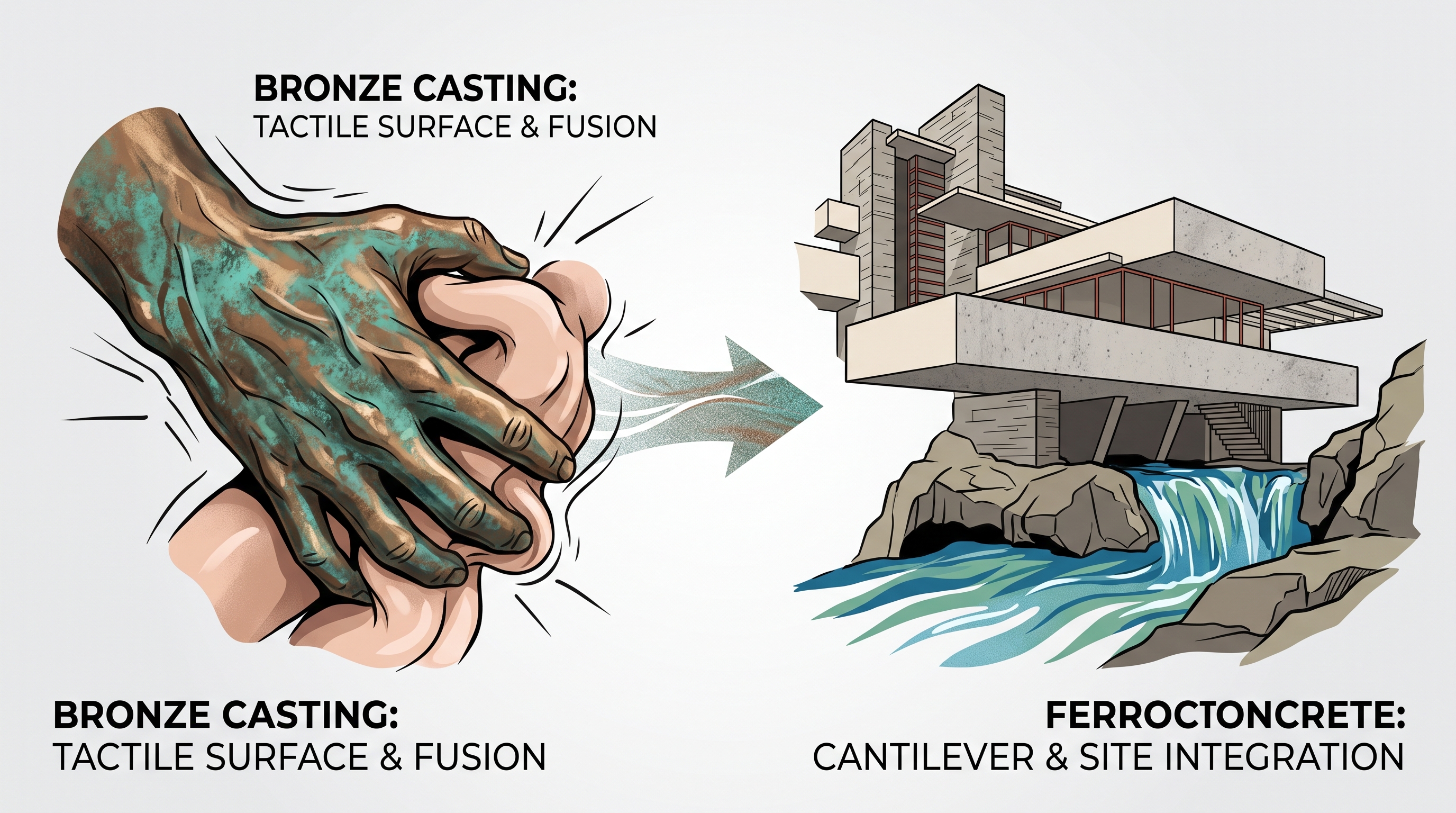
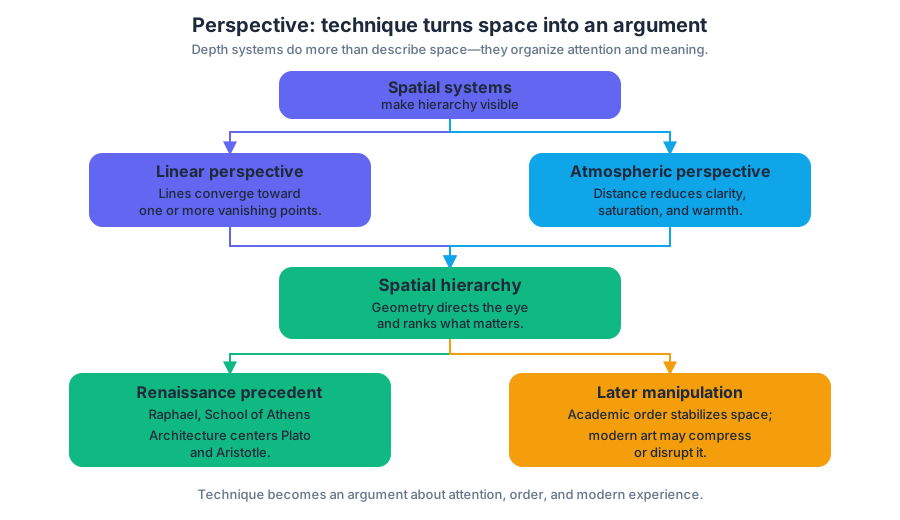
4.4 Theories and Interpretations of Later European and American Art
Key concepts: Theories and interpretations of later European and American art · Visual analysis as a basis for interpretation · Influence of other disciplines on art-historical interpretations · The role of available technology and evidence · Use of form, style, materials, content, function, and context in interpretation · Interpretations as arguments about individual works or groups of related works · Manipulation, adaptation, and harnessing of interpretations to make art-historical arguments · Art-historically valid interpretations · The relationship between learning objectives and analytical skills · Interactive small-group discussion as a learning strategy
Art-historical interpretation is an evidence-based argument about what a work means, how it functions, and why it matters—not a personal reaction detached from the object.
4.4 Theories and Interpretations of Later European and American Art
Art-historical interpretation is an evidence-based argument about what a work means, how it functions, and why it matters—not a personal reaction detached from the object. The central question is: How do visual analysis, scholarship, technology, and available evidence change what we think a work of art means?
THR-1: Interpretation changes as knowledge changes
The enduring understanding for this topic, THR-1, recognizes that theories and interpretations of art and art making change over time. Interpretations may arise from close looking at a work, but they are also shaped by other disciplines, available technology, and the evidence that survives.
Interpretation is a reasoned claim about a work or group of related works, supported by observable features and relevant contextual evidence.
A work does not change when a new interpretation appears; the questions asked of it change. For example, a painting once discussed mainly as a formal arrangement of color may later be examined through feminist history, psychology, anthropology, environmental studies, economics, or studies of colonialism. Each discipline can reveal relationships that a purely visual description cannot explain by itself.
Visual analysis and scholarship work together
Visual analysis begins with what can be observed: form, style, scale, composition, color, line, spatial organization, materials, content, and condition. Scholarship then connects those observations to historical circumstances, artistic traditions, patronage, audience, function, reception, and meaning. Neither method replaces the other.
Consider Frank Lloyd Wright’s Fallingwater. Its projecting terraces appear to extend dramatically over the stream. Visual and material analysis identifies the structural principle of cantilevering, in which a horizontal element projects outward while being supported primarily at one end. That observation can support an interpretation of the house as an attempt to make architecture appear integrated with, rather than merely placed beside, the natural landscape.
The argument becomes stronger when the evidence is connected precisely:
- Observation: The terraces project horizontally beyond their supports.
- Formal effect: The house seems to float above the waterfall.
- Material evidence: Reinforced concrete made those extended projections possible.
- Context: Wright designed the house in a setting where the relationship between dwelling and landscape was central.
- Interpretation: The structure’s visual drama and engineering express an architectural ideal of organic connection with nature.
The interpretation does not claim that cantilevering automatically proves Wright’s intention. It shows how form and material evidence make a particular claim plausible. This is the work of Suggested Skill 7.B: explaining how an art-historically valid interpretation is derived from analysis of form, style, materials, content, function, context, reception, and/or meaning.
Evidence, technology, and limits
Interpretations depend on evidence, and evidence is never unlimited. Archival documents, inscriptions, photographs, conservation reports, scientific imaging, provenance records, oral histories, and contemporary reviews may confirm, complicate, or challenge an interpretation. Technology can make previously hidden information visible, but it does not eliminate the need for judgment.
For instance, infrared or X-ray imaging may reveal changes beneath a painted surface. Digital mapping may reconstruct an artwork’s original location or circulation. Conservation science may identify pigments or later alterations. These discoveries can shift interpretation by distinguishing an artist’s choices from damage, restoration, or later modification.
A limitation in evidence must remain part of the argument. If no written statement survives, an interpreter should not present an inferred intention as certain. Strong art history distinguishes among what is visible, what is documented, and what is argued from the available evidence.
Evidence supports an interpretation; evidence does not make speculation certain.
Six lenses for interpretation
A useful interpretation often coordinates several kinds of evidence rather than relying on one dramatic feature.
| Lens | Question it asks | Example of evidence |
|---|---|---|
| Form | How is the work organized visually or physically? | Composition, scale, spatial projection |
| Style | What characteristic visual choices connect it to a person, period, or movement? | Distortion, realism, abstraction |
| Materials | How do substances and construction methods affect meaning or appearance? | Reinforced concrete at Fallingwater |
| Content | What figures, objects, events, or symbols are represented? | Subject matter and imagery |
| Function | What was the work intended to do or enable? | Worship, commemoration, habitation, protest |
| Context | What historical, social, political, religious, or cultural conditions surround it? | Patronage, place, identity, conflict |
These lenses can generate different but compatible interpretations. Frida Kahlo’s The Two Fridas, for example, can be interpreted through its doubled figure, exposed hearts, connected blood vessels, clothing, and stormy setting. Those visual facts can support arguments about divided identity, personal and cultural belonging, or the tensions between distinct social selves—but each claim must be tied to specific evidence rather than reduced to “the artist felt sad.”
Interpretations as arguments
Interpretations may be used, adapted, or even manipulated to make an art-historical argument. A museum label, exhibition, political movement, or scholar may emphasize one aspect of a work while minimizing another. Interpretations therefore need to be tested for scope, evidence, and assumptions.
Use 6.A and 6.B when justifying an interpretation or claim with appropriate evidence. Then use 8.A, 8.B, and 8.C to build the argument:
- 8.A — Articulate a defensible claim about one work or a related group.
- 8.B — Using specific and relevant evidence, support a claim about the work or group.
- 8.C — Explain how the evidence justifies the claim.
For the required works The Two Fridas, Narcissus Garden, and Spiral Jetty, avoid merely naming a theory. Instead, state a claim, identify visible or documented evidence, and explain the connection. A defensible response might argue that Spiral Jetty transforms landscape into an active artistic medium because its enormous spiral form, remote location, earth-and-rock construction, and changing relationship to water make environmental conditions part of the work’s meaning.
Misconception check — “Any interpretation is equally valid.”
Interpretations can differ, but they are not equally supported. A persuasive interpretation must account for the work’s visual properties and use relevant contextual evidence. Personal associations may begin inquiry; they become art-historical arguments only when evidence and reasoning connect them to the object.
Retrieval check: If a new scientific scan revealed that part of a sculpture had been restored, which interpretive lenses might change first, and why? A strong answer names the evidence, identifies the affected lens—such as materials, function, or reception—and explains how the new information revises, rather than merely decorates, the interpretation.
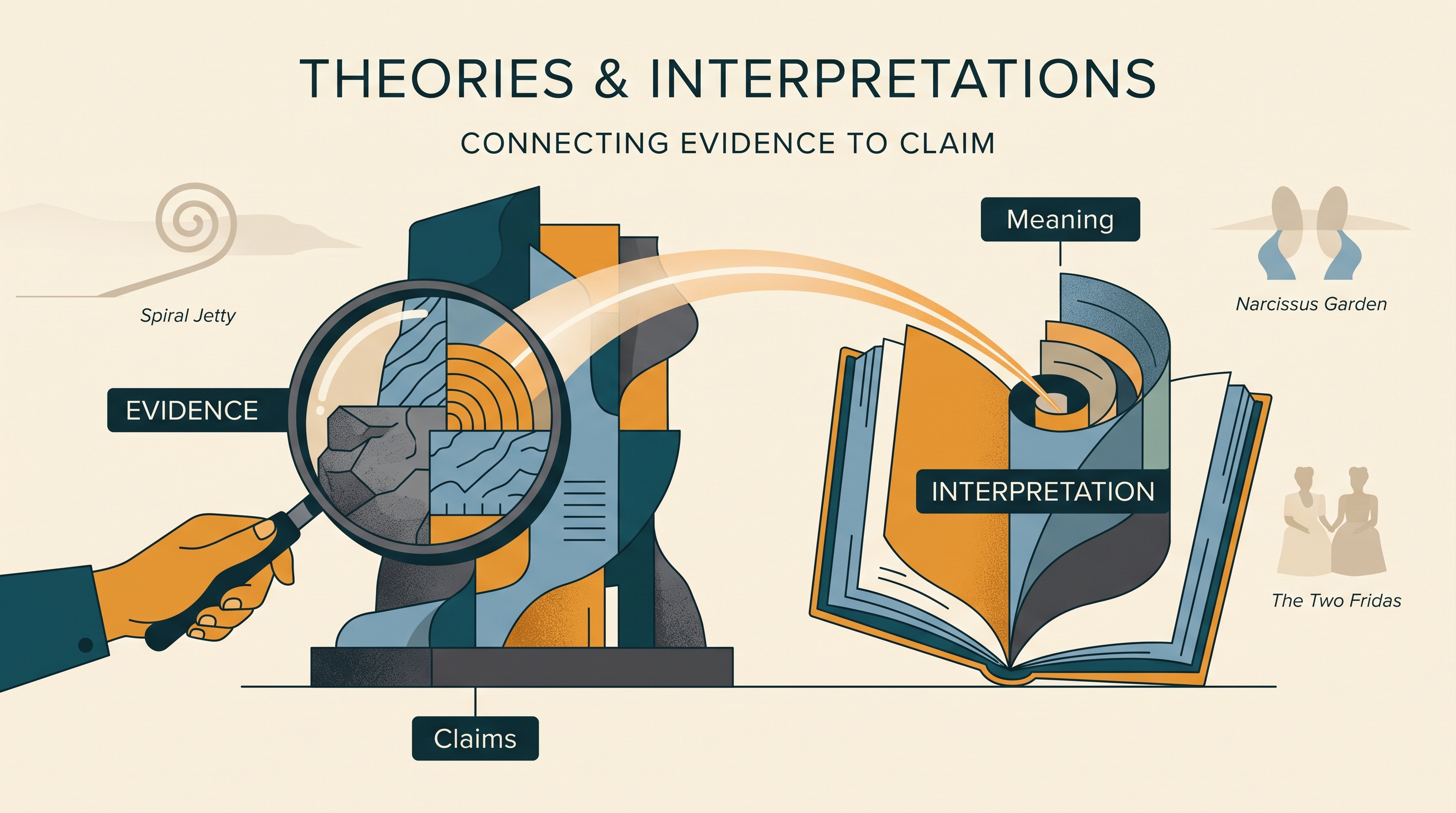
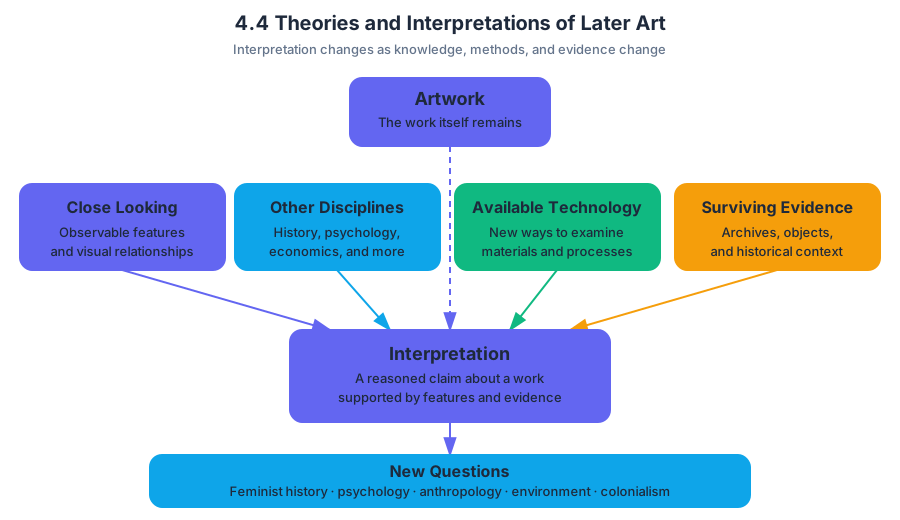
5.1 Interactions Within and Across Cultures in Indigenous American Art
Key concepts: Cultural interaction and its influence on art and art making · Factors motivating interaction between cultures, including travel, trade, war, conquest, and colonization · Artistic influence through practices such as spolia and appropriation · The relationship between cultural practices, belief systems, physical setting, and artistic decisions · Geographic and chronological distinctions between Ancient America and Native North America · Regional groupings of Native North American cultures, including the Arctic, Northwest Coast, Southwest, Plains, and Eastern Woodlands · Shared Indigenous American ideas of harmony with nature · Continuity of Indigenous cultures and the limitations of non-Indigenous terminology · The relationship between artistic expression and intellectual pursuits such as astronomy, poetry, song, dance, and medicine · Artistic production through workshops, apprentice-master relationships, and gender specialization
Ancient America refers to art created before $1550$ CE south of the current United States–Mexico border, while Native North American art refers to Indigenous traditions north of that border from ancient times to the present.
5.1 Interactions Within and Across Cultures in Indigenous American Art
Ancient America refers to art created before $1550$ CE south of the current United States–Mexico border, while Native North American art refers to Indigenous traditions north of that border from ancient times to the present. These labels are geographic and historical conveniences—not names that all Indigenous peoples used for themselves.
The central question is: How do relationships among cultures change what artists make, where they make it, and how people encounter it? Cultural interaction can arise through travel, trade, war, conquest, and colonization. It can influence subject matter, visual styles, ritual use, artistic labor, and the placement or display of works.
A geographic vocabulary for Indigenous American art
Native North American cultures are often grouped into broad regional areas, including the Arctic, Northwest Coast, Southwest, Plains, and Eastern Woodlands. These groupings help organize comparison, but they should not be mistaken for single cultures: each region contains many distinct peoples, nations, languages, histories, and artistic traditions.
| Geographic term | What it helps you track |
|---|---|
| Ancient America | Art made before $1550$ CE south of the present United States–Mexico border |
| Native North America | Indigenous art traditions north of that border, from ancient times to the present |
| Regional grouping | Broad comparison among Arctic, Northwest Coast, Southwest, Plains, Eastern Woodlands, and other areas |
Many Native American groups share larger ideas such as harmony with nature, oneness with animals, respect for elders, community cohesion, dream guidance, shamanic leadership, and participation in large rituals. These broad similarities do not erase cultural difference; instead, they help explain why physical surroundings, social organization, spiritual beliefs, and artistic decisions are often inseparable.
Interaction changes art making
Under INT-1.A and INT-1.A.11, cultural interaction is understood as an exchange—or a struggle—among cultures that can influence art and art making. Under CUL-1.A, the relevant learning objective is: “Explain how cultural practices, belief systems, and/or physical setting affect art and art making.”
The mechanism can be visualized as a chain:
Contact through travel, trade, war, conquest, or colonization
$\downarrow$
Exchange, borrowing, restriction, or resistance
$\downarrow$
Changes in style, subject matter, ritual practice, siting, display, or production
$\downarrow$
A new work carrying both local meaning and evidence of cultural history
Two important forms of artistic influence are spolia, the reuse of material from an earlier or conquered structure in a later work, and appropriation, the adoption or reuse of imagery, forms, or cultural expressions from another culture. Neither term automatically means “simple copying.” The exam-relevant issue is the relationship: who reused what, under what circumstances, and for what purpose?
Worked contextual example: Mesa Verde
The Mesa Verde cliff dwellings demonstrate how physical setting and cultural practice can shape art and architecture. Communities built into sheltered cliff alcoves rather than treating the landscape as an empty backdrop. The setting affected where structures could be placed, how people moved through them, how they were seen, and how communal or ceremonial life related to the surrounding environment.
A strong contextual explanation would connect three kinds of evidence: the physical cliff setting, the social organization required to construct and inhabit the dwellings, and beliefs that could give the landscape spiritual significance. Merely identifying the site is description; explaining how setting and belief produced architectural decisions is Contextual Analysis.
Belief, power, and artistic labor
In many Indigenous American traditions, the more powerful a work is believed to be, the more it is thought to contain and transfer life force and power. This belief changes how an object should be interpreted: its importance may depend less on detached visual appreciation than on ritual activation, handling, performance, or relationship to a community.
Art making could involve workshops, apprentice-master relationships, and specialization by gender, including women’s weaving. These systems show that art is not only the product of an isolated “genius.” Social roles, training, community knowledge, and ritual responsibility can all shape the finished work.
Worked contextual example: Yaxchilán
Yaxchilán, an ancient Maya site, can be approached through interaction among political power, belief, and visual representation. Its art should be interpreted in relation to rulers, ritual authority, dynastic history, and the setting in which images and inscriptions were encountered. A comparison with Mesa Verde must remain precise: both connect art to place and community, but they represent different cultural and historical contexts.
Misconception check
Misconception: “Cultural interaction means one culture replaces another.” Cultural interaction can involve exchange, coercion, resistance, revival, adaptation, or the continued use of older values under new political conditions. Post-contact art may preserve long-standing ideas while also addressing conflict within Indigenous communities and between Indigenous peoples and the governments of the United States and Canada.
Retrieval check: A work shows imagery borrowed after conquest and incorporates fragments from an earlier monument. Identify one possible form of interaction and explain one question an art historian should ask before calling it appropriation. A complete answer names appropriation or spolia and then considers power, purpose, context, and the relationship between the source culture and the later maker.
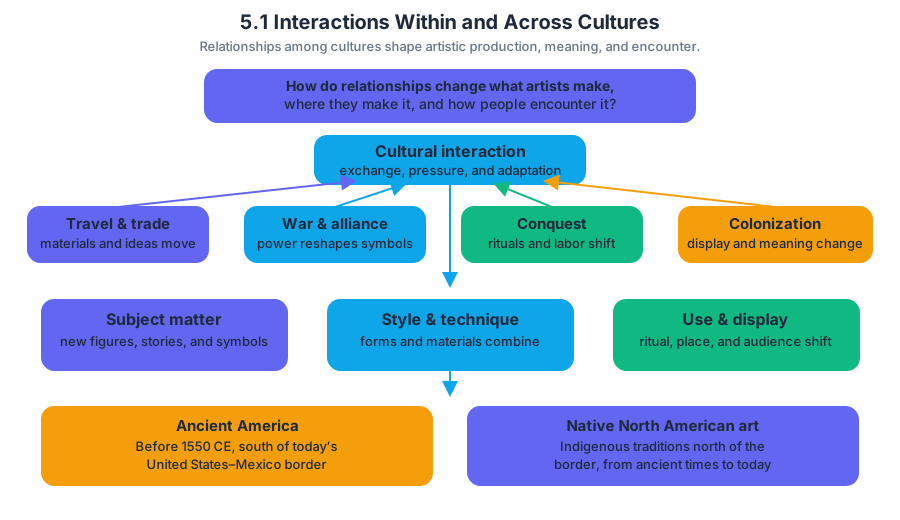
5.2 Materials, Processes, and Techniques in Indigenous American Art
Key concepts: Materials, processes, and techniques vary by location and culture. · Artistic decisions about form, style, materials, content, function, and context shape the creation and meaning of a work of art. · Interpretations of art are derived from analyzing its visual elements and materials, processes, and techniques. · Indigenous American art encompasses cultures across the American continent, from the Arctic to Tierra del Fuego. · Tradition is dynamic rather than static, incorporating introduced materials and subjects over time. · Indigenous peoples used art to maintain cultural identity despite forced assimilation. · Contemporary Native American artists revive ancient techniques while engaging in modern political discourse. · Indigenous American artistic traditions value unity with the natural world and five-direction cosmic geometry: north, south, east, west, and center. · Animal-based media, including featherwork, bone carving, and hide painting, are important in Indigenous American art. · Trade materials, including greenstones such as turquoise and jadeite, were incorporated into Indigenous American art.
A cliff dwelling, a feather headdress, and a black ceramic vessel can all reveal the same art-historical truth: what a work is made from changes what it can do, how it looks, and what viewers understand it to mean.
5.2 Materials, Processes, and Techniques in Indigenous American Art
A cliff dwelling, a feather headdress, and a black ceramic vessel can all reveal the same art-historical truth: what a work is made from changes what it can do, how it looks, and what viewers understand it to mean. Indigenous American art encompasses cultures across the American continent, from the Arctic to Tierra del Fuego, so no single material or technique defines the category.
MPT-1: Art and art making take many different forms both within and across cultures, and materials, processes, and techniques vary by location and culture, with wide-ranging influence on the art generated.
MPT-1.A asks you to explain how materials, processes, and techniques affect art and art making. The key essential knowledge is MPT-1.A.13: Indigenous American artistic traditions often emphasize unity with the natural world, a five-direction cosmic geometry—north, south, east, west, and center—visionary shamanism, animal-based media, trade materials, the essential character of subjects rather than literal appearance, and strong functional utility.
Material is not the same as style, subject, or function
A material is the substance used to make an object: sandstone, feathers, gold, clay, bone, hide, turquoise, cloth, or beads. A process is the major way the material is transformed—carving, weaving, modeling, painting, firing, or assembling. A technique is the specific method used within that process, such as layering feathers, burnishing a clay surface, or applying paint to hide.
These choices must be distinguished from other artistic decisions. Form is the object’s shape and structure; style is its characteristic visual language; content is its subject or idea; function is what it does; and context is the cultural, historical, geographic, and social situation in which it was made and used. A material does not automatically determine meaning: the same cloth can become clothing, a ritual object, or a political statement depending on form, style, content, function, and context.
Worked example — Mesa Verde cliff dwellings: Ancestral Puebloan builders constructed the Mesa Verde cliff dwellings in Montezuma County, Colorado, between $450$ and $1300$ CE, using sandstone in natural cliff alcoves. The sandstone and masonry process made permanent, protective architecture possible; the alcove shaped the settlement’s form and offered shelter. Its context—an Ancestral Puebloan community in a particular landscape—helps interpret the work as more than a picturesque building: location, construction, and use are inseparable from its meaning.
Now separate the decisions. Material: sandstone. Process: constructing masonry walls within existing alcoves. Form: clustered rooms integrated into the cliff. Style: the visual effect of geometric, built forms against the natural rock. Content: a community’s relationship to place and built environment. Function: habitation and communal activity. Context: Ancestral Puebloan life in Colorado during $450$–$1300$ CE. A strong answer explains how these factors work together rather than claiming that “sandstone symbolizes protection” without evidence.
Animal media and status materials
Animal-based media carried both physical and cultural significance. Featherwork, bone carving, and hide painting made the animal world materially present in art; they could express relationships among humans, animals, spirituality, and power. In traditions connected to visionary shamanism, animal materials could support ideas about transformation or access to spiritual knowledge, although interpretation must remain grounded in the particular object and culture.
The Ruler’s feather headdress demonstrates how material, technique, status, and interpretation converge. Quetzal feathers, cotinga feathers, and gold were difficult to obtain and associated with preciousness and high status. The visual richness results from the materials and their arrangement, while the object’s form and context as regalia communicate rank; the feathers are not merely decorative color.
Trade materials also expanded artistic possibilities. Greenstones such as turquoise and jadeite, shells such as spiny oyster, and—particularly in Native North America—imported beads, machine-made cloth, and glazes entered Indigenous artistic traditions through exchange. Their presence can provide evidence of trade networks, but it does not make a work “less Indigenous.” Tradition is dynamic rather than static: communities adapt introduced materials and subjects, including beads, cloth, and horses, into continuing cultural practices.
Identity, adaptation, and contemporary practice
Art also helped Indigenous peoples sustain cultural identity despite forced assimilation. Maintaining designs, objects, techniques, and knowledge could preserve community memory when outside institutions attempted to suppress Indigenous languages, religions, dress, and social practices. The continued use of a technique is therefore not automatically evidence of an unchanged past; it may be an active response to historical pressure.
Contemporary Native American artists make this continuity visible in two directions at once. Some revive ancient crafts, such as Puebloan pottery, while others use contemporary materials, imagery, and exhibition practices to address modern political issues including racism. Their work demonstrates that cultural identity is not frozen in an earlier period: ancient processes can be recovered, modified, and used to speak about the present.
Misconception check
Misconception: “The material tells us the entire meaning.” Correction: material is evidence, not a complete interpretation. To earn a defensible explanation, connect the material or technique to visible form, style, content, function, and context. For example, gold in the Ruler’s feather headdress supports an interpretation of high status because its preciousness works together with the headdress’s form, feather arrangement, and elite context.
AP skill connection and retrieval check
This topic most directly develops Skill 5.A: Describe visual elements of a work of art beyond the image set and Skill 5.B: Explain how artistic decisions shape a work of art beyond the image set. In practice, describe the evidence first, then explain its consequence: “The work uses sandstone masonry in a natural alcove” becomes stronger when followed by “that construction integrates habitation with the landscape and shapes interpretation of community and place.”
Retrieval check: Choose one example—Mesa Verde, the Ruler’s feather headdress, or a Puebloan ceramic tradition. Name its material, process, form, function, and context. Then complete this sentence: “Because the artist or maker chose ___ rather than ___, the work’s appearance and interpretation are affected by ___.”
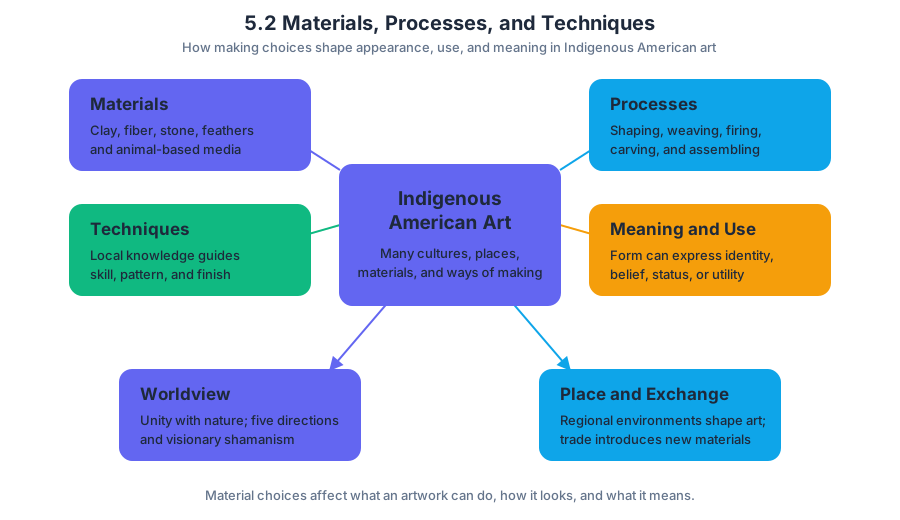
5.3 Purpose and Audience in Indigenous American Art
Key concepts: Purpose and audience in Indigenous American art · Reciprocity and cyclicality rather than individualism · Interaction with challenging environments · Reverence for animal and plant worlds · Shamanistic religion and spiritual practice · Community-centered art making and performance · Gender-based specialization in artistic labor · Patronage by tribal leaders, elders, or family members · Restricted sacred or political audiences · Cultural practices, beliefs, and settings as essential context
Indigenous American art often functioned less like a picture hung for private viewing and more like a participant in a social, religious, or political event.
5.3 Purpose and Audience in Indigenous American Art
Indigenous American art often functioned less like a picture hung for private viewing and more like a participant in a social, religious, or political event. Its purpose and audience emerge from geography, cultural practice, belief systems, environmental pressures, and relationships among community members.
Learning Objective PAA-1.A: Explain how purpose, intended audience, or patron affect art and art making.
The key question is not simply “What does this object look like?” but “What was it meant to do, for whom, and under whose authority?” A textile, sculpture, costume, or performance may communicate status, channel spiritual power, mark a communal identity, or mediate a relationship with animals, plants, ancestors, and supernatural forces.
Purpose is cultural, not automatically aesthetic
In many Indigenous American contexts, art was created for active use rather than passive appreciation. An artwork could be worn, carried, performed, activated in a ritual, exchanged, or encountered only by people with the appropriate religious or political standing.
This idea connects to PAA-1.A.14, which emphasizes that art may be understood as containing or transferring life force. The object’s significance therefore depends on what happens with it. A ceremonial object removed from its ritual setting may still be visually impressive, but its original purpose cannot be reconstructed from appearance alone.
Environment, reciprocity, and cyclicality
Indigenous American art reflects interaction with particular environments, including the demanding landscapes of Mesoamerica and the Central Andes. CUL-1.A.28 identifies Central Andean cultural similarities such as survival in challenging environments, reciprocal and cyclical relationships with nature rather than individualism, and reverence for animal and plant worlds within shamanistic religious practice.
Reciprocity means a relationship based on mutual exchange: humans depend on the natural world, but humans also have obligations toward it. Cyclicality describes time and existence as recurring processes rather than a one-way progression. Art could therefore support ceremonies intended to renew balance, honor life-giving forces, or acknowledge the continuing power of ancestors and nonhuman beings.
Animal and plant imagery should not automatically be treated as decoration. Within shamanistic religious practice, animals and plants may be revered as powerful beings or as sources of transformation. Mesoamerican art could also depict shamanic transformation, visions, and cosmic realms even when its style remained naturalistic and figural, as noted in CUL-1.A.27.
Community-centered making
Art making frequently occurred through community relationships rather than through the modern idea of the isolated individual artist. Several people might contribute labor, knowledge, ritual authority, or performance. Gender specialization could appear in particular communities—for example, women weaving and men carving—although such patterns describe social organization, not a universal rule for every Indigenous American society.
Patrons could include tribal leaders, elders, or family members. The patron is the person or group that commissions, supports, owns, or authorizes the work. The audience was often the entire community or cultural group, especially when the work participated in a communal ceremony, but some objects and performances had restricted audiences because of their sacred or political nature.
Worked contextual example
Imagine an Andean ceremonial object used during a community performance connected to a difficult mountain environment. Its purpose might be to acknowledge the powers sustaining the community, reinforce reciprocal obligations to the natural world, and make visible the group’s shared identity. The likely audience would be the participating community, while a leader or elder might serve as patron or authorize its use.
Now add a restriction: if the object could be seen only by initiated religious specialists, its audience would not be “everyone,” even if the broader community benefited from the ceremony. The correct interpretation must distinguish public social function from restricted ritual access.
An AP-quality explanation might read: The object’s purpose was shaped by a reciprocal religious relationship with the environment, while its audience was determined by the community’s ritual structure. Its restricted visibility suggests that spiritual or political authority, rather than individual artistic expression, controlled how and by whom it could be encountered. The reasoning links visual or functional evidence to context instead of merely naming a belief.
Misconception check
Misconception: “Indigenous American art was made for the whole community, so every object was publicly accessible.” Correction: community-centered art often served the group, but sacred or political objects and performances could have restricted audiences. Always ask whether the intended audience was communal, elite, familial, initiated, or supernatural.
Misconception: “If an object is beautiful, its main purpose was aesthetic.” Correction: visual appeal may support ritual, political, social, or spiritual purposes. Function and belief determine meaning more reliably than modern museum display.
Skill focus: 2.B
Skill 2.B: Explain how purpose, intended audience, or patron affect art and art making. To apply it, build a chain:
- Identify the object’s likely function or setting.
- Name the relevant patron, such as a leader, elder, or family member.
- Identify the intended audience and any access restrictions.
- Connect those factors to artistic choices, communal labor, ritual performance, or subject matter.
- Support the explanation with cultural and religious context.
Retrieval check: Why would identifying an audience as “the entire community” be incomplete if an object was used by religious specialists? Answer in one sentence: the community may have been the broader beneficiary, but sacred or political rules could restrict who directly saw, handled, or performed with the object.
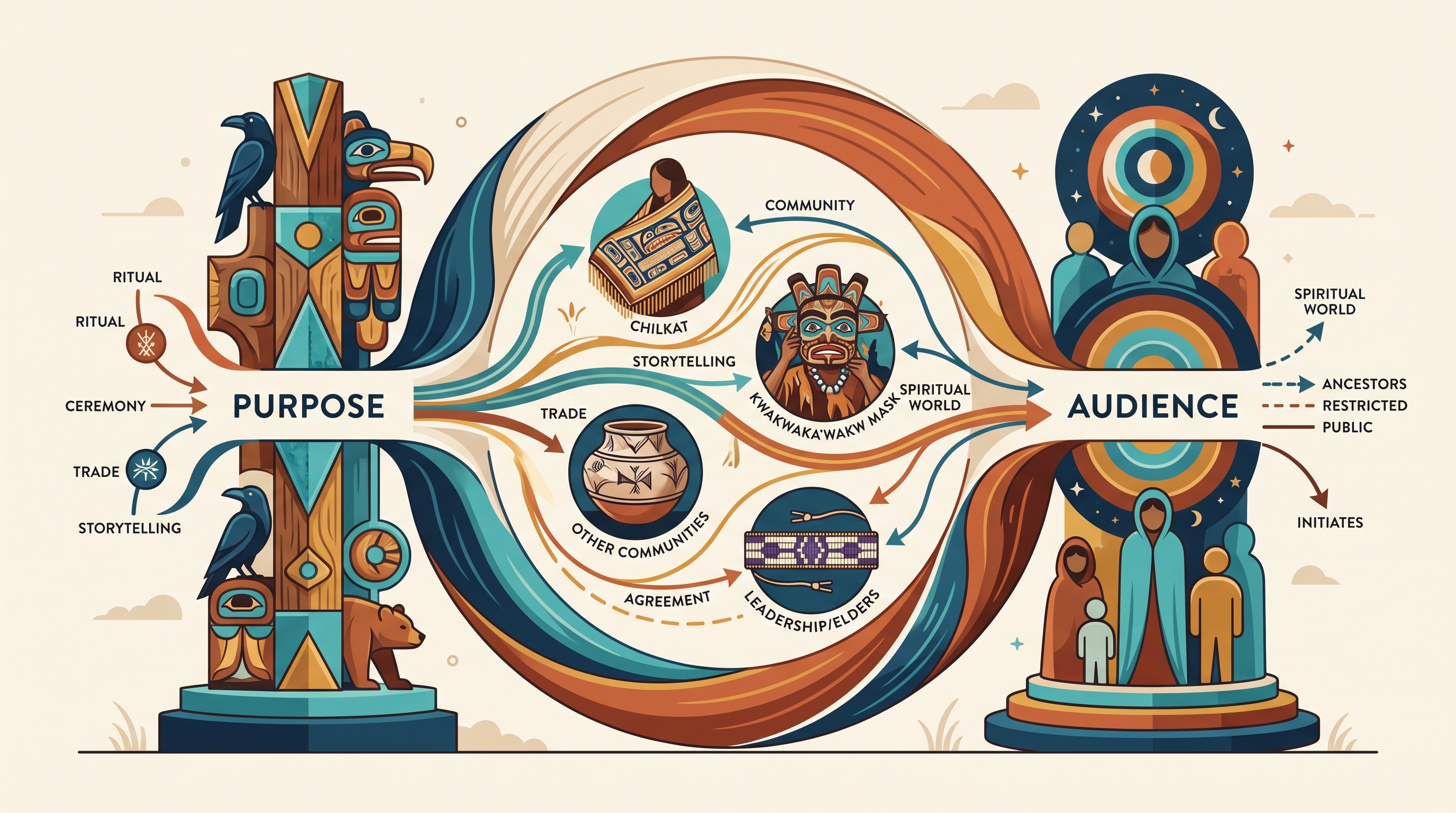
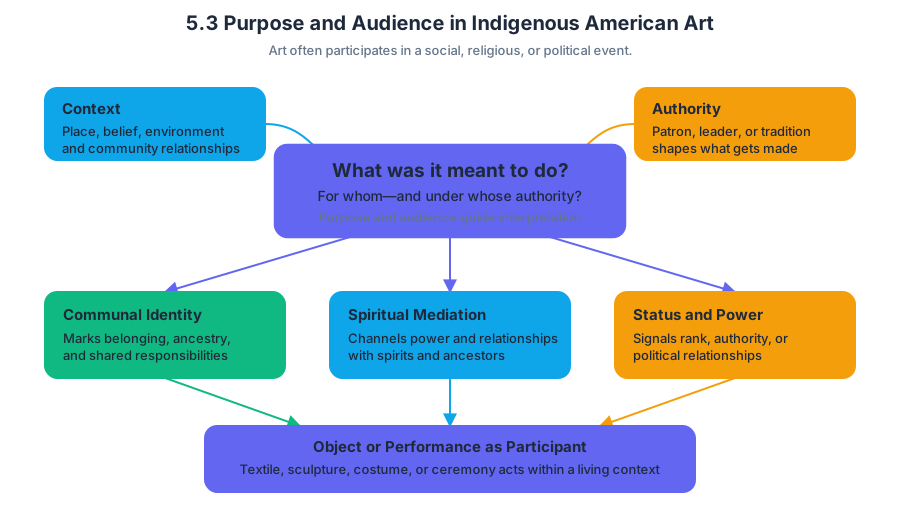
5.4 Theories and Interpretations of Indigenous American Art
Key concepts: Theories and interpretations of Indigenous American art · Pattern identification in art-historical analysis · Transformational animal-human iconography · Ethnographic approaches · Shamanic interpretations of iconography · Cross-cultural analysis · Archaeological, written, oral, and scientific evidence · Changing interpretations through new evidence and interdisciplinary research · Persecution, genocide, and marginalization in Indigenous American history · Contemporary Indigenous identity and artistic expression
Indigenous American art often preserves ideas that cannot be recovered from written records alone, so interpretation begins with a difficult question: How can scholars explain an image when its original makers left no written explanation of it?
5.4 Theories and Interpretations of Indigenous American Art
Indigenous American art often preserves ideas that cannot be recovered from written records alone, so interpretation begins with a difficult question: How can scholars explain an image when its original makers left no written explanation of it? The answer is not to guess from appearance, but to build, test, and revise interpretations from multiple kinds of evidence.
THR-1 states that art history is shaped by changing theories and interpretations derived from visual analysis and diverse scholarly disciplines. The learning objective THR-1.A asks students to explain how interpretations are shaped by visual analysis, other disciplines, technology, and the availability of evidence. For Topic 5.4, the associated Suggested Skill 7.B: Explain how evidence supports interpretations of works of art is the central reasoning process.
From visual pattern to historical hypothesis
A pattern is a recurring visual feature identified across multiple works. For example, art historians may notice a prevalence of transformational animal-human iconography: figures that combine human and animal characteristics or appear to change between those states. Identifying the pattern is visual analysis; explaining what the pattern may have meant requires contextual and interdisciplinary evidence.
A useful interpretive sequence is:
- Identify a recurring form: What features repeatedly appear?
- Compare examples: Does the pattern occur across one site, region, period, or several cultures?
- Propose a hypothesis: What belief or practice might explain the recurrence?
- Test the hypothesis against archaeological, historical, oral, and scientific evidence.
- Revise or reject it if conflicting evidence appears.
This sequence prevents a common error: treating visual resemblance as proof of identical meaning. A repeated animal-human form may suggest a shared concern with transformation, but it does not automatically establish a single universal religion or artistic purpose.
Ethnography and the shamanic hypothesis
Ethnographic approaches use the study of living or historically documented communities to develop hypotheses about cultural practices and meanings. Applied carefully, ethnography can help scholars ask whether transformational imagery relates to ritual specialists, altered states of consciousness, healing, or communication with supernatural forces.
One proposed interpretation is that certain animal-human iconography may be shamanic in nature. Here, “shamanic” functions as a hypothesis about ritual transformation or visionary experience—not as a label that automatically explains every ambiguous image. The interpretation becomes stronger only when visual evidence aligns with independent evidence about ritual practice, belief, place, or material use.
Key distinction: A shamanic interpretation is an evidence-based proposal, not a certainty produced by the presence of an animal-human figure.
Worked example — Chavín de Huántar: A scholar could begin by identifying hybrid or transformational imagery at the site, then examine its placement, archaeological context, associated objects, and evidence for ceremonial activity. If those forms occur in spaces connected with ritual performance, an interpretation involving transformation or visionary practice may become plausible; if other evidence contradicts that reading, the theory must be refined or abandoned.
Evidence is a network, not a single clue
Interpretations of Indigenous American art should draw on several evidence types:
| Evidence | What it can contribute |
|---|---|
| Archaeological data | Site placement, objects, chronology, and patterns of use |
| Written records | Observations, descriptions, and historical changes, when available |
| Oral histories | Community-held accounts, meanings, and cultural memory |
| Scientific fields such as botany | Evidence about plants, medicines, foodways, or ritual substances |
| Visual analysis | Form, imagery, composition, scale, and recurring motifs |
These forms of evidence can be diverse and sometimes conflicting. A written account may reflect a colonizer’s assumptions; an archaeological discovery may challenge an earlier interpretation; botanical evidence may alter what scholars understand about ritual or subsistence. Consequently, theories can change as new evidence and cross-disciplinary research become available.
Cross-cultural comparison: useful, but limited
Cross-cultural analysis compares works or practices from different societies to identify broader patterns. Rock and cave expressions from South African, Asian, and Indigenous American peoples, for instance, can be compared as evidence of a wider visionary aesthetic. The comparison may establish a general similarity in human artistic behavior without proving that the cultures shared the same beliefs.
Misconception check — “same image, same meaning”: Similar imagery does not guarantee cultural contact or identical interpretation. Cross-cultural comparison is strongest when it distinguishes visual resemblance from demonstrated historical connection and explains both similarities and differences.
Colonial violence and interpretation
Interpretation must also account for historical conditions that shaped which artworks survived, how they were recorded, and how Indigenous peoples are represented today. Persecution, genocide, and marginalization have shaped the current identity and artistic expression of Amerindian survivors; these forces also affected the evidence available to scholars and the categories outsiders used to describe Indigenous art.
Great Serpent Mound demonstrates why interpretation requires more than visual description. Its massive serpentine form invites pattern recognition, but archaeological context, Indigenous histories, changing scholarly theories, and the effects of colonial marginalization all influence what claims can responsibly be made about its meaning.
Retrieval check
A scholar sees recurring animal-human imagery and proposes a shamanic interpretation. What would Suggested Skill 7.B require next? The strongest answer is: identify the visual evidence, connect it to archaeological, oral, written, or scientific evidence, acknowledge uncertainty, and explain how confirming or conflicting evidence could change the interpretation.
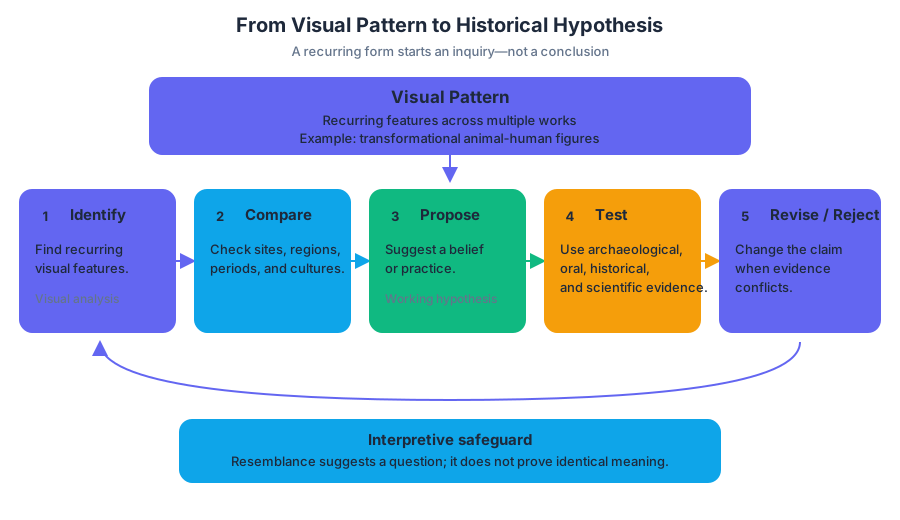
6.1 Course placement
Key concepts: textual evidence · cultural values and beliefs · cultural context · point value · acceptable responses · Mayan culture · glyphs
A work of art can reinforce cultural values not only through its subject matter, but also through its inscriptions, ritual setting, materials, and portrayal of social rank.
6.1 Course placement
A work of art can reinforce cultural values not only through its subject matter, but also through its inscriptions, ritual setting, materials, and portrayal of social rank. In an attribution-style response, the key question is precise: How does one visible feature of the work support a belief or value held by the culture that created it?
This task belongs to the art-historical reasoning process of connecting visual evidence—what can be seen in the work—to cultural context—the beliefs, social structures, rituals, and historical circumstances that shaped its creation. The response earns 1 point when it explains one way the work may have reinforced the values or beliefs of the culture in which it was made.
Point-value rule: This sub-part is worth 1 point. One clearly explained cultural connection is enough; several unsupported possibilities do not earn more credit.
The required cultural context here is the Mayan culture, also called the Maya. An acceptable response must identify a feature of the work and explain how that feature could have supported Mayan ideas about rulership, religion, ritual authority, social hierarchy, or the relationship between humans, ancestors, and the divine.
From what you see to what you can argue
A strong response follows a short evidence chain:
- Name the visual evidence. Identify a glyph, inscription, ruler, ritual action, garment, jewelry, carving technique, or architectural placement.
- Identify the cultural value or belief. Connect that feature to Mayan ideas about royal authority, religious obligation, ancestry, elite status, or ritual order.
- Explain the reinforcement. State how seeing, reading, or encountering the work would make that value appear legitimate, important, or powerful.
The third step is the one students most often omit. Merely writing “the sculpture shows Mayan religion” identifies a topic but does not explain how the artwork reinforced a belief. The response must show the mechanism: the image, inscription, or setting presents a cultural idea in a form that confirms it for an audience.
Worked contextual example: glyphs and royal authority
Imagine that the work includes carved glyphs identifying a ruler or recording an event associated with the ruler. A complete one-point response might read:
The glyphs reinforce Mayan beliefs about legitimate rulership because they identify the ruler and preserve information about the ruler’s authority. By placing the ruler’s name or accomplishments on a durable monument, the work presents royal power as publicly recognized and worthy of remembrance.
This answer succeeds because it uses textual evidence—the glyphs or inscriptions—and explains its cultural significance. The glyphs do not merely decorate the surface: they communicate information about a ruler, making political authority visible and permanent.
Other evidence can produce the same point when the explanation is specific. A ruler shown in contact with ancestors or deities may reinforce the belief that royal power is connected to the divine. A scene of bloodletting may emphasize the ruler’s responsibility to perform religious ceremonies. Detailed jewelry and garments may communicate elite wealth and status, while highly skilled carving may demonstrate that a ruler possessed the resources to commission exceptional art.
Placement, audience, and ritual meaning
The location of the work can also function as evidence. If a sculpture was placed in a temple, its setting may have emphasized a royal relationship with the gods. An inscription explaining when a ritual occurred could reinforce the ruler’s right to reign by linking political authority to sacred timing and religious responsibility.
An elite female figure participating in a ritual may reinforce the importance of women within Mayan political or religious life. The safest response does not assume that every represented person held identical power; instead, it explains what the figure’s ritual participation suggests about gender, status, and religious roles in the culture.
Common misconception check
Misconception: “I earn the point by naming a Mayan belief.” Not by itself. “The Maya believed in gods” is too general, and “the work is religious” is only description. To earn the point, attach the belief to a visible or textual feature and explain its effect: the ruler’s ritual action presents royal authority as necessary for maintaining communication with the divine.
Misconception: “I need to explain every possible meaning.” The criterion asks for one way the work may have reinforced cultural values or beliefs. A focused claim supported by one precise feature is stronger than a list of vague interpretations.
Retrieval check
Suppose a Mayan work shows an elaborately dressed ruler beside carved glyphs. Which response is stronger, and why?
- A: “The work shows that the Maya had powerful rulers.”
- B: “The ruler’s elaborate garments communicate elite status, while the glyphs preserve information about the ruler; together, these features present social hierarchy and royal authority as culturally important.”
Answer: B. It identifies textual and visual evidence, connects that evidence to Mayan values, and explains how the work reinforced those values.
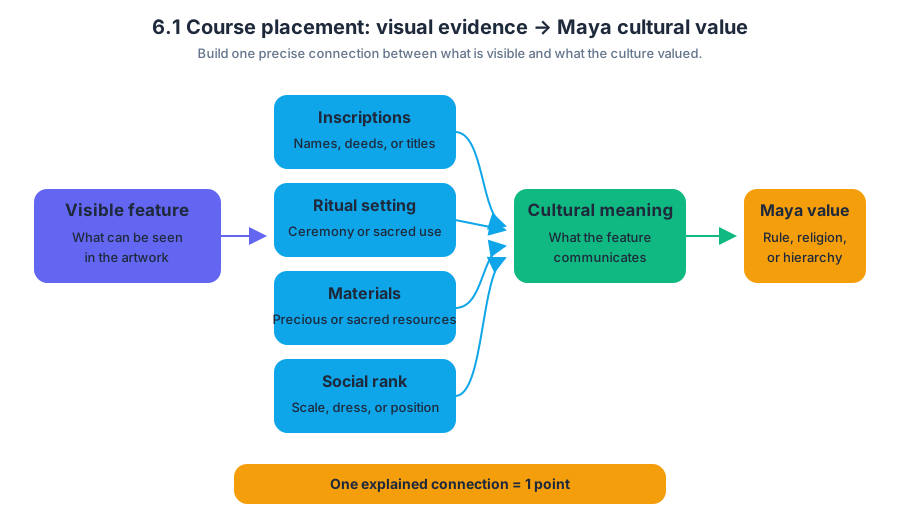
6.2 6.1 Cultural Contexts of African Art
Key concepts: Cultural practices, belief systems, and physical setting affect art and art making · African art’s connections to family, community, and shared ancestors · Art as a marker of personal identity and social status · Common ancestors, leadership, and social order · Education, adulthood, and civic responsibility in African societies · Performance, costumes, and the social use of art objects · Custodianship and inheritance of commissioned art objects · Power and authority represented through art · Nkisi n’kondi power figures · Pwo masks and Ikenga shrine figures
Human life is understood to have begun in Africa, and African art repeatedly connects individual identity to family, community, ancestors, leadership, and place. The central question is not simply What does this object look like?
6.2 6.1 Cultural Contexts of African Art
Human life is understood to have begun in Africa, and African art repeatedly connects individual identity to family, community, ancestors, leadership, and place. The central question is not simply What does this object look like? but What cultural work does it perform?
CUL-1.A: Explain how cultural practices, belief systems, and/or physical setting affect art and art making.
A cultural map for African art
Culture includes shared practices, beliefs, social structures, and ways of understanding the world. In African art, those forces shape both the object and the circumstances in which it is made, owned, worn, performed, remembered, or interpreted.
| Cultural factor | Effect on art making | Useful question |
|---|---|---|
| Shared ancestors | Links families, leaders, and communities across generations | Whose authority or memory does the object preserve? |
| Social status | Marks rank, identity, achievement, or civic role | Who may wear, commission, or possess it? |
| Life-cycle practices | Supports education, adulthood, initiation, and responsibility | What transition or role does the work represent? |
| Belief systems | Gives objects spiritual, protective, or ancestral efficacy | Is the object meant to be viewed, activated, or consulted? |
| Physical setting | Supplies materials and influences settlement, architecture, and imagery | How do climate, animals, agriculture, or trade shape the work? |
From place to image: the physical setting
Human life developed over millions of years in Africa and later radiated beyond the continent. The earliest African art dates to approximately $77{,}000$ years ago. Early artistic expression appears in the rock art of the Sahara and southern Africa, where artists depicted regional animals and human pursuits such as herding and combat.
This is a direct example of physical setting affecting art making: the animals represented are connected to local environments, while the scenes record activities important to human survival and social organization. The relationship is not mechanical—artists do not merely copy what they see—but environmental knowledge supplies subjects through which communities express experience and identity.
African urbanization also produced monumental architecture shaped by agriculture, herding, seasonal climatic shifts, and the organization of administrative or liturgical life. Meroë, Timbuktu, Zimbabwe, Igbo Ukwu, and Kilwa Kisiwani demonstrate that African art histories include urban planning, religious architecture, political structures, and long-distance cultural connections—not only portable objects.
Art, ancestry, and social order
Common ancestors link people to families and communities. They can also legitimize leaders, sanction social behavior and choices, and define the order of social life. Consequently, an African art object may function simultaneously as an image, a social instrument, and a visible claim about authority.
Personal identity means how a person or group is socially recognized; social status means a position or rank within a community. Both can be expressed through aesthetic choices—materials, hairstyle, clothing, bodily presentation, scale, pattern, or the right to use a particular object.
Consider the Ikenga shrine figure. Its association with personal achievement and masculine identity makes it more than a generalized human sculpture: it participates in a system in which accomplishment, responsibility, and spiritual support are made visible. A veranda post, by contrast, can connect architectural space with social presence, status, and the people or institution represented in that setting.
Performance makes the object active
Many African art objects are not designed for isolated, silent viewing. Their meaning emerges through use and efficacy—what they are believed to accomplish in ritual, social, or political life. Performances may include movement, music, speech, bodily display, and costumes.
The Nkisi n’kondi power figure is a useful example of an object whose significance depends on activation and belief, not only on its carved form. The Female (Pwo) mask and Aka elephant mask likewise make most sense within performance: a mask transforms the wearer, and costume, gesture, and communal setting complete the artistic event.
Education, adulthood, and remembered achievement
Cultural practices may support education, incorporation into adulthood, and civic responsibility. The creation, manipulation, and interpretation of art objects can teach people how to inhabit a role, recognize obligations, and participate in collective life.
Accomplishments may be entrusted to and lauded by historians, bards, and elders. Their spoken, sung, or recited histories preserve social memory, so art and oral tradition work together: an object can embody a history, while specialists explain why that history matters.
Commissioning also determines ownership and responsibility. A commissioned object comes under the custodianship of its commissioner or a member of the commissioner’s family. Custodianship means stewardship rather than simple private possession: the custodian carries obligations to maintain, protect, and correctly transmit the object’s significance.
Worked contextual example
Imagine encountering a mask without knowing its community or performance context. A weak interpretation says, “The mask represents an elephant because it has elephant-like features.” A stronger CUL-1.A analysis proceeds in three steps:
- Observe: Identify the mask’s animal imagery, materials, scale, and visual emphasis.
- Contextualize: Connect the elephant to status, leadership, communal identity, or local belief systems rather than assuming decoration is the sole purpose.
- Explain function: Show how costume and performance could make the object socially effective—transforming a wearer and communicating authority to an audience.
Misconception check — “African art is primarily decorative.” Many works are aesthetically powerful, but decoration alone cannot explain a power figure, shrine figure, mask, or architectural post. Ask who uses the object, during what practice, under whose authority, and with what expected effect.
Retrieval check
A community commissions an object for a leader and uses it during a costumed public performance. Name two cultural factors that could affect its making and explain how each factor would shape the object’s meaning. A complete answer should connect visual or material choices to status, ancestry, civic responsibility, custodianship, belief, or performance—not merely describe the object.
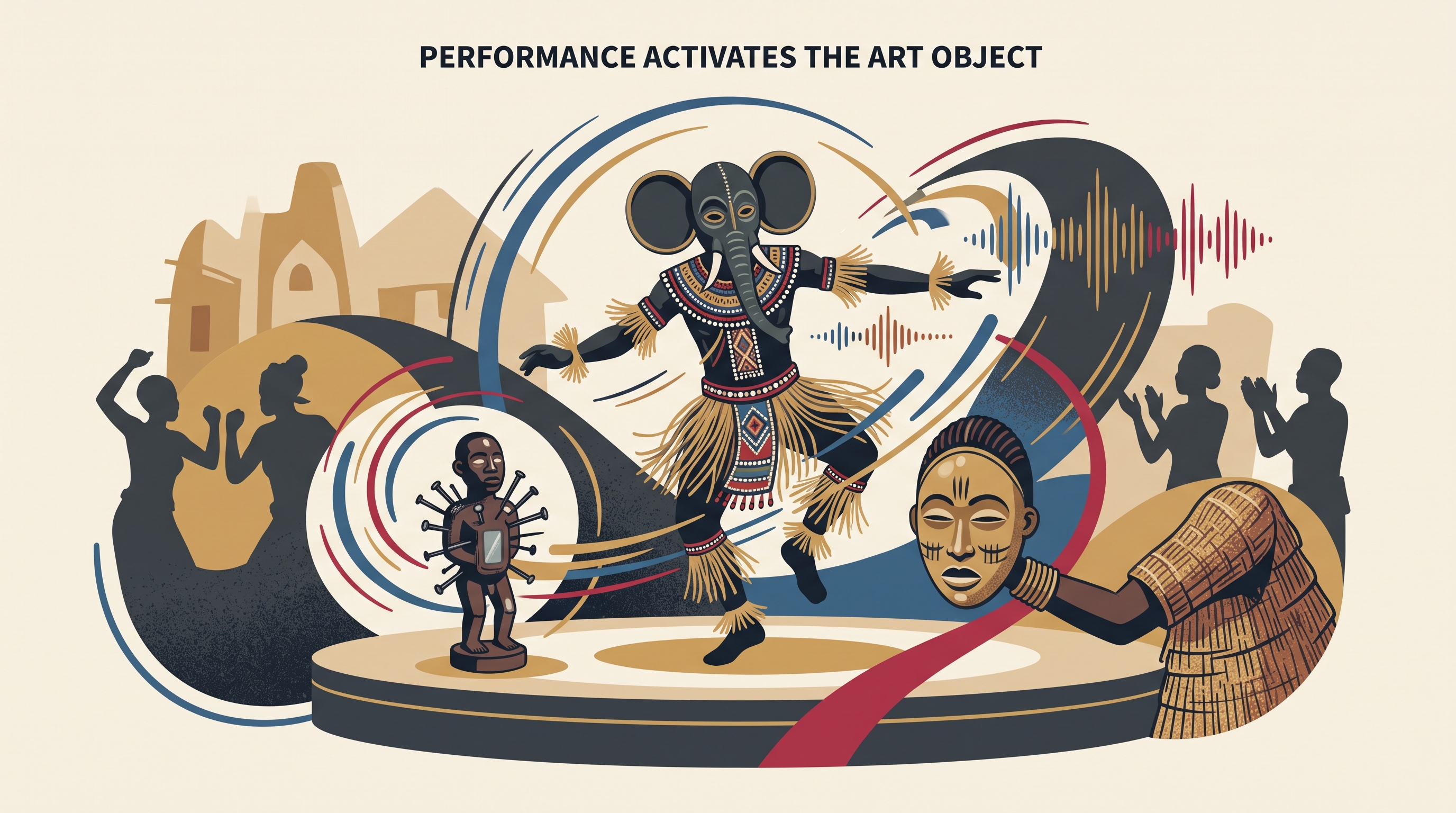
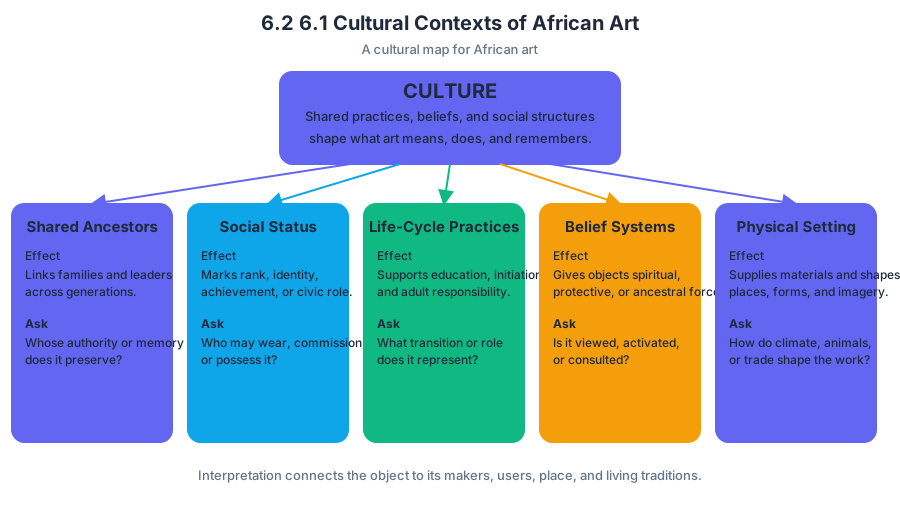
6.4 6.3 Theories and Interpretations of African Art
Key concepts: Theories and interpretations of art change over time · Visual analysis as a basis for interpreting art · The influence of other disciplines, technology, and available evidence on art-historical interpretation · Outsider collection and classification of African art · Uncertain or unrecorded authorship and dates in African art · Art’s role in supporting and validating leadership and status · Art, identity, and social order · Art in rites of passage and life transitions · The performative and holistic nature of African art · The use of historical skills and case studies such as Great Zimbabwe
A stone wall can preserve political power long after the names of its builders disappear. At Great Zimbabwe, monumental dry-stone architecture once led some outsiders to claim that Africans could not have created it; archaeology, historical research, and reconsideration of colonial assumptions later demonstrated…
6.4 6.3 Theories and Interpretations of African Art
A stone wall can preserve political power long after the names of its builders disappear. At Great Zimbabwe, monumental dry-stone architecture once led some outsiders to claim that Africans could not have created it; archaeology, historical research, and reconsideration of colonial assumptions later demonstrated the achievements of local African communities. The example shows why art-historical interpretation is never based on appearance alone.
THR-1: The study of art history is shaped by different theories and interpretations of art and art making that change over time. These interpretations arise through visual analysis and scholarship, which can be affected by other disciplines, available technology, and the availability of evidence.
The key distinction is between visual analysis, the close study of an artwork’s observable features, and scholarship, the research that places those features into historical, cultural, and intellectual contexts. A wall’s construction, scale, materials, and location may suggest labor organization and authority; archaeology, oral histories, trade records, and scientific dating can then test or revise that interpretation.
Why the record of African art is uneven
THR-1.A: Explain how theories and interpretations of works of art are shaped by visual analysis as well as by other disciplines, technology, or the availability of evidence.
THR-1.A.19 is essential because many African art objects were traditionally collected by outsiders. Works with similar forms were often grouped according to place of origin and a designated ethnic group rather than identified through individual artists, workshops, patrons, or precise dates. The artist’s name and the date of creation may therefore be unknown or unacknowledged.
That absence is not neutral. Museum classification systems, colonial collecting practices, and limited documentation helped shape the categories through which African art was understood. A label such as “made by Group X” may communicate a collector’s system more clearly than it communicates the object’s original social identity.
Misconception check — “Unknown artist means unimportant art.” Unknown authorship does not mean that a work lacked an artist, skill, audience, patron, or social purpose. It may instead reflect outsider collecting, the loss of records, oral rather than written transmission, or a tradition in which communal identity mattered more than individual fame.
Missing information also does not prove that the people who commissioned, used, or protected an artwork were uninterested in it. An object can be highly valued while its maker’s name remains unrecorded. In interpretation, absence of evidence is not automatically evidence of absence.
Great Zimbabwe: interpretation changes with evidence
Great Zimbabwe is a useful worked example. Begin with visual evidence: enormous, carefully fitted granite walls; multiple enclosures; elevated and restricted spaces; and substantial labor invested without the use of mortar. These features support an interpretation involving organized authority, social differentiation, and a major center rather than an ordinary settlement.
Next add contextual evidence. Archaeological research connects Great Zimbabwe to local southern African communities and to regional trade networks. Imported materials and evidence of exchange indicate long-distance connections, while the monumental architecture demonstrates that African rulers and builders could mobilize labor, resources, and technical knowledge on a large scale.
Earlier colonial interpretations attributed the site to foreign builders. That interpretation was not simply a visual conclusion; it was shaped by racist assumptions about African history and by the limited use—or dismissal—of local evidence. As archaeology, regional history, and more rigorous scholarship expanded the available evidence, interpretation shifted toward recognizing Great Zimbabwe as an achievement of local African societies.
This is the reasoning chain an exam response should make visible:
- Visual evidence: monumental scale and sophisticated dry-stone construction suggest organized power.
- Contextual evidence: settlement, trade, and regional history locate the monument within African societies.
- Interpretive revision: new evidence and more responsible scholarship challenge the earlier foreign-builder theory.
- Historical conclusion: interpretations change when evidence, methods, and scholarly assumptions change.
Art, status, and social order
African art objects can support and validate leadership and status. Aesthetic choices may define identity and rank, while representations of common ancestors can reinforce shared social norms. In this context, an artwork does not merely depict authority; its materials, scale, access, costume, or ceremonial use can help produce authority.
PAA-1.A.22 connects interpretation to function: African histories were often sung or recited by specialists, and art could be sung, danced, and presented in holistic experiences for designated audiences. Performative means that an artwork is completed through action—movement, sound, speech, ritual, and audience response—not only through detached looking.
Education, incorporation into adulthood, and civic responsibility may be marked by the creation, manipulation, and interpretation of art objects. During rites of passage, art can transmit knowledge, establish new social identities, and validate the authority of elders or specialists. A mask, costume, sculpture, or emblem therefore should not be interpreted as an isolated visual object when its meaning depends on performance.
Misconception check — “The object’s museum appearance is its original meaning.” A museum display may freeze an object in silence and stillness, while its original meaning depended on song, dance, recitation, restricted access, movement, or a specific ceremonial outcome. Interpretation must ask what the object did, for whom, and under what conditions.
The AP reasoning move
Use Skill 1: Visual Analysis to identify formal evidence; Skill 2: Contextual Analysis to connect that evidence to social, political, religious, and historical circumstances; Skill 7: Art Historical Interpretations to explain why scholars have disagreed or changed their conclusions; and Skill 8: Argumentation to turn evidence into a defensible claim. A strong response does not merely say that an interpretation changed—it names the evidence or disciplinary development that caused the change.
Retrieval check: Why might Great Zimbabwe’s interpretation change even though the walls themselves remain unchanged? In two sentences, connect one visual feature to one change in evidence, technology, or scholarship. Then explain why identifying an African artwork’s function may require studying performance as well as form.
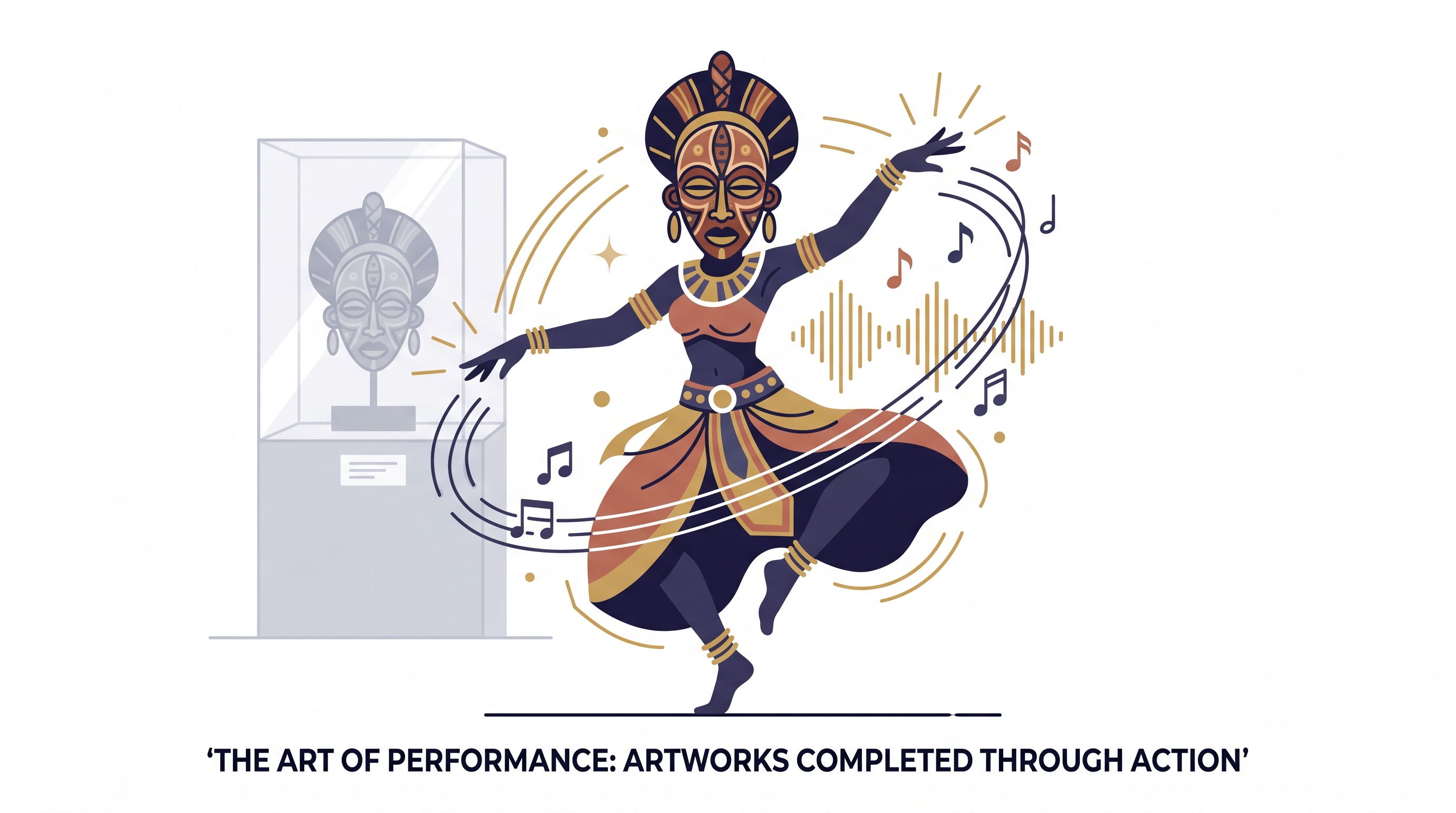
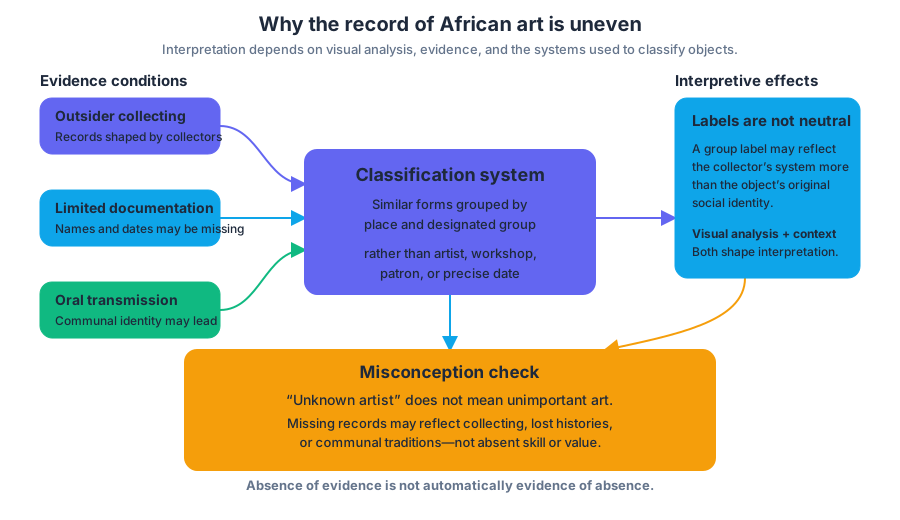
7.1 Materials, Processes, and Techniques in West and Central Asian Art
Key concepts: Materials, processes, and techniques · Regional and cultural variation in art making · Ceramics · Metalwork · Textiles · Painting · Mosaic-tile architectural decoration · Utilitarian vessels · Architectural decoration · The influence of materials and techniques on art
A blue-and-white tile, a silver-inlaid metal vessel, a woven carpet, and a miniature painting may look unrelated, yet each records a chain of decisions: what material was available, how it could be manipulated, and what cultural tradition made those choices meaningful.
7.1 Materials, Processes, and Techniques in West and Central Asian Art
A blue-and-white tile, a silver-inlaid metal vessel, a woven carpet, and a miniature painting may look unrelated, yet each records a chain of decisions: what material was available, how it could be manipulated, and what cultural tradition made those choices meaningful. In West and Central Asia, materials, processes, and techniques vary by location and culture, producing art with wide-ranging visual and functional effects.
MPT-1: Art and art making take many different forms both within and across cultures, and the materials, processes, and techniques employed may also vary by location and culture with wide-ranging influence on the art that is generated.
The learning objective MPT-1.A, “Explain how materials, processes, and techniques affect art and art making,” asks for more than naming a medium. A strong analysis connects material—what an artwork is made from—to process—the physical action used to shape or transform it—and then to the visible result, function, or cultural association.
Regional variation: one principle, many forms
MPT-1.A.18 identifies ceramics, metalwork, textiles, painting, and calligraphy as important forms in West and Central Asian artistic traditions. The region is not artistically uniform: a Persian carpet, an Ottoman ceramic tile, and a Central Asian embroidered textile belong to different local histories, even when they share techniques, motifs, or trade connections.
A useful analytical chain is:
- Material: clay, metal, fiber, pigment, or paper
- Process: firing, hammering, weaving, dyeing, or painting
- Visible result: gloss, relief, pattern, flexibility, opacity, or saturated color
- Cultural effect: a particular object becomes useful, prestigious, portable, devotional, architectural, or regionally recognizable
Ceramics: from vessel to architecture
MPT-1.A.19 emphasizes that ceramic arts flourished in West Asia from the prehistoric era. Ceramic material could be shaped into utilitarian vessels, but it could also become a major architectural surface through painted tiles and mosaic-tile decoration.
Two technical developments are especially important. Lusterware applies a metallic-looking surface effect to fired ceramics, producing a reflective sheen. Cobalt-on-white slip painting uses cobalt pigment over a light slip—a liquid clay coating—creating a strong blue-and-white contrast. In both cases, the process changes not only appearance but also the associations of the object: a vessel or tile can become visually luxurious and architecturally commanding.
Persian mosaic-tile architecture developed through the Seljuk and Safavid dynasties; the Great Mosque of Isfahan demonstrates how individual colored and shaped tiles can combine into monumental geometric and vegetal surfaces. Ottoman Iznik tile work and export ceramics similarly show how a regional ceramic tradition could operate both within architecture and through objects that circulated beyond their place of production.
Metalwork: shaping permanence and prestige
Metalwork demonstrates how process controls both surface and status. A metalworker may use repoussé, hammering the reverse of a metal sheet so forms project outward, or inlay, fitting contrasting metal into a prepared surface. The result can be a vessel with raised ornament, sharply defined pattern, or shimmering contrast between materials.
In Persian and broader West Asian traditions, metal vessels and objects often combine practical form with elaborate surface treatment. A basin or ewer may remain functional, while hammering, engraving, or inlay transforms it into a display of technical skill and elite patronage. The key point is not that metal automatically signals luxury, but that labor-intensive processes make material value visible.
Textiles: pattern made flexible
Textiles begin with fibers that are spun into threads and then organized through processes such as weaving, in which threads crossing in perpendicular systems create a stable cloth structure. Dyeing adds color before or after weaving, while knotting or embroidery can build raised pattern on the surface.
The Persian carpet tradition makes this material especially clear. A woven or knotted carpet has a flexible, portable surface, unlike a fixed mosaic wall; its repeated pattern can travel with people, define an interior, and communicate regional design traditions. The Ardabil Carpet, for example, makes the carpet both a functional floor covering and a highly controlled field of ornament.
Painting: image through layered surface
Painting depends on the interaction of support, pigment, and application. Persian manuscript painting often uses opaque watercolor on paper, allowing artists to build precise figures, architecture, landscapes, and patterned surfaces in works such as Bahram Gur Fights the Karg. Fine brushes and layered pigment produce detail suited to close viewing, while the page format makes the image portable and connected to a written manuscript.
Painting and calligraphy may also work together rather than occupy separate categories. The page can coordinate image, writing, border pattern, and decorative surface, showing how a technique affects not only what is depicted but how the viewer encounters it.
Skills in action
This topic most directly develops Skill 1: Visual Analysis by requiring precise observations—gloss, relief, pattern, brushwork, tile repetition—and Skill 2: Contextual Analysis by connecting those observations to regional production and use. It also develops Skill 4: Artistic Traditions, Skill 5: Visual Analysis of Unknown Works, and Skill 6: Attribution of Unknown Works: a blue-and-white surface, woven pattern, or manuscript painting may provide clues, but attribution must rely on several converging visual and contextual features rather than one stereotype.
Misconception check
Misconception: “A region has one characteristic style.” West and Central Asia contain many cultures, periods, materials, and workshops. Correct analysis says which material and process produce which visible effect in which regional tradition—not that every artwork from the region looks the same.
Retrieval check: If a ceramic surface is metallic and reflective, which process might explain that effect? If a carpet’s design is portable and flexible, which material process makes that possible? Finally, why would mosaic tile be especially effective for architectural decoration rather than for a manuscript page?
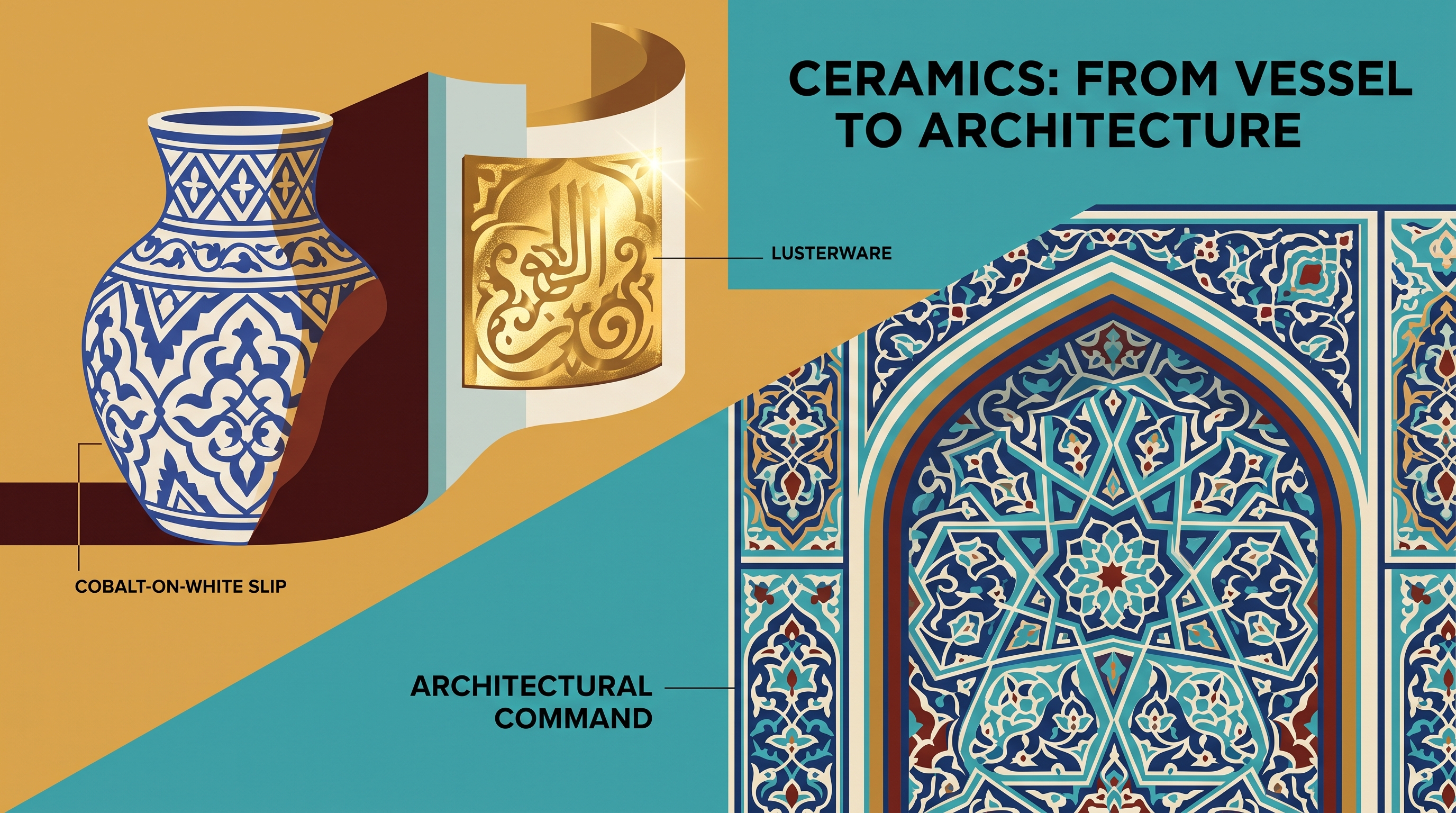
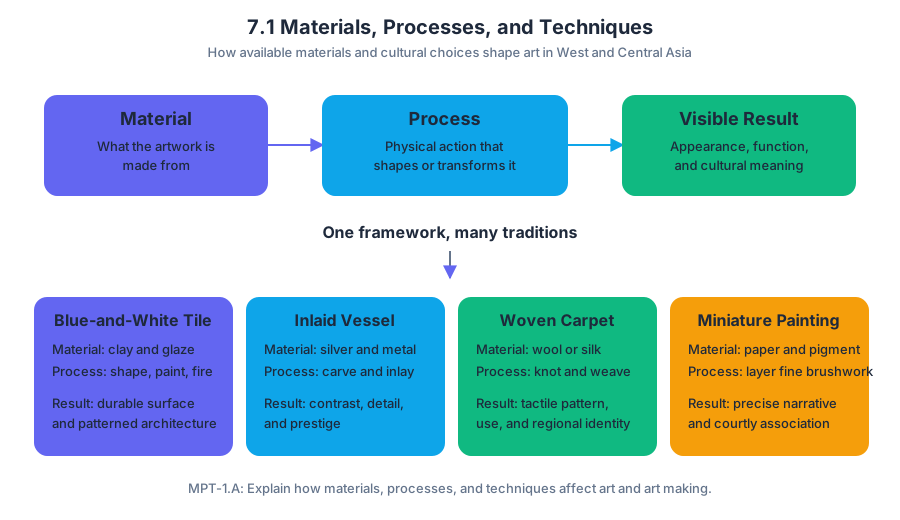
7.2 Purpose and Audience in West and Central Asian Art
Key concepts: Purpose and intended audience in religious art · Islamic mosque architecture · Minbar as a pulpit for the imam · Minaret as an architectural feature associated with prayer · Central courtyard for accommodating worshippers · Buddhist stupas · Buddhist monastic architecture · Sacred Buddhist images and devotional significance · Jowo Rinpoche as a highly sacred image in Tibet
A mosque is not simply a decorated building: its layout tells worshippers where to face, where to gather, where prayer is led, and how a community is organized.
7.2 Purpose and Audience in West and Central Asian Art
A mosque is not simply a decorated building: its layout tells worshippers where to face, where to gather, where prayer is led, and how a community is organized. In West and Central Asian art, religious purpose and intended audience often determine architecture more directly than individual artistic expression.
Learning Objective PAA-1.A: Explain how purpose, intended audience, or patron affect art and art making.
The essential knowledge for this topic is PAA-1.A.23, which identifies several audiences and patrons: royal and wealthy patrons, lay and monastic religious practitioners, and foreign collectors who acquired works through gift or trade. PAA-1.A.24 applies that relationship especially to religious architecture, including Islamic mosques, Buddhist cave architecture, stupas, and monastic buildings.
From purpose to architectural feature
A useful way to analyze a building is to connect each visible feature to a practical or religious need:
| Architectural feature | Purpose or audience connection |
|---|---|
| Qibla wall | Faces Mecca, the direction of the Kaaba, organizing communal prayer |
| Mihrab | An empty niche in the Qibla wall that marks the direction of prayer |
| Minbar | A pulpit from which the imam addresses the congregation |
| Minaret | An architectural feature associated with calling practitioners to prayer |
| Central courtyard | Provides space to gather and accommodate worshippers |
| Nonfigural imagery | Calligraphy and vegetal forms decorate the mosque without relying on figural imagery |
The building therefore performs several roles at once. It directs bodies toward Mecca, provides a place for communal worship, supports religious leadership, and accommodates a congregation. The audience is not a passive viewer standing outside the work; worshippers activate the architecture through movement, prayer, listening, and gathering.
Worked contextual example: reading a mosque as a social system
Imagine identifying a large congregational mosque with an empty niche in one wall, a raised pulpit nearby, a tower rising above the structure, and an open courtyard. Begin with observation, not assumptions: the niche is not a statue, the pulpit is not a throne, and the tower is not merely ornamental.
Next, connect observation to function. The niche is the mihrab, located in the Qibla wall, so it indicates the direction of Mecca. The raised pulpit is the minbar, used by the imam. The minaret and courtyard support the gathering and calling of practitioners for prayer. A strong interpretation would argue that the mosque’s design is shaped by communal religious use, not only by visual decoration.
This example demonstrates Skill 1.A: Describe features of a work of art or architecture, Skill 1.B: Explain how visual characteristics of a work of art or architecture convey meaning, Skill 2.A: Identify a work of art, and Skill 2.B: Explain the context in which a work of art was created. It also uses Skill 7.A: Make a claim about a work of art and Skill 7.B: Support an argument with visual and contextual evidence.
Religious architecture across traditions
Islamic religious architecture in the region also includes commemorative monuments, such as the Kaaba and the Dome of the Rock, as well as tomb architecture. Their purposes differ from the everyday congregation of a mosque: they can commemorate sacred places, preserve religious memory, or mark burial sites.
Central Asia is also recognized for Buddhist cave architecture, where relief carving, constructive sculpture, and wall painting transform caves into religious environments. In Tibetan lands, Buddhist architecture includes stupas—monumental structures associated with Buddhist devotion—and monastic architecture designed for religious communities.
The Jowo Rinpoche, identified as the most sacred image in Tibet, clarifies why audience matters. A sacred image may be encountered by lay practitioners, monks, pilgrims, and patrons, but these viewers do not necessarily approach it in the same way. Its importance depends on religious belief and ritual use, not simply on its materials or visual appeal.
Misconception check: “A minaret is the mosque”
Named misconception — feature substitution: A minaret is not the mosque itself, and it is not equivalent to the minbar. The minaret is an architectural feature associated with calling practitioners to prayer; the minbar is the imam’s pulpit inside the mosque. Confusing these terms can turn an otherwise accurate visual identification into an incorrect functional explanation.
Retrieval check: If a question asks how a mosque’s architecture accommodates communal worship, name two features and explain each function. A complete response might connect the central courtyard to gathering worshippers and the Qibla wall and mihrab to orienting prayer toward Mecca.
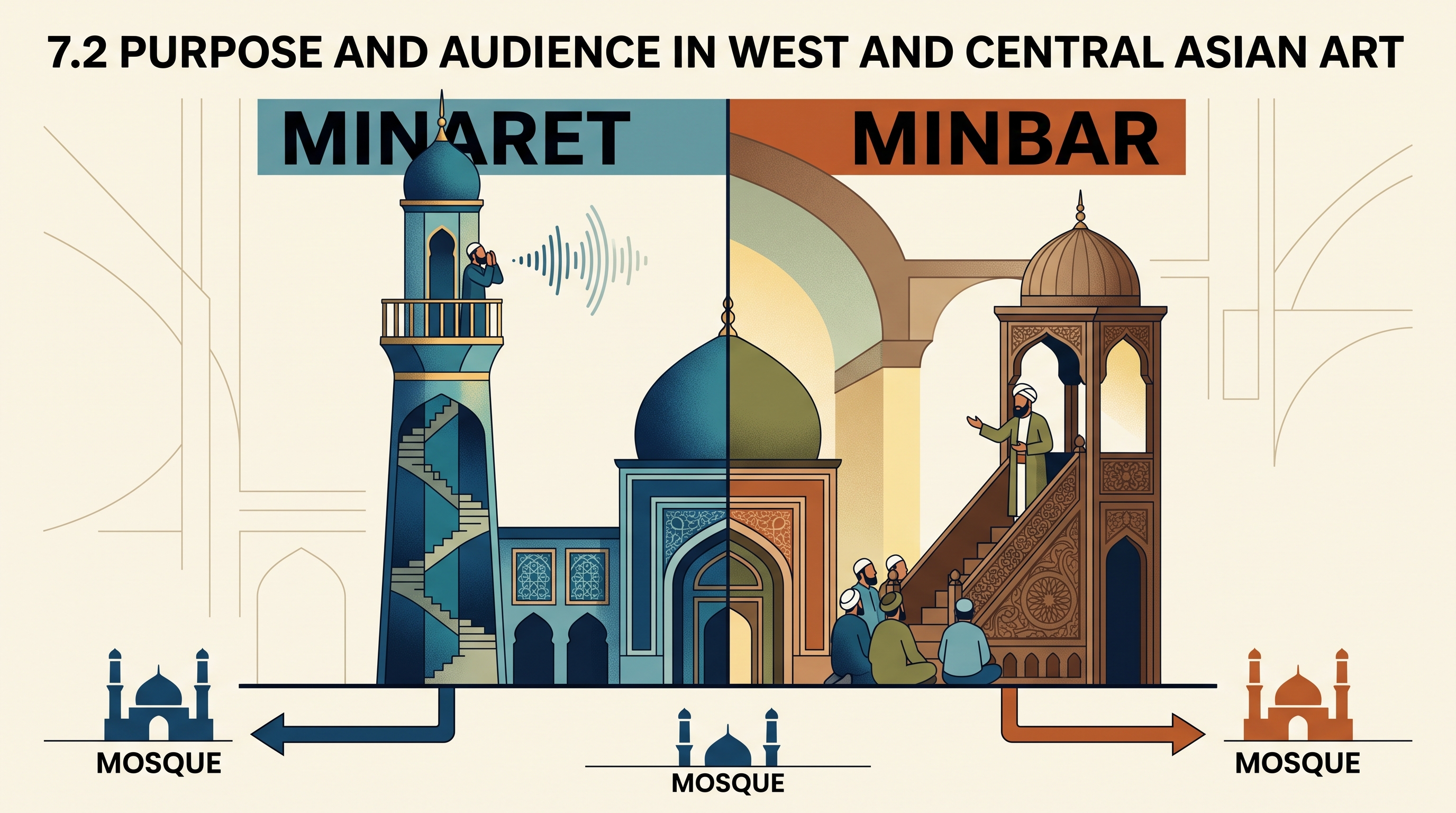
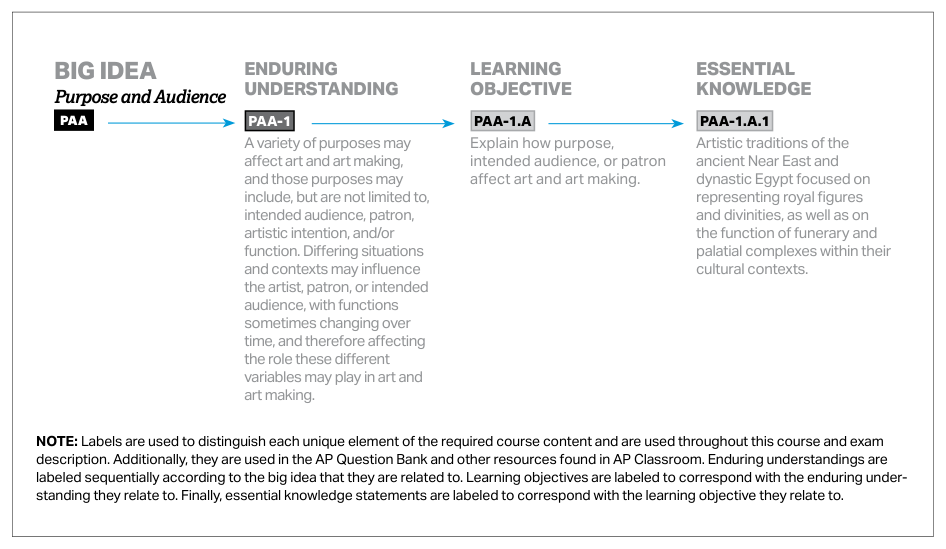
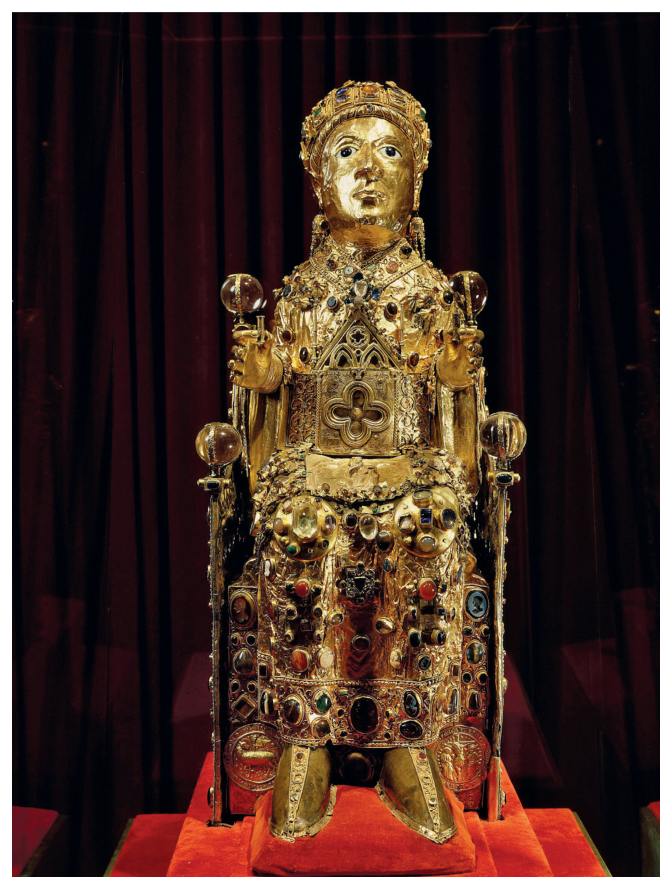
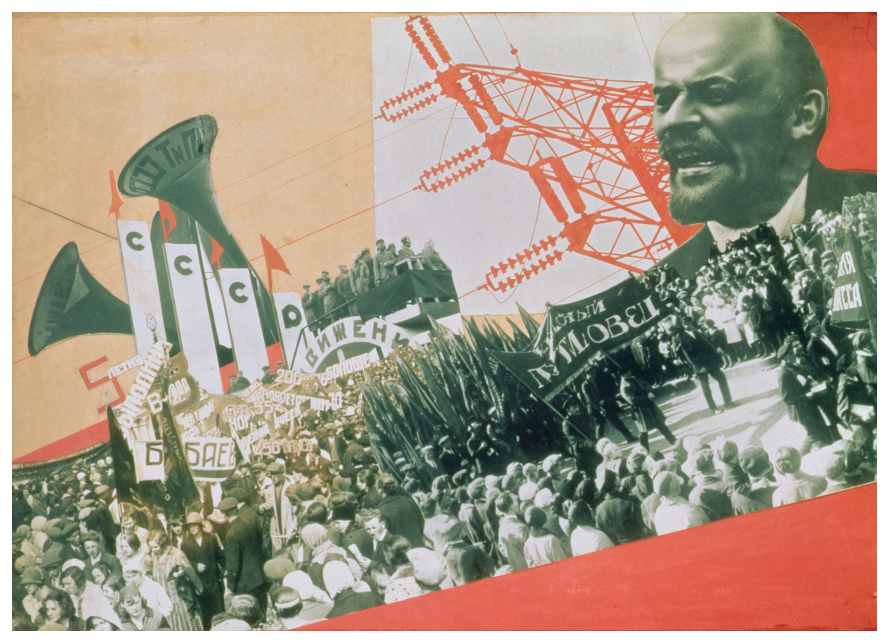
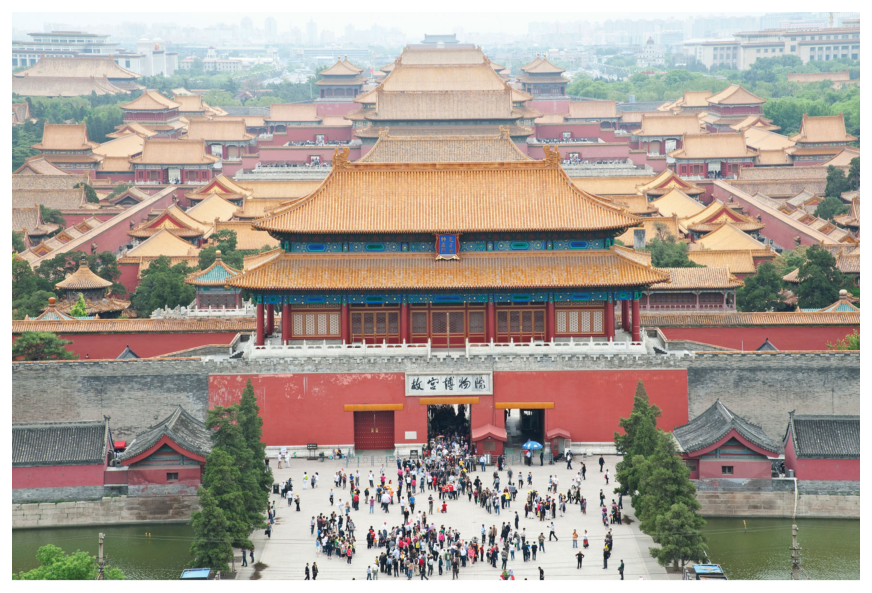
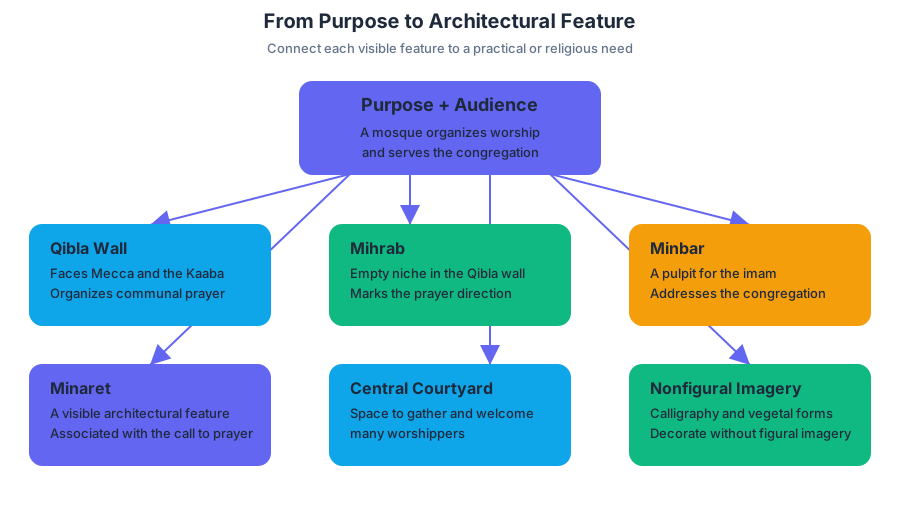
7.3 Interactions Within and Across Cultures in West and Central Asian Art
Key concepts: Cultural interaction and exchange across West and Central Asia · Continuity and change within artistic traditions · Islamic religious art and its shared visual characteristics · Persianate artistic influence · The influence of West and Central Asian art on Ottoman and Mughal art · Trade networks as channels for cultural transmission · Monsoon-based maritime trade across Asia · The relationship between figural art and religious contexts · International trade and cultural influence in Islamic art · Using comparisons and interpretations to make art-historical arguments
A textile, ceramic vessel, or metal basin could travel farther than the artist who made it. Across West and Central Asia, trade routes, religious networks, dynastic power, and migration carried not only objects but also images, techniques, and ideas.
7.3 Interactions Within and Across Cultures in West and Central Asian Art
A textile, ceramic vessel, or metal basin could travel farther than the artist who made it. Across West and Central Asia, trade routes, religious networks, dynastic power, and migration carried not only objects but also images, techniques, and ideas. The central question is therefore: when an artistic tradition crosses a cultural boundary, what remains continuous—and what changes?
Learning Objective INT-1.A: Explain how interactions with other cultures affect art and art making.
The arts of West and Central Asia connect European and Asian peoples through cultural interchange. This broad zone includes the Arabian Peninsula, the Levant, Anatolia, Greater Iran, Central Asia, Inner Asia, and Himalayan Asia—regions historically linked by routes often associated with the Silk Route.
Islam and shared artistic traditions
Islam originated in West Asia during the seventh century CE and shaped religious arts across traditional Islamic lands. Islamic art is not one uniform style, but works from different regions often share visual characteristics such as calligraphy, geometric pattern, vegetal ornament, emphasis on surface design, and architectural spaces organized for communal worship.
The Great Mosque, or Masjid-e Jameh, is a major example of Islamic religious architecture from West Asia. Its importance lies not simply in its appearance but in how mosque architecture developed through interaction: local building traditions, Islamic religious requirements, regional materials, and changing dynasties all contributed to its form.
Key distinction: Shared characteristics do not prove that every Islamic work was made in the same place or for the same audience. Similarity may result from shared religious practice, trade, political authority, artistic migration, or the adaptation of an older local tradition.
Persianate influence: continuity through adaptation
West Asian art found a major source of refinement and international influence in the Persianate arts associated with the Timurid and Safavid dynasties of Iran. These traditions influenced Ottoman arts in Turkey and Mughal arts in India, demonstrating that cultural interaction can preserve an artistic language while changing its setting, users, and meanings.
A useful comparison is between the Folio from a Qur’an and Bahram Gur Fights the Karg. The Qur’an folio emphasizes the sacred power of written language through carefully organized calligraphy and ornament. The Bahram Gur image, by contrast, uses figural representation to narrate a secular or literary episode. Both belong to Persianate visual culture, but their imagery and functions differ.
This contrast corrects a frequent misconception: Islamic art does not universally prohibit figural imagery. The use of figural art varies by tradition and context. Figural imagery is common in secular art across West and Central Asia, while religious contexts may favor calligraphy, ornament, and nonfigural design—or may incorporate figures in particular traditions.
Trade networks as artistic transmission systems
Seasonal monsoon winds connected North Africa, West Asia, South Asia, Southeast Asia, and southern China. These maritime networks moved textiles, ceramics, metalwork, and religious and artistic ideas. Borobudur Temple and Angkor exemplify the broader Asian cultural networks made possible by sustained interaction and exchange.
The source identifies textiles as perhaps the most important traded art form in the region. Islamic metalwork, including objects with figural imagery and even Christian subject matter, also circulated through international trade between Europe and Asia. Turkish Iznik wares provide another example: ceramics became both regional products and globally exchanged objects.
| Transmission channel | Artistic consequence |
|---|---|
| Monsoon-season trade | Movement of objects, techniques, and motifs across Asian ports |
| Silk Route connections | Exchange linking the Greco-Roman world, West Asia, Central Asia, and China |
| Dynastic courts | Refinement and political spread of Persianate styles |
| Religious networks | Repetition and adaptation of mosque forms, calligraphy, and ornament |
| International markets | Production of metalwork, textiles, and ceramics for foreign buyers |
Central Asian styles can be analyzed as either Persianate Islamic styles, which maintain developments from West Asian art, or Indian-inspired styles, characterized by idealized figural traditions from South Asia. This distinction is not a rigid geographic boundary; it is a way to track which visual traditions an artwork adapts.
Worked contextual example: tracing influence
Suppose an unfamiliar court painting combines Persianate courtly refinement with idealized South Asian figures. Begin with visual evidence: identify the delicate line, patterned surface, literary subject, or courtly setting. Then make the contextual argument: the work may reflect the movement of Persianate arts from Timurid or Safavid Iran into Mughal India, where imported conventions were adapted to Indian-inspired figural traditions.
The strongest explanation separates continuity from change: continuity appears in the inherited Persianate style; change appears in the new figures, local context, patronage, or function. Interactions with other cultures therefore affect styles, meanings, and functions—not merely decoration.
Misconception check
Misconception: “Cultural influence means passive copying.” In art history, influence is usually selective. Ottoman and Mughal artists did not simply duplicate Iranian works; they transformed Persianate conventions within their own political, religious, and regional environments.
Retrieval check
A metal vessel with figural imagery is found in a Mediterranean collection. Name two explanations for why it might reflect West and Central Asian cultural interaction, and identify one feature that could distinguish a Persianate Islamic style from an Indian-inspired style. A complete answer should connect visual evidence to trade, dynastic influence, or adaptation—not rely on geography alone.
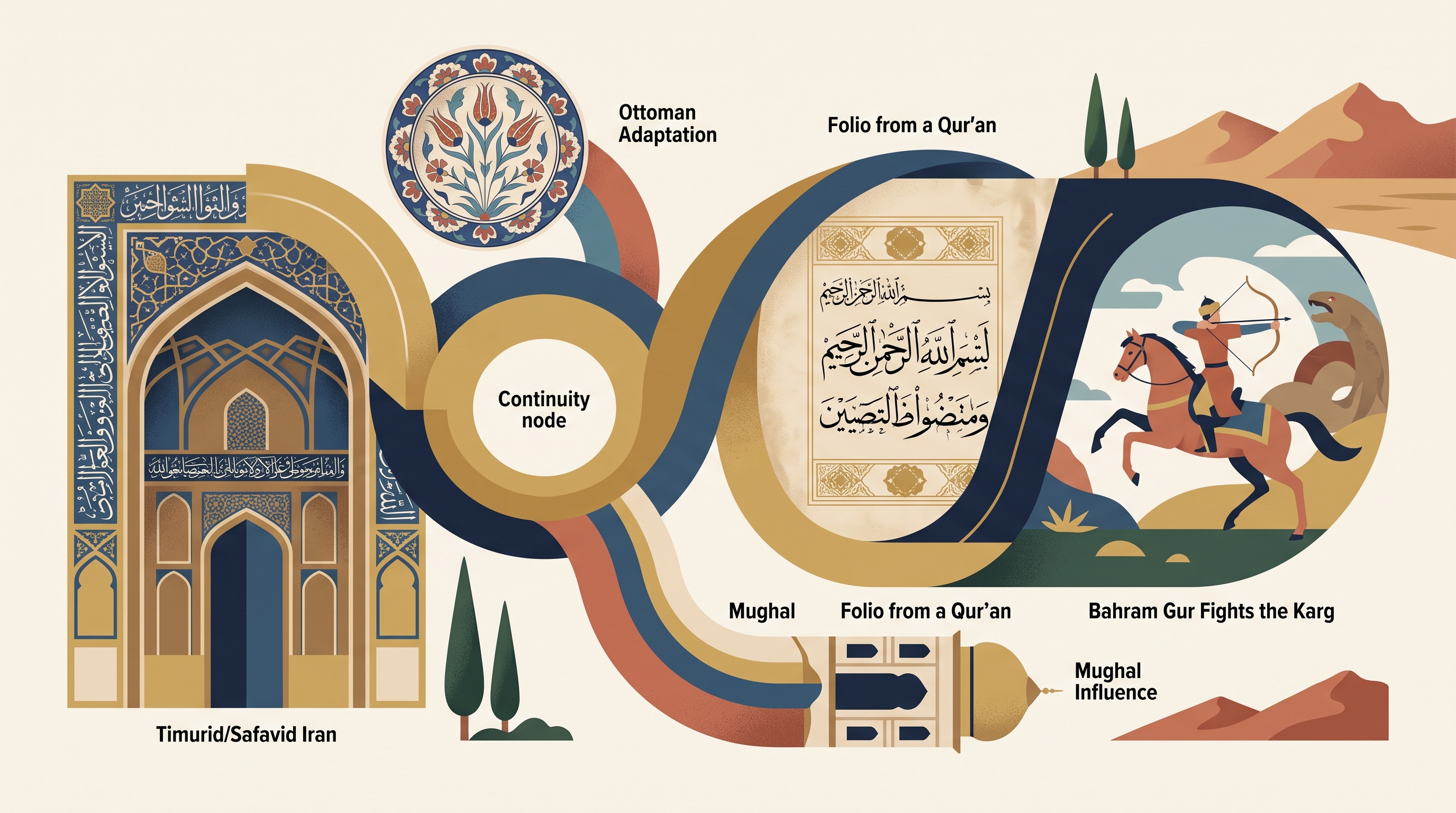
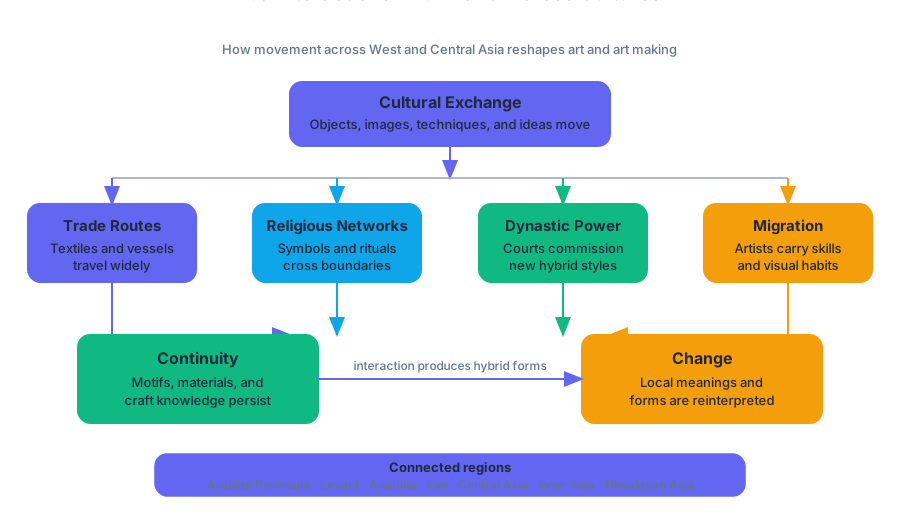
8.1 Course placement
A qualifying AP Art History score may help a student receive college credit, advanced placement, or both—but the decision belongs to the college or university, not to the AP program alone.
8.1 Course placement
A qualifying AP Art History score may help a student receive college credit, advanced placement, or both—but the decision belongs to the college or university, not to the AP program alone.
The crucial distinction is simple:
- College credit means the institution awards academic credit for work completed through the AP Exam.
- Advanced placement means the score allows a student to begin in a more advanced course, skip an introductory requirement, or enter a different sequence.
- A college may grant one, both, or neither.
How the placement decision works
AP Exams are administered annually in May. After scores are reported, each institution applies its own AP credit policy—its published rule specifying which scores qualify and what academic benefit follows.
A useful way to model the process is:
- The student completes AP Art History and takes the May AP Exam.
- The student receives an AP score.
- The college checks that score against its AP Art History policy.
- The institution determines whether the result produces credit, placement, both, or no award.
- The student follows the institution’s advising and enrollment procedures.
For example, two universities might treat the same score differently. University A could award credit for an introductory art-history requirement, while University B could grant placement into a higher-level course without awarding equivalent credit. A third institution might require a higher score or offer no AP benefit for the course. The score has not changed; the institutional policy has.
What students should verify
Students should not assume that a qualifying score automatically removes every introductory requirement. They need to check the policy of each college or university they may attend, including the required score, the number or type of credits awarded, the course requirement satisfied, and whether the credit counts toward the intended major.
The AP Credit Policy Search is designed to help students locate college and university policies. Because institutions can revise their rules, the final authority is the college’s current official policy and its advising or registrar’s office.
Key distinction: AP provides the examination and score; the college decides how that score functions in its own degree system.
Why placement is not the same as exemption
Being placed into an advanced course does not always mean that a student has earned the same number of credits as a student who completed the introductory course at that institution. Placement concerns where the student begins; credit concerns what academic hours the institution records. These outcomes often overlap, but they are not identical.
A student entering an advanced art-history course should therefore be prepared for college-level visual and contextual analysis: examining how an artwork looks and is made, then connecting those choices to historical and cultural circumstances.
Misconception check: “A high score guarantees college credit”
Correction: A high score can make a student eligible under a particular institution’s policy, but it does not guarantee the same result everywhere. AP scores are commonly used for credit or placement, yet each college sets its own thresholds and academic rules.
Retrieval check: If one university awards introductory-course credit and another places the student into an advanced course without credit, are the institutions contradicting the AP score? No. They are applying different institutional policies to the same AP result.

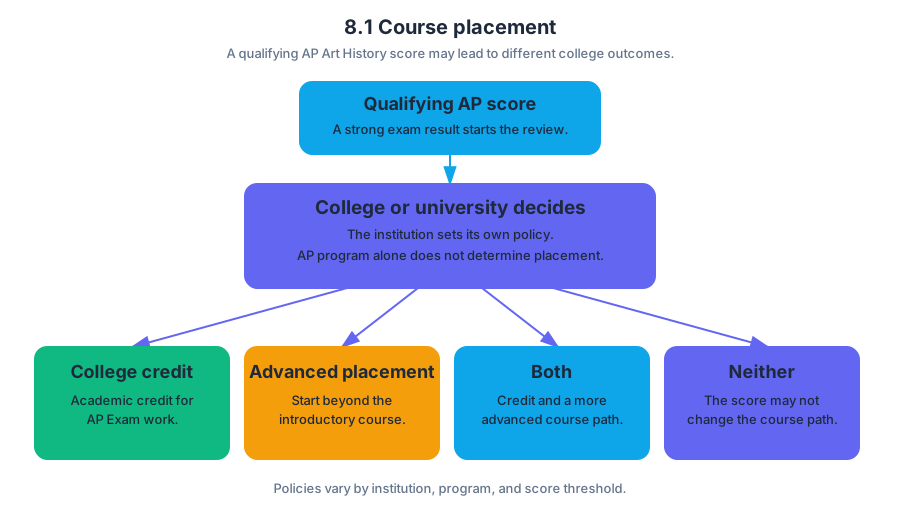
8.2 8.1–8.3 Topic entries
Purpose changes what an artwork does: a Buddhist image may teach devotion, a palace may stage political authority, and a textile may identify community, rank, or ritual belonging.
8.2 8.1–8.3 Topic entries
Purpose changes what an artwork does: a Buddhist image may teach devotion, a palace may stage political authority, and a textile may identify community, rank, or ritual belonging. The same visual feature can therefore mean something different when its intended use and audience change.
Key distinction: Purpose is the work’s intended function or effect; audience is the person or group expected to encounter, use, perform with, or respond to it.
In the Unit 8 outline, the three central topic entries are 8.1 Materials, Processes, and Techniques in South, East, and Southeast Asian Art, 8.2 Purpose and Audience in South, East, and Southeast Asian Art, and 8.3 Interactions Within and Across Cultures in South, East, and Southeast Asian Art. The topic sequence moves from how a work is made, to what it is meant to do and for whom, to how artistic traditions meet and change.
| Topic | Main question | Skills listed in the course outline |
|---|---|---|
| 8.1 Materials, Processes, and Techniques in South, East, and Southeast Asian Art | How do material and process shape meaning and appearance? | 1.C, 3.A, 3.B, 6.A |
| 8.2 Purpose and Audience in South, East, and Southeast Asian Art | What function did the work serve, and who encountered it? | 2.B, 2.C, 2.D |
| 8.3 Interactions Within and Across Cultures in South, East, and Southeast Asian Art | How do cultures influence, adapt, or reinterpret artistic traditions? | 4.A, 4.B, 4.C, 4.D |
Reading purpose through visual evidence
Begin with the object, not with an unsupported guess about intention. Ask four connected questions:
- What is visible? Identify scale, imagery, placement, materials, gestures, inscriptions, and degree of realism.
- What action could the work support? Could it be worshipped, carried, displayed, worn, entered, gifted, or used in a ceremony?
- Who had access to it? Consider worshippers, rulers, monks, merchants, family members, performers, or visitors.
- What response might it produce? A work can encourage devotion, communicate status, preserve memory, authorize rule, or structure communal identity.
Skill 2.B asks you to connect an artwork’s features to its function or purpose. A strong response does not merely label an object “religious” or “political.” It explains the mechanism: a repeated sacred image might support meditation; an imposing scale might make a ruler appear powerful; restricted placement might separate insiders from outsiders.
Skill 2.C asks you to explain how contextual factors shape purpose. Relevant factors may include religious practice, social hierarchy, political authority, economic systems, gender roles, trade networks, or ritual traditions. Context is not a decorative fact added after visual analysis; it explains why those particular visual choices mattered.
Skill 2.D asks you to identify and explain the role of the audience. Audience is more precise than “the public.” A work may address a deity, initiate, royal court, monastic community, household, local worshipper, or distant viewer. Its scale, location, accessibility, and imagery can reveal whom it was designed to reach.
Worked contextual example: purpose is not the same as subject
Imagine an image showing a revered Buddhist figure. Its subject alone does not prove how it functioned. To earn a complete explanation, connect appearance, use, and audience:
- Visual evidence: The figure is presented frontally, calmly, and with recognizable sacred attributes.
- Purpose: These features can make the image a focus for devotion or meditation rather than a record of an ordinary human individual.
- Context: Buddhist practices give images an active role in religious life; the object may help worshippers visualize teachings or approach a sacred presence.
- Audience: If placed in a temple, its immediate audience would include worshippers and monastic communities. If small and portable, it could address an individual devotee in a domestic or traveling setting.
- Argument: The image’s formal stability and sacred attributes support a devotional purpose because they make the figure recognizable and suitable for repeated acts of contemplation.
The reasoning pattern is:
$$ \text{visual feature} \rightarrow \text{function} \rightarrow \text{context} \rightarrow \text{audience} $$
Misconception check: “The audience is whoever sees it today”
Correction: The modern museum visitor is often not the original audience. Ask who could access the work when it was made, where it was placed, and what actions viewers were expected to perform. A sculpture displayed in a museum may originally have been encountered in a shrine, palace, tomb, procession, or household.
How 8.2 connects to the neighboring topics
Material choices from 8.1 can reveal purpose: portability may support pilgrimage or personal devotion, while monumental construction may serve public display or political authority. In turn, 8.3 helps explain why a work’s purpose may shift when a form, image, or technique moves across cultural boundaries.
Retrieval check: A work is large, permanently installed, difficult to access, and positioned in a ceremonial setting. Which claim is strongest?
A. Its size proves that it was made by a wealthy artist.
B. Its scale and restricted placement may support a public, political, or ritual function for a selected audience.
C. Its audience must have been modern tourists.
D. Its purpose cannot be inferred from visual evidence.
Answer: B. The claim links observable features to a plausible function and audience without treating one clue as absolute proof.
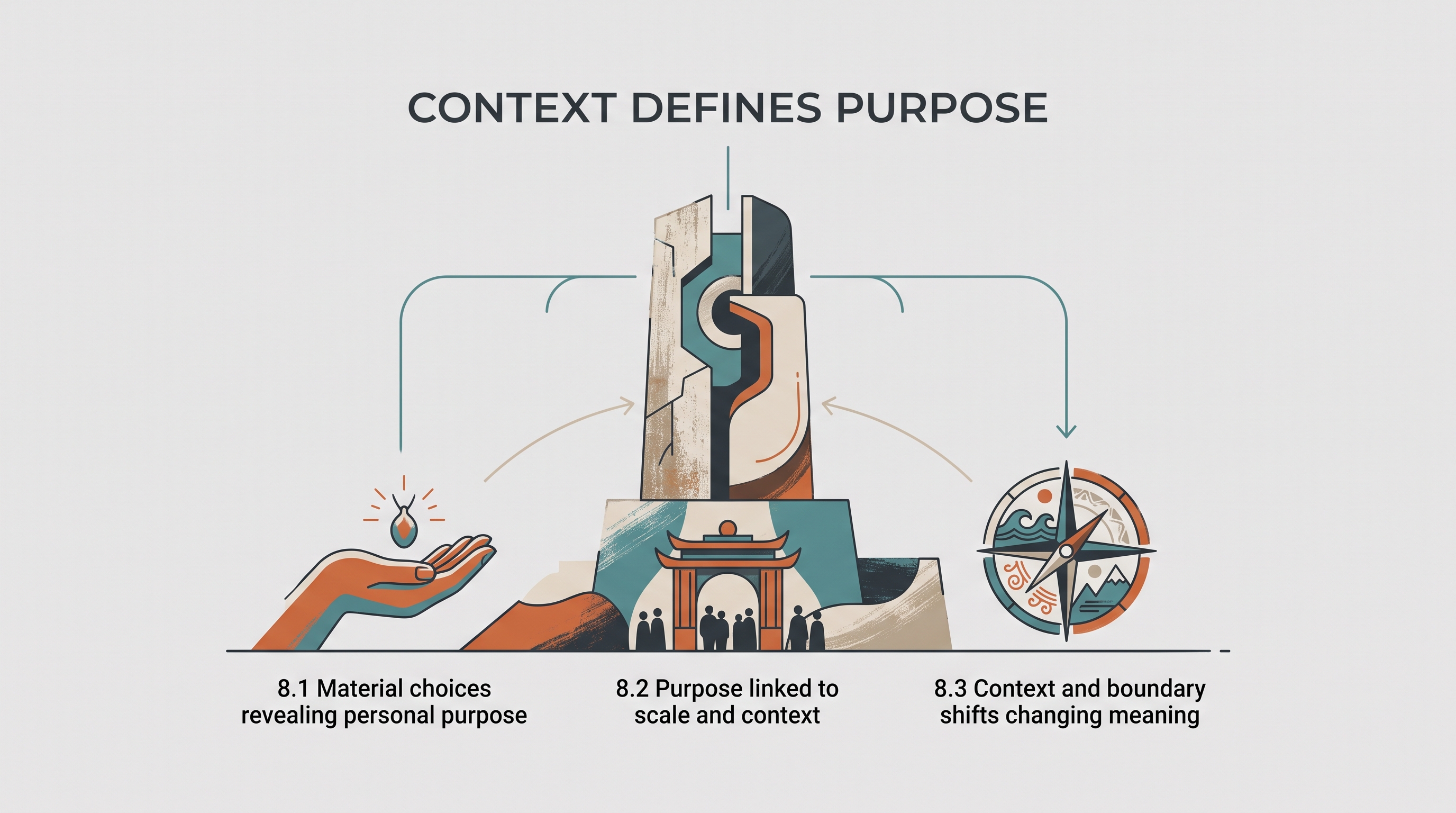
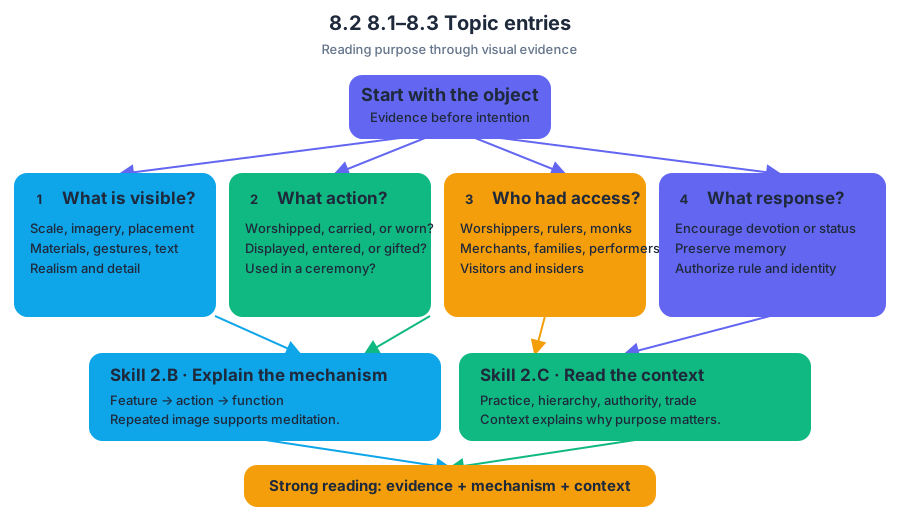
8.3 8.4 Theories and Interpretations of South, East, and Southeast Asian Art
Key concepts: Interactions within and across cultures in South, East, and Southeast Asian art · Theories and interpretations of Asian art · Cultural influence and adaptation in artistic traditions · The rock garden at Ryoan-ji as evidence of cross-cultural influence · The role of religion and philosophy in artistic practice · The ancient Indic worldview · Hinduism, Buddhism, Jainism, Sikhism, and folk religions · Narrative and iconographic compositions · Diverse media and ceramic techniques · The development and transmission of Buddhist imagery across Asia
A Japanese Zen rock garden can look intensely local while carrying ideas that traveled across Asia. The stones and raked gravel at Ryoan-ji are not simply “Japanese nature”; they are evidence of how artistic traditions are transmitted, selectively adopted, and transformed.
8.3 8.4 Theories and Interpretations of South, East, and Southeast Asian Art
A Japanese Zen rock garden can look intensely local while carrying ideas that traveled across Asia. The stones and raked gravel at Ryoan-ji are not simply “Japanese nature”; they are evidence of how artistic traditions are transmitted, selectively adopted, and transformed.
Culture as influence, adaptation, and transformation
Cultural influence is the effect one society, belief system, or artistic tradition has on another. Influence does not mean that the receiving culture merely copies an outside model. Adaptation occurs when artists reshape imported ideas to fit local materials, beliefs, spaces, and audiences; transformation occurs when the result becomes meaningfully different from its earlier source.
South, East, and Southeast Asian art developed through interactions among many communities. Religious, cultural, and political influence moved through trade, migration, diplomacy, pilgrimage, and local adoption, with substantial regional variation. The Indic worldview, for example, was incorporated into preexisting animistic and popular beliefs in Southeast Asia rather than replacing every local tradition with a single Indian system.
The region’s artistic traditions also extend across many media: sculpture, textiles, wall painting, architecture, gardens, ink painting, and ceramics. Fired ceramic shards from Yuchanyan Cave in China, dated to approximately $18{,}300$ and $17{,}500$ BCE, demonstrate the deep antiquity of ceramic production in East Asia; they are important evidence for the region’s long material history, but their dates alone do not prove a particular cultural exchange.
Worked interpretation: the rock garden at Ryoan-ji
Begin with what can be observed: Ryoan-ji uses carefully arranged rocks set within expanses of raked gravel. The restricted palette, controlled composition, and absence of literal plants or buildings encourage contemplation rather than narrative viewing. Its identity as a Zen rock garden connects it to Buddhist practice and to a specifically Japanese setting.
Now separate evidence from inference. Zen Buddhism developed in East Asia through the broader transmission and reinterpretation of Buddhism, whose imagery and practices spread widely across Asia. The garden therefore reflects cross-cultural influence at the level of religious philosophy and contemplative practice. Yet its particular arrangement, materials, setting, and visual restraint are not a transparent copy of an earlier foreign artwork. They show local adaptation: an imported religious tradition became a Japanese garden form.
A strong argument would therefore claim that Ryoan-ji reflects substantial but transformed cultural influence. Evidence includes its association with Zen Buddhism, its use of a nonfigural environment for spiritual reflection, and its development within Japanese architectural and garden practice. The conclusion should avoid claiming that the garden is either wholly foreign or entirely isolated.
Key distinction: Similarity can suggest influence, but influence becomes more convincing when visual evidence is joined to historical evidence about transmission, shared religious ideas, or sustained contact.
The ancient Indic worldview and artistic practice
The ancient Indic worldview differentiated earthly and cosmic realms, recognized certain beings and places as sacred, and understood time and life as cyclic. This worldview shaped both the subjects artists represented and the forms used to make spiritual realities visible.
Major South Asian religious traditions—including Hinduism, Buddhism, Jainism, Sikhism, and numerous folk religions—developed within or alongside this worldview. These traditions sought spiritual development, spiritual release, or divine union through distinct religious methodologies and social practices. Because religious practice required spaces, images, and objects that could support those aims, it encouraged the development of novel artistic and architectural forms.
| Religious idea or practice | Artistic consequence |
|---|---|
| Sacred beings and teachers | Iconic figural images of divinities and revered teachers |
| Cosmic realms | Conceptual landscapes, ideal Buddhist worlds, and mandalas |
| Ritual and devotion | Shrines, temples, caves, stupas, and monastic complexes |
| Narrative teaching | Elaborate compositions in sculpture, textiles, and wall painting |
| Contemplative practice | Zen rock gardens and Zen ink painting |
These works are not merely illustrations of religious stories. In many settings, images could be venerated in temples or shrines, inhabit imagined cosmic landscapes, or function within mandalas. Buddhist imagery became especially widespread across Asia; the scale and variety of Buddhist art form a major body of religious art, comparable in richness to the Christian imagery of medieval Europe.
How interpretation distinguishes copying from synthesis
Contextual analysis asks what religious, political, social, and geographic conditions shaped an artwork. Comparison asks which features resemble another tradition and which features differ. Evidence-based interpretation then connects those observations into a defensible claim—for example, that Buddhist imagery traveled across Asia but changed in style, ritual use, and local meaning as communities adopted it.
A common misconception is “cultural influence equals cultural replacement.” Asian art instead often records layered histories: an imported religion may coexist with local beliefs; a foreign visual convention may acquire new symbolism; and an architectural form may be redesigned for a different climate, ritual, or audience. The most persuasive interpretation identifies both the transmitted element and the local transformation.
Misconception check: Calling Ryoan-ji “purely Japanese” ignores the transregional history of Zen Buddhism. Calling it “Chinese art in Japan” ignores the garden’s Japanese materials, composition, setting, and local use. The evidence supports cultural synthesis.
Retrieval check: In two sentences, argue whether Ryoan-ji is best described as borrowed, adapted, or transformed. Name one piece of visual evidence and one contextual piece of evidence. A complete response should identify Zen’s wider Asian transmission while explaining how the Japanese garden form gives that tradition a distinctive local expression.
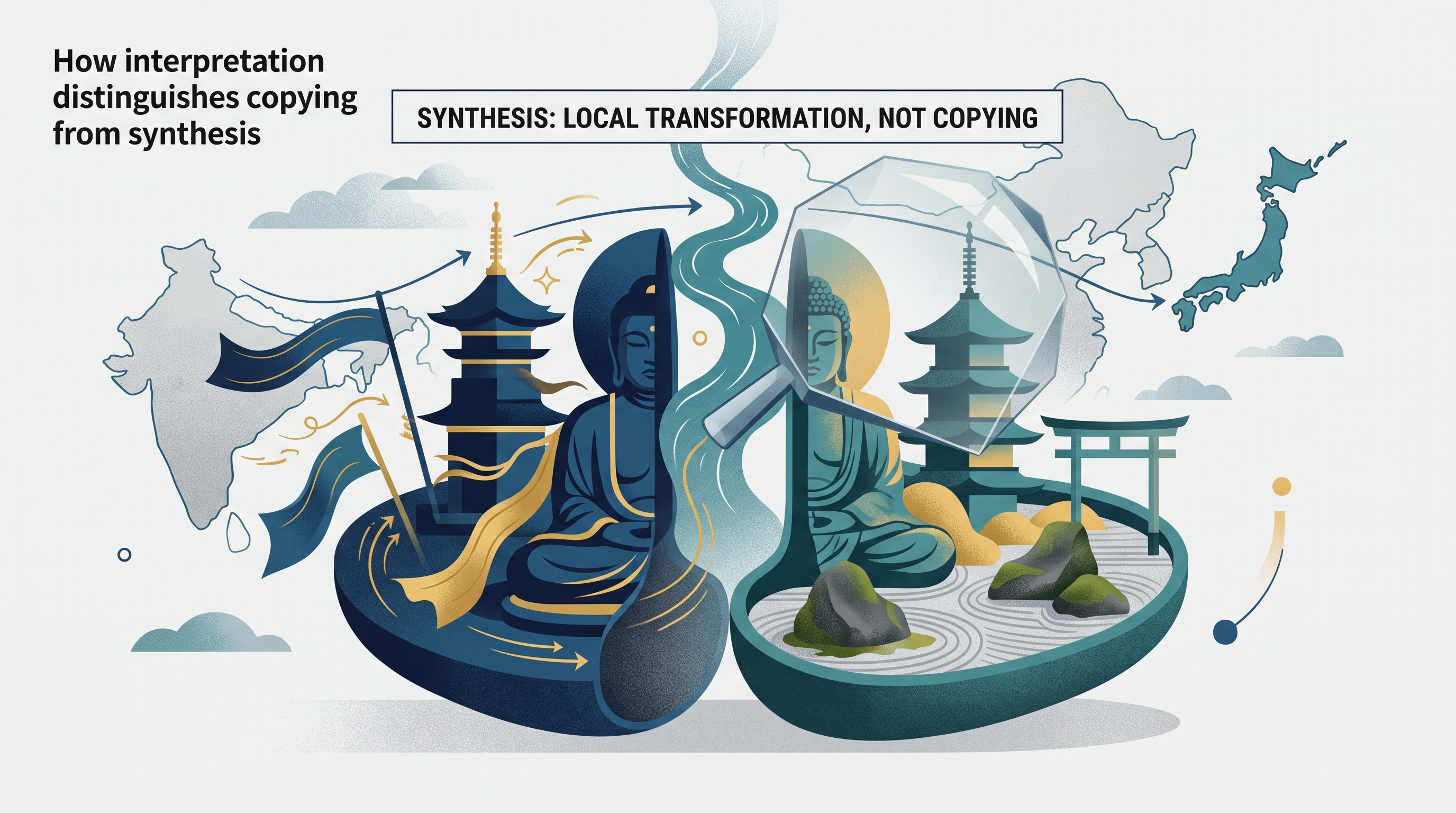
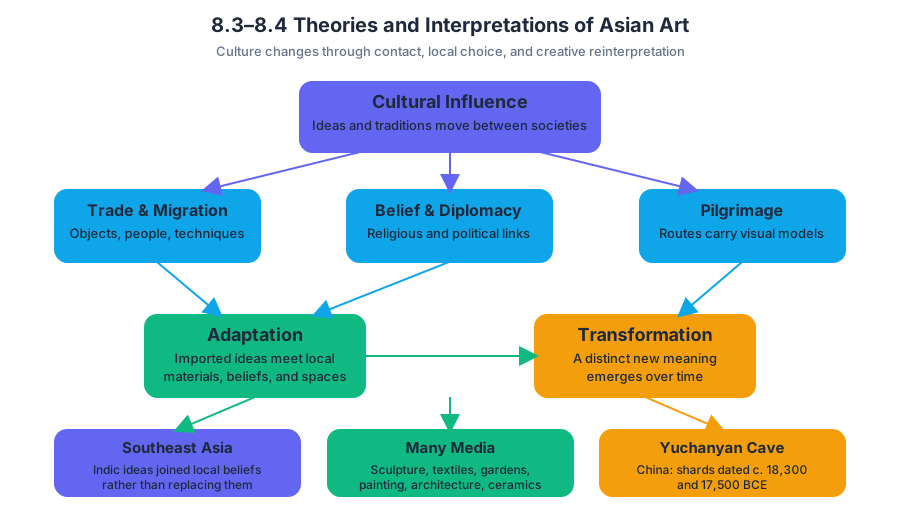
9.1 Materials, Processes, and Techniques in Pacific Art
Key concepts: Pacific art · Materials, processes, and techniques · Objects, acts, and events · Fibers and pigments · Bone, sea ivory, seashell, and tortoise shell · Rare and precious materials · Wealth and status · Ritual settings and sensory response · Ferocity in dress, dance, and verbal aggression · MPT-1.A.31 and MPT-1.A.32
Pacific art is not limited to a portable object: it can be an object, an act, or an event—a force that operates within social life.
9.1 Materials, Processes, and Techniques in Pacific Art
Pacific art is not limited to a portable object: it can be an object, an act, or an event—a force that operates within social life. A fiber costume, a pigment-covered body, a threatening dance, and the sensory arrangement of a ritual setting can all function as art because materials and performance work together to produce a response.
Learning Objective MPT-1.A: Explain how materials, processes, and techniques affect art and art making.
The key distinction is between a thing that is merely made and an artistic form that is deliberately activated. In Pacific cultures, objects may be carried, exchanged, worn, displayed, or used in ceremonies; acts and events may involve movement, speech, sound, gesture, color, and touch. The material is therefore part of the artwork’s meaning, not just its physical support.
A material is also a message
Materials are the substances used to create an artwork. Processes are the actions performed on those substances, such as weaving, shaping, coloring, assembling, wearing, or displaying them. Techniques are the specific skills or methods through which those processes are carried out. Together, they affect an artwork’s form, function, context, reception, and meaning.
MPT-1.A.31 identifies Pacific arts as composed of “objects, acts, and events” that are forces in social life. Their effect depends partly on the virtuosity—the highly skilled, controlled, and impressive use—of materials and presentation. A material can attract attention, establish authority, provoke fear, or create an atmosphere of sacred importance.
MPT-1.A.32 names a wide range of Pacific materials: fibers, pigments, bone, sea ivory, seashell, and tortoise shell, as well as wood, coral, and stone. These materials become meaningful through what people do with them and through the circumstances in which they are carried, exchanged, worn, or displayed.
| Material or material group | What its use can make visible |
|---|---|
| Fibers | Skilled construction, bodily movement, clothing, or ceremonial display |
| Pigments | Color, transformation, visibility, identity, or emotional intensity |
| Bone, sea ivory, seashell, tortoise shell | Craft virtuosity, distinction, exchange, or status |
| Wood, coral, stone | Durability, environmental connection, construction, or presence |
The point is not to assign one fixed meaning to every material. A shell object does not automatically mean wealth, and pigment does not automatically mean ritual. Meaning comes from the material’s rarity, the technique used, the object’s setting, and the response it is designed to stimulate.
Objects, acts, and events
Pacific arts may be understood as a sequence rather than a static artifact:
Material → Process → Presentation → Audience response
For example, fibers may be transformed into an elaborate wearable form. Its meaning changes when it is carried in procession, worn during a ritual, or used in a display of ferocity. The material contributes to the form; the presentation activates its social function; the audience’s response completes the event.
Worked contextual example: designing a response
Imagine a Pacific ceremony in which participants enter wearing carefully constructed fiber forms, their bodies marked with pigments, while gestures, verbal aggression, and dance communicate hostility. Bone, sea ivory, seashell, or tortoise shell may appear in objects whose rarity and skilled presentation distinguish their wearers.
The analysis should proceed in four steps:
- Identify the materials: fibers, pigments, and possibly rare shell or ivory.
- Explain the processes and techniques: shaping, weaving, coloring, assembling, wearing, and choreographing movement.
- Connect form to function: the combination creates a visually and physically powerful display rather than a neutral costume.
- Infer the intended response: the dress, dance, verbal aggression, and gestural threats announce or precede physical combat and stimulate fear, intimidation, or readiness.
This example demonstrates MPT-1.A.33: objects and behaviors are designed and presented to stimulate a particular response. The work’s meaning lies not only in what it is made from but also in how it is encountered.
Rarity, status, and circumstance
Rare and precious materials can demonstrate wealth and status, but they may also communicate a particular circumstance. Their value is social as well as physical: scarcity, difficulty of acquisition, specialized skill, and controlled presentation can make a material powerful.
Ritual settings extend this principle across the senses. MPT-1.A.33 explains that ritual environments are structured with elements addressing sight, sound, touch, movement, and possibly smell or taste. A purely visual description misses how an event’s total sensory organization produces authority, sacredness, fear, or participation.
Misconception check: “Pacific art means objects made from natural materials”
Correction: Natural materials matter, but Pacific art is not defined only by an object’s substance. It also includes acts and events, and its materials gain meaning through exchange, display, ritual use, bodily performance, and social response. The strongest explanation links a material choice to a process, a setting, and an effect.
AP skill application
This topic most directly develops Skill 1: Visual Analysis by requiring precise identification of material effects, bodily presentation, surface, color, movement, and gesture. It also uses Skill 2: Contextual Analysis when those visible features are connected to ritual, status, exchange, warfare, or social life.
A strong response can also use Skill 3: Comparison of Works of Art by comparing how two works use materials or presentation to produce different responses, and Skill 8: Argumentation by making a claim supported by specific visual and contextual evidence. The essential chain is: material choice → technique or presentation → social function or intended response.
Retrieval check: If a work uses a rare material in a ceremonial setting, what must an explanation do beyond naming the material? State the material, describe how it is processed or presented, identify the setting or circumstance, and explain the response or social meaning it helps produce.
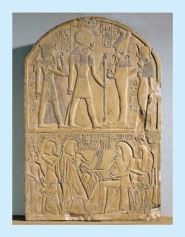
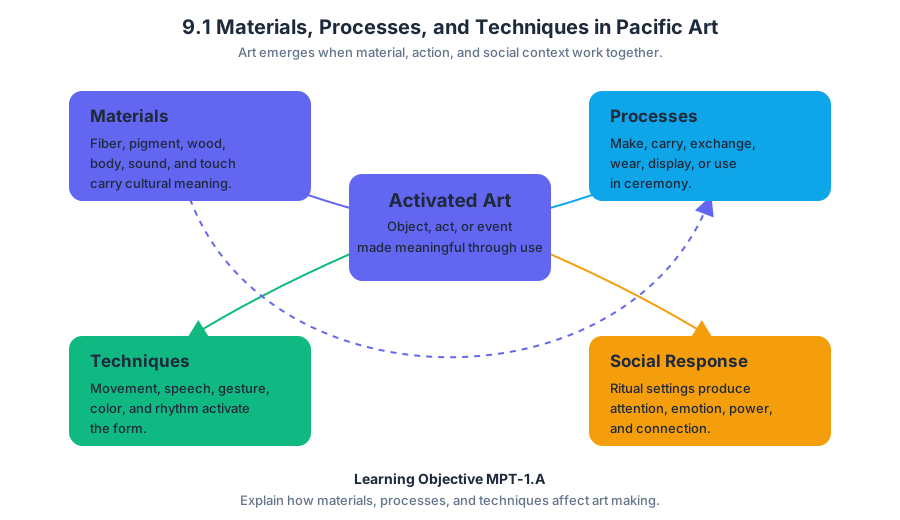
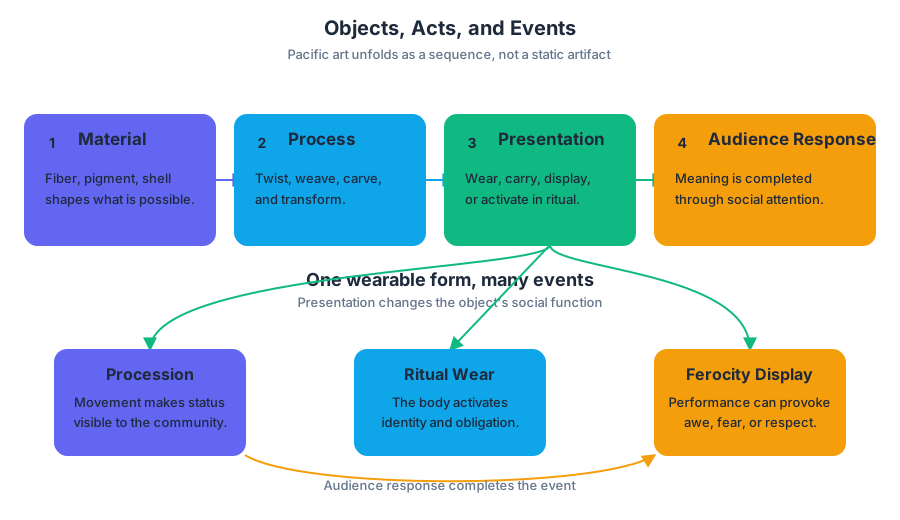
9.2 Interactions Within and Across Cultures in Pacific Art
Key concepts: Cultural interaction within and across Pacific cultures · Travel, migration, trade, war, conquest, and colonization as forces of cultural exchange · The Pacific Ocean as a central theme and medium in Pacific art · Ocean-going vessels and navigation as means of exploration, migration, and exchange · Personal navigation charts as representations of navigators’ experiences · Objects created to protect journeys · Artistic influence through spolia, appropriation, and stylistic adaptation · Papuan-speaking peoples’ early migration across a land bridge between Asia and Australia · Lapita peoples’ migration across the Pacific · The Pacific region defined by its location within the Pacific Ocean and its many islands
The Pacific Ocean is not merely the space between islands: it is a highway, archive, boundary, and subject of art. Its waters connected communities that traveled, traded, migrated, fought, and exchanged artistic ideas across a region containing more than $25{,}000$ islands, about $1{,}500$ of them inhabited.
9.2 Interactions Within and Across Cultures in Pacific Art
The Pacific Ocean is not merely the space between islands: it is a highway, archive, boundary, and subject of art. Its waters connected communities that traveled, traded, migrated, fought, and exchanged artistic ideas across a region containing more than $25{,}000$ islands, about $1{,}500$ of them inhabited.
The Pacific as a Cultural Network
CUL-1.A.50 explains why Pacific art cannot be separated from geography. The region includes continental lands, volcanic islands, and atolls, each with distinct ecologies. These environments shaped where people could live, what resources they could use, how communities were organized, and how movement occurred across the ocean.
Geological and archaeological evidence indicates that Papuan-speaking peoples crossed a land bridge connecting Asia and present-day Australia about $30{,}000$ years ago. Much later, Lapita people migrated eastward across the Pacific beginning about $4{,}000$ years ago. Populations sailing from Vanuatu carried plants, animals, and pottery, leaving material evidence of migration and connection associated with Lapita culture.
The important reasoning move is to treat migration as an artistic force rather than as background history. When a community moves, it carries practices, objects, symbols, technologies, and beliefs; when it encounters another community, those traditions may be retained, adapted, combined, or contested.
Retrieval check: Why does the Pacific’s physical setting belong in an explanation of Pacific art? A strong answer connects ecological variation and ocean travel to the movement of communities, practices, and artistic traditions.
Navigation as Exploration, Migration, and Exchange
Under CUL-1.A.52, ships and navigational devices are not simply functional technologies. Ocean-going vessels enabled entire communities to move across vast distances, making exploration, migration, and cultural exchange possible. Navigation therefore became both a practical necessity and a cultural knowledge system.
Navigators created personal charts—representations of their own experiences of routes, currents, islands, and ocean conditions. These charts should not be mistaken for universally standardized maps. Their meaning depended on the navigator’s knowledge and use of the sea; they recorded lived experience rather than presenting an abstract, identical picture for every viewer.
Objects were also made to protect journeys. Such protective objects reveal that travel involved more than technical skill: it could carry spiritual, social, and emotional significance. A vessel might transport people physically, while protective objects helped express hopes for safety, successful passage, and communal continuity.
Worked contextual example: reading a navigation object
Imagine an object associated with a Pacific voyage. Begin with visible evidence: its connection to a vessel, route, or protective practice. Add context: ocean-going travel enabled migration and exchange across distant islands. Then make the interpretive connection: the object represents navigation not only as transportation but also as a culturally meaningful practice involving experience, protection, and community.
A weak answer says, “The object shows that Pacific peoples traveled.” A stronger answer explains how travel shaped art making: navigation demanded specialized knowledge, vessels moved communities, personal charts represented individual experience, and protective objects materialized cultural beliefs about the dangers and possibilities of the sea.
Cultural Interaction and Artistic Change
The enduring understanding INT-1 identifies several forces that produce interaction among cultures: travel, trade, war, conquest, and colonization. These forces do not all involve equal relationships. Trade may create exchange, while conquest or colonization may impose power, reshape institutions, or redirect artistic production.
INT-1.A asks you to explain how interaction with other cultures affects art and art making. In Pacific contexts, artistic change may include:
- Spolia: the reuse of material or artistic elements from another culture, often carrying traces of an earlier context.
- Appropriation: the adoption or use of imagery, forms, or practices from another culture, sometimes involving unequal power.
- Stylistic influence: the adaptation of visual characteristics from another tradition without necessarily reproducing the original object or meaning.
- Colonial and missionary influence: external systems that altered local social structures, beliefs, commerce, and artistic practices.
INT-1.A.30 emphasizes that Pacific arts vary according to ecological situations, social structures, and external influences such as commerce, colonialism, and missionary activity. INT-1.A.31 places European exploration within this history: exploration began in the sixteenth century and intensified in the late eighteenth century. In the nineteenth century, Dumont d’Urville divided the region into Melanesia, Micronesia, and Polynesia—categories that should be understood as later organizing labels applied to cultural areas that had developed by about $800$ CE.
Common misconception — “cultural interaction means simple borrowing.” Artistic exchange is rarely a one-way process. Ask who traveled, who controlled resources, who made the object, what changed in its meaning, and whether the interaction involved commerce, coercion, or colonization.
The Sea as Connector and Separator
CUL-1.A.53 identifies the sea as a central theme in Pacific art because it performs two seemingly opposite roles. It connects islands by enabling travel, migration, trade, and cultural exchange; it also separates communities by creating distance, danger, and distinct local environments.
This double role explains why the ocean may appear simultaneously as a source of identity, a challenge to be mastered, and a medium through which communities understand their relationships to one another. The sea is therefore not merely represented in Pacific art; it helps determine the art’s setting, purpose, imagery, and social meaning.
AP Skill Application
This topic most directly activates Skill 2: Contextual Analysis, because the physical setting, migration history, social structures, and external influences explain artistic decisions. It also develops Skill 1: Visual Analysis when you use evidence from a vessel, chart, or protective object rather than relying on identification alone.
For comparisons, use Skill 3: Comparison of Works of Art to contrast how two Pacific objects represent travel, community, or the sea. Skill 4: Artistic Traditions helps trace how practices move across generations and regions. Skill 7: Art Historical Interpretations becomes important when deciding whether an object is best understood through navigation, protection, exchange, colonial contact, or several perspectives at once. Finally, Skill 8: Argumentation requires a defensible claim supported by specific visual and contextual evidence.
Final retrieval check: Explain one way the Pacific Ocean connects communities and one way it separates them. Then name one artistic consequence of travel, trade, conquest, or colonization. A complete response should link a force of interaction to a change in art making, not merely list historical events.
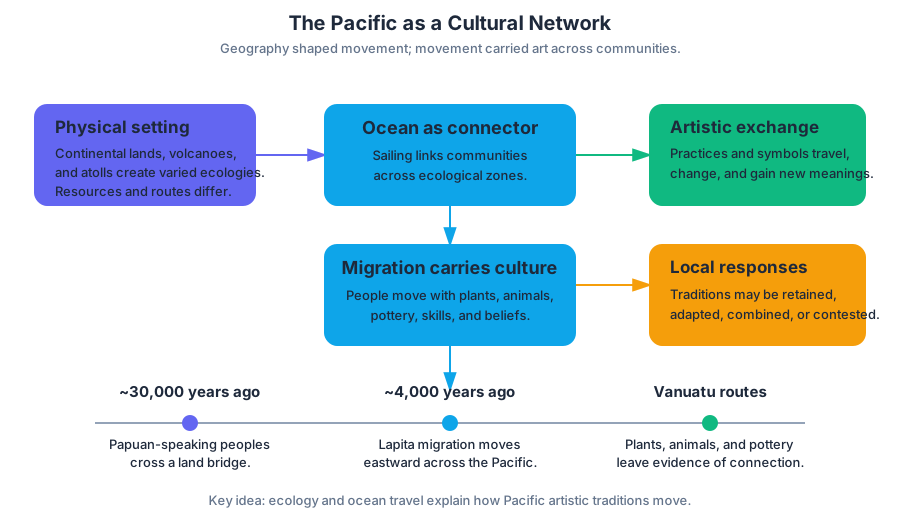
9.3 Theories and Interpretations of Pacific Art
Key concepts: Theories and interpretations of art change over time · Visual analysis as a basis for art-historical interpretation · Scholarship and the influence of other disciplines · Technology and availability of evidence in shaping interpretations · Pacific art as an expression of societal beliefs and social relations · Artworks as essential truths or compendia of information held by designated members of society · Social hierarchy in Pacific art · Ceremonial performance and sensory-rich ceremonial exchange · Systems of exchange and social order · The significance of creation, performance, and destruction of masks and costumes
A Pacific mask may be understood not as a permanently complete object but as part of a sequence: its creation, appearance in performance, evocation of ancestral memory, and eventual destruction can all communicate meaning.
9.3 Theories and Interpretations of Pacific Art
A Pacific mask may be understood not as a permanently complete object but as part of a sequence: its creation, appearance in performance, evocation of ancestral memory, and eventual destruction can all communicate meaning. The central question is therefore not only What does this object look like? but also What did it do, for whom, and under what conditions did its meaning become visible?
THR-1.A: Explain how theories and interpretations of works of art are shaped by visual analysis as well as by other disciplines, technology, or the availability of evidence.
Interpretation is an argument, not a label
An art-historical interpretation is an explanation of what an artwork means, how it functioned, or why it mattered in its society. Interpretations begin with visual analysis—careful attention to form, style, materials, content, and function—but they are also shaped by scholarship from other disciplines, available technology, and the evidence that survives.
A scholar might first observe the repeated forms, materials, or visual signs of a Pacific object. Anthropological research may then clarify social relationships; historical research may identify systems of exchange or ceremonial hierarchy; technological analysis may reveal how the object was made or altered. If new evidence appears—or if older evidence is reinterpreted—the art-historical argument may change.
The reasoning process can be pictured as a chain:
Visible evidence → contextual research → interpretation → art-historical argument
The arrow does not mean that interpretation becomes perfectly certain. It means that a strong interpretation makes its evidence and reasoning visible.
Why interpretations change over time
THR-1.A.26 establishes that theories and interpretations of art and art making change over time. They may be generated through visual analysis and through scholarship, then used, adapted, or even manipulated to make an argument about one work or a group of works.
This change is not automatically a weakness. Earlier scholars may have worked with limited documentation, misunderstood the social role of an object, or treated a performance object as if it were designed only for permanent display. Later researchers may gain access to oral histories, new technical methods, additional comparative evidence, or interpretations from disciplines that were previously absent.
Key distinction: A changed interpretation is not necessarily a changed artwork. The object, performance, or historical event may remain the same while the evidence and questions brought to it change.
Misconception check — “The first interpretation must be the original meaning.” Not necessarily. A modern museum label or early scholarly account is itself an interpretation. Art historians must ask who produced it, what evidence it used, and what evidence may have been unavailable.
Pacific art, social knowledge, and essential truths
Under THR-1.A.26, the arts of the Pacific can express beliefs, social relations, and essential truths. They may also function as compendia of information—concentrated bodies of knowledge—held by designated members of society. Meaning is therefore connected to authority: particular people may be responsible for preserving, interpreting, performing, or transmitting knowledge.
Pacific art is integrated with social hierarchies, ceremonial performances, systems of exchange, and social order. Its purpose and patronage cannot be separated from these relationships. Asking Who commissioned, owned, controlled, performed, or received this work? can reveal why its materials, appearance, and use mattered.
Creation, performance, and destruction
THR-1.A.27 emphasizes that acts of creation, performance, and even destruction can carry meaning. A mask or costume may communicate through its appearance during a ceremony, through the actions of the performer, and through the memories of cultural heroes or ancestors evoked by its forms.
Consider a hypothetical ceremonial mask. Its makers create it for a particular event; a designated performer activates it through movement and appearance; the audience recognizes ancestral or heroic associations; and the mask is later destroyed. The destruction does not simply erase meaning. It can produce a new iteration of memory, because the object’s disappearance becomes part of the cultural event.
The same object could therefore carry different meanings at different moments:
| Moment | What an interpretation must consider |
|---|---|
| Creation | Materials, makers, authority, and intended occasion |
| Performance | Movement, audience, ceremony, and evoked memory |
| Destruction | Ritual purpose, transformation, and the survival of memory |
The crucial caveat is context. Creation, performance, and destruction do not have one universal meaning. Their significance depends on the time, social setting, participants, and purpose of the object’s appearance.
Applying the AP skills
7.A: Describe art-historically relevant interpretations. A strong response identifies an interpretation that explains meaning, function, social relations, or reception—not merely an opinion such as “the mask is interesting.”
7.B: Explain how interpretations are derived from an analysis of a work’s form, style, materials, content, function, context, reception, and/or meaning. This skill requires the connective step: identify evidence, then explain how that evidence supports the interpretation.
For example: The object’s significance may extend beyond its physical form because its performance activates ancestral memory; its meaning is therefore connected to ceremony, designated cultural knowledge, and the social context of its appearance. The sentence earns analytical force by linking interpretation to function, context, and meaning.
Retrieval check
A Pacific object is newly documented through technical evidence and oral testimony. Explain why its interpretation might change, and identify one way its creation, performance, or destruction could communicate meaning. A complete answer should name visual analysis, connect the interpretation to evidence or scholarship, and explain the object’s social or ceremonial context.
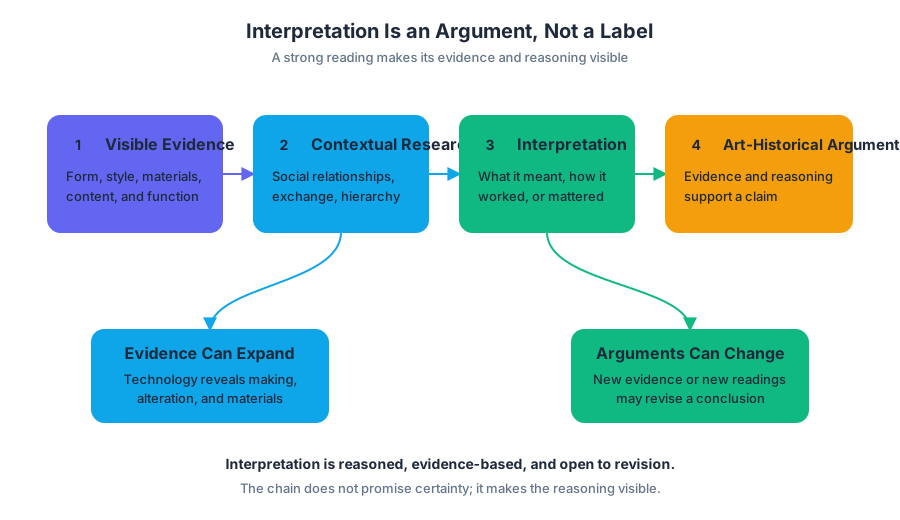
10.1 Course placement
A qualifying AP Art History score may lead to college credit, advanced placement, or both, but the result depends on the policy of the specific college or university—not on the AP score alone.
10.1 Course placement
A qualifying AP Art History score may lead to college credit, advanced placement, or both, but the result depends on the policy of the specific college or university—not on the AP score alone.
The practical question is therefore not simply “What score did I earn?” but “How will my college use that score?” One institution might award course credit, another might place a student into a more advanced art-history course, and a third might grant neither. Placement policies are local decisions made by colleges and universities.
What “course placement” means
Course placement is the use of an AP Exam result to determine where a student begins in a college curriculum. Placement can operate in two different ways:
- Credit: The institution counts the AP result as equivalent to one or more college courses or credits.
- Advanced placement: The institution allows the student to begin in a higher-level course without taking an introductory requirement.
- Both: Some institutions award credit and also permit enrollment in an advanced course.
These outcomes are not interchangeable. A student may receive enough credit to reduce the number of required courses but still need to complete a department-specific art-history requirement. Conversely, a student may be placed into a more advanced course without receiving the same number of transferable credits.
How the decision is made
AP Exams are administered each year in May. After scores are released, colleges interpret them according to their published policies. Those policies commonly specify the minimum score accepted, the amount of credit awarded, and the course or placement level associated with that score.
A useful way to model the process is:
| Evidence | Institutional decision |
|---|---|
| AP Art History score | Whether the score meets the college’s threshold |
| College policy | Number or type of credits awarded |
| Departmental rules | Whether the student may skip an introductory course |
| Degree requirements | Whether the credit satisfies a particular graduation requirement |
The same score can therefore produce different results at two institutions. The AP Program provides score reporting and recommended policy information, but each college establishes its own credit and placement rules.
Worked example: one score, three policies
Imagine a student earns a qualifying score on the AP Art History Exam and applies to three colleges:
- College A awards introductory art-history credit. The student completes fewer total credits but must check whether the awarded credit fulfills a humanities requirement.
- College B grants no direct credit but permits enrollment in an upper-level art-history course. The student begins beyond the introductory course while still completing the department’s required number of courses.
- College C recognizes the score only as elective credit. The student receives credit toward graduation, but the credit may not replace a required course in the major.
The correct conclusion is not that one college is “using the AP score properly” and another is not. Each institution is applying its own academic policy. Students must inspect the policy for the college they plan to attend.
Finding an institution’s policy
The AP Credit Policy Search is the designated place to look up college and university policies. A student should verify at least three details:
- the minimum AP score accepted;
- the amount and kind of credit awarded; and
- whether the result produces advanced placement, course exemption, or both.
Policies can also distinguish among majors, departments, or degree programs. A credit that counts toward general graduation requirements may not automatically substitute for a required course in an art-history major.
Misconception check: “A qualifying score guarantees college credit”
Misconception: Every qualifying AP score automatically earns the same college credit everywhere.
Correction: A qualifying score makes a student typically eligible to receive credit, placement, or both, but the college or university determines the exact outcome. Always treat the institution’s current published policy as the controlling information.
Why the course’s college-level character matters
AP Art History is developed collaboratively by college faculty and experienced AP teachers. These committees help shape the course and exam, establish scoring standards, and connect the course with college-level expectations. College faculty also review AP teacher syllabi.
That structure explains why the exam can function as evidence for placement: students analyze art across cultures and time, investigate history and symbolism, and practice visual analysis and interpretation. The score is not itself a universal college transcript; it is evidence that an institution may evaluate under its own rules.
Retrieval check
A student earns a qualifying AP Art History score. What must the student still determine before assuming the score will replace a college course?
Answer: The student must consult the specific college’s AP credit policy to determine the minimum accepted score, the amount and type of credit, and whether the score provides credit, advanced placement, or both.

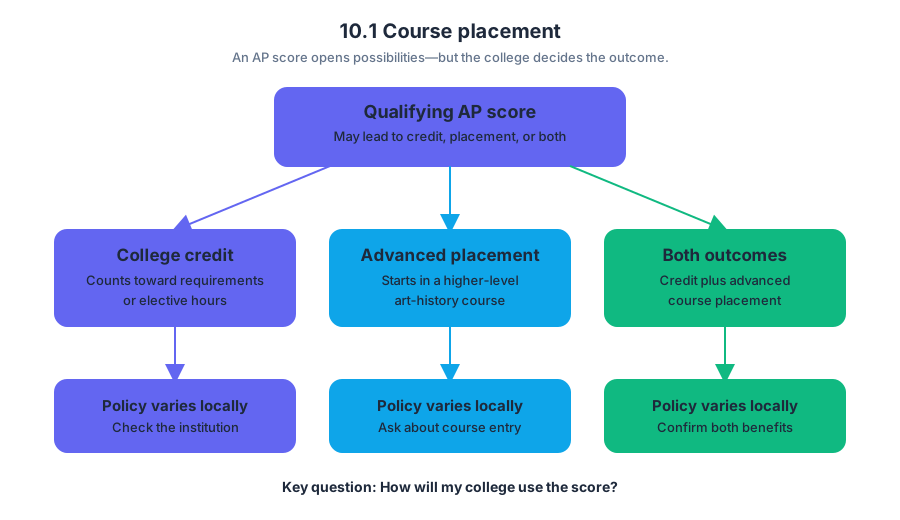
10.2 10.1–10.2 Topic entries
A contemporary artwork can be made from almost anything—photographs, video, industrial materials, found objects, digital media, or the human body—but its materials are never merely technical choices.
10.2 10.1–10.2 Topic entries
A contemporary artwork can be made from almost anything—photographs, video, industrial materials, found objects, digital media, or the human body—but its materials are never merely technical choices. They shape what viewers can see, how long a work survives, where it can exist, and what kinds of audiences it can reach.
Topics 10.1 Materials, Processes, and Techniques in Global Contemporary Art and 10.2 Purpose and Audience in Global Contemporary Art therefore belong together. The first asks how a work is made and what that making permits; the second asks what the work is trying to do and for whom. The relevant skill emphasis includes 1.C, 2.B, 2.C, 2.D, 3.A, 3.B, 5.A, and 5.B.
10.1 Materials, Processes, and Techniques
Materials are the physical or digital substances used to make an artwork. Processes are the actions applied to those materials, while techniques are the specific methods through which those actions are controlled. In contemporary art, this distinction matters because the artwork may be temporary, reproducible, participatory, technologically mediated, or assembled from materials that carry strong social associations.
A photograph, for example, is not simply an image of something. Its production may involve staging, lighting, digital manipulation, printing, installation, and careful control of scale. A large photographic image placed in a gallery produces a different encounter from the same image viewed on a phone: the material presentation changes the viewer’s physical relationship to the work.
Skill 1.C: Explain how artistic decisions about materials, processes, and techniques shape an artwork’s meaning and function. Do not stop at identifying a medium. Connect the medium to an effect: an installation assembled from discarded consumer objects may make consumption physically visible; a video work may depend on duration and repeated viewing; a digital image may deliberately question whether an “original” object is necessary.
Skill 3.A: Identify and describe features of an artwork using appropriate visual or contextual evidence. Skill 3.B: Explain how those features contribute to the work’s meaning. A strong response moves from observation to interpretation: “The work uses repeated manufactured objects” is description; “the repetition suggests standardized production and invites criticism of mass consumption” is analysis.
Worked contextual example: a site-specific installation
Imagine a contemporary artist fills a gallery with discarded plastic containers collected from a nearby coastline. The materials establish a local environmental context; the collecting process turns research into part of the artwork; and the installation technique transforms individual objects into an immersive field through which viewers must walk.
The reasoning chain is: material—discarded plastic—connects the work to pollution and consumer culture; process—collection and sorting—documents human responsibility; technique—repetition and spatial arrangement—changes scattered waste into an overwhelming visual experience. The work’s meaning does not come from the objects alone. It emerges from the relationship among substance, method, site, and viewer.
Misconception check — “The medium determines the meaning.” A material does not carry one fixed interpretation. Plastic can signify convenience, pollution, industry, memory, or abundance depending on how it is used, where it is shown, and what cultural circumstances surround it.
10.2 Purpose and Audience
Purpose is what an artwork is intended to accomplish; audience is the individual or group expected to encounter, use, interpret, or respond to it. Contemporary artists may address museum visitors, online communities, political authorities, local residents, consumers, or audiences who will never encounter the work in person.
Skill 2.B: Explain how an artwork’s purpose and intended audience relate to its form and content. Skill 2.C: Explain how context can affect an artwork’s meaning. Skill 2.D: Explain how an artwork’s meaning may change for different audiences. These skills prevent a common mistake: treating personal reaction as sufficient evidence. Interpretation must be anchored in visible choices and relevant context.
Consider a public artwork that projects changing text onto the exterior of a government building. Its scale and location make the work visible beyond the museum-going public; its temporary projection allows the artist to intervene without permanently altering the structure; and its changing language may invite debate rather than deliver one fixed message. The intended audience includes passersby, residents, officials, and online viewers who encounter documentation of the event.
Skill 5.A: Identify a work’s relationship to a larger artistic tradition or historical pattern. Skill 5.B: Explain how an artwork continues, transforms, or challenges that tradition. A contemporary installation may extend traditions of monument, protest image, portraiture, or ritual object while changing their location, materials, or audience. Contemporary art is not detached from history; it often makes historical forms newly unstable.
Misconception check — “Contemporary art has no audience if it is difficult to understand.” Difficulty may be intentional. A work can ask viewers to investigate, participate, disagree, or recognize that different communities possess different knowledge. Confusion is evidence of an interpretive problem to solve, not proof that the work lacks purpose.
Retrieval check
A work uses fragile organic material, exists for only one day, and is documented online for a worldwide audience. Name one way the material affects meaning, one way the process affects meaning, and one way the audience changes the work’s interpretation. A complete answer links each claim to a specific feature rather than merely labeling the work “temporary” or “interactive.”

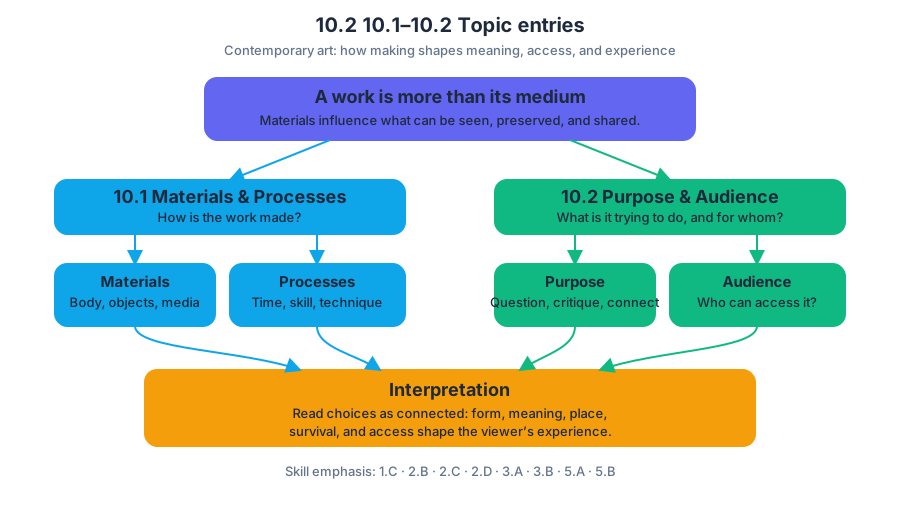
10.3 10.3 Interactions Within and Across Cultures in Global Contemporary Art
Key concepts: Cultural interaction and exchange in global contemporary art · The influence of other cultures on art and art making · Global interconnectedness and a shift away from Eurocentric art history · African artistic and cultural contributions across the diaspora · Appropriation and mash-ups in contemporary art · The treatment of culturally sacred objects through revaluation or devaluation · Digital technology’s role in expanding access to artists, artworks, and contextual information · Activism challenging the privileged place of white, heterosexual men in art history · Deconstructionist and feminist theories supporting art-historical activism · Global contemporary art from 1980 CE to the present
Contemporary art is made inside a web of cultural exchange: images, beliefs, materials, identities, and political ideas move across borders, while artists reshape them for new communities and purposes.
10.3 10.3 Interactions Within and Across Cultures in Global Contemporary Art
Contemporary art is made inside a web of cultural exchange: images, beliefs, materials, identities, and political ideas move across borders, while artists reshape them for new communities and purposes. The Global Contemporary period, approximately $1980$ CE to the present, therefore cannot be understood through an exclusively European or North American storyline.
Enduring Understanding INT-1: A variety of factors leads to and motivates interaction between and among cultures, and this interaction may influence art and art making.
The key question is not simply “Which culture influenced this artwork?” but how did interaction change what was made, how it was made, and how viewers understood it? A useful answer must identify the cultural exchange, connect it to visible or conceptual features, and explain the historical conditions that made the exchange possible.
A global, interconnected art history
Cultural interaction means that artistic ideas, practices, symbols, and beliefs encounter one another and produce effects. The exchange may be voluntary, forced, celebratory, commercial, religious, political, or technologically mediated. It does not automatically create equality: one culture may borrow from another while suppressing, stereotyping, or profiting from the people whose traditions it uses.
The CED learning objective INT-1.A asks students to “Explain how interactions with other cultures affect art and art making.” Its essential knowledge, INT-1.A.18, emphasizes the global circulation of African creative contributions. African people and beliefs have carried artistic practices across locations from Macao to Manaus to Mauritania. These contributions appear in diverse forms, including Santeria, Japanese screens, Renaissance Venetian painting, the literature of Negritude, and the Harlem Renaissance.
This range matters because “African influence” is not limited to a recognizable traditional sculpture or mask. Cultural contributions can appear in religious practice, literature, painting, screen design, performance, music, visual symbolism, and ideas about race and place. The Negritude movement and the Harlem Renaissance, for example, expanded how artists and writers represented Black identity, diaspora, cultural memory, and geographic belonging.
Contemporary African arts have also increased global awareness of the continent’s artistic production. Digital technology intensifies this change by giving viewers greater access to imagery and contextual information about diverse artists and artworks throughout history and across the globe. Access can broaden art history, but it does not eliminate the need to ask who controls the image, who supplies its context, and whose interpretation receives authority.
From Eurocentric history to global interconnectedness
A Eurocentric art history treats European traditions as the central standard and places other cultures at the margins or describes them mainly through European influence. A global approach instead recognizes multiple centers of innovation and examines circulation in more than one direction. Activism, postcolonial critique, deconstructionist theory, and feminist theory have challenged the traditional privileged position of white, heterosexual men in the writing and display of art history.
Deconstructionist theories question apparently stable categories—such as “high art,” “primitive art,” “artist,” or “masterpiece”—by examining the assumptions and power structures behind them. Feminist theories investigate how gender shapes artistic production, authorship, visibility, labor, and interpretation. Together with activism, these approaches have encouraged museums and scholars to reconsider which artists, cultures, and forms of knowledge receive attention.
Appropriation, mash-ups, and sacred meaning
Appropriation is the reuse of an existing image, symbol, object, style, or cultural practice in a new artwork. A mash-up combines elements from different cultural or visual sources. These strategies can revalue a neglected tradition by giving it visibility, or devalue a sacred object by stripping it from its community, ritual, and meaning.
The same visual act can therefore produce competing interpretations. An artist may place a culturally sacred form in a contemporary installation to expose colonial collecting or restore its significance. Another artist—or a commercial institution—may use the same form as decoration, treating a living belief system as an exotic design resource.
Worked contextual example: Imagine a contemporary artist combining a sacred symbol from an African diasporic practice with advertising graphics and digital projections. First, identify the interaction: a religious or culturally specific image is entering a global media environment. Next, identify the artistic effect: the mash-up may make the symbol visible to new audiences and criticize commercialization. Finally, evaluate the ethical tension: if the work supplies cultural context and collaborates with practitioners, it may revalue the tradition; if it removes the symbol from ritual meaning and presents it as exotic decoration, it may devalue it.
Skills in action
This topic most directly activates the suggested Skill 4: Artistic Traditions, especially 4.A, 4.B, and 4.D, which focus on explaining relationships of continuity and change within and across artistic traditions. A strong response does three things: identifies the traditions involved, points to evidence of borrowing or transformation, and explains why the interaction matters in its historical context.
It also draws on Skill 2: Contextual Analysis when connecting an artwork to diaspora, activism, digital circulation, colonial history, religion, or identity; Skill 3: Comparison of Works of Art when distinguishing respectful revaluation from extractive appropriation; and Skill 8: Argumentation when making a defensible claim supported by visual and contextual evidence.
Misconception check: Cultural similarity does not automatically prove direct borrowing. An argument about influence needs evidence of contact, circulation, shared practice, or a historically plausible connection—not merely a resemblance.
Retrieval check
An artist combines a sacred object’s form with consumer imagery. Give one reason the work could revalue the object and one reason it could devalue it. Then name the evidence you would need before deciding which interpretation is stronger.
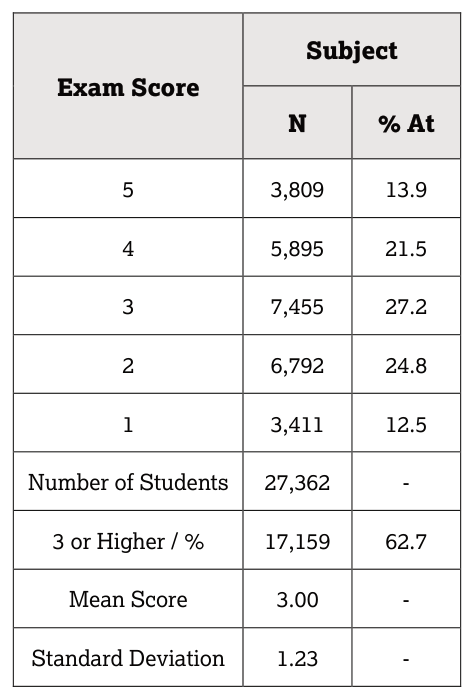
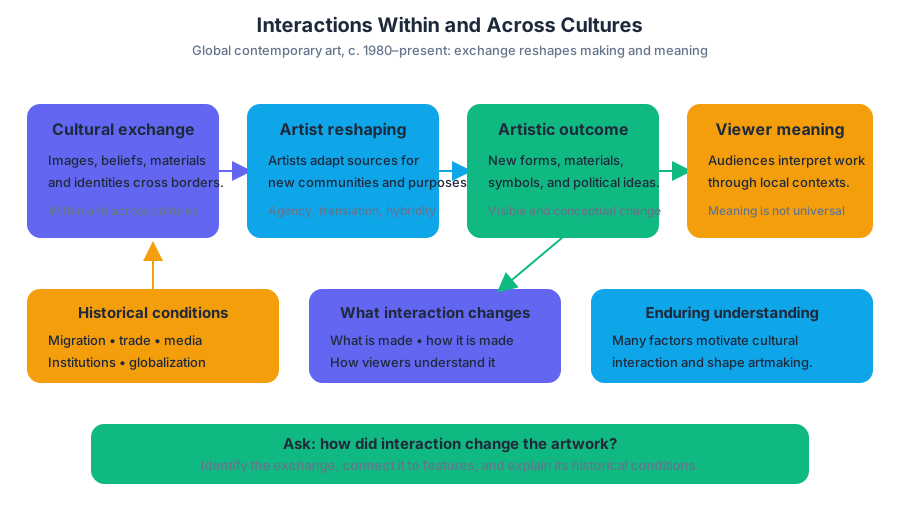
AP Practice 1
Key concepts: AP course clarity and transparency · AP opposes indoctrination and rewards evidence-based analysis rather than agreement with a viewpoint · Respectful evaluation of diverse perspectives and backgrounds · Using primary sources to study experiences and identities · AP college credit and placement policies · Becoming an AP Reader and its professional benefits · AP Classroom customized tests and feedback · Digital activation and AP class-section registration · AP ID labels and reduced exam-day bubbling · Personal Progress Checks and instructional planning reports
AP Art History is designed to make evidence, not personal agreement, the basis of academic judgment. Its public course frameworks, required works, sample questions, and scoring information show students what kinds of knowledge and reasoning the course values before they take the exam.
AP Practice 1
AP Art History is designed to make evidence, not personal agreement, the basis of academic judgment. Its public course frameworks, required works, sample questions, and scoring information show students what kinds of knowledge and reasoning the course values before they take the exam.
Core principle: AP points reward an answer’s accurate use of evidence and reasoning—not agreement with a particular cultural, political, religious, or personal viewpoint.
That distinction matters when studying art connected to identities, religions, ethnicities, nationalities, or contested histories. A student may analyze a work’s function, symbolism, historical setting, or reception without being required to adopt the beliefs represented by the work or to share the interpretation of another student.
Evidence-based analysis is not viewpoint conformity
Indoctrination means pressuring people to accept a particular viewpoint without allowing independent evaluation. AP’s stated approach is the opposite: students analyze perspectives different from their own, assess the credibility of sources, draw conclusions, and make up their own minds.
In an art-historical discussion, “I agree with this belief” is not yet analysis. A stronger response identifies a visible or documented feature, connects it to a historical context, and explains what that evidence suggests.
Worked example: Suppose a student is asked to interpret a ceremonial object associated with a religious community. An evidence-based answer might proceed as follows:
- Observe: Identify the object’s materials, scale, imagery, and setting.
- Contextualize: Explain how its use relates to the community’s ritual or social structure.
- Evaluate: Distinguish between what the object itself demonstrates and what a written source claims about it.
- Conclude: Make a qualified interpretation supported by the strongest available evidence.
The answer earns value through the chain from evidence to conclusion. It does not earn value because the writer praises, condemns, or personally identifies with the object’s beliefs.
Respectful disagreement and diverse perspectives
AP classrooms encourage students to evaluate arguments rather than one another. Students can challenge an interpretation by questioning its evidence, assumptions, or logic, while still treating classmates’ backgrounds and perspectives with respect.
A useful distinction is:
| Evaluate | Do not attack |
|---|---|
| “The source was produced much later, so its account may reflect later priorities.” | “You are wrong because of who you are.” |
| “The visual evidence supports a political function more strongly than a purely decorative one.” | “Only someone with your background would interpret it that way.” |
| “This interpretation overlooks the object’s original audience.” | “Your identity makes your argument invalid.” |
Misconception check — “Open-minded” means “every interpretation is equally strong.” It does not. Respect requires listening fairly; art-historical reasoning still requires testing claims against visual, historical, and primary-source evidence.
Primary sources and independent judgment
Studies of different cultures and experiences are grounded in primary sources—evidence produced within or close to the historical situation being studied. In art history, these may include the artwork itself, inscriptions, archival records, contemporary criticism, photographs, contracts, or accounts by participants and observers.
Primary sources do not automatically tell one uncomplicated truth. Their authors, audiences, purposes, and omissions must also be evaluated. The goal is not merely to repeat a source but to ask what it can reliably establish.
Retrieval check: A museum label claims that an object was “used exclusively for private devotion.” Name two questions that would help test the claim independently. A strong response might ask who wrote the label, when it was written, what evidence supports “exclusively,” and whether the object’s scale or wear suggests public use.
Transparency, access, and AP participation
Teachers and students can consult public AP course frameworks and sample exams to understand course expectations. AP Classroom extends that transparency into daily practice: teachers can locate questions by topic and skill, assemble customized tests, assign them online or on paper, and give feedback on individual questions.
Digital activation connects course participation with exam administration. Teachers and students sign in to My AP; teachers confirm course-audit approval, teachers or AP Coordinators establish class sections, and students join with a teacher- or coordinator-provided join code.
When students join their first section, they provide registration information. The AP ID links exam materials to that registration information, reducing pre-administration sessions and the amount of bubbling required on exam day. Digital activation also gives students and teachers access to AP resources and supports exam registration and ordering.
College credit and professional participation
A qualifying AP score may lead to college credit, placement into advanced courses, or both, but colleges and universities set their own policies. Students should therefore use the AP Credit Policy Search and then verify the policy with each institution, especially for differences between credit, placement, and degree requirements.
Teachers can also become AP Readers, who score AP Exam responses using established standards. Reading can expose teachers to scoring expectations and student responses while helping them bring informed, positive changes to classroom instruction. It is professional development tied directly to how evidence-based reasoning is evaluated.
Final interpretation check: Why can two answers that express opposing viewpoints both receive credit? Because the scoring target is not ideological agreement; it is the accurate use of relevant evidence, disciplinary reasoning, and a defensible conclusion.

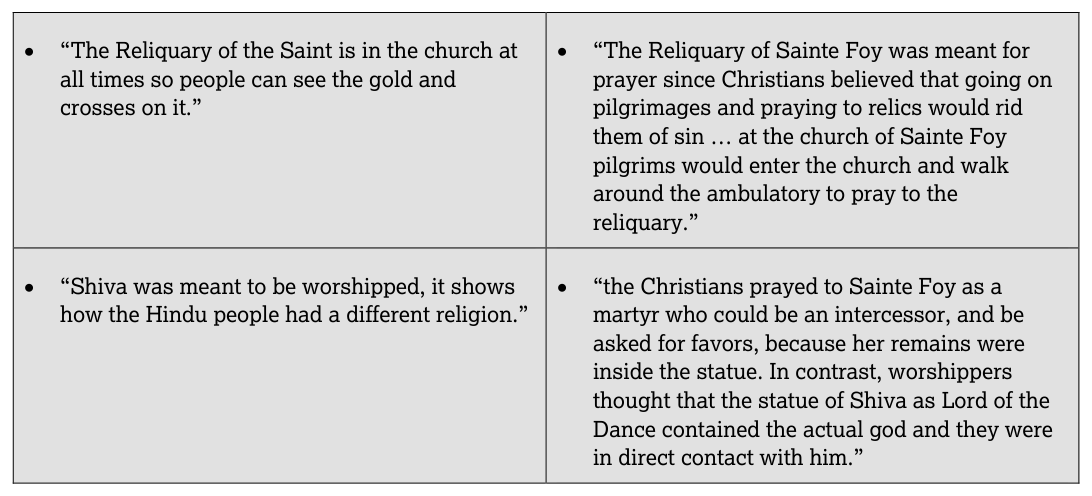
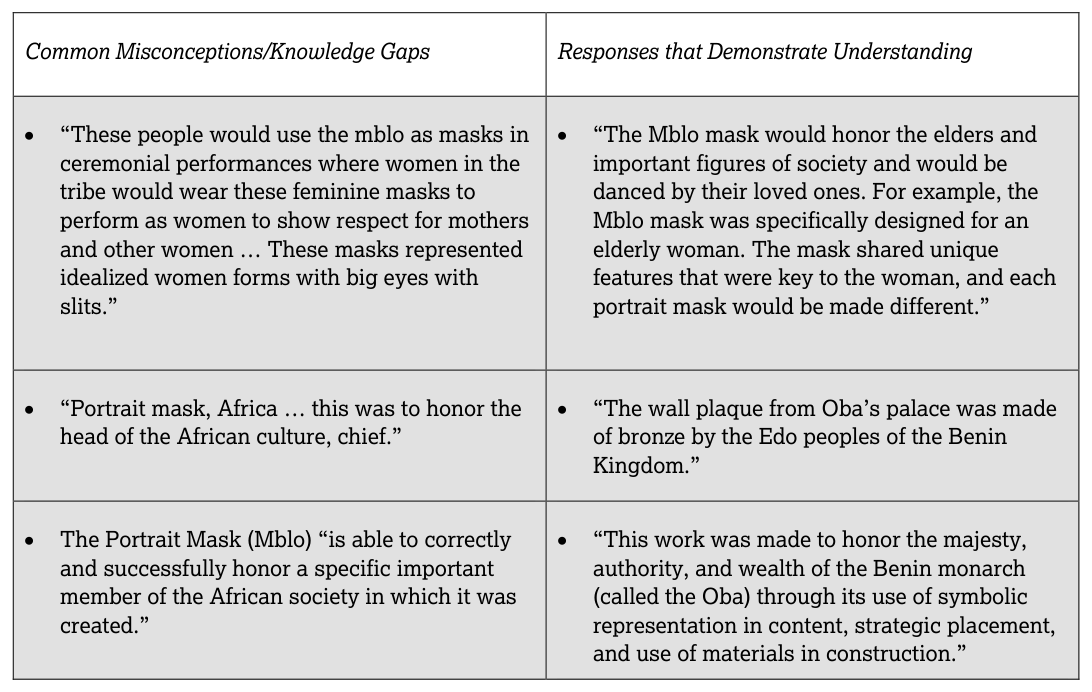
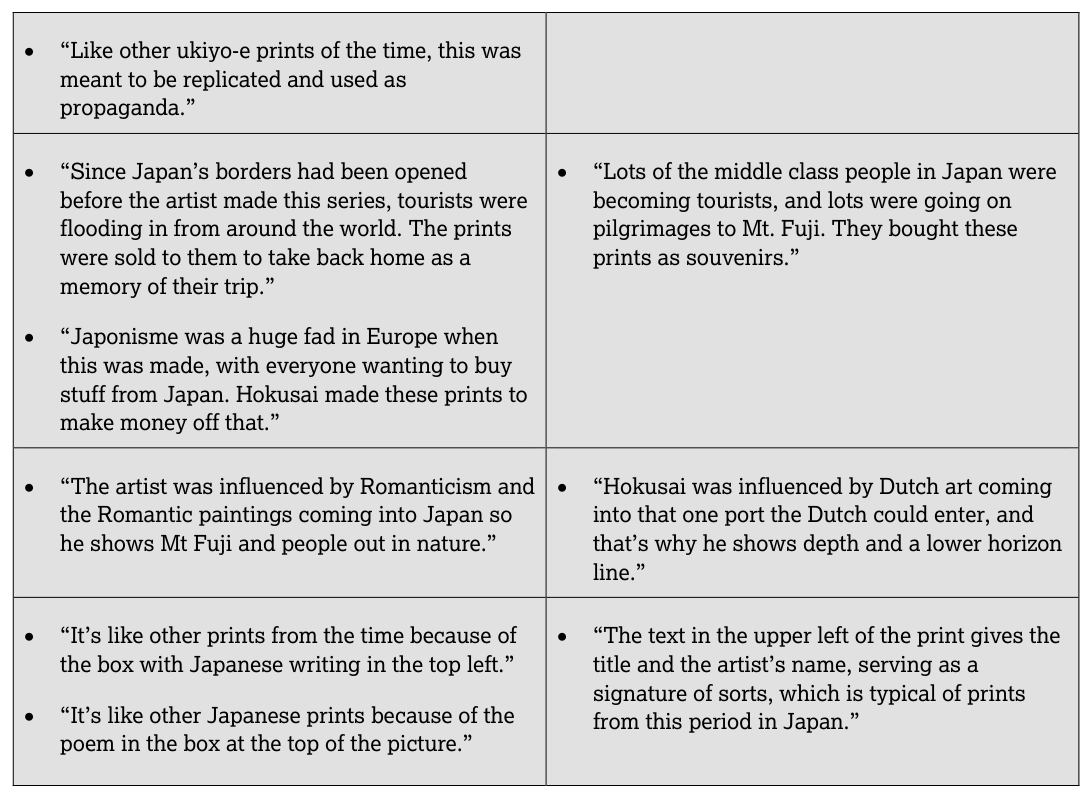
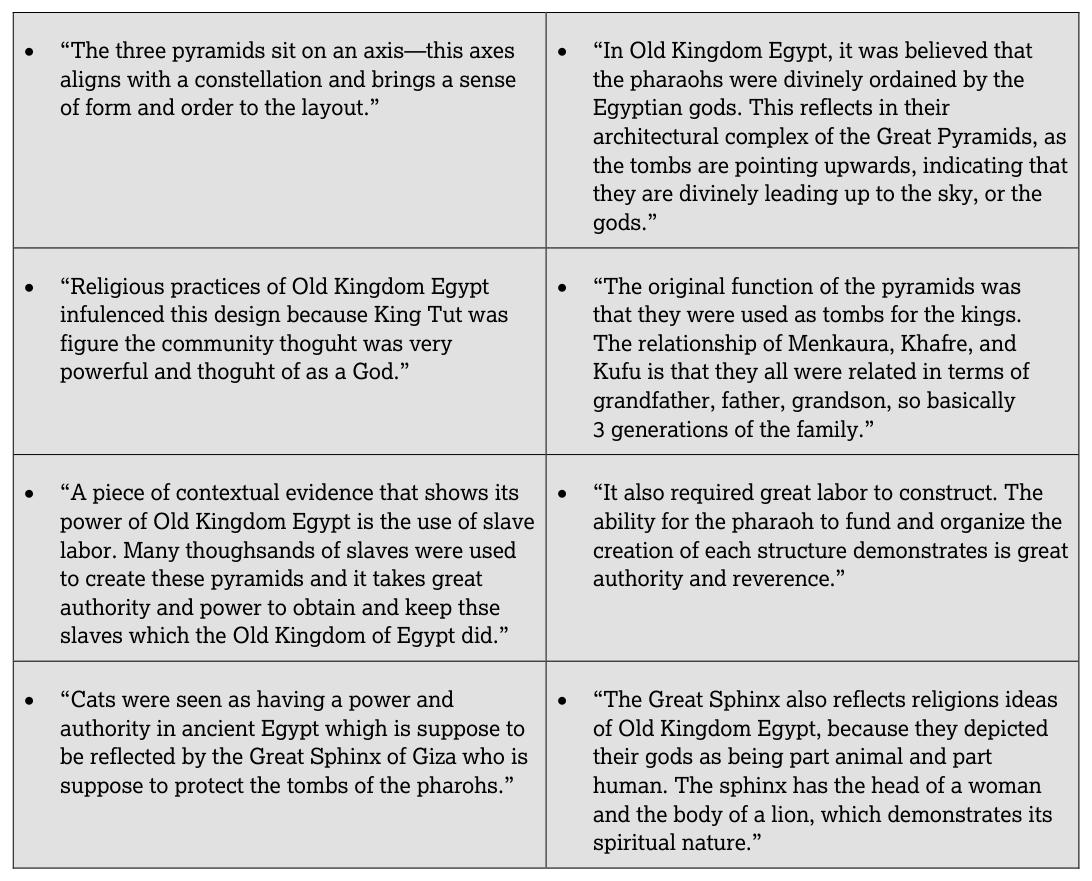
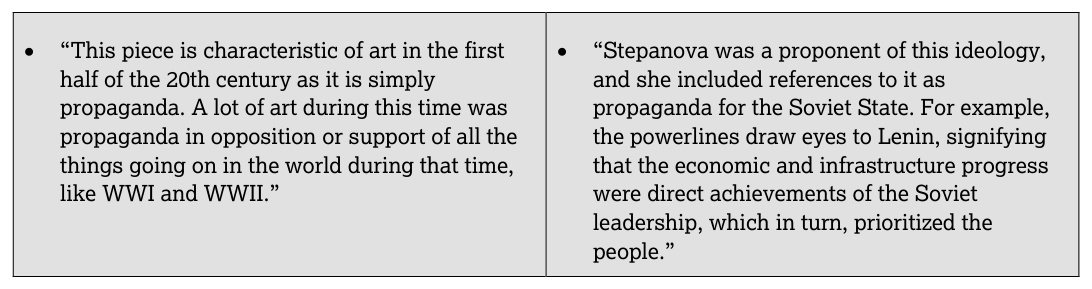
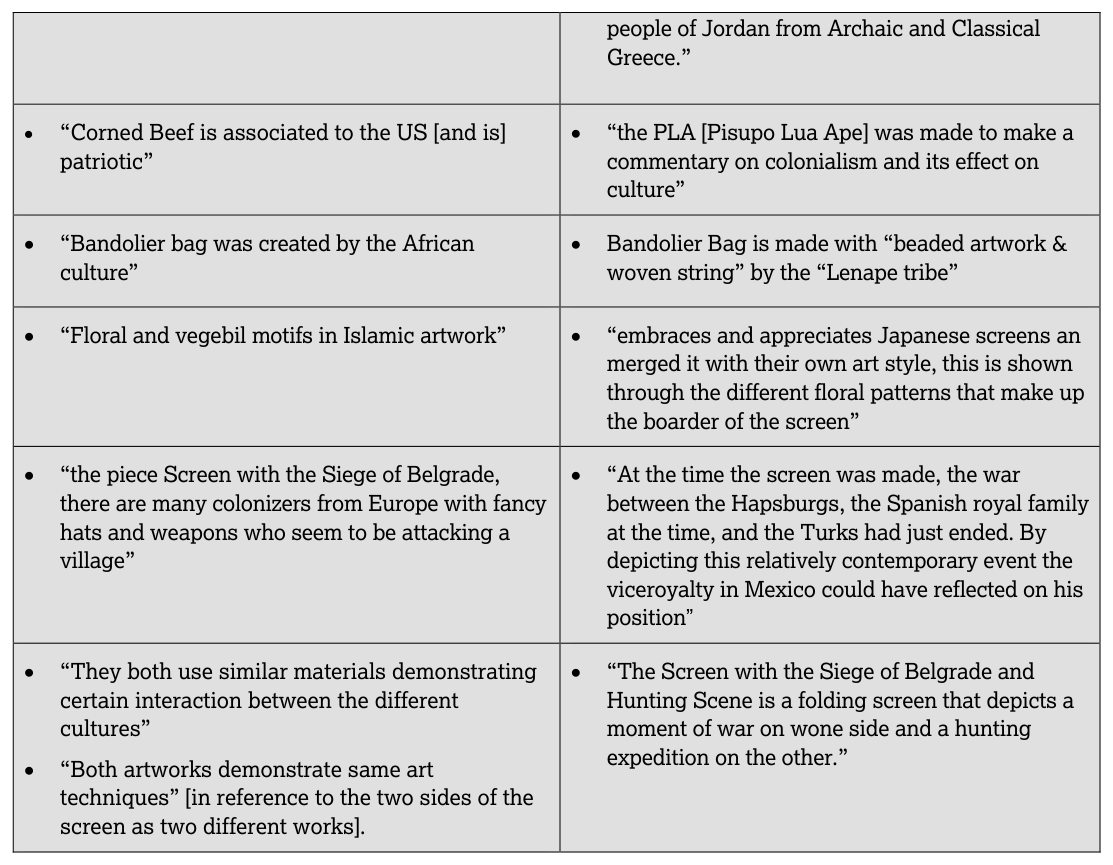
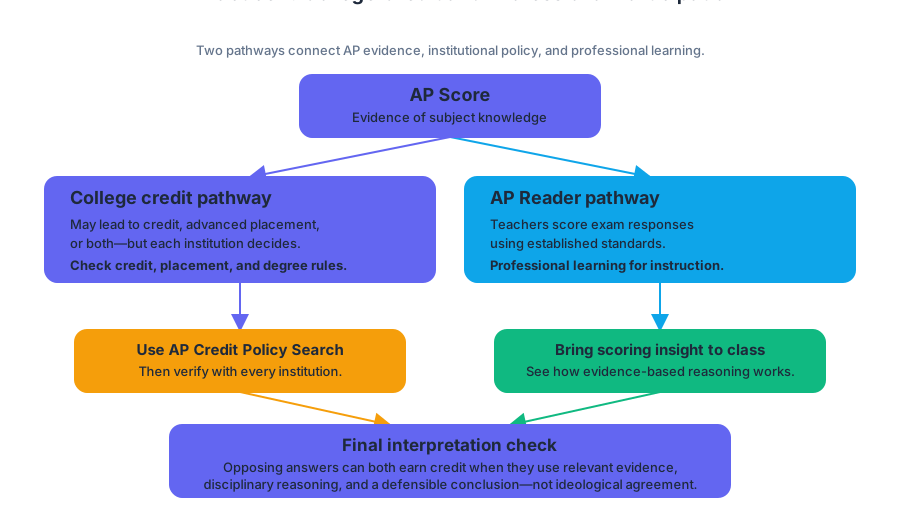
AP Practice 2
Key concepts: Visual analysis of art and architecture · Purpose and intent shaping creation and meaning · Continuity and change within artistic traditions · Comparison of related works of art · Contemporary art museums, galleries, biennials, and triennials · The worldwide proliferation of contemporary art institutions · Sacred spaces and communal worship · Political power and imperial rule in art · Contrapposto in classical sculpture · AP Art History work identification and accurate identifiers
A successful AP Art History long essay does more than recognize an artwork: it explains how visual choices, purpose, audience, and historical context produce meaning.
AP Practice 2
A successful AP Art History long essay does more than recognize an artwork: it explains how visual choices, purpose, audience, and historical context produce meaning. The central move is to turn observation into interpretation—what do I see? becomes why might the artist, patron, or culture have made it this way?
The core reasoning chain
Use this four-step chain when analyzing an unfamiliar work or comparing related works:
- Visual analysis: identify materials, pose, composition, scale, color, space, technique, and subject.
- Purpose and intent: explain what the work was made to do—commemorate, worship, persuade, challenge, display status, or communicate an idea.
- Tradition: connect the work to a related style, practice, or artistic lineage.
- Significance: explain what the continuity or change means in its cultural, political, religious, or social setting.
A description names visible facts: “The figure stands with one leg relaxed.” Analysis adds significance: “The relaxed leg and shifted weight create contrapposto, presenting the body as balanced but active; this idealized anatomy connects the sculpture to Greek Classical ideas about proportion and human excellence.”
Description answers what is visible. Analysis explains how those choices create meaning or significance.
Worked comparison: Polykleitos’s Doryphoros
Identify the work completely before interpreting it: Doryphoros (“Spear Bearer”), by Polykleitos, approximately $450$–$440$ BCE in its original Greek form, known through a Roman marble copy of a Greek bronze original. It is a nude, muscular male athlete in a contrapposto stance, with the body’s weight shifted onto one leg while the other relaxes.
A weak response stops at inventory: “The sculpture is nude, muscular, and standing.” A stronger response connects form to artistic tradition: the controlled weight shift, idealized anatomy, and carefully balanced proportions embody Classical Greek interest in an ordered, rational image of the human body. The Roman copy also demonstrates continuity: Roman artists and patrons preserved and circulated Greek sculptural ideals.
The work’s meaning is therefore not simply “an athlete.” Its ideal body can signify discipline, excellence, and a culturally valued model of human achievement. The distinction between the lost Greek bronze and surviving Roman marble also reveals change in material and historical setting: the same artistic ideal continued, but its physical form and audience changed.
Purpose can reshape meaning
A sacred complex does not function like a detached statue in a gallery. Monumental Buddhist sculpture, including complexes associated with Buddha images and the Great Buddha at Todai-ji, can occupy spaces designated for communal worship. Architecture organizes movement, attention, and access, turning the image into part of a shared religious experience rather than merely an object to inspect.
Purpose can also be political. Monumental Buddhist images at Longmen, associated with imperial patronage such as Empress Wu Zetian, demonstrate how religious art could reinforce the political power of imperial rule. The correct interpretation is not that religious and political meanings are mutually exclusive: sacred imagery could support devotion while also presenting the ruler as powerful, legitimate, and connected to Buddhist authority.
Purpose is evidence, not decoration. Ask who commissioned the work, where it was placed, who encountered it, and what behavior or belief the setting encouraged.
Continuity and change: the comparison engine
Skill 4.A. Explain how a specific work of art (or group of related works of art) demonstrates continuity and/or change within an artistic tradition, style, or practice. Begin by naming the tradition, then identify what persists and what shifts.
Skill 4.D. Explain the meaning or significance of continuity and/or change between works of art (or groups of related works of art) within a related artistic tradition, style, or practice. Do not merely state “the works are similar” or “the later work is different.” Explain why the similarity or difference matters.
| Move | Too weak | AP-ready reasoning |
|---|---|---|
| Describe | “Both works show human figures.” | “Both use the body as a vehicle for cultural ideals.” |
| Compare | “One is more realistic.” | “Both idealize the body, but Doryphoros stabilizes movement through contrapposto, while a later work may intensify motion to express a changed social or political world.” |
| Interpret | “This shows change.” | “The change matters because the altered pose shifts emphasis from rational balance toward emotional intensity or conflict.” |
Contemporary institutions and global comparison
Contemporary art is not confined to a few European or North American museums. Museums, galleries, biennials, and triennials have proliferated worldwide, creating new spaces for artists to address migration, identity, colonial history, technology, and global exchange. The institution itself can shape meaning by changing scale, audience, circulation, and interpretation.
This is useful when comparing works such as Basquiat’s expressive street-derived symbols, Song Su-nam’s gestural ink practice, Magdalena Abakanowicz’s soft sculptural forms, and Xu Bing’s meticulously crafted unreadable pseudo-text in A Book from the Sky. Their materials and marks differ, but each work asks viewers to reconsider how cultural traditions, language, and artistic authority operate.
Original practice prompt
Prompt: Select Doryphoros and one contemporary work from the examples above. Explain how each work uses its visual characteristics and relationship to an artistic tradition to communicate meaning. Discuss one continuity and one change between the works. Include at least two accurate identifiers beyond the title for the selected contemporary work.
Worked response plan: Identify Doryphoros as a Roman marble copy of Polykleitos’s Greek bronze original, approximately $450$–$440$ BCE, then identify the contemporary work with artist, date or period, material, culture, or style. Describe specific evidence—such as contrapposto, unreadable pseudo-text, gestural marks, or nontraditional soft materials. Explain how that evidence produces meaning, and end by connecting the change to the contemporary work’s altered purpose, audience, or institutional setting.
Error check
Common misconceptions include treating visual description as interpretation, assuming sacred art cannot communicate political power, calling Doryphoros an original Greek marble, and naming only a title when the prompt requires additional identifiers. Before submitting, underline each claim and draw an arrow to the visual or contextual evidence that proves it.
Timing and review: Reserve roughly $15$–$20$ minutes for a long essay of this type. During review, label every sentence V for visual evidence, C for context, R for reasoning, or I for identification. If a paragraph contains only V and I, revise it by adding the missing explanation of how or why.

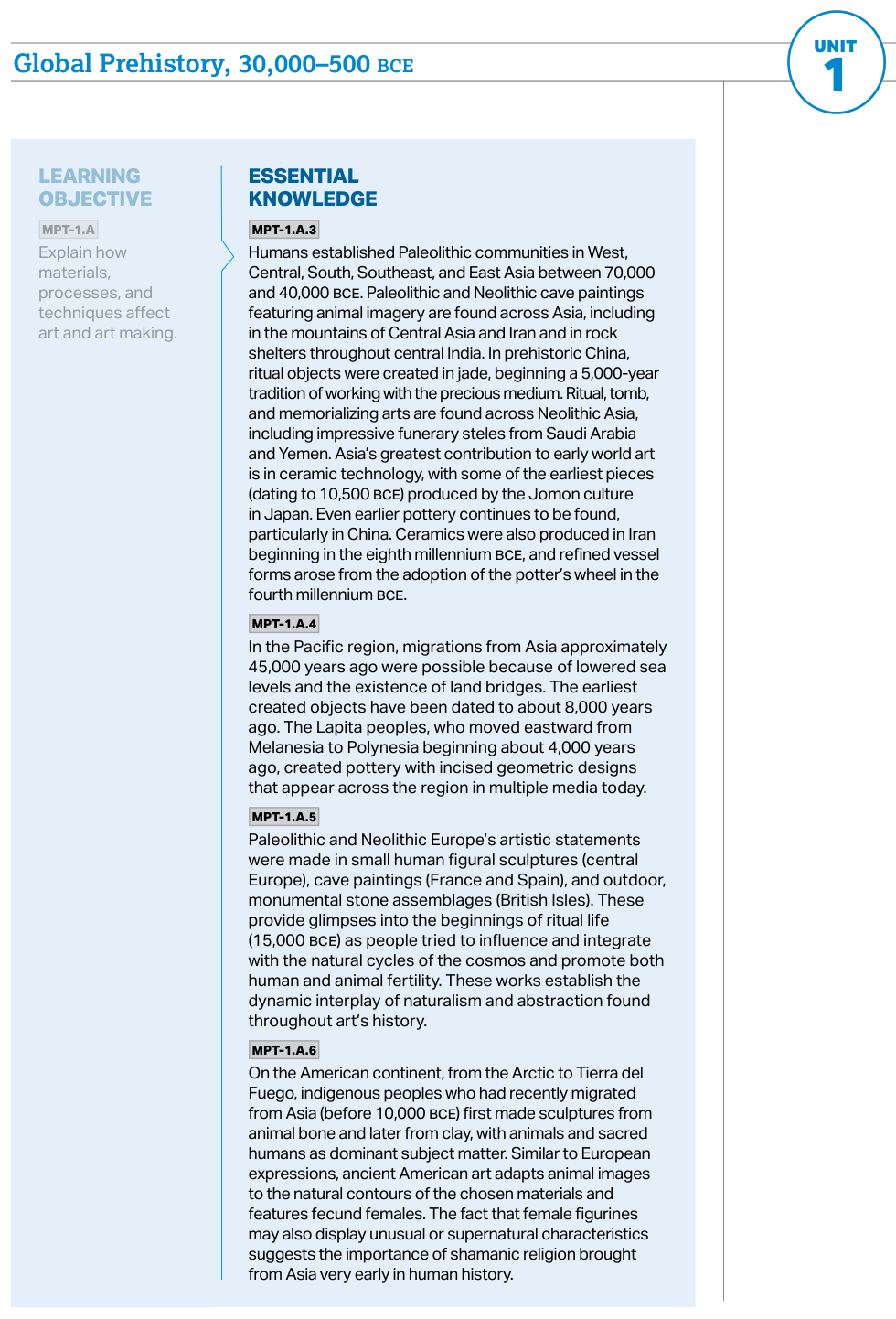
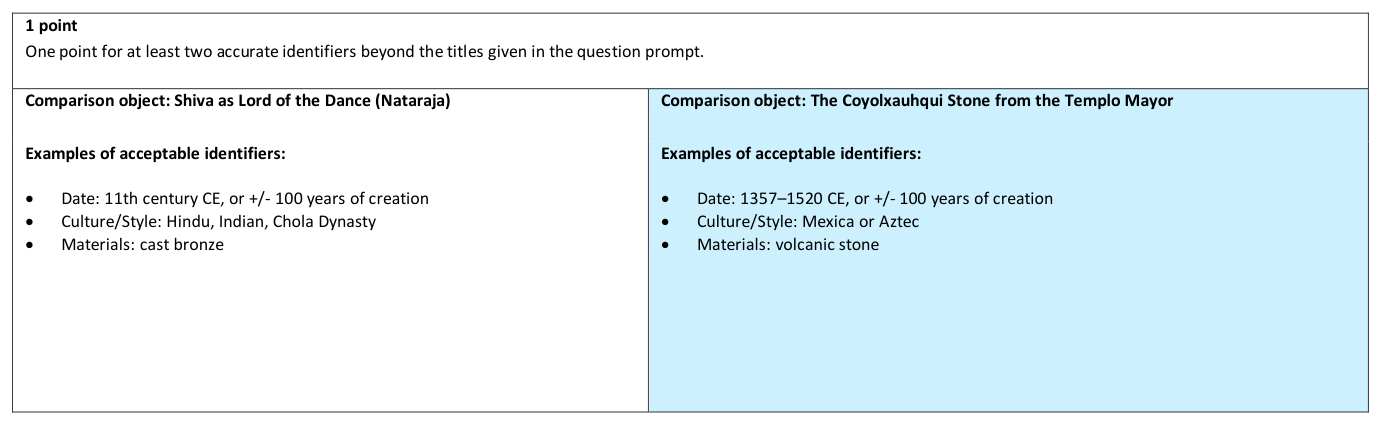
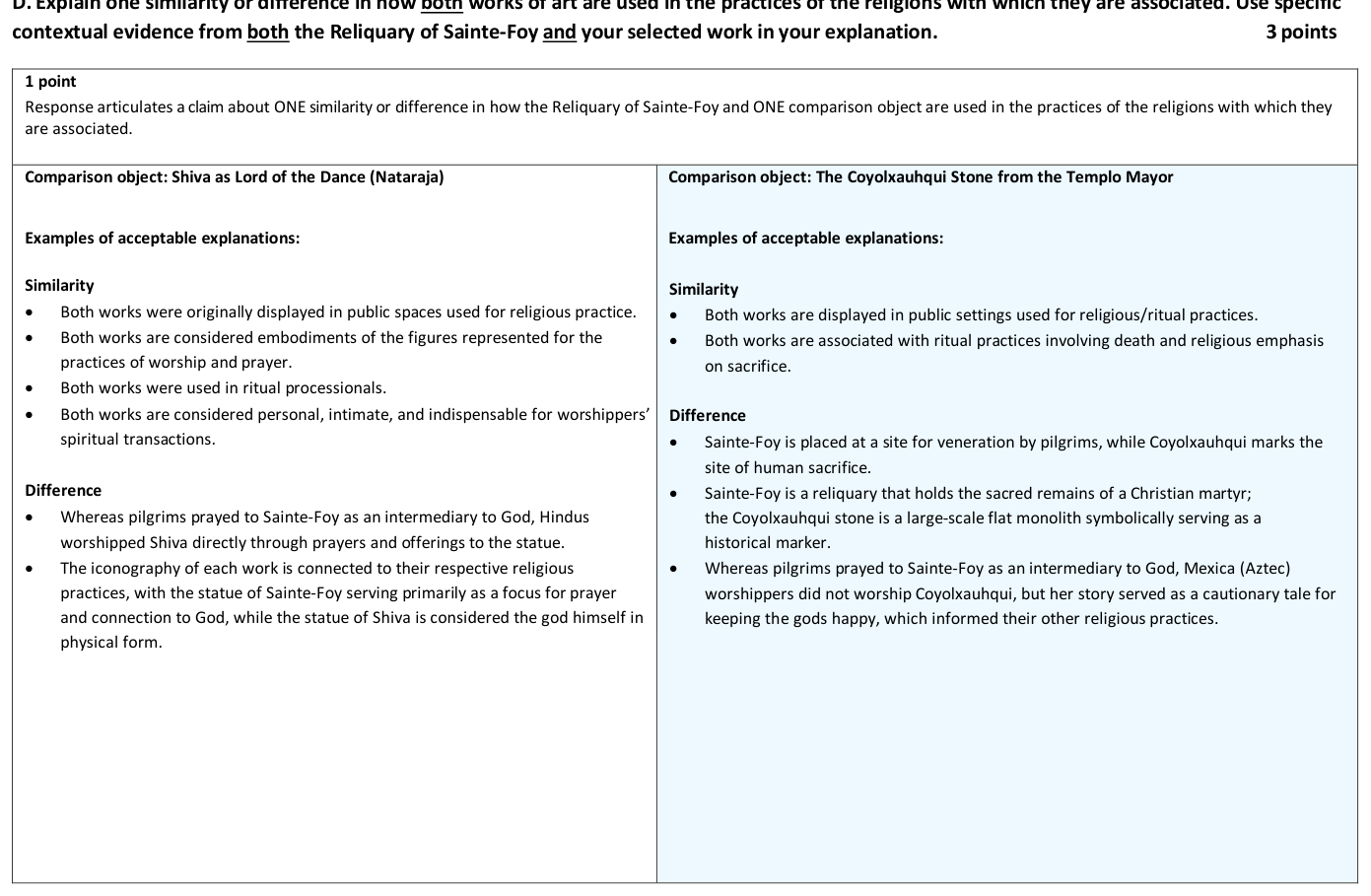
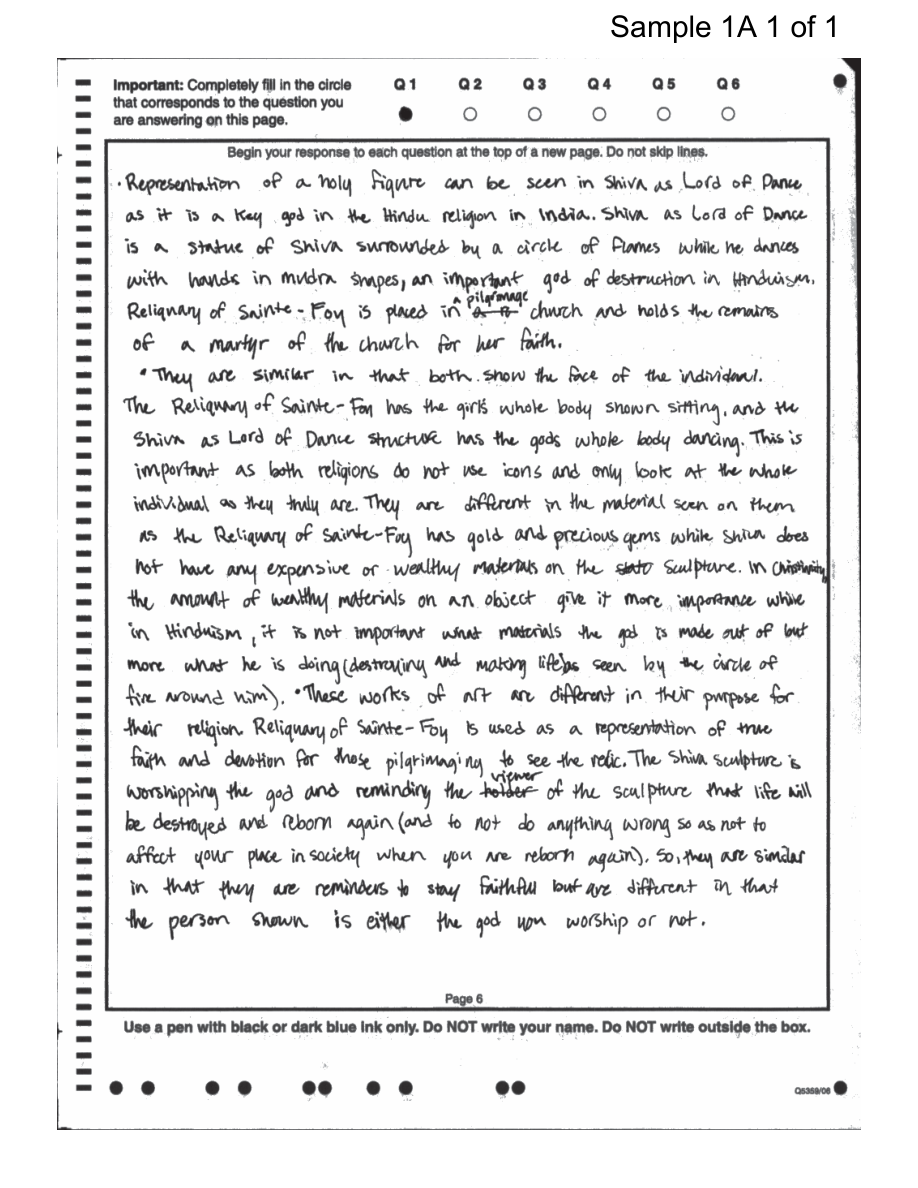
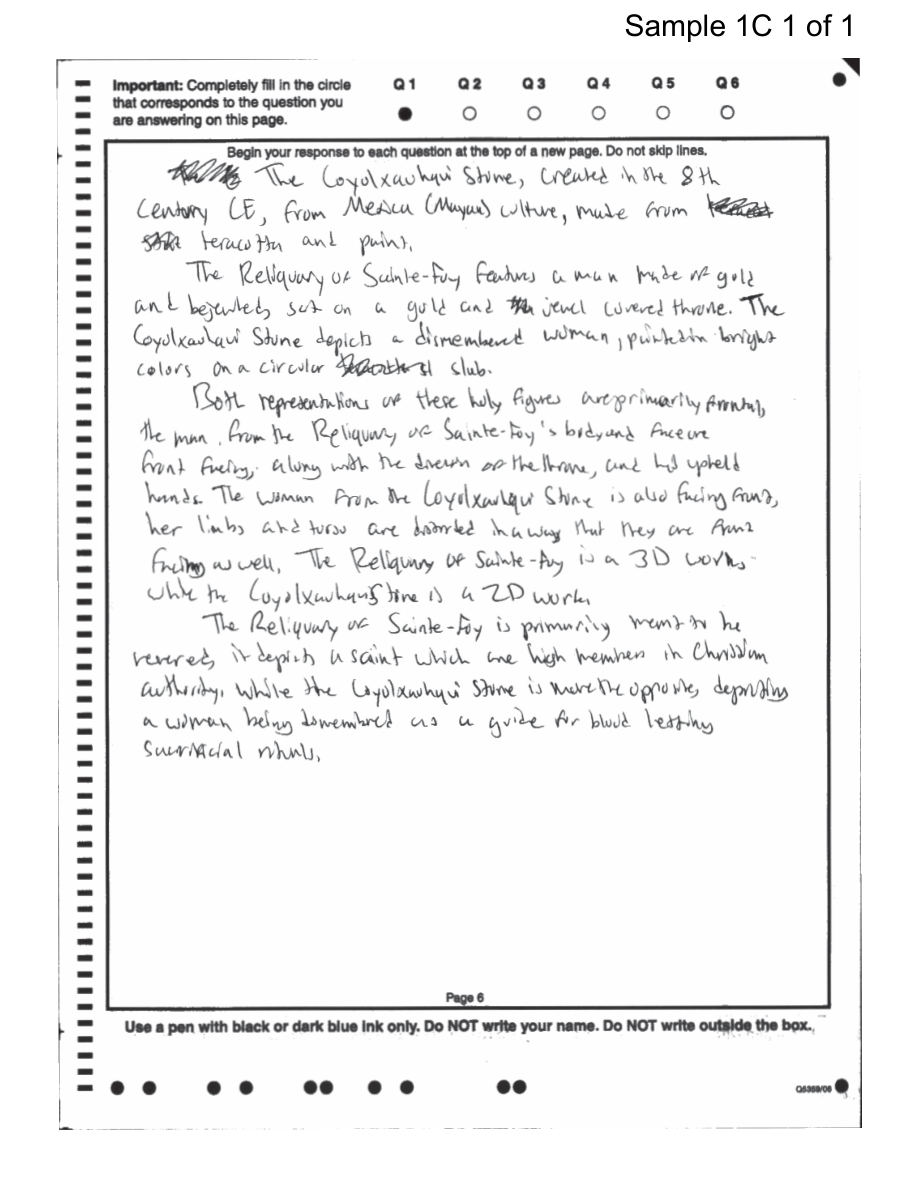
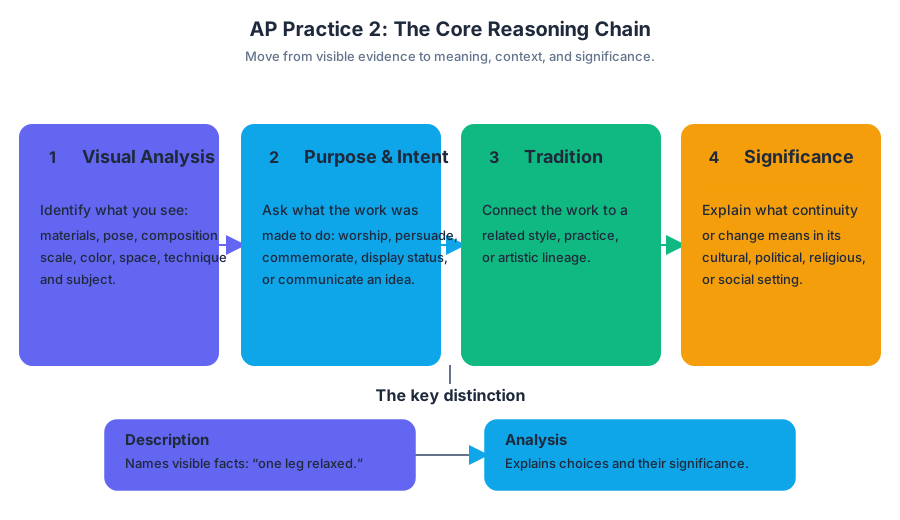
AP Practice 3
A strong comparison does more than place two artworks side by side: it explains why their similarities and differences matter. On the AP Art History free-response section, a comparison response must connect visible evidence to cultural context, purpose, materials, audience, or artistic tradition rather than merely…
AP Practice 3
A strong comparison does more than place two artworks side by side: it explains why their similarities and differences matter. On the AP Art History free-response section, a comparison response must connect visible evidence to cultural context, purpose, materials, audience, or artistic tradition rather than merely listing what each work looks like.
Task focus: comparison of two works
This practice uses the comparison task type, which primarily develops Skill 3: Comparison:
- 3.A — Identify similarities and differences between works of art.
- 3.B — Explain the significance of similarities and differences between works of art.
A complete answer also depends on supporting skills:
- 1.B — Describe visual elements of a work of art, using precise evidence rather than vague adjectives.
- 2.A — Identify the cultural practices that a work of art represents.
- 2.B — Explain how possible intent, purpose, and/or function shape the creation or meaning of a work of art.
- 4.C — Explain the influence of a specific work of art within a related artistic tradition, style, and/or practice.
Original practice prompt
Work A: A marble statue of a standing youthful male figure from ancient Greece, shown nude, balanced on one leg with the other leg relaxed, and constructed with carefully calculated proportions.
Work B: A carved wooden royal ancestor figure from the Yoruba tradition of West Africa, shown seated on a stool, wearing elaborate regalia and holding objects associated with authority.
Prompt: Compare Work A and Work B. In your response:
- Present a defensible claim about a significant similarity or difference between the works.
- Describe one relevant visual similarity or difference.
- Explain how the cultural context of each work shaped its appearance or meaning.
- Explain why the comparison is historically or art historically significant.
How to see the comparison
| Comparison lens | Work A | Work B |
|---|---|---|
| Figure | Idealized youthful male body | Royal or ancestral figure with emphasized status |
| Pose | Standing, balanced, physically self-contained | Seated, formally presented, connected to authority |
| Materials | Marble | Wood |
| Meaning emphasized | Bodily proportion, human achievement, and ideal form | Leadership, ancestry, social order, and spiritual authority |
| Viewer relationship | Invites attention to the idealized body | Communicates rank and links the ruler to ancestors |
The most useful comparison is not “both are sculptures.” That observation is true but weak. A stronger comparison recognizes that both works use the human figure to express cultural ideals, while the ideals differ: Work A emphasizes an idealized physical body, whereas Work B makes social and ancestral authority visible through posture, costume, objects, and ceremonial presentation.
Worked response
Claim: Both works use the human figure to communicate an ideal, but Work A presents ideality through bodily proportion and controlled anatomy, while Work B presents ideality through royal status, ritual identity, and connection to ancestors.
Visual evidence: Work A is nude and stands in a balanced pose that distributes the body’s weight across the legs. Its carefully organized proportions direct attention to the human body as a perfected form. Work B instead depicts a seated figure whose authority is communicated through regalia, a formal posture, and objects associated with leadership.
Contextual explanation: The Greek figure reflects an artistic tradition that valued idealized representations of the human body and explored relationships among beauty, order, and physical excellence. The Yoruba figure functions within a context in which royal images can preserve lineage, embody political authority, and connect living leadership with ancestral or spiritual power. The different materials and poses therefore support different meanings: marble helps present the Greek body as an enduring ideal, while carved wood supports a culturally specific image of status and presence.
Significance: The comparison demonstrates that naturalistic or recognizable human imagery does not carry one universal meaning. Similar subject matter—the human figure—can serve different purposes depending on the culture, audience, artistic tradition, and beliefs surrounding the work. Comparing the figures prevents the viewer from treating Greek art as the default model for representing the human body.
Why this earns credit
The response makes a defensible claim rather than repeating the prompt. It gives specific visual evidence—nudity, proportion, pose, regalia, and objects—and then explains how those features relate to cultural context. Most importantly, it addresses 3.B — Explain the significance of similarities and differences between works of art: the difference in meaning is not decorative; it reveals distinct ideas about the body, leadership, ancestry, and social order.
A response that says “Work A is realistic and Work B is symbolic” remains underdeveloped. “Realistic” does not explain what the realism does, and “symbolic” is not meaningful unless the answer identifies the visual features that communicate status or explains the cultural system that gives those features meaning.
Timing and error review
For a short comparison response, spend approximately:
- 1 minute identifying the central comparison
- 2 minutes listing visual evidence for both works
- 4–5 minutes writing the response
- 1 minute checking that every major claim applies to both works
After writing, mark each sentence as V for visual evidence, C for context, or S for significance. If the response contains many V sentences but no C or S sentences, it is describing rather than analyzing. If it contains C sentences without visible evidence, it is making unsupported generalizations.
Misconception check
Misconception: “Comparison means finding only similarities.”
Effective comparison includes similarities, differences, or both. The key requirement is significance: explain what the relationship between the works reveals about artistic purpose, cultural values, materials, audience, or artistic traditions.
Retrieval check
In two sentences, compare the role of the human figure in the two works. Your first sentence should identify a similarity or difference using visual evidence. Your second should explain why that relationship matters in context.
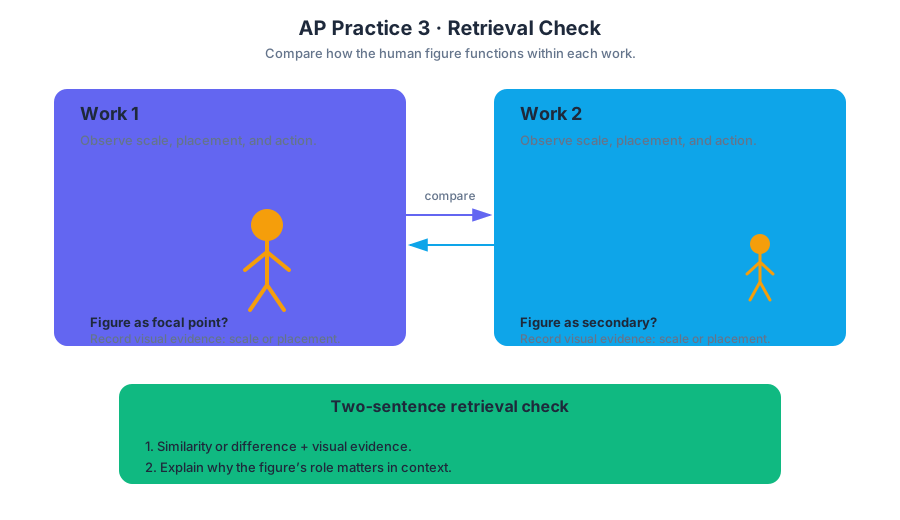
AP Practice 4
A building can preserve an artistic tradition while radically changing what that tradition means. That tension—continuity alongside change—is the central problem in this original, unofficial AP Art History practice task.
AP Practice 4
A building can preserve an artistic tradition while radically changing what that tradition means. That tension—continuity alongside change—is the central problem in this original, unofficial AP Art History practice task.
Task type: Continuity and Change
This task asks you to connect two works through a historically defensible claim. You must do more than identify shared features: explain what continues, what changes, and why those continuities and changes make sense in context.
Works for analysis
- Dome of the Rock, Jerusalem, completed 691–692 CE, Umayyad period
- Great Mosque of Córdoba, begun 785–786 CE and expanded through the tenth century, Umayyad al-Andalus
Original practice prompt
Using the two works named above, make an argument about how Islamic architectural traditions demonstrate both continuity and change between the late seventh and tenth centuries.
In your response:
- Identify one architectural feature or principle that continues between the works.
- Describe one visual or material similarity that supports your claim.
- Explain one important change in form, function, or audience.
- Connect that change to a specific historical or cultural context.
- Support your argument with evidence from both works.
A visual map before writing
| Analytical lens | Dome of the Rock | Great Mosque of Córdoba |
|---|---|---|
| Form | Centralized octagonal shrine with a prominent dome | Hypostyle congregational mosque with repeated arches and columns |
| Materials and decoration | Stone, mosaic, marble, inscriptions | Stone, brick, marble, mosaics, horseshoe arches |
| Function | Monumental shrine associated with Islamic sacred history | Communal mosque for congregational prayer |
| Audience | Pilgrims, worshippers, and visitors to Jerusalem | Muslim worshippers and the Umayyad community in Córdoba |
| Possible continuity | Monumentality, geometry, costly materials, Qur'anic inscription, sacred authority | Monumentality, geometry, costly materials, Qur'anic inscription, sacred authority |
| Major change | Centralized commemorative structure | Expansive communal prayer space adapted to a western Islamic capital |
Worked reasoning
Step 1: Build a claim, not a list. A weak response says, “Both buildings have domes and decoration.” A stronger claim explains the relationship: Both monuments use geometry, monumental scale, rich surface decoration, and Islamic inscriptions to communicate sacred authority, but the Dome of the Rock presents that authority through a centralized shrine in Jerusalem, while the Great Mosque of Córdoba transforms related visual principles into a large congregational space for an expanding western Islamic society.
Step 2: Use visual evidence precisely. The Dome of the Rock organizes the viewer’s experience around a central plan and elevated dome. Its exterior and interior surfaces use mosaics, marble, and inscriptions to create a highly controlled, luminous environment. The Great Mosque instead emphasizes repetition: rows of columns and two-tiered arches extend across the prayer hall, producing a sense of expansion. Both are visually ordered and monumental, but one concentrates attention while the other distributes it across a communal interior.
Step 3: Explain the historical change. The difference is not merely stylistic. The Dome of the Rock was built in Jerusalem, a city already associated with major Jewish and Christian sacred traditions. Its centralized form and prominent location helped proclaim the presence and authority of the new Islamic faith. The Great Mosque of Córdoba served a Muslim community in al-Andalus and required a spatial arrangement suitable for congregational worship. Its repeated bays could accommodate many worshippers and could be enlarged as the mosque complex developed.
Step 4: Finish the argument with both continuity and change. The continuing use of geometry, precious materials, inscriptions, and monumental scale shows that Islamic patrons used architecture to express religious and political legitimacy. The changed plan and audience show that Islamic architecture was not a fixed formula: it adapted to local histories, political ambitions, available building traditions, and the practical needs of worshippers.
What earns credit
A rubric-aligned response should make the following moves:
- Identification: Correctly name or clearly identify both works.
- Visual description: Describe relevant features rather than merely labeling them.
- Comparison: Explain a meaningful similarity and difference.
- Contextual analysis: Connect the difference to a specific historical, religious, political, or social circumstance.
- Argumentation: Present a defensible claim and use evidence from both works to support it.
The key distinction is between description and explanation. “The Great Mosque has many arches” describes. “The repeated arches help create a large congregational prayer space and distinguish the mosque’s communal function from the Dome of the Rock’s centralized shrine” explains.
Timing and error review
Allow about $15$ minutes: $2$ minutes to identify continuity and change, $3$ minutes to outline visual and contextual evidence, and $10$ minutes to write. Afterward, mark every sentence as identification, visual evidence, context, or argument. If one category is missing—especially context or argument—the response is probably describing the works rather than analyzing them.
Retrieval check
In one sentence, explain why “both buildings are Islamic” is not yet a continuity-and-change argument. Then add one visual feature and one contextual reason that would make the statement defensible.
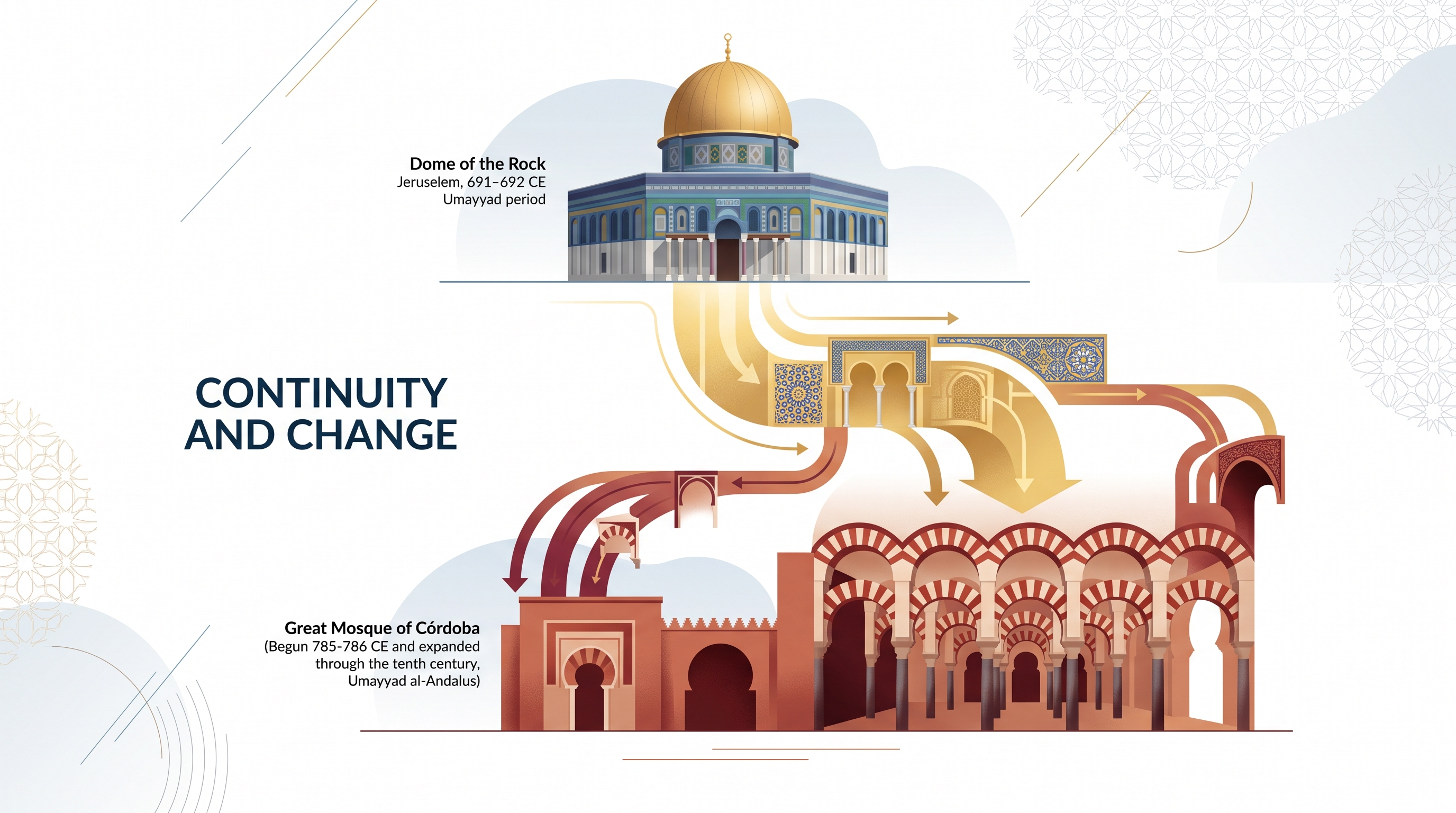
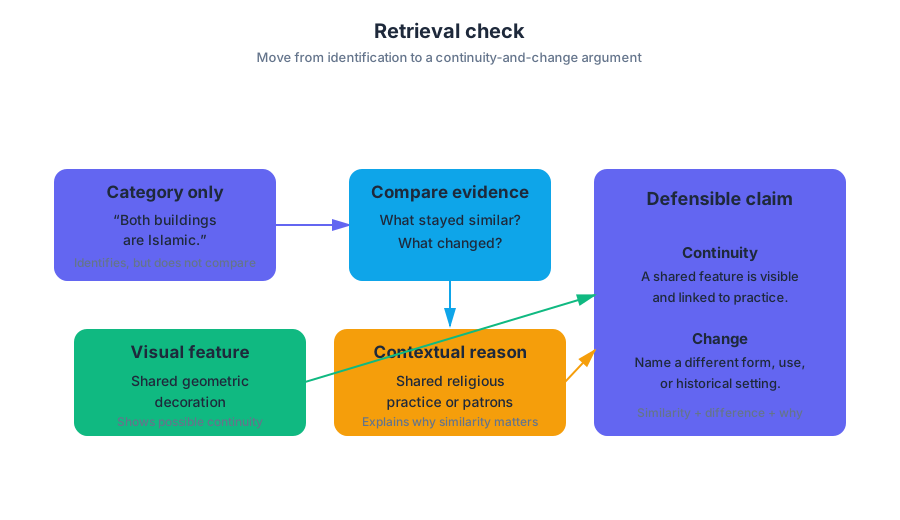
AP Practice 5
A convincing attribution does not begin with “I recognize this image.” It begins with a testable question: Which visual, material, and contextual clues make one attribution more plausible than another?
AP Practice 5
A convincing attribution does not begin with “I recognize this image.” It begins with a testable question: Which visual, material, and contextual clues make one attribution more plausible than another? In AP Art History, attribution means assigning an unknown work to an artist, culture, period, workshop, region, or artistic tradition by using evidence rather than visual resemblance alone.
This practice set focuses on the attribution task type: analyzing an unfamiliar work and defending a conclusion about its origin. It exercises the art-historical thinking skills identified in the course materials, especially CR9: Visual analysis of unknown works, CR10: Attribution of unknown works, and CR12: Argumentation using claims and evidence.
A reliable attribution pipeline
Use the sequence below when the image is unfamiliar. The order matters: description supplies evidence; interpretation explains what the evidence may mean; attribution comes only after those steps.
- Inventory visible evidence. Record pose, scale, composition, facial features, clothing, gestures, symbols, inscriptions, materials, and surface treatment.
- Separate observation from inference. “The figure holds a staff” is observation. “The staff identifies a ruler” is interpretation.
- Generate two or three plausible possibilities. Consider region, period, function, and cultural tradition rather than jumping to a famous artist.
- Test each possibility against multiple clues. A strong attribution explains several features at once.
- Make a qualified claim. State what is most likely and identify the evidence that supports it.
- Address uncertainty. Explain what additional evidence—provenance, scientific testing, inscription, or comparison—could confirm or weaken the claim.
Original practice prompt
Image description: An unfamiliar sculpture shows a standing human figure carved from dark wood. The figure has an enlarged head, sharply angular shoulders, long narrow legs, and hands held close to the abdomen. The surface is polished on the torso but roughened in selected areas of the hair and clothing. Small metal elements are attached near the chest and waist. The figure appears designed to be viewed from the front, although the back is also carved. No artist’s name or inscription is visible.
Task: Attribute the work to the most plausible artistic tradition or cultural context. Support your attribution with two specific visual or material features and explain how each feature contributes to your conclusion. Then identify one piece of additional evidence that would help verify the attribution.
Worked reasoning
Begin with a claim that is specific but not overconfident: The sculpture is most plausibly associated with an African ritual or devotional tradition in which a carved figure could operate as more than a purely naturalistic portrait. This claim does not depend on treating “African art” as a single style; it identifies a broad context while leaving room for a more precise regional attribution.
The first supporting clue is the figure’s frontality and enlarged head. A rigid frontal stance can direct attention toward the figure’s presence and function rather than toward an ordinary moment of movement. The enlarged head may emphasize thought, spiritual force, identity, or status, but the answer should not claim one meaning without contextual evidence.
The second clue is the combination of wood carving and attached metal elements. The contrast between organic wood and added metal suggests that the object’s meaning may depend on its materials as well as its appearance. Metal could mark protection, power, offerings, or later alteration; therefore, the strongest response describes the clue and presents its possible significance cautiously.
A useful verification step would be provenance research: documentation showing where the sculpture was collected, who used it, or which community recognized it. Technical analysis of the wood and metal could also help, but scientific testing alone would not establish the object’s ritual function or cultural meaning.
What earns credit
A high-scoring response follows the logic of claim → evidence → explanation. It does not earn strength merely by naming a region. The attribution must be connected to observable features, and each feature must be explained rather than listed.
| Response move | What the examiner needs to see |
|---|---|
| Attribution claim | A plausible cultural, regional, chronological, or traditional identification |
| Visual evidence | Specific features such as frontality, proportion, surface, pose, or attached materials |
| Reasoning | An explanation of why those features support the attribution |
| Qualification | Recognition that attribution is an evidence-based probability, not a guess |
| Verification | A relevant source of confirmation, such as provenance, inscription, comparison, or material analysis |
Weak: “This is African because it has an unusual shape and looks spiritual.”
Stronger: “The frontal stance, emphasized head, and combination of carved wood with attached metal support an attribution to a ritual sculpture tradition in which material presence and spiritual efficacy may be important. Provenance or comparison with documented works from a specific community would be needed to narrow the attribution.”
Misconception check: style is not a fingerprint
A common error is style-as-fingerprint reasoning: assuming that one visual feature proves an origin. Enlarged heads, abstraction, dark wood, or frontal poses occur across many cultures and periods. Attribution becomes persuasive only when several clues converge and the answer acknowledges alternative explanations.
Timed attempt and error review
Allow approximately 8–10 minutes for this task: one minute to inspect, four minutes to build evidence-based reasoning, three minutes to write, and one or two minutes to check whether every claim has support. Afterward, label each sentence in your response as observation, inference, or attribution. If an attribution has no preceding observation, it is probably a guess.
Retrieval check: Why is “the sculpture has a frontal pose” stronger evidence than “the sculpture looks spiritual”? The first is directly observable; the second is an interpretation that requires cultural and functional support.
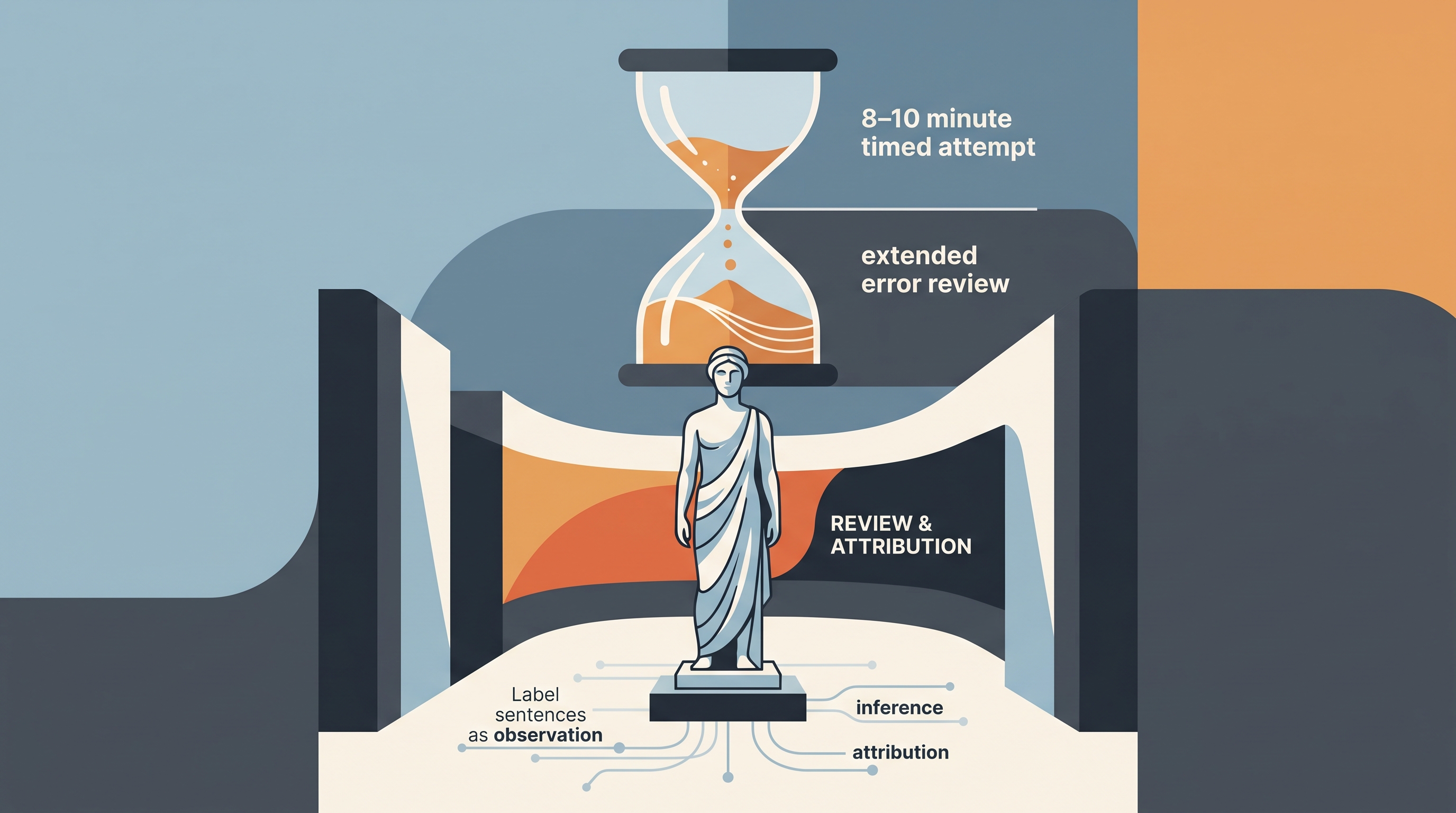
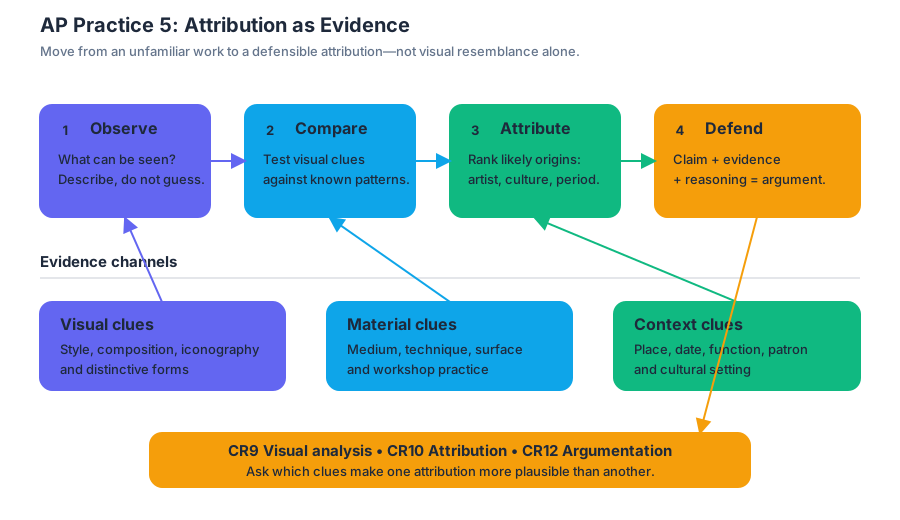
AP Practice 6
A strong art-historical argument does more than identify an artwork: it makes a defensible claim and proves that claim with visual and contextual evidence. In the exam’s extended argumentation task, the highest-scoring response behaves like a compact museum-label essay with a thesis, evidence, and reasoning—not a…
AP Practice 6
A strong art-historical argument does more than identify an artwork: it makes a defensible claim and proves that claim with visual and contextual evidence. In the exam’s extended argumentation task, the highest-scoring response behaves like a compact museum-label essay with a thesis, evidence, and reasoning—not a list of memorized facts.
Task: Build an Argument from Multiple Works
Original unofficial practice prompt
Choose two works of art from different cultures or historical periods that demonstrate how art can legitimize political or religious authority. For each work, explain one visual feature and one contextual factor that support your argument. Then explain one important difference in the way the two works communicate authority.
You may use works from the required course content, including the Great Mosque of Córdoba, the Hagia Sophia, the Rani ki Vav, The Augustus of Prima Porta, or another appropriate work you know accurately. Your response should make a claim that connects both works rather than treating them as two unrelated identification exercises.
The reasoning pipeline
| Move | What you do | What it sounds like |
|---|---|---|
| Claim | Answer the prompt directly | “Monumental art legitimizes authority by making power appear permanent and cosmically ordered.” |
| Visual evidence | Point to a visible feature | “The repeated horseshoe arches create a seemingly endless visual rhythm.” |
| Contextual evidence | Explain historical, religious, or political circumstances | “The mosque’s expansion was connected to Córdoba’s status as the capital of the Umayyad caliphate.” |
| Reasoning | Show why the evidence proves the claim | “The scale and repetition make the ruler’s religious and political order seem stable rather than temporary.” |
| Comparison | Explain a meaningful difference | “Unlike the mosque’s repeated spatial rhythm, the Augustus uses a single idealized body to concentrate authority in one ruler.” |
This sequence develops the official art-historical thinking skills 7.A Develop a defensible thesis, 7.B Support an argument using specific evidence, and 7.C Explain how evidence supports an argument. It also draws on 1.B Describe visual elements, 1.C Explain how artistic decisions shape meaning, 2.A Identify contextual elements, 2.B Explain how context shapes meaning, and 4.B Explain relevant similarities and differences among works of art.
Worked example: Córdoba and Augustus
Thesis: The Great Mosque of Córdoba and the Augustus of Prima Porta both legitimize authority by linking political power to an order larger than any individual ruler, but the mosque achieves this through collective sacred space while the Roman statue concentrates authority in the idealized body of one emperor.
The Great Mosque of Córdoba supports this claim visually through its forest of columns and alternating red-and-white voussoirs, or wedge-shaped arch stones. The repeated arches produce a rhythmic interior that seems to continue beyond the viewer’s immediate sight. Contextually, the mosque functioned within Umayyad Córdoba, a major Islamic political and cultural center. Its monumental scale and ordered repetition present religious and dynastic power as expansive, organized, and enduring.
The Augustus of Prima Porta communicates authority differently. Augustus stands in a commanding contrapposto pose and wears decorated armor, while his raised arm suggests public address or command. Cupid at his feet connects the emperor to Venus and therefore to a divine genealogy associated with Julius Caesar and the Julian family. The statue does not make authority feel anonymous or collective; instead, it presents Augustus as the ideal individual whose body, ancestry, military success, and divine associations justify rule.
The difference matters because the two works use different audiences and experiences. A visitor inside the mosque encounters authority through movement, repetition, and communal worship. A viewer facing Augustus encounters authority through a recognizable political body that combines military achievement with divine ancestry. In both cases, artistic form turns power into something that appears natural, ordered, and worthy of obedience.
Why this response earns credit
- Thesis: The opening makes a clear, defensible claim and establishes a difference between the works.
- Specific visual evidence: The response identifies the mosque’s arches, columns, and color pattern, then identifies Augustus’s pose, armor, raised arm, and Cupid.
- Specific contextual evidence: It connects Córdoba to the Umayyad caliphate and Augustus to Roman imperial ideology and Julian divine ancestry.
- Reasoning: Each evidence point is followed by an explanation of how form and context create authority.
- Comparison: The answer explains a consequential difference—collective sacred space versus individualized ruler imagery—rather than merely saying the works are “different.”
A sophisticated response may also acknowledge that authority is not communicated identically to every viewer. The mosque’s meaning depends on religious participation and spatial experience, while Augustus’s message depends more heavily on imperial imagery, public display, and the viewer’s recognition of Roman political symbols.
Common misconception check: “More facts means a stronger argument”
Misconception: A response earns the most credit by naming as many dates, rulers, materials, and religious terms as possible.
Correction: Facts become evidence only when the writer explains their relevance. “Augustus ruled after the Roman Republic” is contextual information; “the statue’s idealized body presents Augustus as permanently youthful, making imperial authority appear stable beyond ordinary human aging” is contextual evidence connected to an argument.
Timing and error review
For a longer argumentation task, reserve approximately 30 minutes: spend 3–4 minutes selecting works and drafting a claim, 20–22 minutes writing, and 4–5 minutes checking evidence and reasoning. Before submitting, underline your thesis mentally, circle each specific visual detail, and ask after every fact: Have I explained how this proves my claim?
Retrieval check: If your thesis says that a work makes authority appear “permanent,” name one visual feature that could support that idea and explain the connection in one sentence. A correct answer must include both the feature and the meaning it produces.

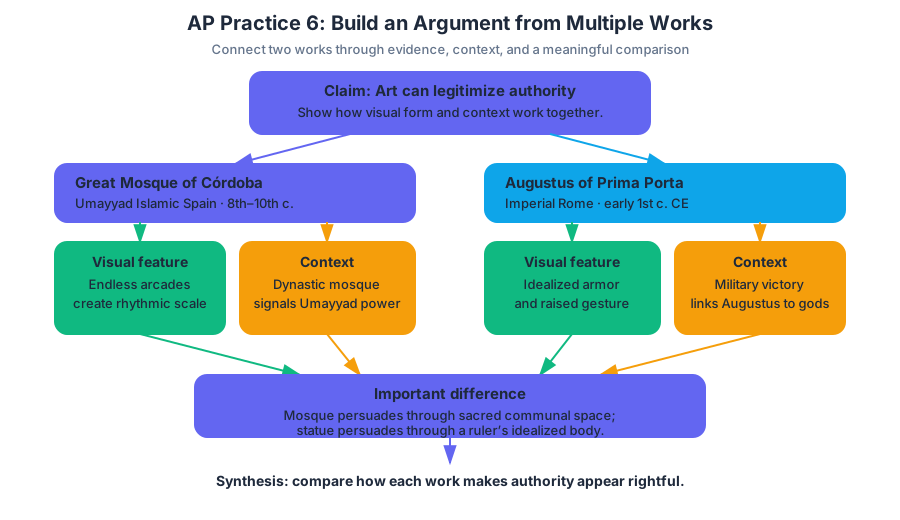
Source Materials
- AP Art History Course and Exam Description
- AP Art History Course and Exam Description Clarifications and Corrections
- AP Art History Course Overview
- AP Art History Course at a Glance
- AP Art History Course at a Glance Poster
- Adopt AP Art History
- AP Art History
- AP Art History
- Figure — AP Art History Course and Exam Description (p. 1)
- Figure — AP Art History Course and Exam Description (p. 17)
- Figure — AP Art History Course and Exam Description (p. 25)
- Figure — AP Art History Course and Exam Description (p. 27)
Study AP Art History with AI — Free on Lykke
Sign up for free to generate personalized flashcards, quizzes, and study guides from this course. Chat with an AI tutor that knows the material.
Get Started FreeView this course wiki on Lykke · Browse all public course wikis