From the free course AP Art History on Lykke
6.2 6.1 Cultural Contexts of African Art
Key concepts: Cultural practices, belief systems, and physical setting affect art and art making · African art’s connections to family, community, and shared ancestors · Art as a marker of personal identity and social status · Common ancestors, leadership, and social order · Education, adulthood, and civic responsibility in African societies · Performance, costumes, and the social use of art objects · Custodianship and inheritance of commissioned art objects · Power and authority represented through art · Nkisi n’kondi power figures · Pwo masks and Ikenga shrine figures
Human life is understood to have begun in Africa, and African art repeatedly connects individual identity to family, community, ancestors, leadership, and place. The central question is not simply What does this object look like?
6.2 6.1 Cultural Contexts of African Art
Human life is understood to have begun in Africa, and African art repeatedly connects individual identity to family, community, ancestors, leadership, and place. The central question is not simply What does this object look like? but What cultural work does it perform?
CUL-1.A: Explain how cultural practices, belief systems, and/or physical setting affect art and art making.
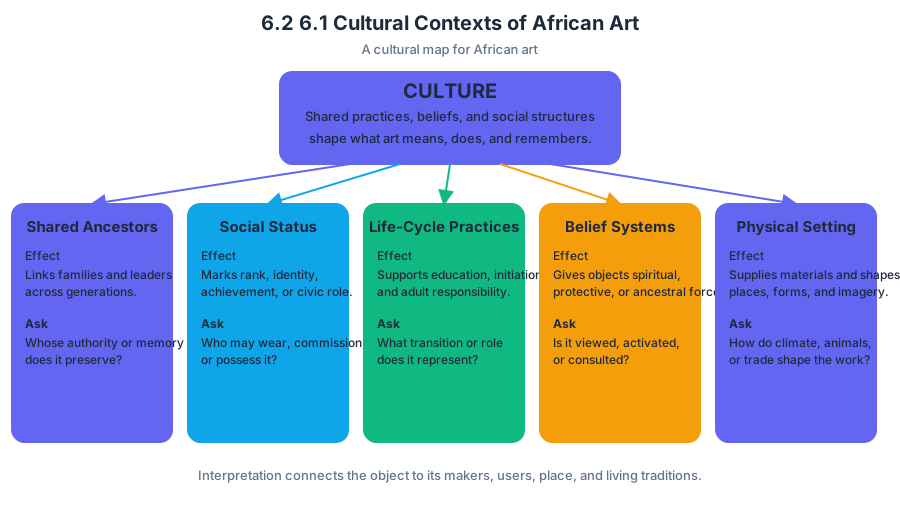
A cultural map for African art
Culture includes shared practices, beliefs, social structures, and ways of understanding the world. In African art, those forces shape both the object and the circumstances in which it is made, owned, worn, performed, remembered, or interpreted.
| Cultural factor | Effect on art making | Useful question |
|---|---|---|
| Shared ancestors | Links families, leaders, and communities across generations | Whose authority or memory does the object preserve? |
| Social status | Marks rank, identity, achievement, or civic role | Who may wear, commission, or possess it? |
| Life-cycle practices | Supports education, adulthood, initiation, and responsibility | What transition or role does the work represent? |
| Belief systems | Gives objects spiritual, protective, or ancestral efficacy | Is the object meant to be viewed, activated, or consulted? |
| Physical setting | Supplies materials and influences settlement, architecture, and imagery | How do climate, animals, agriculture, or trade shape the work? |
From place to image: the physical setting
Human life developed over millions of years in Africa and later radiated beyond the continent. The earliest African art dates to approximately $77{,}000$ years ago. Early artistic expression appears in the rock art of the Sahara and southern Africa, where artists depicted regional animals and human pursuits such as herding and combat.
This is a direct example of physical setting affecting art making: the animals represented are connected to local environments, while the scenes record activities important to human survival and social organization. The relationship is not mechanical—artists do not merely copy what they see—but environmental knowledge supplies subjects through which communities express experience and identity.
African urbanization also produced monumental architecture shaped by agriculture, herding, seasonal climatic shifts, and the organization of administrative or liturgical life. Meroë, Timbuktu, Zimbabwe, Igbo Ukwu, and Kilwa Kisiwani demonstrate that African art histories include urban planning, religious architecture, political structures, and long-distance cultural connections—not only portable objects.
Art, ancestry, and social order
Common ancestors link people to families and communities. They can also legitimize leaders, sanction social behavior and choices, and define the order of social life. Consequently, an African art object may function simultaneously as an image, a social instrument, and a visible claim about authority.
Personal identity means how a person or group is socially recognized; social status means a position or rank within a community. Both can be expressed through aesthetic choices—materials, hairstyle, clothing, bodily presentation, scale, pattern, or the right to use a particular object.
Consider the Ikenga shrine figure. Its association with personal achievement and masculine identity makes it more than a generalized human sculpture: it participates in a system in which accomplishment, responsibility, and spiritual support are made visible. A veranda post, by contrast, can connect architectural space with social presence, status, and the people or institution represented in that setting.
Performance makes the object active
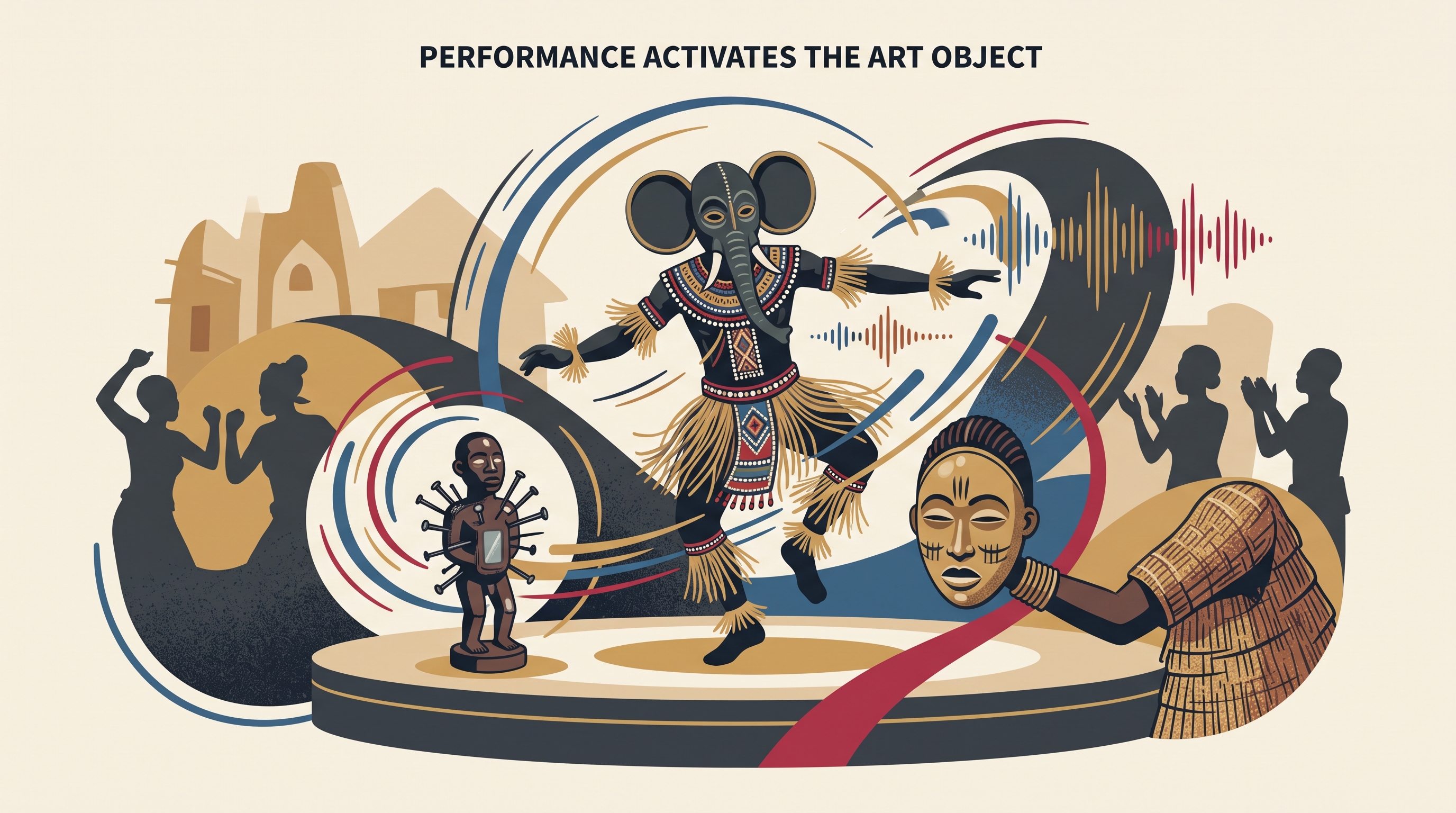
Many African art objects are not designed for isolated, silent viewing. Their meaning emerges through use and efficacy—what they are believed to accomplish in ritual, social, or political life. Performances may include movement, music, speech, bodily display, and costumes.
The Nkisi n’kondi power figure is a useful example of an object whose significance depends on activation and belief, not only on its carved form. The Female (Pwo) mask and Aka elephant mask likewise make most sense within performance: a mask transforms the wearer, and costume, gesture, and communal setting complete the artistic event.
Education, adulthood, and remembered achievement
Cultural practices may support education, incorporation into adulthood, and civic responsibility. The creation, manipulation, and interpretation of art objects can teach people how to inhabit a role, recognize obligations, and participate in collective life.
Accomplishments may be entrusted to and lauded by historians, bards, and elders. Their spoken, sung, or recited histories preserve social memory, so art and oral tradition work together: an object can embody a history, while specialists explain why that history matters.
Commissioning also determines ownership and responsibility. A commissioned object comes under the custodianship of its commissioner or a member of the commissioner’s family. Custodianship means stewardship rather than simple private possession: the custodian carries obligations to maintain, protect, and correctly transmit the object’s significance.
Worked contextual example
Imagine encountering a mask without knowing its community or performance context. A weak interpretation says, “The mask represents an elephant because it has elephant-like features.” A stronger CUL-1.A analysis proceeds in three steps:
- Observe: Identify the mask’s animal imagery, materials, scale, and visual emphasis.
- Contextualize: Connect the elephant to status, leadership, communal identity, or local belief systems rather than assuming decoration is the sole purpose.
- Explain function: Show how costume and performance could make the object socially effective—transforming a wearer and communicating authority to an audience.
Misconception check — “African art is primarily decorative.” Many works are aesthetically powerful, but decoration alone cannot explain a power figure, shrine figure, mask, or architectural post. Ask who uses the object, during what practice, under whose authority, and with what expected effect.
Retrieval check
A community commissions an object for a leader and uses it during a costumed public performance. Name two cultural factors that could affect its making and explain how each factor would shape the object’s meaning. A complete answer should connect visual or material choices to status, ancestry, civic responsibility, custodianship, belief, or performance—not merely describe the object.