From the free course AP Art History on Lykke
AP Practice 1
Key concepts: AP course clarity and transparency · AP opposes indoctrination and rewards evidence-based analysis rather than agreement with a viewpoint · Respectful evaluation of diverse perspectives and backgrounds · Using primary sources to study experiences and identities · AP college credit and placement policies · Becoming an AP Reader and its professional benefits · AP Classroom customized tests and feedback · Digital activation and AP class-section registration · AP ID labels and reduced exam-day bubbling · Personal Progress Checks and instructional planning reports
AP Art History is designed to make evidence, not personal agreement, the basis of academic judgment. Its public course frameworks, required works, sample questions, and scoring information show students what kinds of knowledge and reasoning the course values before they take the exam.
AP Practice 1
AP Art History is designed to make evidence, not personal agreement, the basis of academic judgment. Its public course frameworks, required works, sample questions, and scoring information show students what kinds of knowledge and reasoning the course values before they take the exam.
Core principle: AP points reward an answer’s accurate use of evidence and reasoning—not agreement with a particular cultural, political, religious, or personal viewpoint.
That distinction matters when studying art connected to identities, religions, ethnicities, nationalities, or contested histories. A student may analyze a work’s function, symbolism, historical setting, or reception without being required to adopt the beliefs represented by the work or to share the interpretation of another student.
Evidence-based analysis is not viewpoint conformity
Indoctrination means pressuring people to accept a particular viewpoint without allowing independent evaluation. AP’s stated approach is the opposite: students analyze perspectives different from their own, assess the credibility of sources, draw conclusions, and make up their own minds.
In an art-historical discussion, “I agree with this belief” is not yet analysis. A stronger response identifies a visible or documented feature, connects it to a historical context, and explains what that evidence suggests.
Worked example: Suppose a student is asked to interpret a ceremonial object associated with a religious community. An evidence-based answer might proceed as follows:
- Observe: Identify the object’s materials, scale, imagery, and setting.
- Contextualize: Explain how its use relates to the community’s ritual or social structure.
- Evaluate: Distinguish between what the object itself demonstrates and what a written source claims about it.
- Conclude: Make a qualified interpretation supported by the strongest available evidence.
The answer earns value through the chain from evidence to conclusion. It does not earn value because the writer praises, condemns, or personally identifies with the object’s beliefs.
Respectful disagreement and diverse perspectives
AP classrooms encourage students to evaluate arguments rather than one another. Students can challenge an interpretation by questioning its evidence, assumptions, or logic, while still treating classmates’ backgrounds and perspectives with respect.
A useful distinction is:
| Evaluate | Do not attack |
|---|---|
| “The source was produced much later, so its account may reflect later priorities.” | “You are wrong because of who you are.” |
| “The visual evidence supports a political function more strongly than a purely decorative one.” | “Only someone with your background would interpret it that way.” |
| “This interpretation overlooks the object’s original audience.” | “Your identity makes your argument invalid.” |
Misconception check — “Open-minded” means “every interpretation is equally strong.” It does not. Respect requires listening fairly; art-historical reasoning still requires testing claims against visual, historical, and primary-source evidence.
Primary sources and independent judgment
Studies of different cultures and experiences are grounded in primary sources—evidence produced within or close to the historical situation being studied. In art history, these may include the artwork itself, inscriptions, archival records, contemporary criticism, photographs, contracts, or accounts by participants and observers.
Primary sources do not automatically tell one uncomplicated truth. Their authors, audiences, purposes, and omissions must also be evaluated. The goal is not merely to repeat a source but to ask what it can reliably establish.
Retrieval check: A museum label claims that an object was “used exclusively for private devotion.” Name two questions that would help test the claim independently. A strong response might ask who wrote the label, when it was written, what evidence supports “exclusively,” and whether the object’s scale or wear suggests public use.
Transparency, access, and AP participation
Teachers and students can consult public AP course frameworks and sample exams to understand course expectations. AP Classroom extends that transparency into daily practice: teachers can locate questions by topic and skill, assemble customized tests, assign them online or on paper, and give feedback on individual questions.
Digital activation connects course participation with exam administration. Teachers and students sign in to My AP; teachers confirm course-audit approval, teachers or AP Coordinators establish class sections, and students join with a teacher- or coordinator-provided join code.
When students join their first section, they provide registration information. The AP ID links exam materials to that registration information, reducing pre-administration sessions and the amount of bubbling required on exam day. Digital activation also gives students and teachers access to AP resources and supports exam registration and ordering.
College credit and professional participation
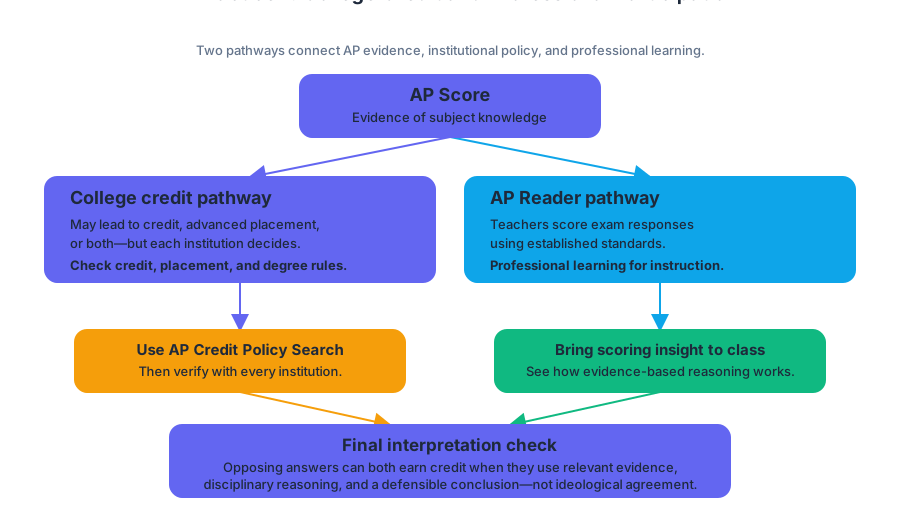
A qualifying AP score may lead to college credit, placement into advanced courses, or both, but colleges and universities set their own policies. Students should therefore use the AP Credit Policy Search and then verify the policy with each institution, especially for differences between credit, placement, and degree requirements.
Teachers can also become AP Readers, who score AP Exam responses using established standards. Reading can expose teachers to scoring expectations and student responses while helping them bring informed, positive changes to classroom instruction. It is professional development tied directly to how evidence-based reasoning is evaluated.
Final interpretation check: Why can two answers that express opposing viewpoints both receive credit? Because the scoring target is not ideological agreement; it is the accurate use of relevant evidence, disciplinary reasoning, and a defensible conclusion.

Source Materials
- AP Art History Course and Exam Description
- AP Art History Course and Exam Description Clarifications and Corrections
- AP Art History Course Overview
- AP Art History Course at a Glance
- AP Art History Course at a Glance Poster
- Adopt AP Art History
- AP Art History
- AP Art History
- Based on your experience at the AP® Reading with student responses, what advice would you offer teachers to help them improve student performance on the exam?
- Based on your experience at the AP® Reading with student responses, what advice would you offer teachers to help them improve the student performance on the exam?