From the free course AP Art History on Lykke
Course Framework, Skills and Reasoning Processes
Key concepts: AP course expectations and informed choice · Validation of AP scores for college credit · Big Idea 5: Purpose and Audience · Influence of purpose, intended audience, and patron on art and art making · Course at a Glance organization · Spiraling of big ideas and skills throughout the course · Unit and topic progression · Teacher adaptation to student needs, block schedules, and academic calendars · Unit 1: Global Prehistory · Skill 1.A: Identifying a work of art or group of related works
AP Art History asks a deceptively powerful question: what can an artwork reveal when you examine its appearance, historical setting, making, purpose, and interpretation together?
Course Framework, Skills and Reasoning Processes
AP Art History asks a deceptively powerful question: what can an artwork reveal when you examine its appearance, historical setting, making, purpose, and interpretation together? A carved figure, temple, portrait, or installation is never only an object to identify. It is also evidence of cultural values, artistic choices, relationships among communities, and the expectations of a patron or intended audience.
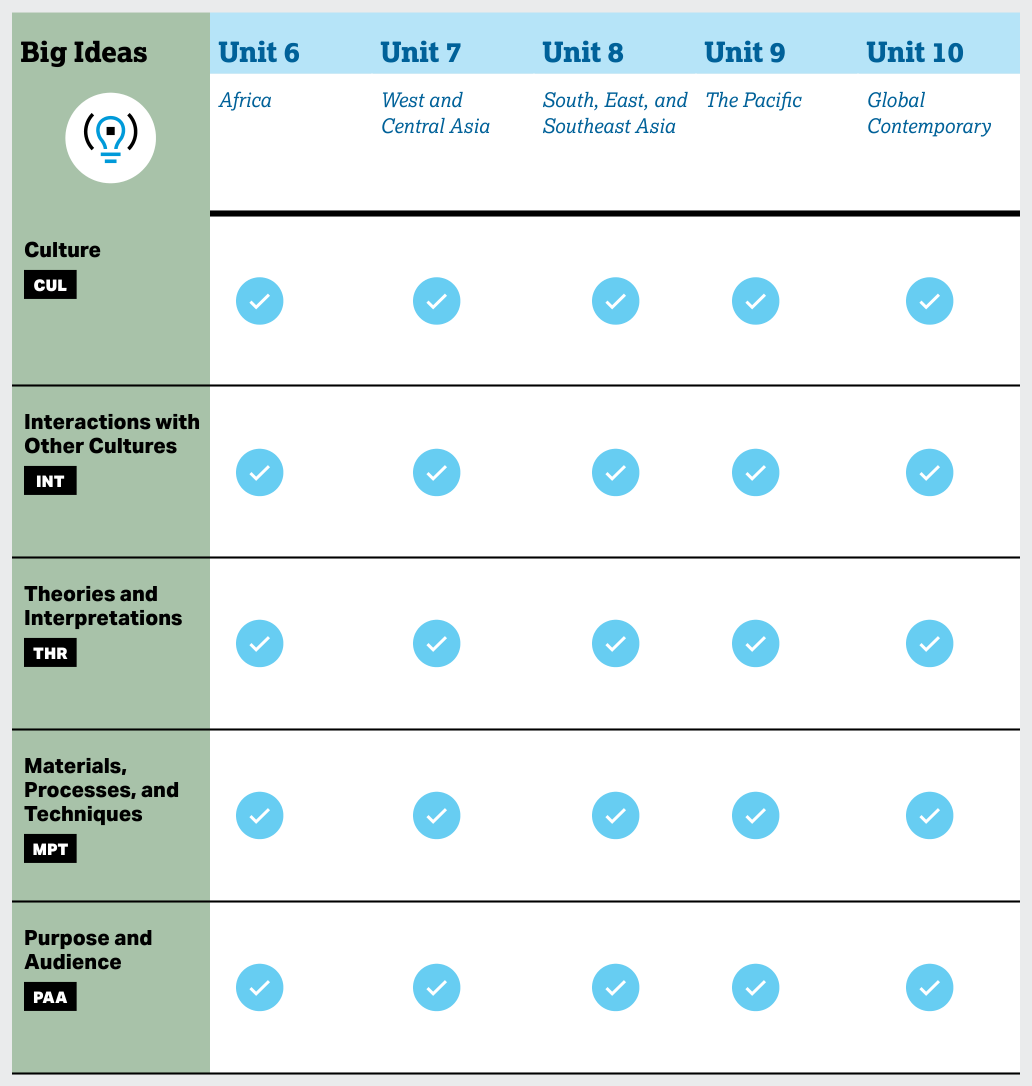
The course framework organizes that investigation around five recurring Big Ideas. These are not isolated chapters; they are lenses that return throughout the course:
| Big Idea | Code | Central concern |
|---|---|---|
| Culture | CUL | How beliefs, values, and social systems shape art |
| Interactions with Other Cultures | INT | How cultural contact, exchange, conflict, and influence appear in art |
| Theories and Interpretations | THR | How art-historical explanations are built and revised |
| Materials, Processes, and Techniques | MPT | How substances, tools, methods, and technology shape form |
| Purpose and Audience | PAA | How function, patronage, intended viewers, and reception affect art making |
Big Idea 5: Purpose and Audience
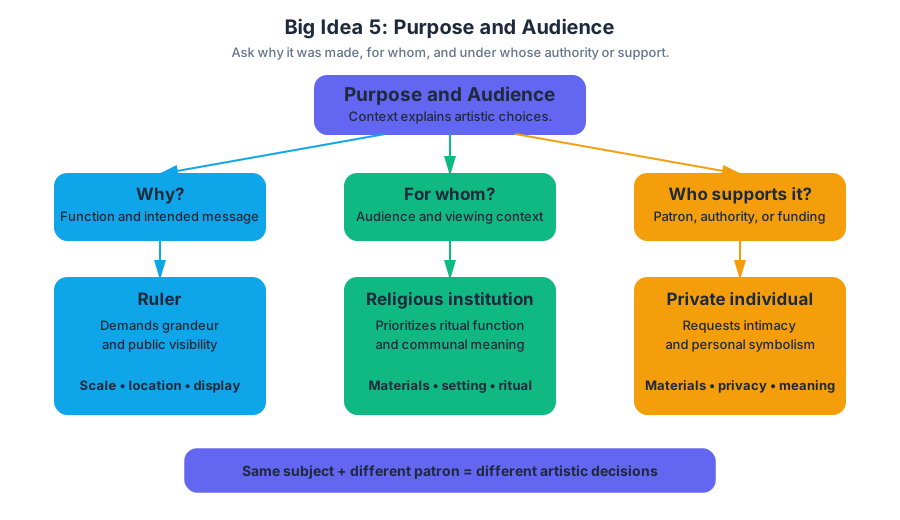
Purpose and Audience (PAA) means asking why a work was made, for whom, and under whose authority or financial support. A patron—a person or institution that commissions or funds art—can influence its subject, scale, materials, location, and message. A work made for private devotion may operate differently from one designed for public ceremony, political display, or commercial circulation.
A useful visual test is to imagine the same subject commissioned by three different patrons: a ruler may demand grandeur and public visibility; a religious institution may prioritize ritual function; a private individual may request intimacy and personal symbolism. The subject alone does not explain the artwork. Purpose, audience, and patron help explain why those artistic decisions made sense in context.
The eight art-historical thinking skills
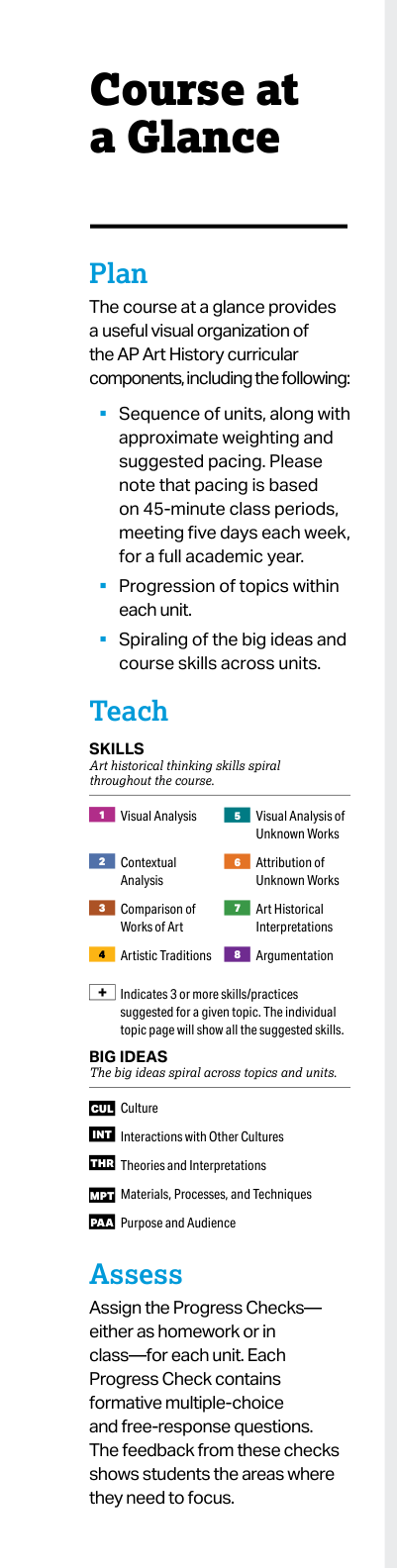
The course repeatedly spirals eight official skills. “Spiraling” means that a skill returns in later units with more complex works and contexts rather than disappearing after its first introduction.
- Skill 1: Visual Analysis — identify and explain visible features such as form, style, materials, technique, and content. In Unit 1, Skill 1.A requires identifying a work of art or group of related works; 1.B develops description and analysis of visual evidence.
- Skill 2: Contextual Analysis — connect a work to historical, cultural, religious, political, or social circumstances.
- Skill 3: Comparison of Works of Art — explain meaningful similarities and differences, not merely list them.
- Skill 4: Artistic Traditions — recognize how artists inherit, adapt, challenge, or transform established conventions.
- Skill 5: Visual Analysis of Unknown Works — use observable evidence to analyze an unfamiliar work rather than relying on memory alone.
- Skill 6: Attribution of Unknown Works — assign a work to an artist, culture, style, or object type and justify the attribution. Skill 6.A identifies a possible attribution; 6.B justifies it through similarities with a known comparison.
- Skill 7: Art Historical Interpretations — evaluate how interpretations arise from form, style, materials, content, function, context, reception, or meaning. Skill 7.A concerns identifying or describing interpretations; 7.B explains how valid interpretations are derived from evidence.
- Skill 8: Argumentation — make a defensible claim and support it with relevant visual and contextual evidence.
On the exam, these skills appear through both sections: multiple-choice questions often require rapid identification, comparison, attribution, or contextual reasoning, while free-response questions require organized explanations and evidence-based arguments. A correct name without analysis demonstrates less than a precise observation connected to a defensible claim.
Course at a Glance: the visual architecture
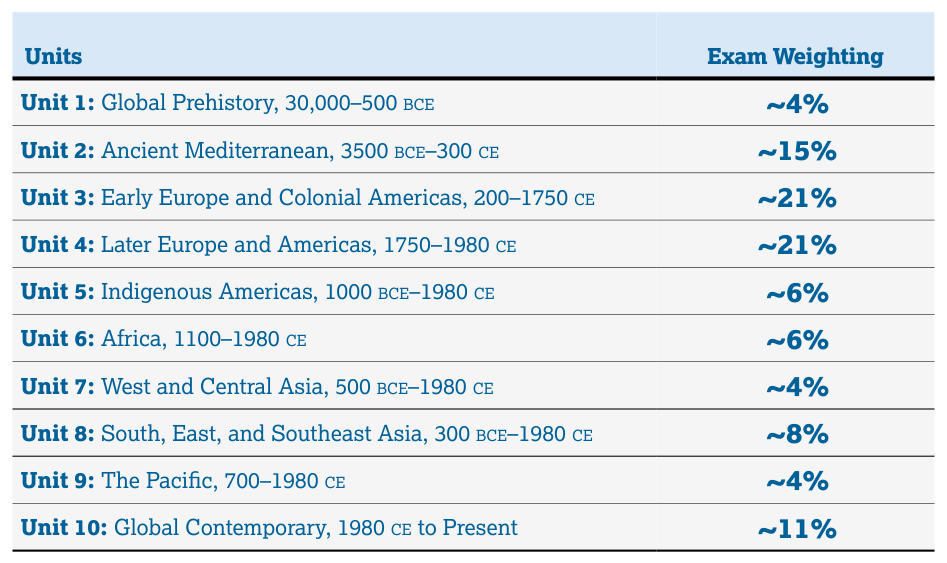
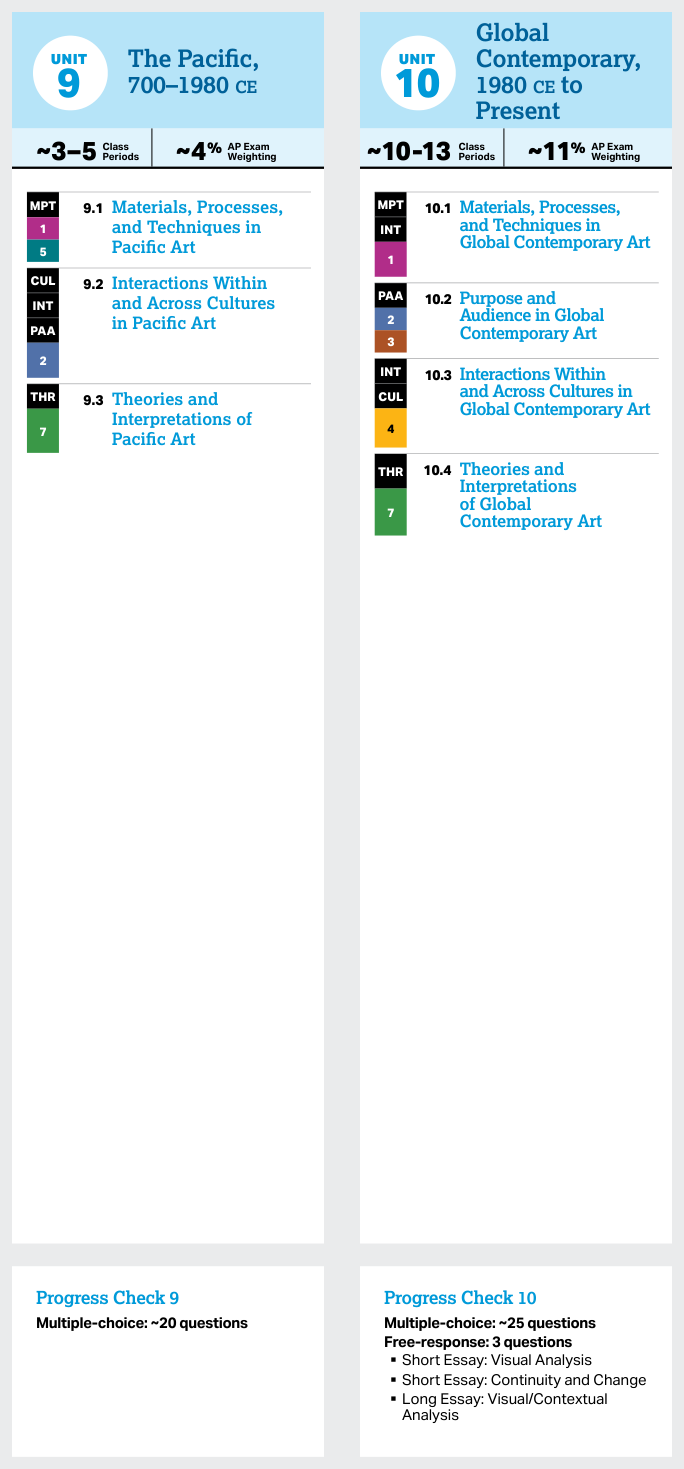
The Course at a Glance is a curriculum map showing each unit’s chronology and geography, suggested class periods, approximate AP Exam weighting, topics, Big Ideas, skills, and Personal Progress Checks. It is a planning guide rather than an inflexible calendar; teachers may adapt pacing for student needs, block scheduling, and the school’s academic calendar.
| Unit | Scope | Suggested periods | Approximate weighting |
|---|---|---|---|
| 1 | Global Prehistory, $30{,}000$–$500$ BCE | $3$–$5$ | $4%$ |
| 2 | Ancient Mediterranean, $3500$ BCE–$300$ CE | $16$–$18$ | $15%$ |
| 3 | Early Europe and Colonial America, $200$–$1750$ CE | $21$–$25$ | $21%$ |
| 4 | Later Europe and the Americas, $1750$–$1980$ CE | $21$–$25$ | $21%$ |
| 5 | Indigenous Americas, $1000$ BCE–$1980$ CE | $5$–$7$ | $6%$ |
| 6 | Africa, $1100$–$1980$ CE | $5$–$7$ | $6%$ |
| 7 | West and Central Asia, $500$ BCE–$1980$ CE | $3$–$5$ | $4%$ |
| 8 | South, East, and Southeast Asia, $300$ BCE–$1980$ CE | $7$–$10$ | $8%$ |
| 9 | The Pacific, $700$–$1980$ CE | $3$–$5$ | $4%$ |
| 10 | Global Contemporary, $1980$ CE to present | $10$–$13$ | $11%$ |
Why spiraling matters
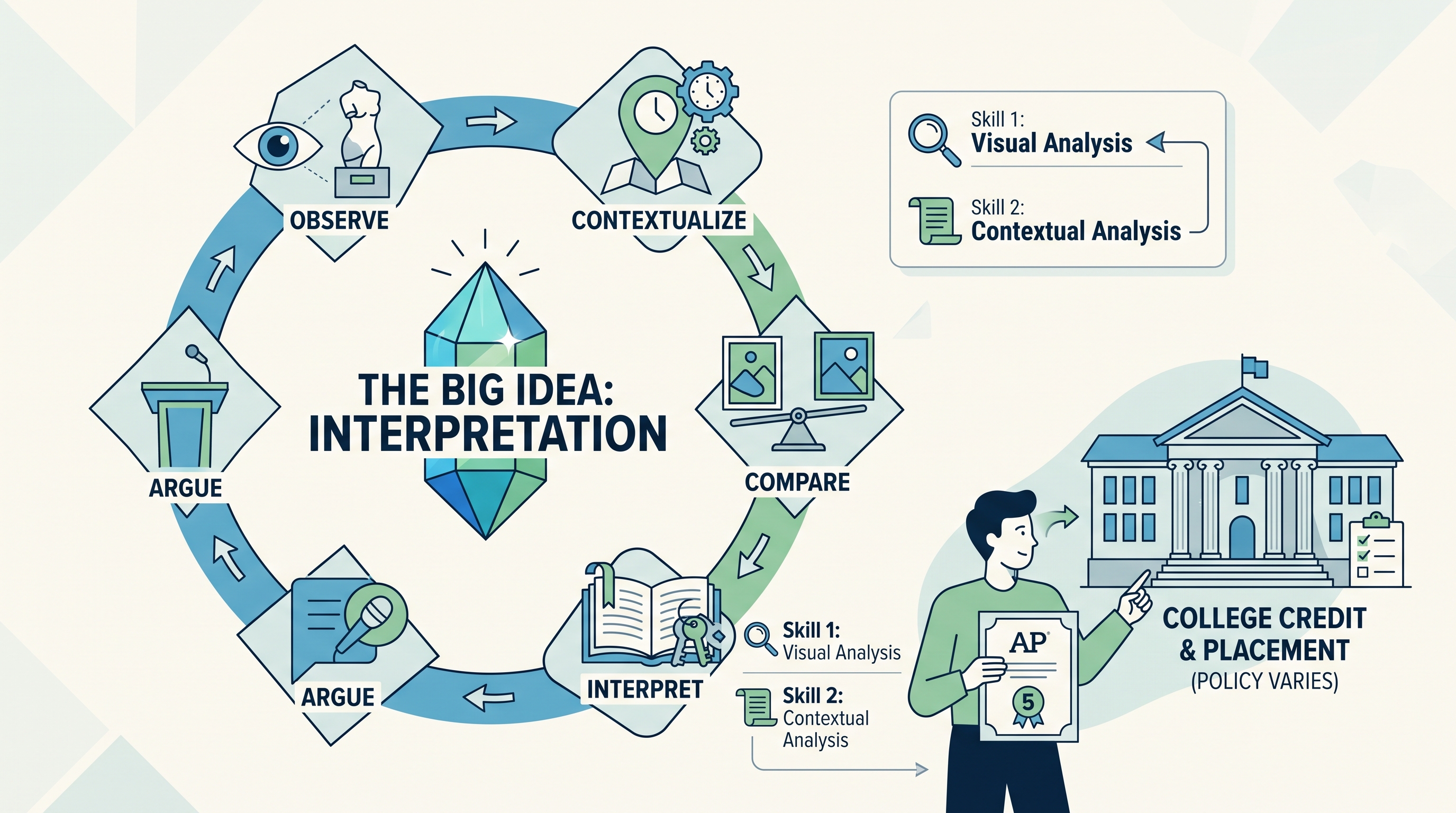
A prehistoric cave image may first prompt Skill 1: Visual Analysis: What lines, pigments, scale, and placement are visible? Later, an unfamiliar work may require Skill 5: Visual Analysis of Unknown Works, followed by Skill 6: Attribution of Unknown Works and Skill 8: Argumentation. The same habits become more demanding: observe, contextualize, compare, interpret, and defend.
Unit 1 illustrates this design clearly. Unit 1: Global Prehistory, $30{,}000$–$500$ BCE connects CUL to Skill 1: Visual Analysis and Skill 2: Contextual Analysis; MPT to visual analysis of known and unknown works; and THR to Skill 7: Art Historical Interpretations. The course therefore begins with identification and description but does not remain there—it builds toward interpretation and evidence-based argument.
Informed choice and college recognition
Advanced Placement is a choice that should be informed. The AP Program encourages educators to review course principles and expectations with students and parents so that workload, college-level analysis, and assessment demands are clear before enrollment.
A qualifying AP score may allow college credit, placement into advanced courses, or both, although each college determines its own policy. AP scores receive further validation through the American Council on Education and studies involving thousands of colleges and universities nationwide; students should still verify the specific policy of each institution.
Key insight: The framework is not a checklist of facts. It is a repeated reasoning cycle: observe → contextualize → compare → interpret → argue.
Retrieval check: A work depicts a ruler, but the prompt asks why its scale, materials, and location matter. Which Big Idea should guide the first response, and which two skills would most naturally support it? A strong answer begins with PAA, then uses Skill 1: Visual Analysis to identify evidence and Skill 2: Contextual Analysis to explain the patron’s intended effect.


Source Materials
- AP Art History Course and Exam Description
- AP Art History Course and Exam Description Clarifications and Corrections
- AP Art History Course Overview
- AP Art History Course at a Glance
- AP Art History Course at a Glance Poster
- Adopt AP Art History
- AP Art History
- AP Art History
- Figure — AP Art History Course and Exam Description (p. 1)
- Figure — AP Art History Course and Exam Description (p. 17)
- Figure — AP Art History Course and Exam Description (p. 25)
- Figure — AP Art History Course and Exam Description (p. 27)