From the free course AP Art History on Lykke
8.1 Course placement
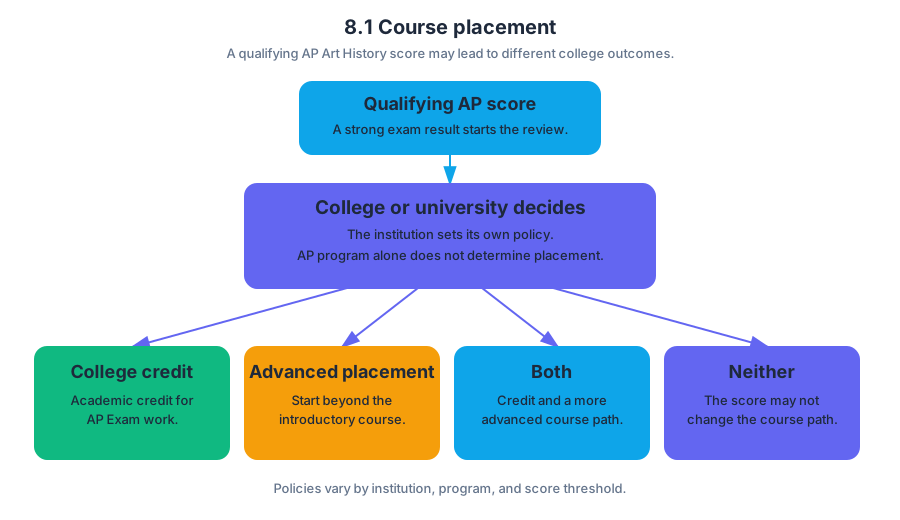
A qualifying AP Art History score may help a student receive college credit, advanced placement, or both—but the decision belongs to the college or university, not to the AP program alone.
8.1 Course placement
A qualifying AP Art History score may help a student receive college credit, advanced placement, or both—but the decision belongs to the college or university, not to the AP program alone.
The crucial distinction is simple:
- College credit means the institution awards academic credit for work completed through the AP Exam.
- Advanced placement means the score allows a student to begin in a more advanced course, skip an introductory requirement, or enter a different sequence.
- A college may grant one, both, or neither.
How the placement decision works
AP Exams are administered annually in May. After scores are reported, each institution applies its own AP credit policy—its published rule specifying which scores qualify and what academic benefit follows.
A useful way to model the process is:
- The student completes AP Art History and takes the May AP Exam.
- The student receives an AP score.
- The college checks that score against its AP Art History policy.
- The institution determines whether the result produces credit, placement, both, or no award.
- The student follows the institution’s advising and enrollment procedures.
For example, two universities might treat the same score differently. University A could award credit for an introductory art-history requirement, while University B could grant placement into a higher-level course without awarding equivalent credit. A third institution might require a higher score or offer no AP benefit for the course. The score has not changed; the institutional policy has.
What students should verify
Students should not assume that a qualifying score automatically removes every introductory requirement. They need to check the policy of each college or university they may attend, including the required score, the number or type of credits awarded, the course requirement satisfied, and whether the credit counts toward the intended major.
The AP Credit Policy Search is designed to help students locate college and university policies. Because institutions can revise their rules, the final authority is the college’s current official policy and its advising or registrar’s office.
Key distinction: AP provides the examination and score; the college decides how that score functions in its own degree system.
Why placement is not the same as exemption
Being placed into an advanced course does not always mean that a student has earned the same number of credits as a student who completed the introductory course at that institution. Placement concerns where the student begins; credit concerns what academic hours the institution records. These outcomes often overlap, but they are not identical.
A student entering an advanced art-history course should therefore be prepared for college-level visual and contextual analysis: examining how an artwork looks and is made, then connecting those choices to historical and cultural circumstances.
Misconception check: “A high score guarantees college credit”
Correction: A high score can make a student eligible under a particular institution’s policy, but it does not guarantee the same result everywhere. AP scores are commonly used for credit or placement, yet each college sets its own thresholds and academic rules.
Retrieval check: If one university awards introductory-course credit and another places the student into an advanced course without credit, are the institutions contradicting the AP score? No. They are applying different institutional policies to the same AP result.

Source Materials
- AP Art History Course and Exam Description
- AP Art History Course and Exam Description Clarifications and Corrections
- AP Art History Course Overview
- AP Art History Course at a Glance
- AP Art History Course at a Glance Poster
- Adopt AP Art History
- AP Art History
- AP Art History
- AP Art History-AP Students
- AP/College Art History-Khan Academy
- AP Art History-Wikipedia
- AP Art History-Smart History