From the free course AP Art History on Lykke
10.2 10.1–10.2 Topic entries
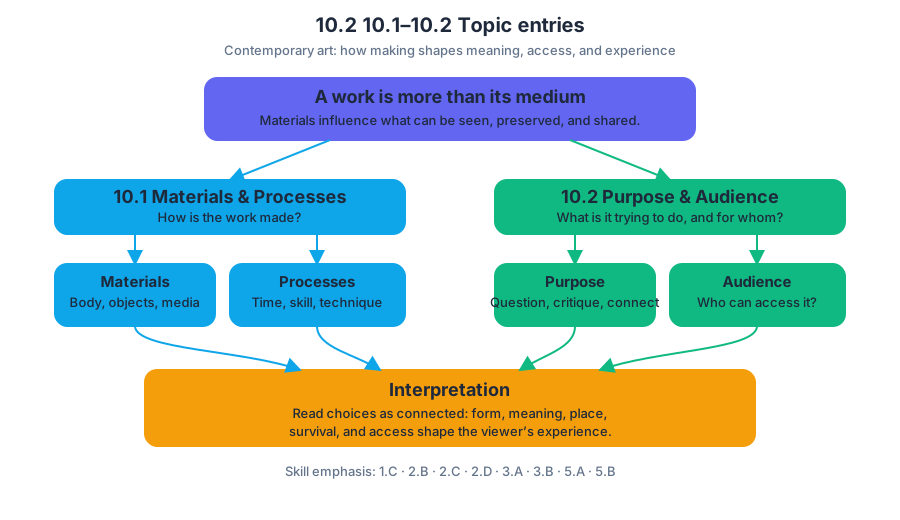
A contemporary artwork can be made from almost anything—photographs, video, industrial materials, found objects, digital media, or the human body—but its materials are never merely technical choices.
10.2 10.1–10.2 Topic entries
A contemporary artwork can be made from almost anything—photographs, video, industrial materials, found objects, digital media, or the human body—but its materials are never merely technical choices. They shape what viewers can see, how long a work survives, where it can exist, and what kinds of audiences it can reach.
Topics 10.1 Materials, Processes, and Techniques in Global Contemporary Art and 10.2 Purpose and Audience in Global Contemporary Art therefore belong together. The first asks how a work is made and what that making permits; the second asks what the work is trying to do and for whom. The relevant skill emphasis includes 1.C, 2.B, 2.C, 2.D, 3.A, 3.B, 5.A, and 5.B.
10.1 Materials, Processes, and Techniques
Materials are the physical or digital substances used to make an artwork. Processes are the actions applied to those materials, while techniques are the specific methods through which those actions are controlled. In contemporary art, this distinction matters because the artwork may be temporary, reproducible, participatory, technologically mediated, or assembled from materials that carry strong social associations.
A photograph, for example, is not simply an image of something. Its production may involve staging, lighting, digital manipulation, printing, installation, and careful control of scale. A large photographic image placed in a gallery produces a different encounter from the same image viewed on a phone: the material presentation changes the viewer’s physical relationship to the work.
Skill 1.C: Explain how artistic decisions about materials, processes, and techniques shape an artwork’s meaning and function. Do not stop at identifying a medium. Connect the medium to an effect: an installation assembled from discarded consumer objects may make consumption physically visible; a video work may depend on duration and repeated viewing; a digital image may deliberately question whether an “original” object is necessary.
Skill 3.A: Identify and describe features of an artwork using appropriate visual or contextual evidence. Skill 3.B: Explain how those features contribute to the work’s meaning. A strong response moves from observation to interpretation: “The work uses repeated manufactured objects” is description; “the repetition suggests standardized production and invites criticism of mass consumption” is analysis.
Worked contextual example: a site-specific installation
Imagine a contemporary artist fills a gallery with discarded plastic containers collected from a nearby coastline. The materials establish a local environmental context; the collecting process turns research into part of the artwork; and the installation technique transforms individual objects into an immersive field through which viewers must walk.
The reasoning chain is: material—discarded plastic—connects the work to pollution and consumer culture; process—collection and sorting—documents human responsibility; technique—repetition and spatial arrangement—changes scattered waste into an overwhelming visual experience. The work’s meaning does not come from the objects alone. It emerges from the relationship among substance, method, site, and viewer.
Misconception check — “The medium determines the meaning.” A material does not carry one fixed interpretation. Plastic can signify convenience, pollution, industry, memory, or abundance depending on how it is used, where it is shown, and what cultural circumstances surround it.
10.2 Purpose and Audience
Purpose is what an artwork is intended to accomplish; audience is the individual or group expected to encounter, use, interpret, or respond to it. Contemporary artists may address museum visitors, online communities, political authorities, local residents, consumers, or audiences who will never encounter the work in person.
Skill 2.B: Explain how an artwork’s purpose and intended audience relate to its form and content. Skill 2.C: Explain how context can affect an artwork’s meaning. Skill 2.D: Explain how an artwork’s meaning may change for different audiences. These skills prevent a common mistake: treating personal reaction as sufficient evidence. Interpretation must be anchored in visible choices and relevant context.
Consider a public artwork that projects changing text onto the exterior of a government building. Its scale and location make the work visible beyond the museum-going public; its temporary projection allows the artist to intervene without permanently altering the structure; and its changing language may invite debate rather than deliver one fixed message. The intended audience includes passersby, residents, officials, and online viewers who encounter documentation of the event.
Skill 5.A: Identify a work’s relationship to a larger artistic tradition or historical pattern. Skill 5.B: Explain how an artwork continues, transforms, or challenges that tradition. A contemporary installation may extend traditions of monument, protest image, portraiture, or ritual object while changing their location, materials, or audience. Contemporary art is not detached from history; it often makes historical forms newly unstable.
Misconception check — “Contemporary art has no audience if it is difficult to understand.” Difficulty may be intentional. A work can ask viewers to investigate, participate, disagree, or recognize that different communities possess different knowledge. Confusion is evidence of an interpretive problem to solve, not proof that the work lacks purpose.
Retrieval check
A work uses fragile organic material, exists for only one day, and is documented online for a worldwide audience. Name one way the material affects meaning, one way the process affects meaning, and one way the audience changes the work’s interpretation. A complete answer links each claim to a specific feature rather than merely labeling the work “temporary” or “interactive.”