From the free course AP Art History on Lykke
AP Practice 2
Key concepts: Visual analysis of art and architecture · Purpose and intent shaping creation and meaning · Continuity and change within artistic traditions · Comparison of related works of art · Contemporary art museums, galleries, biennials, and triennials · The worldwide proliferation of contemporary art institutions · Sacred spaces and communal worship · Political power and imperial rule in art · Contrapposto in classical sculpture · AP Art History work identification and accurate identifiers
A successful AP Art History long essay does more than recognize an artwork: it explains how visual choices, purpose, audience, and historical context produce meaning.
AP Practice 2
A successful AP Art History long essay does more than recognize an artwork: it explains how visual choices, purpose, audience, and historical context produce meaning. The central move is to turn observation into interpretation—what do I see? becomes why might the artist, patron, or culture have made it this way?
The core reasoning chain
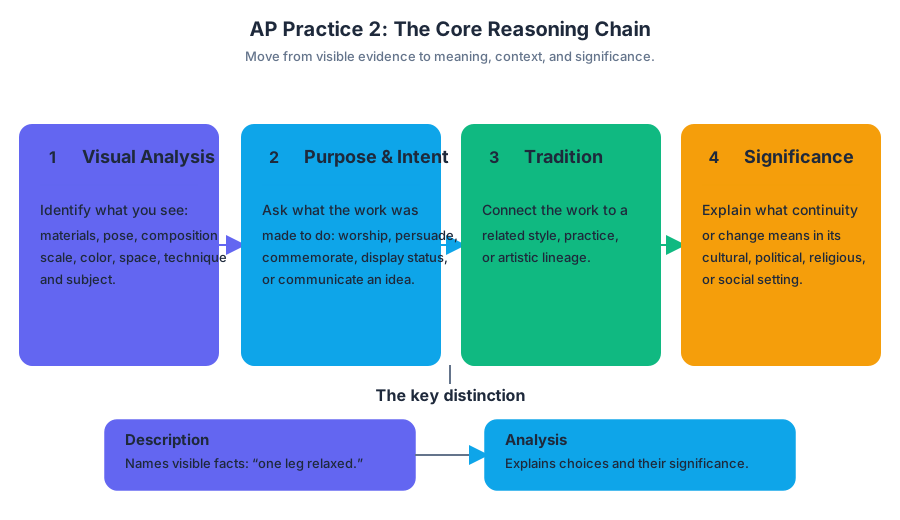
Use this four-step chain when analyzing an unfamiliar work or comparing related works:
- Visual analysis: identify materials, pose, composition, scale, color, space, technique, and subject.
- Purpose and intent: explain what the work was made to do—commemorate, worship, persuade, challenge, display status, or communicate an idea.
- Tradition: connect the work to a related style, practice, or artistic lineage.
- Significance: explain what the continuity or change means in its cultural, political, religious, or social setting.
A description names visible facts: “The figure stands with one leg relaxed.” Analysis adds significance: “The relaxed leg and shifted weight create contrapposto, presenting the body as balanced but active; this idealized anatomy connects the sculpture to Greek Classical ideas about proportion and human excellence.”
Description answers what is visible. Analysis explains how those choices create meaning or significance.
Worked comparison: Polykleitos’s Doryphoros
Identify the work completely before interpreting it: Doryphoros (“Spear Bearer”), by Polykleitos, approximately $450$–$440$ BCE in its original Greek form, known through a Roman marble copy of a Greek bronze original. It is a nude, muscular male athlete in a contrapposto stance, with the body’s weight shifted onto one leg while the other relaxes.
A weak response stops at inventory: “The sculpture is nude, muscular, and standing.” A stronger response connects form to artistic tradition: the controlled weight shift, idealized anatomy, and carefully balanced proportions embody Classical Greek interest in an ordered, rational image of the human body. The Roman copy also demonstrates continuity: Roman artists and patrons preserved and circulated Greek sculptural ideals.
The work’s meaning is therefore not simply “an athlete.” Its ideal body can signify discipline, excellence, and a culturally valued model of human achievement. The distinction between the lost Greek bronze and surviving Roman marble also reveals change in material and historical setting: the same artistic ideal continued, but its physical form and audience changed.
Purpose can reshape meaning
A sacred complex does not function like a detached statue in a gallery. Monumental Buddhist sculpture, including complexes associated with Buddha images and the Great Buddha at Todai-ji, can occupy spaces designated for communal worship. Architecture organizes movement, attention, and access, turning the image into part of a shared religious experience rather than merely an object to inspect.
Purpose can also be political. Monumental Buddhist images at Longmen, associated with imperial patronage such as Empress Wu Zetian, demonstrate how religious art could reinforce the political power of imperial rule. The correct interpretation is not that religious and political meanings are mutually exclusive: sacred imagery could support devotion while also presenting the ruler as powerful, legitimate, and connected to Buddhist authority.
Purpose is evidence, not decoration. Ask who commissioned the work, where it was placed, who encountered it, and what behavior or belief the setting encouraged.
Continuity and change: the comparison engine
Skill 4.A. Explain how a specific work of art (or group of related works of art) demonstrates continuity and/or change within an artistic tradition, style, or practice. Begin by naming the tradition, then identify what persists and what shifts.
Skill 4.D. Explain the meaning or significance of continuity and/or change between works of art (or groups of related works of art) within a related artistic tradition, style, or practice. Do not merely state “the works are similar” or “the later work is different.” Explain why the similarity or difference matters.
| Move | Too weak | AP-ready reasoning |
|---|---|---|
| Describe | “Both works show human figures.” | “Both use the body as a vehicle for cultural ideals.” |
| Compare | “One is more realistic.” | “Both idealize the body, but Doryphoros stabilizes movement through contrapposto, while a later work may intensify motion to express a changed social or political world.” |
| Interpret | “This shows change.” | “The change matters because the altered pose shifts emphasis from rational balance toward emotional intensity or conflict.” |
Contemporary institutions and global comparison
Contemporary art is not confined to a few European or North American museums. Museums, galleries, biennials, and triennials have proliferated worldwide, creating new spaces for artists to address migration, identity, colonial history, technology, and global exchange. The institution itself can shape meaning by changing scale, audience, circulation, and interpretation.
This is useful when comparing works such as Basquiat’s expressive street-derived symbols, Song Su-nam’s gestural ink practice, Magdalena Abakanowicz’s soft sculptural forms, and Xu Bing’s meticulously crafted unreadable pseudo-text in A Book from the Sky. Their materials and marks differ, but each work asks viewers to reconsider how cultural traditions, language, and artistic authority operate.
Original practice prompt
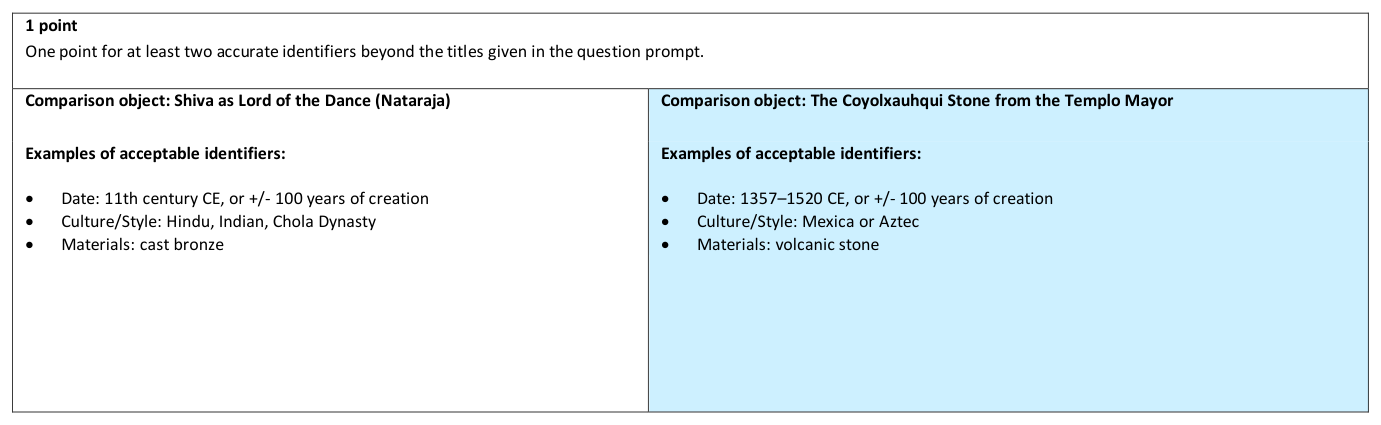
Prompt: Select Doryphoros and one contemporary work from the examples above. Explain how each work uses its visual characteristics and relationship to an artistic tradition to communicate meaning. Discuss one continuity and one change between the works. Include at least two accurate identifiers beyond the title for the selected contemporary work.
Worked response plan: Identify Doryphoros as a Roman marble copy of Polykleitos’s Greek bronze original, approximately $450$–$440$ BCE, then identify the contemporary work with artist, date or period, material, culture, or style. Describe specific evidence—such as contrapposto, unreadable pseudo-text, gestural marks, or nontraditional soft materials. Explain how that evidence produces meaning, and end by connecting the change to the contemporary work’s altered purpose, audience, or institutional setting.
Error check
Common misconceptions include treating visual description as interpretation, assuming sacred art cannot communicate political power, calling Doryphoros an original Greek marble, and naming only a title when the prompt requires additional identifiers. Before submitting, underline each claim and draw an arrow to the visual or contextual evidence that proves it.
Timing and review: Reserve roughly $15$–$20$ minutes for a long essay of this type. During review, label every sentence V for visual evidence, C for context, R for reasoning, or I for identification. If a paragraph contains only V and I, revise it by adding the missing explanation of how or why.

Source Materials
- AP Art History Course and Exam Description
- AP Art History Course and Exam Description Clarifications and Corrections
- AP Art History Course Overview
- AP Art History Course at a Glance
- AP Art History Course at a Glance Poster
- Adopt AP Art History
- AP Art History
- AP Art History
- Course Framework V.1 | 37 AP Art History Course and Exam Description
- Course Framework V.1 | 41 AP Art History Course and Exam Description
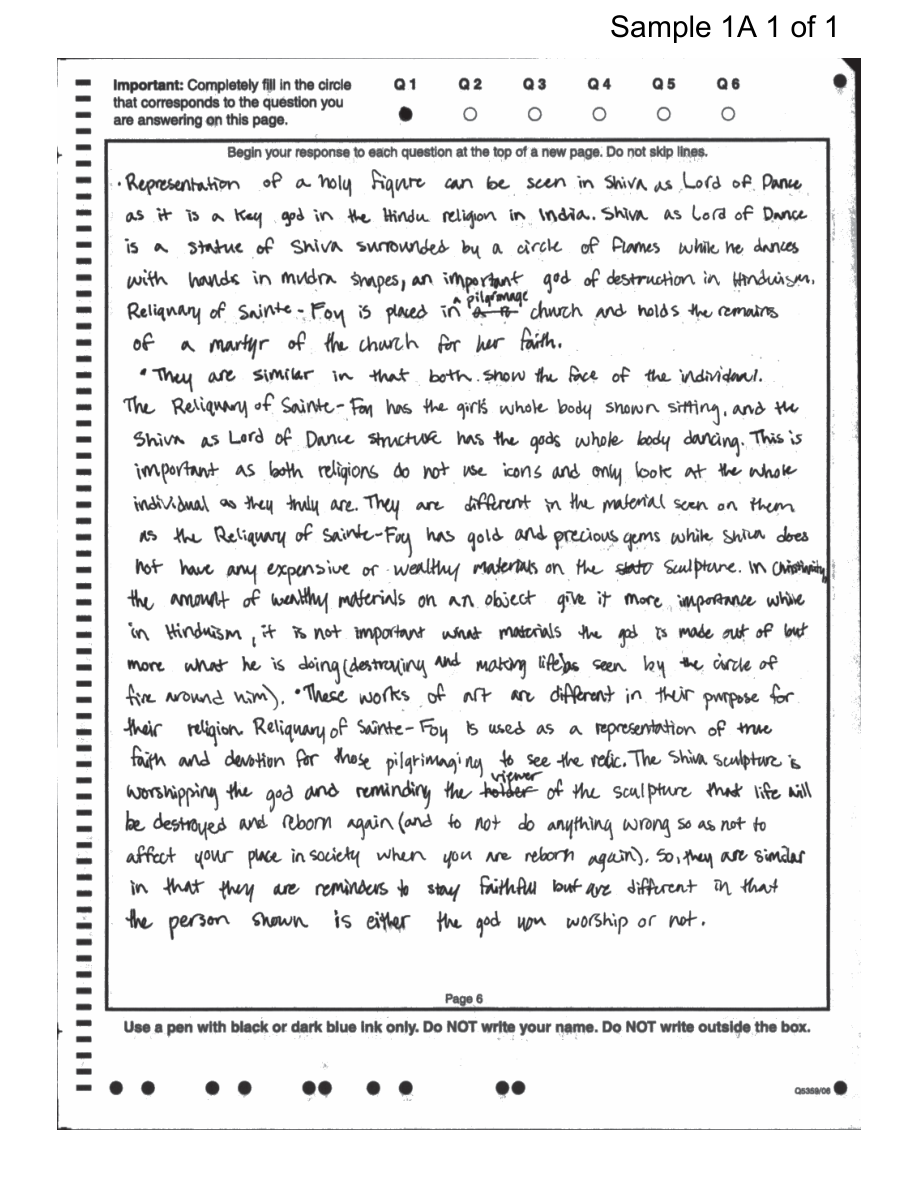
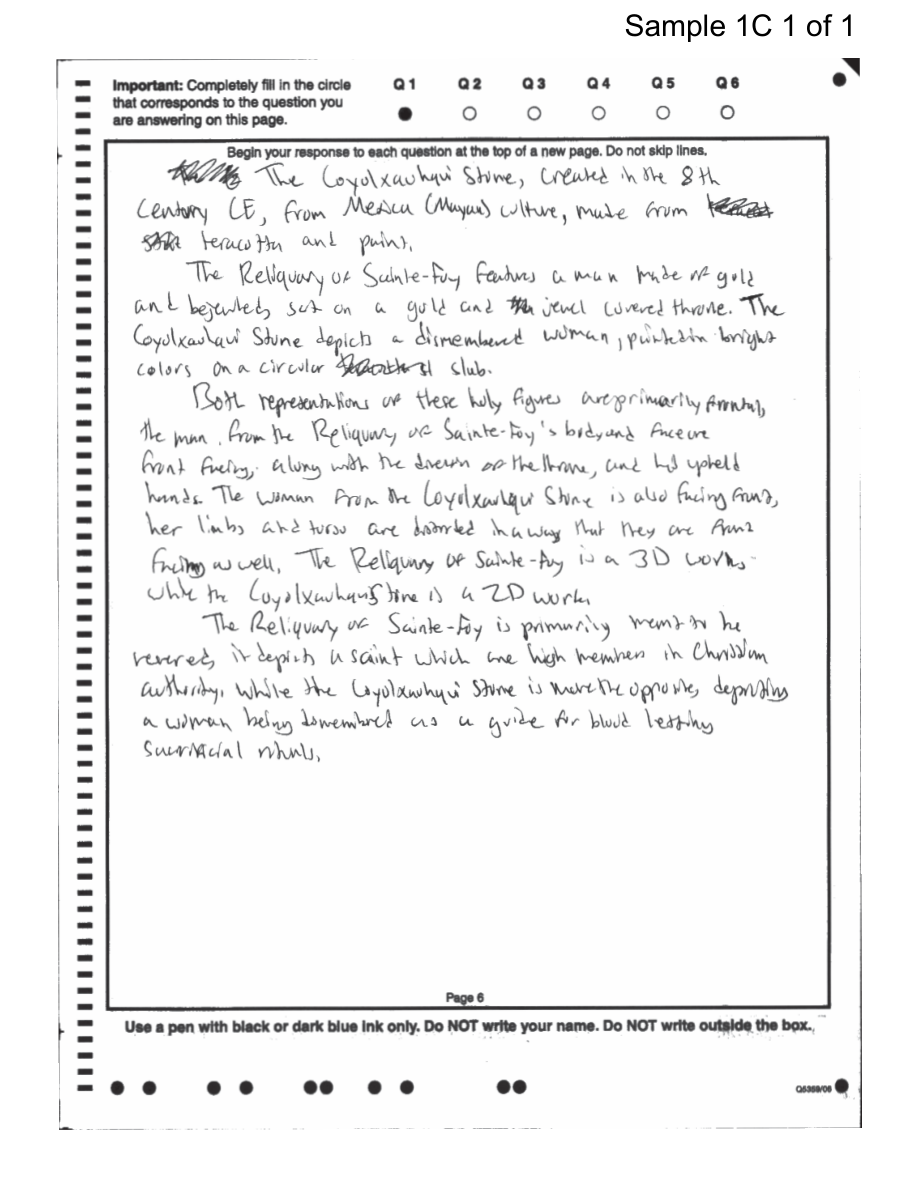
- Figure — Sample Responses - Q1 (p. 2)
- Figure — Sample Responses - Q1 (p. 5)