From the free course AP Art History on Lykke
9.2 Interactions Within and Across Cultures in Pacific Art
Key concepts: Cultural interaction within and across Pacific cultures · Travel, migration, trade, war, conquest, and colonization as forces of cultural exchange · The Pacific Ocean as a central theme and medium in Pacific art · Ocean-going vessels and navigation as means of exploration, migration, and exchange · Personal navigation charts as representations of navigators’ experiences · Objects created to protect journeys · Artistic influence through spolia, appropriation, and stylistic adaptation · Papuan-speaking peoples’ early migration across a land bridge between Asia and Australia · Lapita peoples’ migration across the Pacific · The Pacific region defined by its location within the Pacific Ocean and its many islands
The Pacific Ocean is not merely the space between islands: it is a highway, archive, boundary, and subject of art. Its waters connected communities that traveled, traded, migrated, fought, and exchanged artistic ideas across a region containing more than $25{,}000$ islands, about $1{,}500$ of them inhabited.
9.2 Interactions Within and Across Cultures in Pacific Art
The Pacific Ocean is not merely the space between islands: it is a highway, archive, boundary, and subject of art. Its waters connected communities that traveled, traded, migrated, fought, and exchanged artistic ideas across a region containing more than $25{,}000$ islands, about $1{,}500$ of them inhabited.
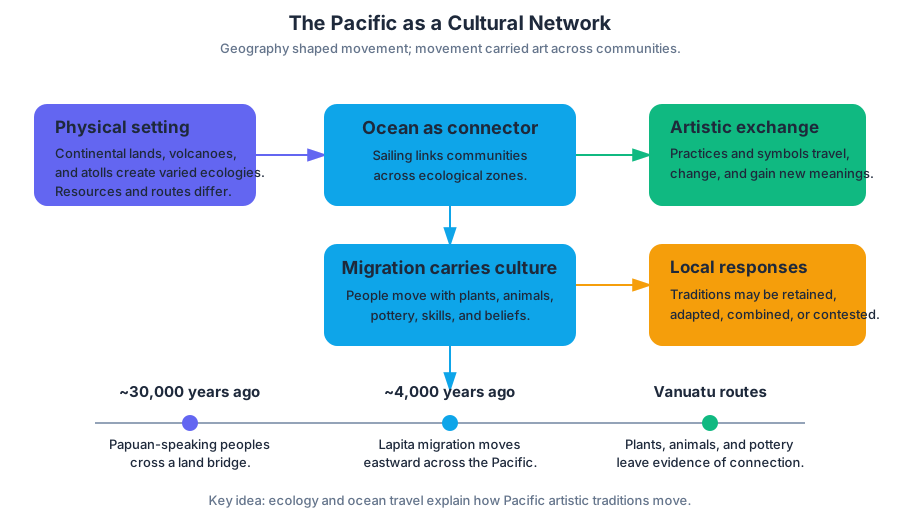
The Pacific as a Cultural Network
CUL-1.A.50 explains why Pacific art cannot be separated from geography. The region includes continental lands, volcanic islands, and atolls, each with distinct ecologies. These environments shaped where people could live, what resources they could use, how communities were organized, and how movement occurred across the ocean.
Geological and archaeological evidence indicates that Papuan-speaking peoples crossed a land bridge connecting Asia and present-day Australia about $30{,}000$ years ago. Much later, Lapita people migrated eastward across the Pacific beginning about $4{,}000$ years ago. Populations sailing from Vanuatu carried plants, animals, and pottery, leaving material evidence of migration and connection associated with Lapita culture.
The important reasoning move is to treat migration as an artistic force rather than as background history. When a community moves, it carries practices, objects, symbols, technologies, and beliefs; when it encounters another community, those traditions may be retained, adapted, combined, or contested.
Retrieval check: Why does the Pacific’s physical setting belong in an explanation of Pacific art? A strong answer connects ecological variation and ocean travel to the movement of communities, practices, and artistic traditions.
Navigation as Exploration, Migration, and Exchange
Under CUL-1.A.52, ships and navigational devices are not simply functional technologies. Ocean-going vessels enabled entire communities to move across vast distances, making exploration, migration, and cultural exchange possible. Navigation therefore became both a practical necessity and a cultural knowledge system.
Navigators created personal charts—representations of their own experiences of routes, currents, islands, and ocean conditions. These charts should not be mistaken for universally standardized maps. Their meaning depended on the navigator’s knowledge and use of the sea; they recorded lived experience rather than presenting an abstract, identical picture for every viewer.
Objects were also made to protect journeys. Such protective objects reveal that travel involved more than technical skill: it could carry spiritual, social, and emotional significance. A vessel might transport people physically, while protective objects helped express hopes for safety, successful passage, and communal continuity.
Worked contextual example: reading a navigation object
Imagine an object associated with a Pacific voyage. Begin with visible evidence: its connection to a vessel, route, or protective practice. Add context: ocean-going travel enabled migration and exchange across distant islands. Then make the interpretive connection: the object represents navigation not only as transportation but also as a culturally meaningful practice involving experience, protection, and community.
A weak answer says, “The object shows that Pacific peoples traveled.” A stronger answer explains how travel shaped art making: navigation demanded specialized knowledge, vessels moved communities, personal charts represented individual experience, and protective objects materialized cultural beliefs about the dangers and possibilities of the sea.
Cultural Interaction and Artistic Change
The enduring understanding INT-1 identifies several forces that produce interaction among cultures: travel, trade, war, conquest, and colonization. These forces do not all involve equal relationships. Trade may create exchange, while conquest or colonization may impose power, reshape institutions, or redirect artistic production.
INT-1.A asks you to explain how interaction with other cultures affects art and art making. In Pacific contexts, artistic change may include:
- Spolia: the reuse of material or artistic elements from another culture, often carrying traces of an earlier context.
- Appropriation: the adoption or use of imagery, forms, or practices from another culture, sometimes involving unequal power.
- Stylistic influence: the adaptation of visual characteristics from another tradition without necessarily reproducing the original object or meaning.
- Colonial and missionary influence: external systems that altered local social structures, beliefs, commerce, and artistic practices.
INT-1.A.30 emphasizes that Pacific arts vary according to ecological situations, social structures, and external influences such as commerce, colonialism, and missionary activity. INT-1.A.31 places European exploration within this history: exploration began in the sixteenth century and intensified in the late eighteenth century. In the nineteenth century, Dumont d’Urville divided the region into Melanesia, Micronesia, and Polynesia—categories that should be understood as later organizing labels applied to cultural areas that had developed by about $800$ CE.
Common misconception — “cultural interaction means simple borrowing.” Artistic exchange is rarely a one-way process. Ask who traveled, who controlled resources, who made the object, what changed in its meaning, and whether the interaction involved commerce, coercion, or colonization.
The Sea as Connector and Separator
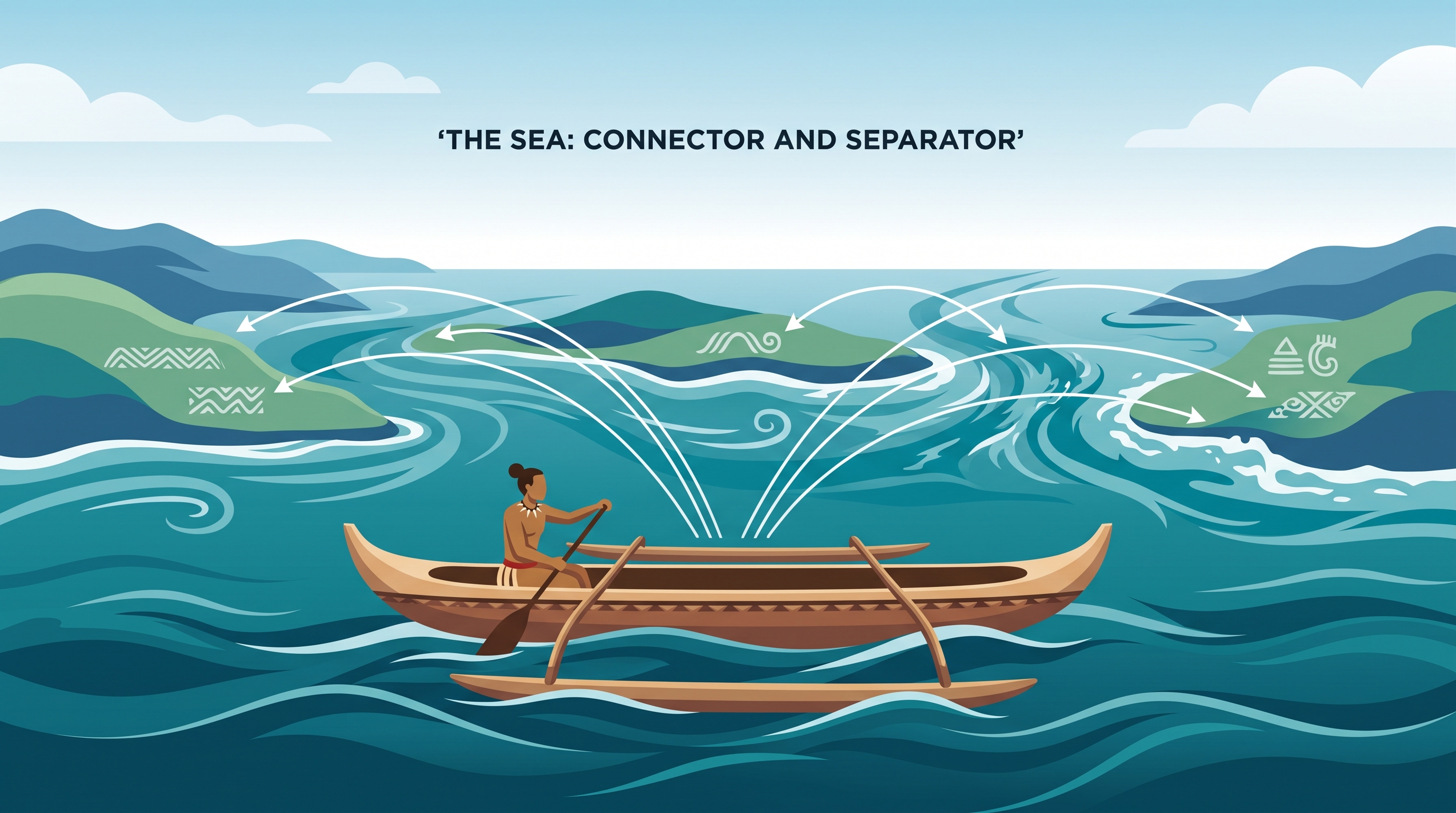
CUL-1.A.53 identifies the sea as a central theme in Pacific art because it performs two seemingly opposite roles. It connects islands by enabling travel, migration, trade, and cultural exchange; it also separates communities by creating distance, danger, and distinct local environments.
This double role explains why the ocean may appear simultaneously as a source of identity, a challenge to be mastered, and a medium through which communities understand their relationships to one another. The sea is therefore not merely represented in Pacific art; it helps determine the art’s setting, purpose, imagery, and social meaning.
AP Skill Application
This topic most directly activates Skill 2: Contextual Analysis, because the physical setting, migration history, social structures, and external influences explain artistic decisions. It also develops Skill 1: Visual Analysis when you use evidence from a vessel, chart, or protective object rather than relying on identification alone.
For comparisons, use Skill 3: Comparison of Works of Art to contrast how two Pacific objects represent travel, community, or the sea. Skill 4: Artistic Traditions helps trace how practices move across generations and regions. Skill 7: Art Historical Interpretations becomes important when deciding whether an object is best understood through navigation, protection, exchange, colonial contact, or several perspectives at once. Finally, Skill 8: Argumentation requires a defensible claim supported by specific visual and contextual evidence.
Final retrieval check: Explain one way the Pacific Ocean connects communities and one way it separates them. Then name one artistic consequence of travel, trade, conquest, or colonization. A complete response should link a force of interaction to a change in art making, not merely list historical events.