From the free course AP Art History on Lykke
2.1 Cultural Contexts of Ancient Mediterranean Art
Key concepts: Cultural contexts of Ancient Mediterranean art · How available evidence, technology, materials, and other disciplines influence art historical analysis · Contextual analysis of artworks · Visual analysis using style, materials, technique, and content · Comparing similarities and differences in form across artworks · Attribution to a specific artist, culture, style, or object type · Ancient Near Eastern cultural powers and traditions · The relationship between artistic permanence and beliefs about rebirth · Greek, Etruscan, and Roman values of harmony and order · Cultural and political distinctions among Etruscan and Roman art
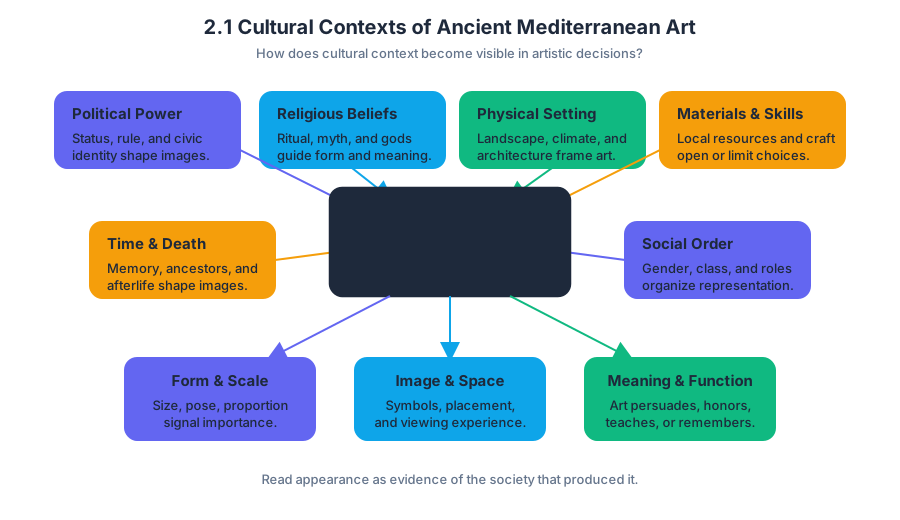
Ancient Mediterranean art cannot be understood from appearance alone: its forms respond to political power, religious beliefs, physical setting, available materials, and ideas about time, death, and social order.
2.1 Cultural Contexts of Ancient Mediterranean Art
Ancient Mediterranean art cannot be understood from appearance alone: its forms respond to political power, religious beliefs, physical setting, available materials, and ideas about time, death, and social order. The central question is therefore: how does cultural context become visible in artistic decisions?
A cultural-context map
The Ancient Mediterranean includes several overlapping traditions rather than one unified culture. The ancient Near East includes present-day Iraq and successive cultural powers such as the Sumerian, Akkadian, Neo-Sumerian, Babylonian, Assyrian, and Neo-Babylonian traditions. Greek, Etruscan, and Roman cultures developed in different physical and political settings, yet all were shaped by values associated with harmony and order, together with distinctive belief systems.
| Contextual factor | Artistic decision it can influence | Ancient Mediterranean example |
|---|---|---|
| Political structure | Scale, imagery, placement, and audience | Monumental architecture can project the authority of rulers or religious institutions |
| Belief system | Subject matter, repetition, permanence, and ritual use | Art may preserve a cycle of rebirth or serve divine and funerary purposes |
| Physical setting | Materials, construction, and visual form | Local resources and landscape affect what can be built or carved |
| Social organization | Access, function, and representation | Images may distinguish rulers, worshippers, elites, or communities |
| Available technology | Construction methods and surface treatment | Technical possibilities shape the size, durability, and finish of a work |
Evidence controls interpretation
Art historical conclusions depend on evidence, and evidence is uneven. Only a small number of ancient monuments and artworks survive and remain located; many objects have been damaged, displaced, excavated incompletely, or separated from their original surroundings. A confident interpretation must therefore distinguish between what the object visibly demonstrates, what its context makes plausible, and what remains uncertain.
Contextual analysis describes the historical, social, religious, political, and physical circumstances surrounding a work, then explains how those circumstances influence its form, style, materials, technique, content, or function.
For example, the White Temple and its ziggurat should not be treated simply as an impressive building. Its elevated architectural setting and relationship to a temple complex support an interpretation connected to organized religious and civic life. The evidence does not allow every detail of ancient experience to be reconstructed, but it does justify linking architecture, elevation, ritual visibility, and institutional power.
Three visual anchors
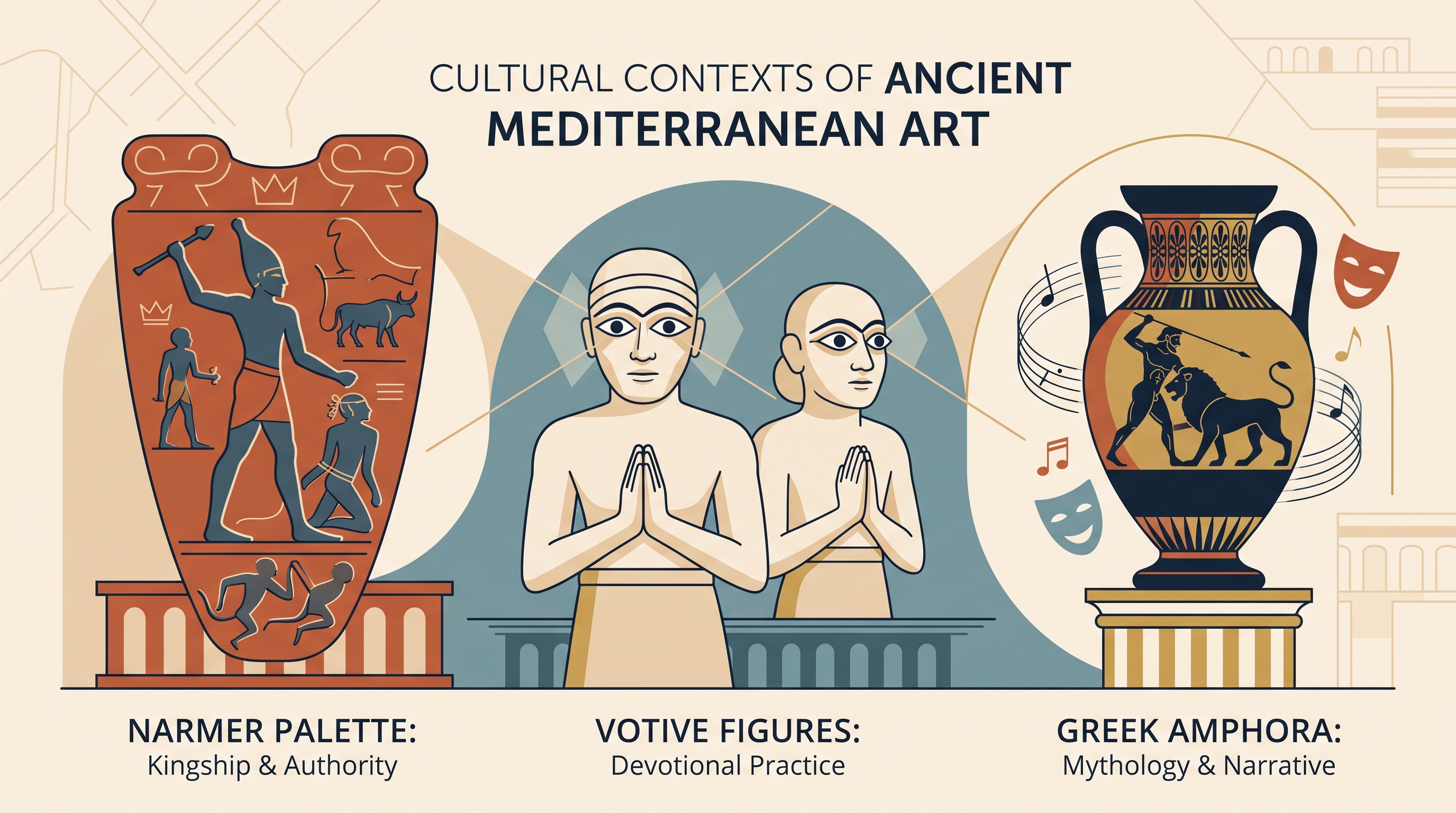
The Palette of King Narmer demonstrates how visual analysis and cultural context work together. A viewer can first identify formal elements—organized registers, differentiated scale, symbolic imagery, and a ruler presented as dominant—and then connect those decisions to kingship and political authority. The contextual claim becomes strong only when the visual evidence and historical explanation reinforce one another.
The votive figures from the Square Temple at Eshnunna provide a different case. Their frontal presentation, simplified geometric bodies, and large attentive eyes can be described visually before being interpreted in relation to devotional practice. The figures’ appearance supports the idea of continual worship or presence, but the interpretation must remain anchored in the objects’ temple context rather than in the modern assumption that they are merely “portraits.”
Comparing and attributing works
Comparison is more precise when it uses the same categories for both works: pose, scale, composition, material, technique, surface, subject, and function. Saying that two works are “similar because they are ancient” earns little analytical force; saying that both use frontal, hieratic presentation to communicate presence or authority identifies a relevant formal similarity and begins to explain its meaning.
Attribution means connecting a work to a specific artist, culture, art-historical style, or object type. Attribution is not a guess based on resemblance alone. It requires justification: identify a relevant visual feature, compare it with known examples, and explain why that similarity supports the proposed attribution. For an unknown work, a useful chain is:
- Describe the visible feature.
- Compare it with a known work or cultural tradition.
- Connect the similarity to a specific attribution.
- Qualify the claim if the surviving evidence is limited.
Permanence, periods, and misconceptions
Some ancient art was created for permanence or eternity, especially within cultures focused on preserving a cycle of rebirth. Permanence is therefore not simply a technical achievement; it can express a religious or cultural priority. A common misconception is that all ancient art had the same purpose because it survives in stone. Survival reflects material durability, while original intent must be inferred from context, function, and evidence.
Another misconception treats Etruscan art as the product of one centralized culture. Etruria consisted of separate city-states, even though art historians often discuss Etruscan art as one cultural unit. Likewise, Roman art is organized into Republican, early Imperial, late Imperial, and late Antique periods according to governmental structures and dynasties—not primarily according to stylistic change.
Skill check
Look at an unfamiliar ancient work and write four sentences: one using 1.B to describe visual elements; one using 2.A to identify context; one using 2.C to explain how context shaped form, material, technique, content, or function; and one using 6.A and 6.B to attribute the work and justify that attribution. Then compare it with the White Temple, Palette of King Narmer, or Eshnunna votive figures using 3.A. This sequence turns observation into evidence-based interpretation rather than unsupported identification.

Source Materials
- AP Art History Course and Exam Description
- AP Art History Course and Exam Description Clarifications and Corrections
- AP Art History Course Overview
- AP Art History Course at a Glance
- AP Art History Course at a Glance Poster
- Adopt AP Art History
- AP Art History
- AP Art History
- About the Advanced Placement Program ® (AP ®)
- Comparison object: Shiva as Lord of the Dance (Nataraja)
- Comparison object: Shiva as Lord of the Dance (Nataraja)
- Private Collection / Bridgeman Images / Courtesy of the artist