From the free course AP Art History on Lykke
6.1 Course placement
Key concepts: textual evidence · cultural values and beliefs · cultural context · point value · acceptable responses · Mayan culture · glyphs
A work of art can reinforce cultural values not only through its subject matter, but also through its inscriptions, ritual setting, materials, and portrayal of social rank.
6.1 Course placement
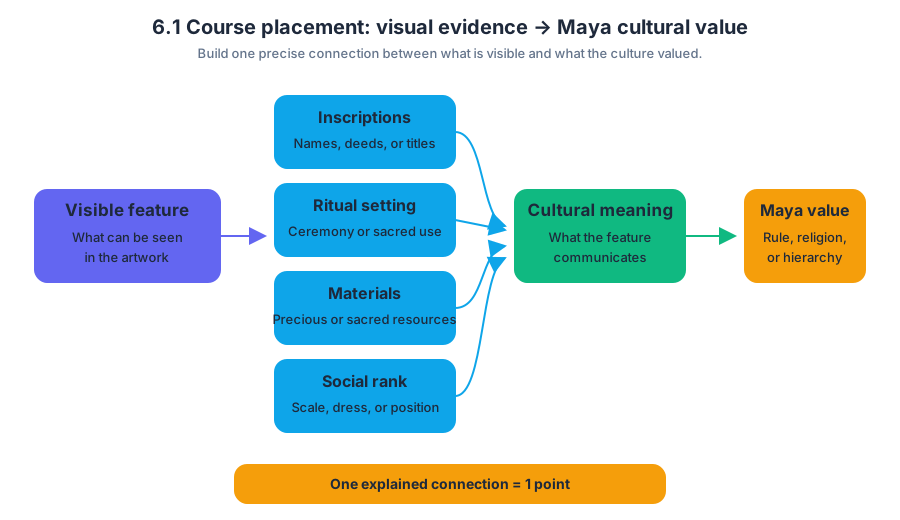
A work of art can reinforce cultural values not only through its subject matter, but also through its inscriptions, ritual setting, materials, and portrayal of social rank. In an attribution-style response, the key question is precise: How does one visible feature of the work support a belief or value held by the culture that created it?
This task belongs to the art-historical reasoning process of connecting visual evidence—what can be seen in the work—to cultural context—the beliefs, social structures, rituals, and historical circumstances that shaped its creation. The response earns 1 point when it explains one way the work may have reinforced the values or beliefs of the culture in which it was made.
Point-value rule: This sub-part is worth 1 point. One clearly explained cultural connection is enough; several unsupported possibilities do not earn more credit.
The required cultural context here is the Mayan culture, also called the Maya. An acceptable response must identify a feature of the work and explain how that feature could have supported Mayan ideas about rulership, religion, ritual authority, social hierarchy, or the relationship between humans, ancestors, and the divine.
From what you see to what you can argue
A strong response follows a short evidence chain:
- Name the visual evidence. Identify a glyph, inscription, ruler, ritual action, garment, jewelry, carving technique, or architectural placement.
- Identify the cultural value or belief. Connect that feature to Mayan ideas about royal authority, religious obligation, ancestry, elite status, or ritual order.
- Explain the reinforcement. State how seeing, reading, or encountering the work would make that value appear legitimate, important, or powerful.
The third step is the one students most often omit. Merely writing “the sculpture shows Mayan religion” identifies a topic but does not explain how the artwork reinforced a belief. The response must show the mechanism: the image, inscription, or setting presents a cultural idea in a form that confirms it for an audience.
Worked contextual example: glyphs and royal authority
Imagine that the work includes carved glyphs identifying a ruler or recording an event associated with the ruler. A complete one-point response might read:
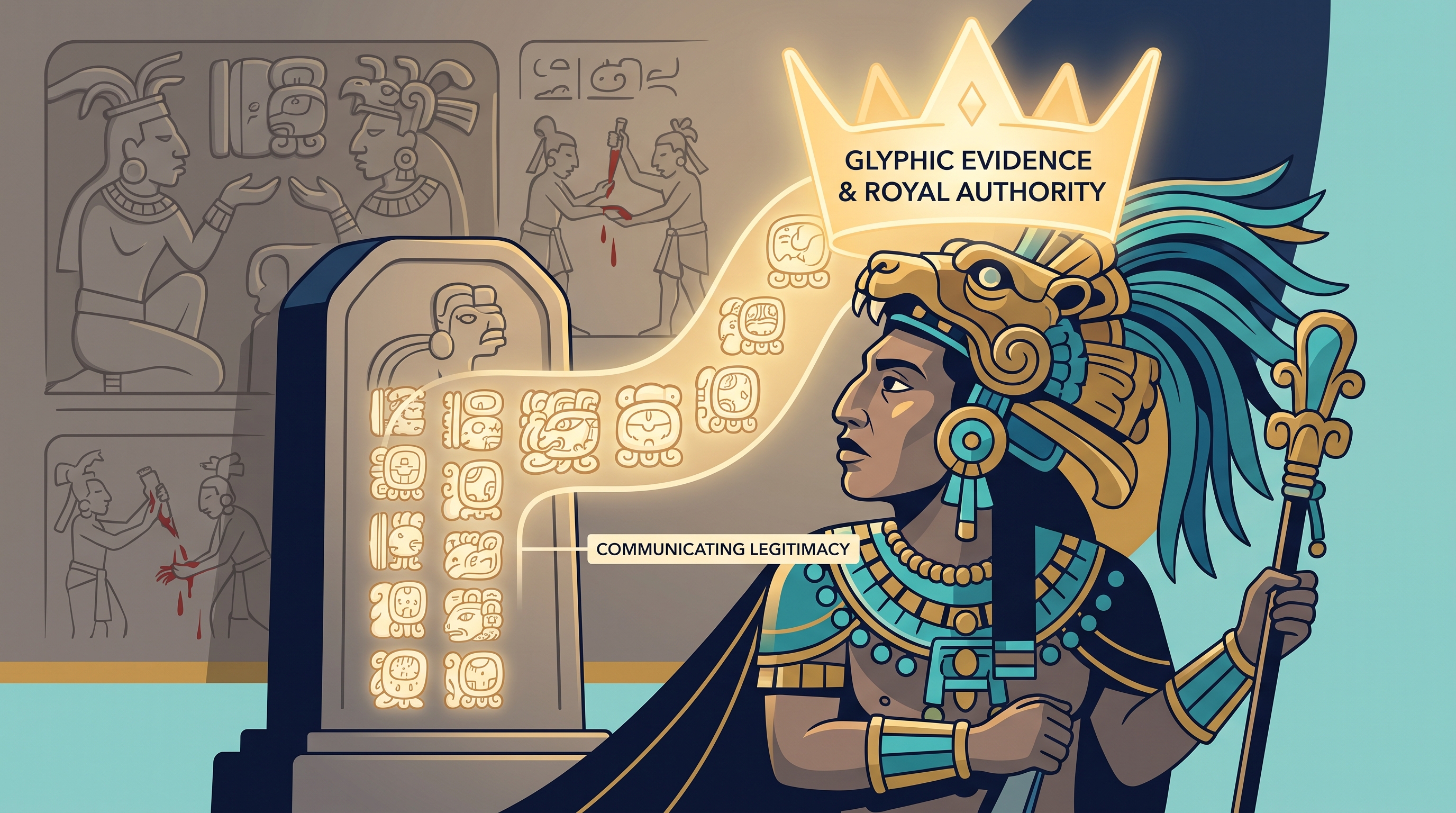
The glyphs reinforce Mayan beliefs about legitimate rulership because they identify the ruler and preserve information about the ruler’s authority. By placing the ruler’s name or accomplishments on a durable monument, the work presents royal power as publicly recognized and worthy of remembrance.
This answer succeeds because it uses textual evidence—the glyphs or inscriptions—and explains its cultural significance. The glyphs do not merely decorate the surface: they communicate information about a ruler, making political authority visible and permanent.
Other evidence can produce the same point when the explanation is specific. A ruler shown in contact with ancestors or deities may reinforce the belief that royal power is connected to the divine. A scene of bloodletting may emphasize the ruler’s responsibility to perform religious ceremonies. Detailed jewelry and garments may communicate elite wealth and status, while highly skilled carving may demonstrate that a ruler possessed the resources to commission exceptional art.
Placement, audience, and ritual meaning
The location of the work can also function as evidence. If a sculpture was placed in a temple, its setting may have emphasized a royal relationship with the gods. An inscription explaining when a ritual occurred could reinforce the ruler’s right to reign by linking political authority to sacred timing and religious responsibility.
An elite female figure participating in a ritual may reinforce the importance of women within Mayan political or religious life. The safest response does not assume that every represented person held identical power; instead, it explains what the figure’s ritual participation suggests about gender, status, and religious roles in the culture.
Common misconception check
Misconception: “I earn the point by naming a Mayan belief.” Not by itself. “The Maya believed in gods” is too general, and “the work is religious” is only description. To earn the point, attach the belief to a visible or textual feature and explain its effect: the ruler’s ritual action presents royal authority as necessary for maintaining communication with the divine.
Misconception: “I need to explain every possible meaning.” The criterion asks for one way the work may have reinforced cultural values or beliefs. A focused claim supported by one precise feature is stronger than a list of vague interpretations.
Retrieval check
Suppose a Mayan work shows an elaborately dressed ruler beside carved glyphs. Which response is stronger, and why?
- A: “The work shows that the Maya had powerful rulers.”
- B: “The ruler’s elaborate garments communicate elite status, while the glyphs preserve information about the ruler; together, these features present social hierarchy and royal authority as culturally important.”
Answer: B. It identifies textual and visual evidence, connects that evidence to Mayan values, and explains how the work reinforced those values.
Source Materials
- AP Art History Course and Exam Description
- AP Art History Course and Exam Description Clarifications and Corrections
- AP Art History Course Overview
- AP Art History Course at a Glance
- AP Art History Course at a Glance Poster
- Adopt AP Art History
- AP Art History
- AP Art History
- AP Art History-AP Students
- AP/College Art History-Khan Academy
- AP Art History-Wikipedia
- AP Art History-Smart History