From the free course AP Art History on Lykke
7.1 Materials, Processes, and Techniques in West and Central Asian Art
Key concepts: Materials, processes, and techniques · Regional and cultural variation in art making · Ceramics · Metalwork · Textiles · Painting · Mosaic-tile architectural decoration · Utilitarian vessels · Architectural decoration · The influence of materials and techniques on art
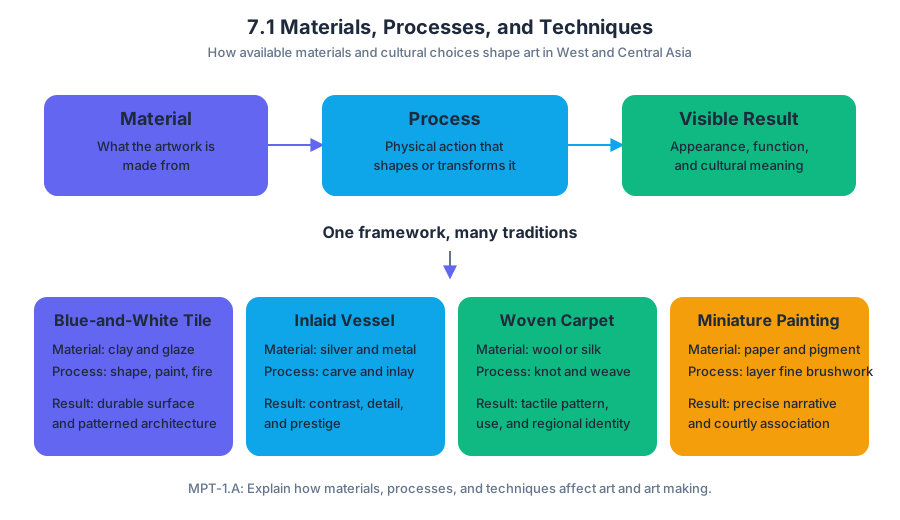
A blue-and-white tile, a silver-inlaid metal vessel, a woven carpet, and a miniature painting may look unrelated, yet each records a chain of decisions: what material was available, how it could be manipulated, and what cultural tradition made those choices meaningful.
7.1 Materials, Processes, and Techniques in West and Central Asian Art
A blue-and-white tile, a silver-inlaid metal vessel, a woven carpet, and a miniature painting may look unrelated, yet each records a chain of decisions: what material was available, how it could be manipulated, and what cultural tradition made those choices meaningful. In West and Central Asia, materials, processes, and techniques vary by location and culture, producing art with wide-ranging visual and functional effects.
MPT-1: Art and art making take many different forms both within and across cultures, and the materials, processes, and techniques employed may also vary by location and culture with wide-ranging influence on the art that is generated.
The learning objective MPT-1.A, “Explain how materials, processes, and techniques affect art and art making,” asks for more than naming a medium. A strong analysis connects material—what an artwork is made from—to process—the physical action used to shape or transform it—and then to the visible result, function, or cultural association.
Regional variation: one principle, many forms
MPT-1.A.18 identifies ceramics, metalwork, textiles, painting, and calligraphy as important forms in West and Central Asian artistic traditions. The region is not artistically uniform: a Persian carpet, an Ottoman ceramic tile, and a Central Asian embroidered textile belong to different local histories, even when they share techniques, motifs, or trade connections.
A useful analytical chain is:
- Material: clay, metal, fiber, pigment, or paper
- Process: firing, hammering, weaving, dyeing, or painting
- Visible result: gloss, relief, pattern, flexibility, opacity, or saturated color
- Cultural effect: a particular object becomes useful, prestigious, portable, devotional, architectural, or regionally recognizable
Ceramics: from vessel to architecture
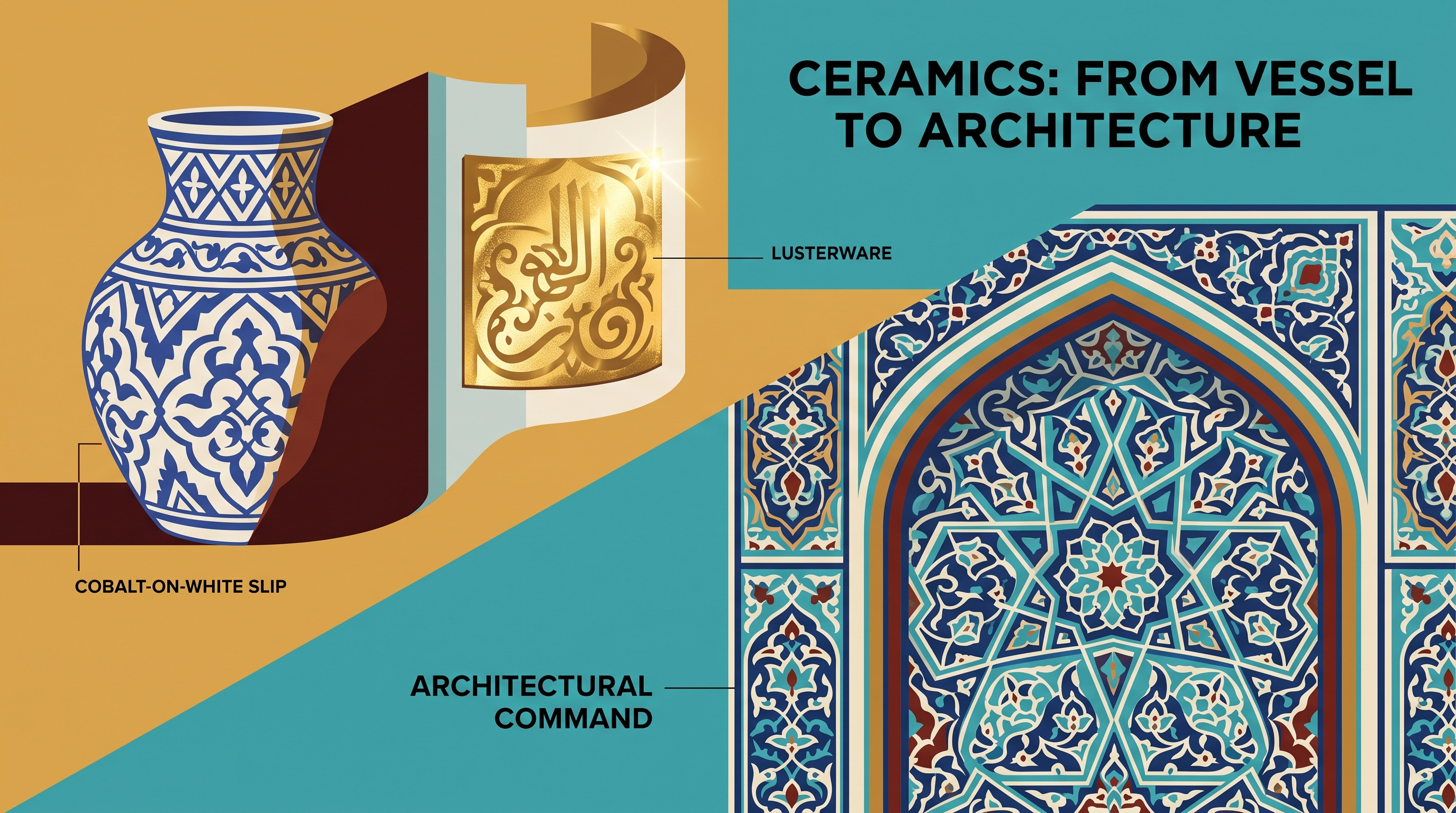
MPT-1.A.19 emphasizes that ceramic arts flourished in West Asia from the prehistoric era. Ceramic material could be shaped into utilitarian vessels, but it could also become a major architectural surface through painted tiles and mosaic-tile decoration.
Two technical developments are especially important. Lusterware applies a metallic-looking surface effect to fired ceramics, producing a reflective sheen. Cobalt-on-white slip painting uses cobalt pigment over a light slip—a liquid clay coating—creating a strong blue-and-white contrast. In both cases, the process changes not only appearance but also the associations of the object: a vessel or tile can become visually luxurious and architecturally commanding.
Persian mosaic-tile architecture developed through the Seljuk and Safavid dynasties; the Great Mosque of Isfahan demonstrates how individual colored and shaped tiles can combine into monumental geometric and vegetal surfaces. Ottoman Iznik tile work and export ceramics similarly show how a regional ceramic tradition could operate both within architecture and through objects that circulated beyond their place of production.
Metalwork: shaping permanence and prestige
Metalwork demonstrates how process controls both surface and status. A metalworker may use repoussé, hammering the reverse of a metal sheet so forms project outward, or inlay, fitting contrasting metal into a prepared surface. The result can be a vessel with raised ornament, sharply defined pattern, or shimmering contrast between materials.
In Persian and broader West Asian traditions, metal vessels and objects often combine practical form with elaborate surface treatment. A basin or ewer may remain functional, while hammering, engraving, or inlay transforms it into a display of technical skill and elite patronage. The key point is not that metal automatically signals luxury, but that labor-intensive processes make material value visible.
Textiles: pattern made flexible
Textiles begin with fibers that are spun into threads and then organized through processes such as weaving, in which threads crossing in perpendicular systems create a stable cloth structure. Dyeing adds color before or after weaving, while knotting or embroidery can build raised pattern on the surface.
The Persian carpet tradition makes this material especially clear. A woven or knotted carpet has a flexible, portable surface, unlike a fixed mosaic wall; its repeated pattern can travel with people, define an interior, and communicate regional design traditions. The Ardabil Carpet, for example, makes the carpet both a functional floor covering and a highly controlled field of ornament.
Painting: image through layered surface
Painting depends on the interaction of support, pigment, and application. Persian manuscript painting often uses opaque watercolor on paper, allowing artists to build precise figures, architecture, landscapes, and patterned surfaces in works such as Bahram Gur Fights the Karg. Fine brushes and layered pigment produce detail suited to close viewing, while the page format makes the image portable and connected to a written manuscript.
Painting and calligraphy may also work together rather than occupy separate categories. The page can coordinate image, writing, border pattern, and decorative surface, showing how a technique affects not only what is depicted but how the viewer encounters it.
Skills in action
This topic most directly develops Skill 1: Visual Analysis by requiring precise observations—gloss, relief, pattern, brushwork, tile repetition—and Skill 2: Contextual Analysis by connecting those observations to regional production and use. It also develops Skill 4: Artistic Traditions, Skill 5: Visual Analysis of Unknown Works, and Skill 6: Attribution of Unknown Works: a blue-and-white surface, woven pattern, or manuscript painting may provide clues, but attribution must rely on several converging visual and contextual features rather than one stereotype.
Misconception check
Misconception: “A region has one characteristic style.” West and Central Asia contain many cultures, periods, materials, and workshops. Correct analysis says which material and process produce which visible effect in which regional tradition—not that every artwork from the region looks the same.
Retrieval check: If a ceramic surface is metallic and reflective, which process might explain that effect? If a carpet’s design is portable and flexible, which material process makes that possible? Finally, why would mosaic tile be especially effective for architectural decoration rather than for a manuscript page?
Source Materials
- AP Art History Course and Exam Description
- AP Art History Course and Exam Description Clarifications and Corrections
- AP Art History Course Overview
- AP Art History Course at a Glance
- AP Art History Course at a Glance Poster
- Adopt AP Art History
- AP Art History
- AP Art History
- AP Art History-AP Students
- AP/College Art History-Khan Academy
- AP Art History-Wikipedia
- AP Art History-Smart History