From the free course AP Art History on Lykke
4.4 Theories and Interpretations of Later European and American Art
Key concepts: Theories and interpretations of later European and American art · Visual analysis as a basis for interpretation · Influence of other disciplines on art-historical interpretations · The role of available technology and evidence · Use of form, style, materials, content, function, and context in interpretation · Interpretations as arguments about individual works or groups of related works · Manipulation, adaptation, and harnessing of interpretations to make art-historical arguments · Art-historically valid interpretations · The relationship between learning objectives and analytical skills · Interactive small-group discussion as a learning strategy
Art-historical interpretation is an evidence-based argument about what a work means, how it functions, and why it matters—not a personal reaction detached from the object.
4.4 Theories and Interpretations of Later European and American Art
Art-historical interpretation is an evidence-based argument about what a work means, how it functions, and why it matters—not a personal reaction detached from the object. The central question is: How do visual analysis, scholarship, technology, and available evidence change what we think a work of art means?
THR-1: Interpretation changes as knowledge changes
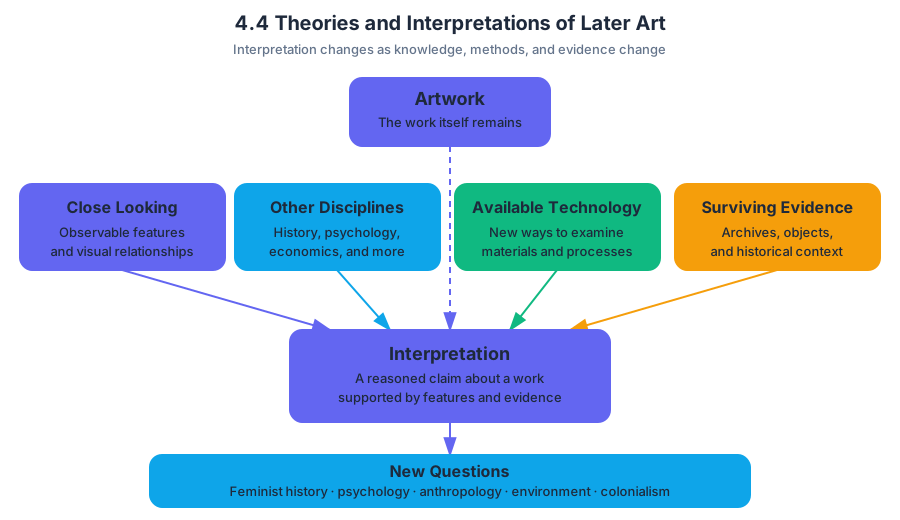
The enduring understanding for this topic, THR-1, recognizes that theories and interpretations of art and art making change over time. Interpretations may arise from close looking at a work, but they are also shaped by other disciplines, available technology, and the evidence that survives.
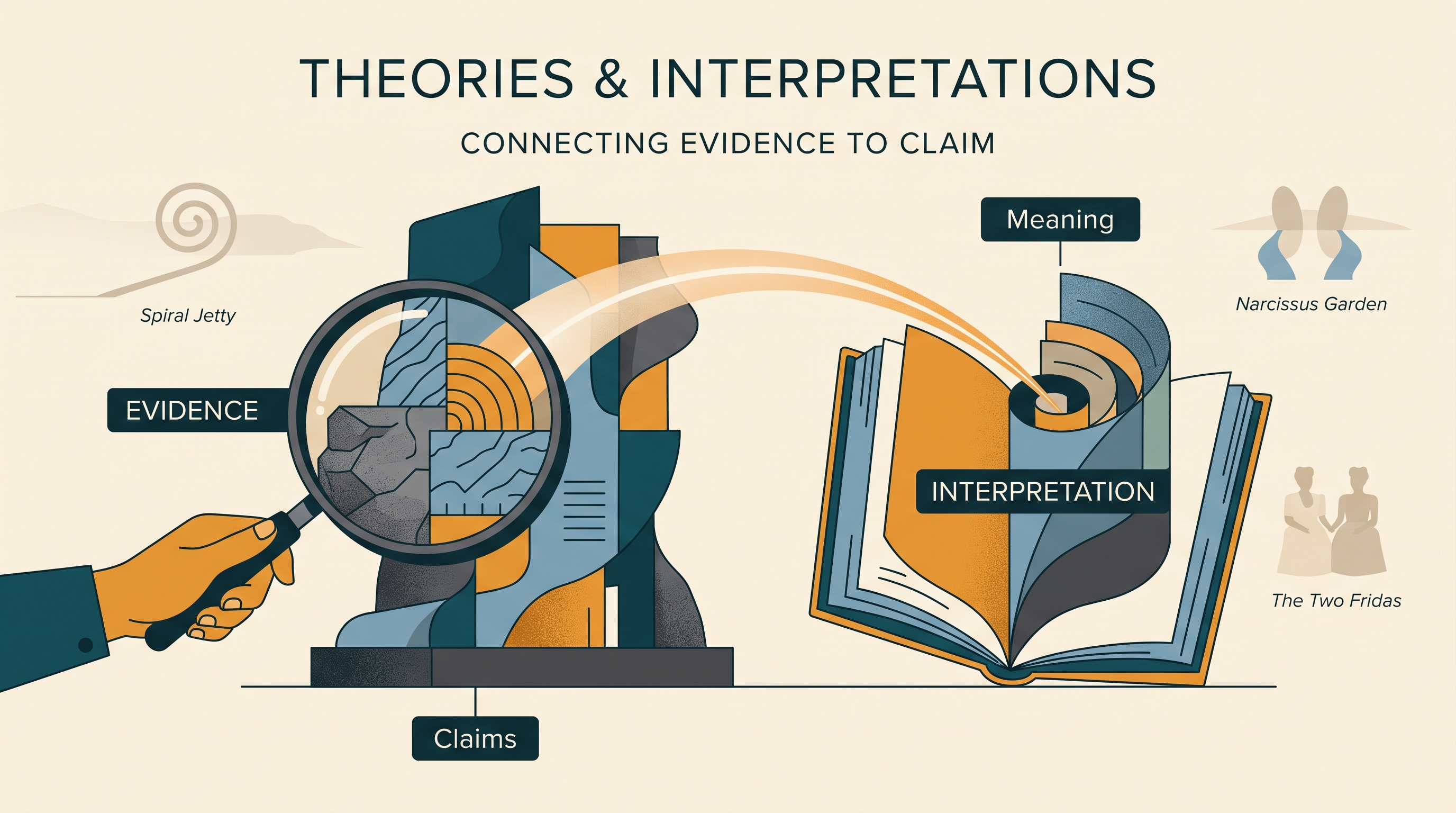
Interpretation is a reasoned claim about a work or group of related works, supported by observable features and relevant contextual evidence.
A work does not change when a new interpretation appears; the questions asked of it change. For example, a painting once discussed mainly as a formal arrangement of color may later be examined through feminist history, psychology, anthropology, environmental studies, economics, or studies of colonialism. Each discipline can reveal relationships that a purely visual description cannot explain by itself.
Visual analysis and scholarship work together
Visual analysis begins with what can be observed: form, style, scale, composition, color, line, spatial organization, materials, content, and condition. Scholarship then connects those observations to historical circumstances, artistic traditions, patronage, audience, function, reception, and meaning. Neither method replaces the other.
Consider Frank Lloyd Wright’s Fallingwater. Its projecting terraces appear to extend dramatically over the stream. Visual and material analysis identifies the structural principle of cantilevering, in which a horizontal element projects outward while being supported primarily at one end. That observation can support an interpretation of the house as an attempt to make architecture appear integrated with, rather than merely placed beside, the natural landscape.
The argument becomes stronger when the evidence is connected precisely:
- Observation: The terraces project horizontally beyond their supports.
- Formal effect: The house seems to float above the waterfall.
- Material evidence: Reinforced concrete made those extended projections possible.
- Context: Wright designed the house in a setting where the relationship between dwelling and landscape was central.
- Interpretation: The structure’s visual drama and engineering express an architectural ideal of organic connection with nature.
The interpretation does not claim that cantilevering automatically proves Wright’s intention. It shows how form and material evidence make a particular claim plausible. This is the work of Suggested Skill 7.B: explaining how an art-historically valid interpretation is derived from analysis of form, style, materials, content, function, context, reception, and/or meaning.
Evidence, technology, and limits
Interpretations depend on evidence, and evidence is never unlimited. Archival documents, inscriptions, photographs, conservation reports, scientific imaging, provenance records, oral histories, and contemporary reviews may confirm, complicate, or challenge an interpretation. Technology can make previously hidden information visible, but it does not eliminate the need for judgment.
For instance, infrared or X-ray imaging may reveal changes beneath a painted surface. Digital mapping may reconstruct an artwork’s original location or circulation. Conservation science may identify pigments or later alterations. These discoveries can shift interpretation by distinguishing an artist’s choices from damage, restoration, or later modification.
A limitation in evidence must remain part of the argument. If no written statement survives, an interpreter should not present an inferred intention as certain. Strong art history distinguishes among what is visible, what is documented, and what is argued from the available evidence.
Evidence supports an interpretation; evidence does not make speculation certain.
Six lenses for interpretation
A useful interpretation often coordinates several kinds of evidence rather than relying on one dramatic feature.
| Lens | Question it asks | Example of evidence |
|---|---|---|
| Form | How is the work organized visually or physically? | Composition, scale, spatial projection |
| Style | What characteristic visual choices connect it to a person, period, or movement? | Distortion, realism, abstraction |
| Materials | How do substances and construction methods affect meaning or appearance? | Reinforced concrete at Fallingwater |
| Content | What figures, objects, events, or symbols are represented? | Subject matter and imagery |
| Function | What was the work intended to do or enable? | Worship, commemoration, habitation, protest |
| Context | What historical, social, political, religious, or cultural conditions surround it? | Patronage, place, identity, conflict |
These lenses can generate different but compatible interpretations. Frida Kahlo’s The Two Fridas, for example, can be interpreted through its doubled figure, exposed hearts, connected blood vessels, clothing, and stormy setting. Those visual facts can support arguments about divided identity, personal and cultural belonging, or the tensions between distinct social selves—but each claim must be tied to specific evidence rather than reduced to “the artist felt sad.”
Interpretations as arguments
Interpretations may be used, adapted, or even manipulated to make an art-historical argument. A museum label, exhibition, political movement, or scholar may emphasize one aspect of a work while minimizing another. Interpretations therefore need to be tested for scope, evidence, and assumptions.
Use 6.A and 6.B when justifying an interpretation or claim with appropriate evidence. Then use 8.A, 8.B, and 8.C to build the argument:
- 8.A — Articulate a defensible claim about one work or a related group.
- 8.B — Using specific and relevant evidence, support a claim about the work or group.
- 8.C — Explain how the evidence justifies the claim.
For the required works The Two Fridas, Narcissus Garden, and Spiral Jetty, avoid merely naming a theory. Instead, state a claim, identify visible or documented evidence, and explain the connection. A defensible response might argue that Spiral Jetty transforms landscape into an active artistic medium because its enormous spiral form, remote location, earth-and-rock construction, and changing relationship to water make environmental conditions part of the work’s meaning.
Misconception check — “Any interpretation is equally valid.”
Interpretations can differ, but they are not equally supported. A persuasive interpretation must account for the work’s visual properties and use relevant contextual evidence. Personal associations may begin inquiry; they become art-historical arguments only when evidence and reasoning connect them to the object.
Retrieval check: If a new scientific scan revealed that part of a sculpture had been restored, which interpretive lenses might change first, and why? A strong answer names the evidence, identifies the affected lens—such as materials, function, or reception—and explains how the new information revises, rather than merely decorates, the interpretation.