From the free course AP Art History on Lykke
5.2 Materials, Processes, and Techniques in Indigenous American Art
Key concepts: Materials, processes, and techniques vary by location and culture. · Artistic decisions about form, style, materials, content, function, and context shape the creation and meaning of a work of art. · Interpretations of art are derived from analyzing its visual elements and materials, processes, and techniques. · Indigenous American art encompasses cultures across the American continent, from the Arctic to Tierra del Fuego. · Tradition is dynamic rather than static, incorporating introduced materials and subjects over time. · Indigenous peoples used art to maintain cultural identity despite forced assimilation. · Contemporary Native American artists revive ancient techniques while engaging in modern political discourse. · Indigenous American artistic traditions value unity with the natural world and five-direction cosmic geometry: north, south, east, west, and center. · Animal-based media, including featherwork, bone carving, and hide painting, are important in Indigenous American art. · Trade materials, including greenstones such as turquoise and jadeite, were incorporated into Indigenous American art.
A cliff dwelling, a feather headdress, and a black ceramic vessel can all reveal the same art-historical truth: what a work is made from changes what it can do, how it looks, and what viewers understand it to mean.
5.2 Materials, Processes, and Techniques in Indigenous American Art
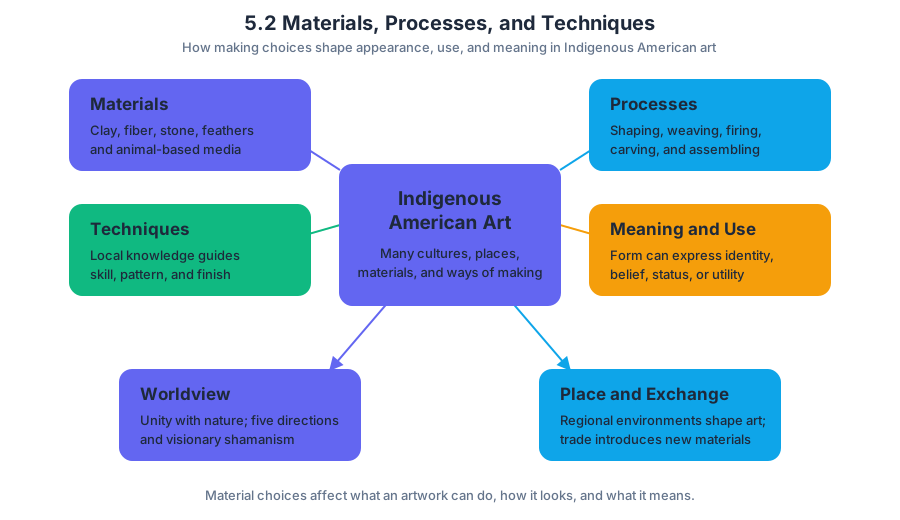
A cliff dwelling, a feather headdress, and a black ceramic vessel can all reveal the same art-historical truth: what a work is made from changes what it can do, how it looks, and what viewers understand it to mean. Indigenous American art encompasses cultures across the American continent, from the Arctic to Tierra del Fuego, so no single material or technique defines the category.
MPT-1: Art and art making take many different forms both within and across cultures, and materials, processes, and techniques vary by location and culture, with wide-ranging influence on the art generated.
MPT-1.A asks you to explain how materials, processes, and techniques affect art and art making. The key essential knowledge is MPT-1.A.13: Indigenous American artistic traditions often emphasize unity with the natural world, a five-direction cosmic geometry—north, south, east, west, and center—visionary shamanism, animal-based media, trade materials, the essential character of subjects rather than literal appearance, and strong functional utility.
Material is not the same as style, subject, or function
A material is the substance used to make an object: sandstone, feathers, gold, clay, bone, hide, turquoise, cloth, or beads. A process is the major way the material is transformed—carving, weaving, modeling, painting, firing, or assembling. A technique is the specific method used within that process, such as layering feathers, burnishing a clay surface, or applying paint to hide.
These choices must be distinguished from other artistic decisions. Form is the object’s shape and structure; style is its characteristic visual language; content is its subject or idea; function is what it does; and context is the cultural, historical, geographic, and social situation in which it was made and used. A material does not automatically determine meaning: the same cloth can become clothing, a ritual object, or a political statement depending on form, style, content, function, and context.
Worked example — Mesa Verde cliff dwellings: Ancestral Puebloan builders constructed the Mesa Verde cliff dwellings in Montezuma County, Colorado, between $450$ and $1300$ CE, using sandstone in natural cliff alcoves. The sandstone and masonry process made permanent, protective architecture possible; the alcove shaped the settlement’s form and offered shelter. Its context—an Ancestral Puebloan community in a particular landscape—helps interpret the work as more than a picturesque building: location, construction, and use are inseparable from its meaning.
Now separate the decisions. Material: sandstone. Process: constructing masonry walls within existing alcoves. Form: clustered rooms integrated into the cliff. Style: the visual effect of geometric, built forms against the natural rock. Content: a community’s relationship to place and built environment. Function: habitation and communal activity. Context: Ancestral Puebloan life in Colorado during $450$–$1300$ CE. A strong answer explains how these factors work together rather than claiming that “sandstone symbolizes protection” without evidence.
Animal media and status materials
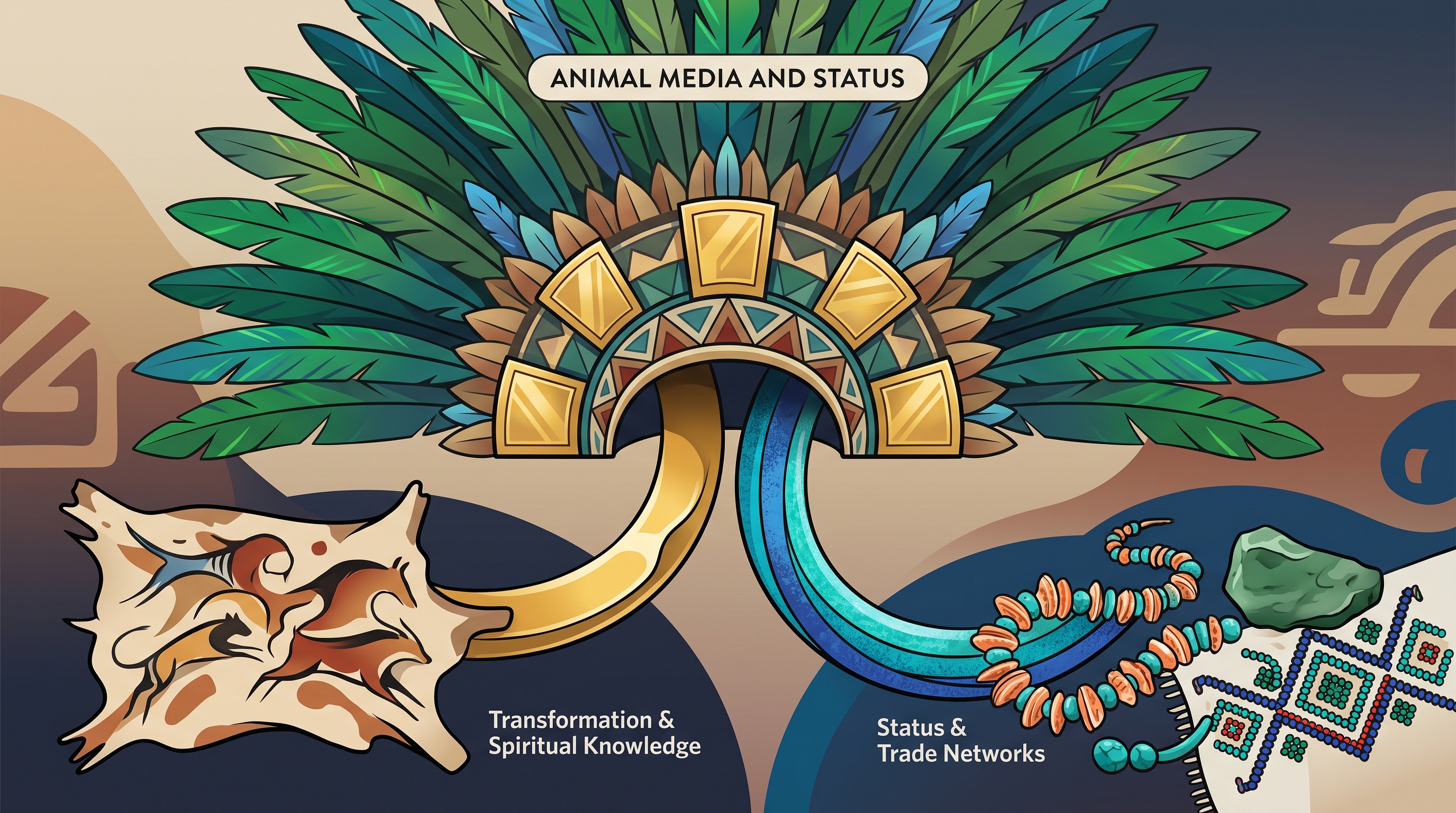
Animal-based media carried both physical and cultural significance. Featherwork, bone carving, and hide painting made the animal world materially present in art; they could express relationships among humans, animals, spirituality, and power. In traditions connected to visionary shamanism, animal materials could support ideas about transformation or access to spiritual knowledge, although interpretation must remain grounded in the particular object and culture.
The Ruler’s feather headdress demonstrates how material, technique, status, and interpretation converge. Quetzal feathers, cotinga feathers, and gold were difficult to obtain and associated with preciousness and high status. The visual richness results from the materials and their arrangement, while the object’s form and context as regalia communicate rank; the feathers are not merely decorative color.
Trade materials also expanded artistic possibilities. Greenstones such as turquoise and jadeite, shells such as spiny oyster, and—particularly in Native North America—imported beads, machine-made cloth, and glazes entered Indigenous artistic traditions through exchange. Their presence can provide evidence of trade networks, but it does not make a work “less Indigenous.” Tradition is dynamic rather than static: communities adapt introduced materials and subjects, including beads, cloth, and horses, into continuing cultural practices.
Identity, adaptation, and contemporary practice
Art also helped Indigenous peoples sustain cultural identity despite forced assimilation. Maintaining designs, objects, techniques, and knowledge could preserve community memory when outside institutions attempted to suppress Indigenous languages, religions, dress, and social practices. The continued use of a technique is therefore not automatically evidence of an unchanged past; it may be an active response to historical pressure.
Contemporary Native American artists make this continuity visible in two directions at once. Some revive ancient crafts, such as Puebloan pottery, while others use contemporary materials, imagery, and exhibition practices to address modern political issues including racism. Their work demonstrates that cultural identity is not frozen in an earlier period: ancient processes can be recovered, modified, and used to speak about the present.
Misconception check
Misconception: “The material tells us the entire meaning.” Correction: material is evidence, not a complete interpretation. To earn a defensible explanation, connect the material or technique to visible form, style, content, function, and context. For example, gold in the Ruler’s feather headdress supports an interpretation of high status because its preciousness works together with the headdress’s form, feather arrangement, and elite context.
AP skill connection and retrieval check
This topic most directly develops Skill 5.A: Describe visual elements of a work of art beyond the image set and Skill 5.B: Explain how artistic decisions shape a work of art beyond the image set. In practice, describe the evidence first, then explain its consequence: “The work uses sandstone masonry in a natural alcove” becomes stronger when followed by “that construction integrates habitation with the landscape and shapes interpretation of community and place.”
Retrieval check: Choose one example—Mesa Verde, the Ruler’s feather headdress, or a Puebloan ceramic tradition. Name its material, process, form, function, and context. Then complete this sentence: “Because the artist or maker chose ___ rather than ___, the work’s appearance and interpretation are affected by ___.”