From the free course AP Art History on Lykke
9.1 Materials, Processes, and Techniques in Pacific Art
Key concepts: Pacific art · Materials, processes, and techniques · Objects, acts, and events · Fibers and pigments · Bone, sea ivory, seashell, and tortoise shell · Rare and precious materials · Wealth and status · Ritual settings and sensory response · Ferocity in dress, dance, and verbal aggression · MPT-1.A.31 and MPT-1.A.32
Pacific art is not limited to a portable object: it can be an object, an act, or an event—a force that operates within social life.
9.1 Materials, Processes, and Techniques in Pacific Art
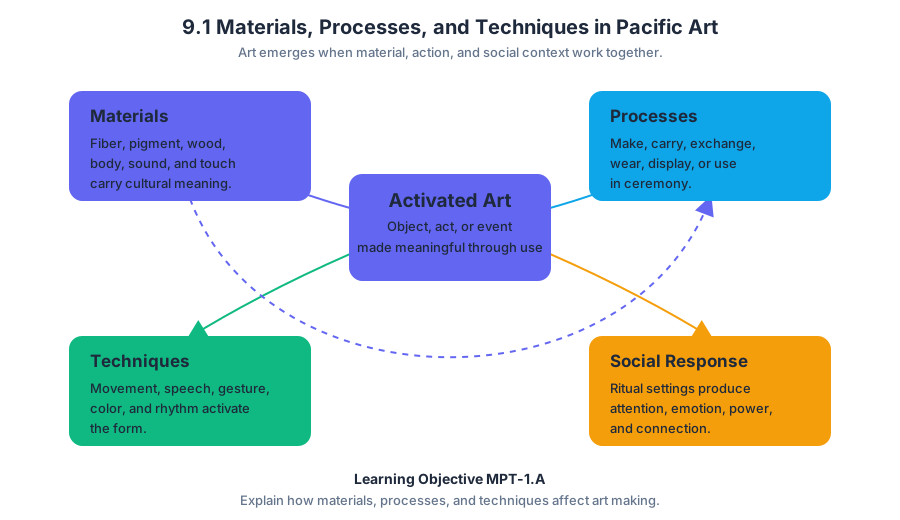
Pacific art is not limited to a portable object: it can be an object, an act, or an event—a force that operates within social life. A fiber costume, a pigment-covered body, a threatening dance, and the sensory arrangement of a ritual setting can all function as art because materials and performance work together to produce a response.
Learning Objective MPT-1.A: Explain how materials, processes, and techniques affect art and art making.
The key distinction is between a thing that is merely made and an artistic form that is deliberately activated. In Pacific cultures, objects may be carried, exchanged, worn, displayed, or used in ceremonies; acts and events may involve movement, speech, sound, gesture, color, and touch. The material is therefore part of the artwork’s meaning, not just its physical support.
A material is also a message
Materials are the substances used to create an artwork. Processes are the actions performed on those substances, such as weaving, shaping, coloring, assembling, wearing, or displaying them. Techniques are the specific skills or methods through which those processes are carried out. Together, they affect an artwork’s form, function, context, reception, and meaning.
MPT-1.A.31 identifies Pacific arts as composed of “objects, acts, and events” that are forces in social life. Their effect depends partly on the virtuosity—the highly skilled, controlled, and impressive use—of materials and presentation. A material can attract attention, establish authority, provoke fear, or create an atmosphere of sacred importance.
MPT-1.A.32 names a wide range of Pacific materials: fibers, pigments, bone, sea ivory, seashell, and tortoise shell, as well as wood, coral, and stone. These materials become meaningful through what people do with them and through the circumstances in which they are carried, exchanged, worn, or displayed.
| Material or material group | What its use can make visible |
|---|---|
| Fibers | Skilled construction, bodily movement, clothing, or ceremonial display |
| Pigments | Color, transformation, visibility, identity, or emotional intensity |
| Bone, sea ivory, seashell, tortoise shell | Craft virtuosity, distinction, exchange, or status |
| Wood, coral, stone | Durability, environmental connection, construction, or presence |
The point is not to assign one fixed meaning to every material. A shell object does not automatically mean wealth, and pigment does not automatically mean ritual. Meaning comes from the material’s rarity, the technique used, the object’s setting, and the response it is designed to stimulate.
Objects, acts, and events
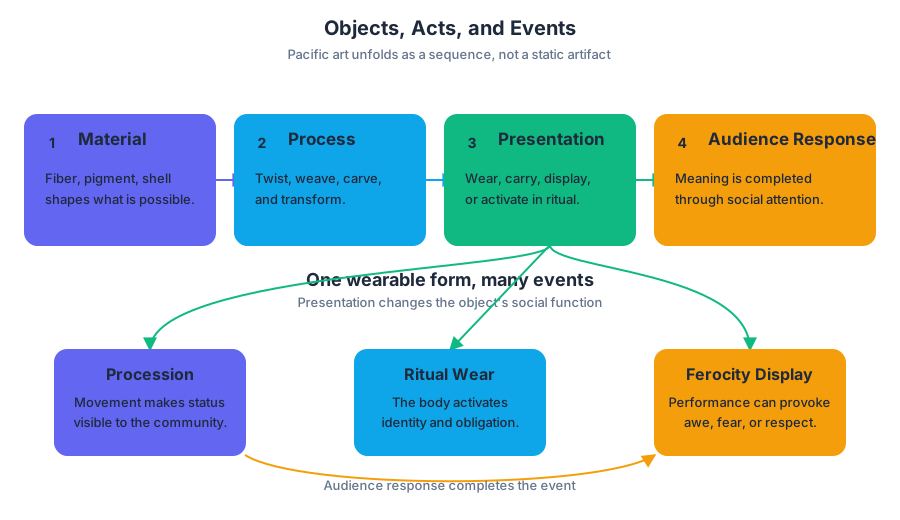
Pacific arts may be understood as a sequence rather than a static artifact:
Material → Process → Presentation → Audience response
For example, fibers may be transformed into an elaborate wearable form. Its meaning changes when it is carried in procession, worn during a ritual, or used in a display of ferocity. The material contributes to the form; the presentation activates its social function; the audience’s response completes the event.
Worked contextual example: designing a response
Imagine a Pacific ceremony in which participants enter wearing carefully constructed fiber forms, their bodies marked with pigments, while gestures, verbal aggression, and dance communicate hostility. Bone, sea ivory, seashell, or tortoise shell may appear in objects whose rarity and skilled presentation distinguish their wearers.
The analysis should proceed in four steps:
- Identify the materials: fibers, pigments, and possibly rare shell or ivory.
- Explain the processes and techniques: shaping, weaving, coloring, assembling, wearing, and choreographing movement.
- Connect form to function: the combination creates a visually and physically powerful display rather than a neutral costume.
- Infer the intended response: the dress, dance, verbal aggression, and gestural threats announce or precede physical combat and stimulate fear, intimidation, or readiness.
This example demonstrates MPT-1.A.33: objects and behaviors are designed and presented to stimulate a particular response. The work’s meaning lies not only in what it is made from but also in how it is encountered.
Rarity, status, and circumstance
Rare and precious materials can demonstrate wealth and status, but they may also communicate a particular circumstance. Their value is social as well as physical: scarcity, difficulty of acquisition, specialized skill, and controlled presentation can make a material powerful.
Ritual settings extend this principle across the senses. MPT-1.A.33 explains that ritual environments are structured with elements addressing sight, sound, touch, movement, and possibly smell or taste. A purely visual description misses how an event’s total sensory organization produces authority, sacredness, fear, or participation.
Misconception check: “Pacific art means objects made from natural materials”
Correction: Natural materials matter, but Pacific art is not defined only by an object’s substance. It also includes acts and events, and its materials gain meaning through exchange, display, ritual use, bodily performance, and social response. The strongest explanation links a material choice to a process, a setting, and an effect.
AP skill application
This topic most directly develops Skill 1: Visual Analysis by requiring precise identification of material effects, bodily presentation, surface, color, movement, and gesture. It also uses Skill 2: Contextual Analysis when those visible features are connected to ritual, status, exchange, warfare, or social life.
A strong response can also use Skill 3: Comparison of Works of Art by comparing how two works use materials or presentation to produce different responses, and Skill 8: Argumentation by making a claim supported by specific visual and contextual evidence. The essential chain is: material choice → technique or presentation → social function or intended response.
Retrieval check: If a work uses a rare material in a ceremonial setting, what must an explanation do beyond naming the material? State the material, describe how it is processed or presented, identify the setting or circumstance, and explain the response or social meaning it helps produce.
Source Materials
- AP Art History Course and Exam Description
- AP Art History Course and Exam Description Clarifications and Corrections
- AP Art History Course Overview
- AP Art History Course at a Glance
- AP Art History Course at a Glance Poster
- Adopt AP Art History
- AP Art History
- AP Art History
- Sample Free-Response Question
- AP Art History-AP Students
- AP/College Art History-Khan Academy
- AP Art History-Wikipedia