From the free course AP Art History on Lykke
5.1 Interactions Within and Across Cultures in Indigenous American Art
Key concepts: Cultural interaction and its influence on art and art making · Factors motivating interaction between cultures, including travel, trade, war, conquest, and colonization · Artistic influence through practices such as spolia and appropriation · The relationship between cultural practices, belief systems, physical setting, and artistic decisions · Geographic and chronological distinctions between Ancient America and Native North America · Regional groupings of Native North American cultures, including the Arctic, Northwest Coast, Southwest, Plains, and Eastern Woodlands · Shared Indigenous American ideas of harmony with nature · Continuity of Indigenous cultures and the limitations of non-Indigenous terminology · The relationship between artistic expression and intellectual pursuits such as astronomy, poetry, song, dance, and medicine · Artistic production through workshops, apprentice-master relationships, and gender specialization
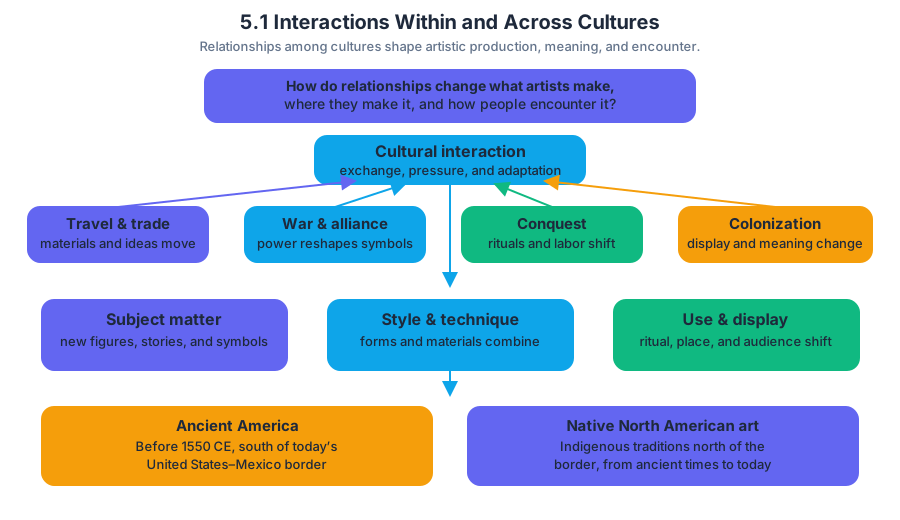
Ancient America refers to art created before $1550$ CE south of the current United States–Mexico border, while Native North American art refers to Indigenous traditions north of that border from ancient times to the present.
5.1 Interactions Within and Across Cultures in Indigenous American Art
Ancient America refers to art created before $1550$ CE south of the current United States–Mexico border, while Native North American art refers to Indigenous traditions north of that border from ancient times to the present. These labels are geographic and historical conveniences—not names that all Indigenous peoples used for themselves.
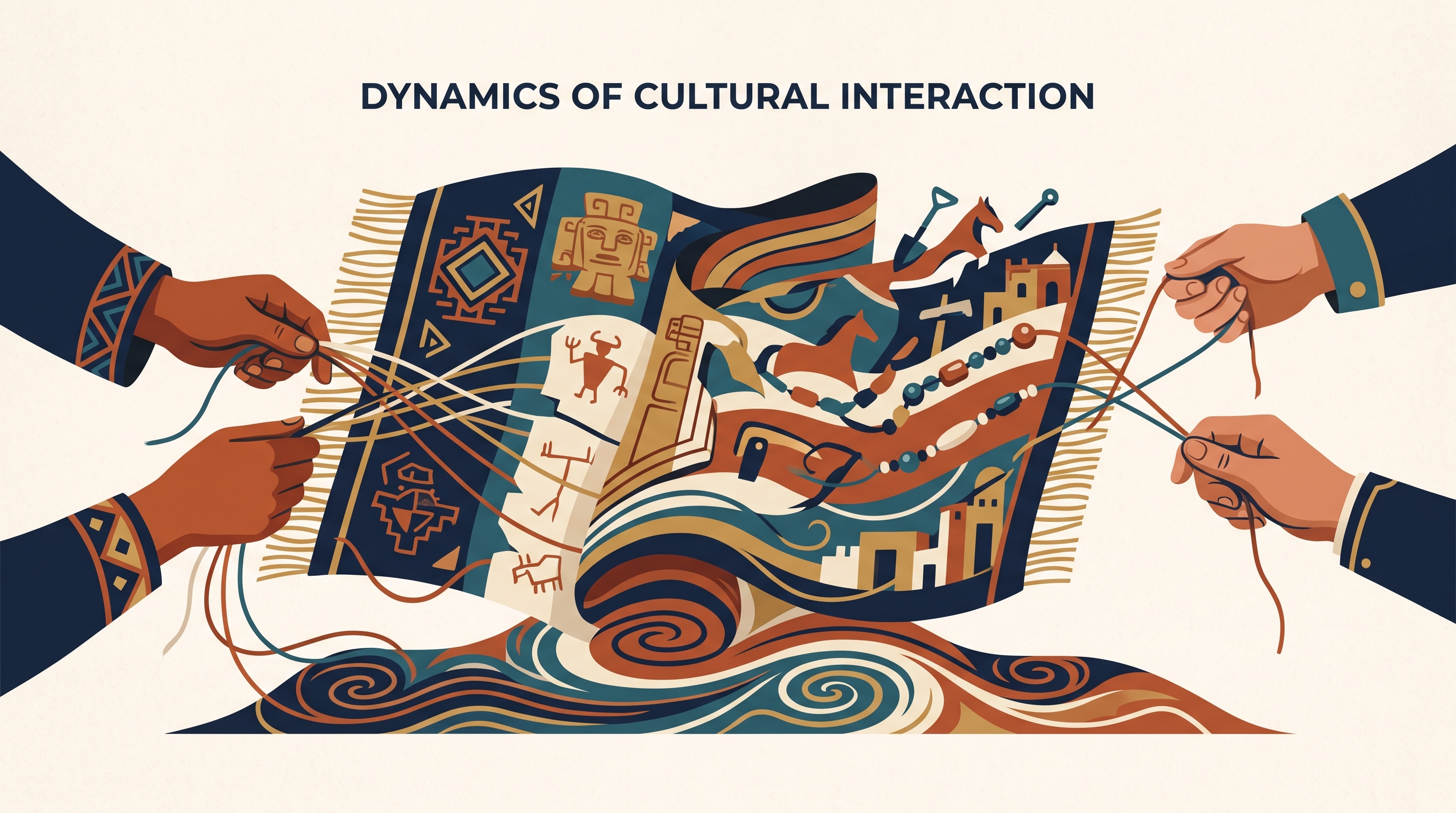
The central question is: How do relationships among cultures change what artists make, where they make it, and how people encounter it? Cultural interaction can arise through travel, trade, war, conquest, and colonization. It can influence subject matter, visual styles, ritual use, artistic labor, and the placement or display of works.
A geographic vocabulary for Indigenous American art
Native North American cultures are often grouped into broad regional areas, including the Arctic, Northwest Coast, Southwest, Plains, and Eastern Woodlands. These groupings help organize comparison, but they should not be mistaken for single cultures: each region contains many distinct peoples, nations, languages, histories, and artistic traditions.
| Geographic term | What it helps you track |
|---|---|
| Ancient America | Art made before $1550$ CE south of the present United States–Mexico border |
| Native North America | Indigenous art traditions north of that border, from ancient times to the present |
| Regional grouping | Broad comparison among Arctic, Northwest Coast, Southwest, Plains, Eastern Woodlands, and other areas |
Many Native American groups share larger ideas such as harmony with nature, oneness with animals, respect for elders, community cohesion, dream guidance, shamanic leadership, and participation in large rituals. These broad similarities do not erase cultural difference; instead, they help explain why physical surroundings, social organization, spiritual beliefs, and artistic decisions are often inseparable.
Interaction changes art making
Under INT-1.A and INT-1.A.11, cultural interaction is understood as an exchange—or a struggle—among cultures that can influence art and art making. Under CUL-1.A, the relevant learning objective is: “Explain how cultural practices, belief systems, and/or physical setting affect art and art making.”
The mechanism can be visualized as a chain:
Contact through travel, trade, war, conquest, or colonization
$\downarrow$
Exchange, borrowing, restriction, or resistance
$\downarrow$
Changes in style, subject matter, ritual practice, siting, display, or production
$\downarrow$
A new work carrying both local meaning and evidence of cultural history
Two important forms of artistic influence are spolia, the reuse of material from an earlier or conquered structure in a later work, and appropriation, the adoption or reuse of imagery, forms, or cultural expressions from another culture. Neither term automatically means “simple copying.” The exam-relevant issue is the relationship: who reused what, under what circumstances, and for what purpose?
Worked contextual example: Mesa Verde
The Mesa Verde cliff dwellings demonstrate how physical setting and cultural practice can shape art and architecture. Communities built into sheltered cliff alcoves rather than treating the landscape as an empty backdrop. The setting affected where structures could be placed, how people moved through them, how they were seen, and how communal or ceremonial life related to the surrounding environment.
A strong contextual explanation would connect three kinds of evidence: the physical cliff setting, the social organization required to construct and inhabit the dwellings, and beliefs that could give the landscape spiritual significance. Merely identifying the site is description; explaining how setting and belief produced architectural decisions is Contextual Analysis.
Belief, power, and artistic labor
In many Indigenous American traditions, the more powerful a work is believed to be, the more it is thought to contain and transfer life force and power. This belief changes how an object should be interpreted: its importance may depend less on detached visual appreciation than on ritual activation, handling, performance, or relationship to a community.
Art making could involve workshops, apprentice-master relationships, and specialization by gender, including women’s weaving. These systems show that art is not only the product of an isolated “genius.” Social roles, training, community knowledge, and ritual responsibility can all shape the finished work.
Worked contextual example: Yaxchilán
Yaxchilán, an ancient Maya site, can be approached through interaction among political power, belief, and visual representation. Its art should be interpreted in relation to rulers, ritual authority, dynastic history, and the setting in which images and inscriptions were encountered. A comparison with Mesa Verde must remain precise: both connect art to place and community, but they represent different cultural and historical contexts.
Misconception check
Misconception: “Cultural interaction means one culture replaces another.” Cultural interaction can involve exchange, coercion, resistance, revival, adaptation, or the continued use of older values under new political conditions. Post-contact art may preserve long-standing ideas while also addressing conflict within Indigenous communities and between Indigenous peoples and the governments of the United States and Canada.
Retrieval check: A work shows imagery borrowed after conquest and incorporates fragments from an earlier monument. Identify one possible form of interaction and explain one question an art historian should ask before calling it appropriation. A complete answer names appropriation or spolia and then considers power, purpose, context, and the relationship between the source culture and the later maker.
Source Materials
- AP Art History Course and Exam Description
- AP Art History Course and Exam Description Clarifications and Corrections
- AP Art History Course Overview
- AP Art History Course at a Glance
- AP Art History Course at a Glance Poster
- Adopt AP Art History
- AP Art History
- AP Art History
- AP Art History-AP Students
- AP/College Art History-Khan Academy
- AP Art History-Wikipedia
- AP Art History-Smart History