From the free course AP Art History on Lykke
7.2 Purpose and Audience in West and Central Asian Art
Key concepts: Purpose and intended audience in religious art · Islamic mosque architecture · Minbar as a pulpit for the imam · Minaret as an architectural feature associated with prayer · Central courtyard for accommodating worshippers · Buddhist stupas · Buddhist monastic architecture · Sacred Buddhist images and devotional significance · Jowo Rinpoche as a highly sacred image in Tibet
A mosque is not simply a decorated building: its layout tells worshippers where to face, where to gather, where prayer is led, and how a community is organized.
7.2 Purpose and Audience in West and Central Asian Art
A mosque is not simply a decorated building: its layout tells worshippers where to face, where to gather, where prayer is led, and how a community is organized. In West and Central Asian art, religious purpose and intended audience often determine architecture more directly than individual artistic expression.
Learning Objective PAA-1.A: Explain how purpose, intended audience, or patron affect art and art making.
The essential knowledge for this topic is PAA-1.A.23, which identifies several audiences and patrons: royal and wealthy patrons, lay and monastic religious practitioners, and foreign collectors who acquired works through gift or trade. PAA-1.A.24 applies that relationship especially to religious architecture, including Islamic mosques, Buddhist cave architecture, stupas, and monastic buildings.
From purpose to architectural feature
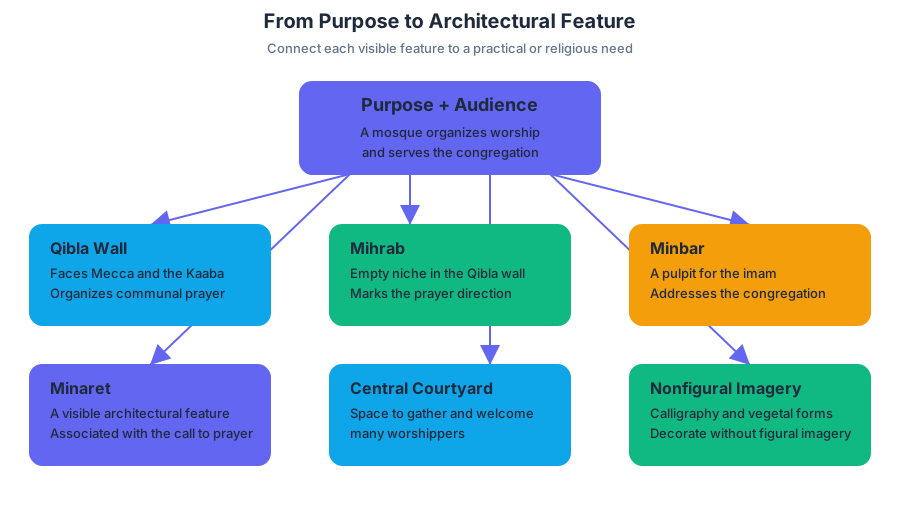
A useful way to analyze a building is to connect each visible feature to a practical or religious need:
| Architectural feature | Purpose or audience connection |
|---|---|
| Qibla wall | Faces Mecca, the direction of the Kaaba, organizing communal prayer |
| Mihrab | An empty niche in the Qibla wall that marks the direction of prayer |
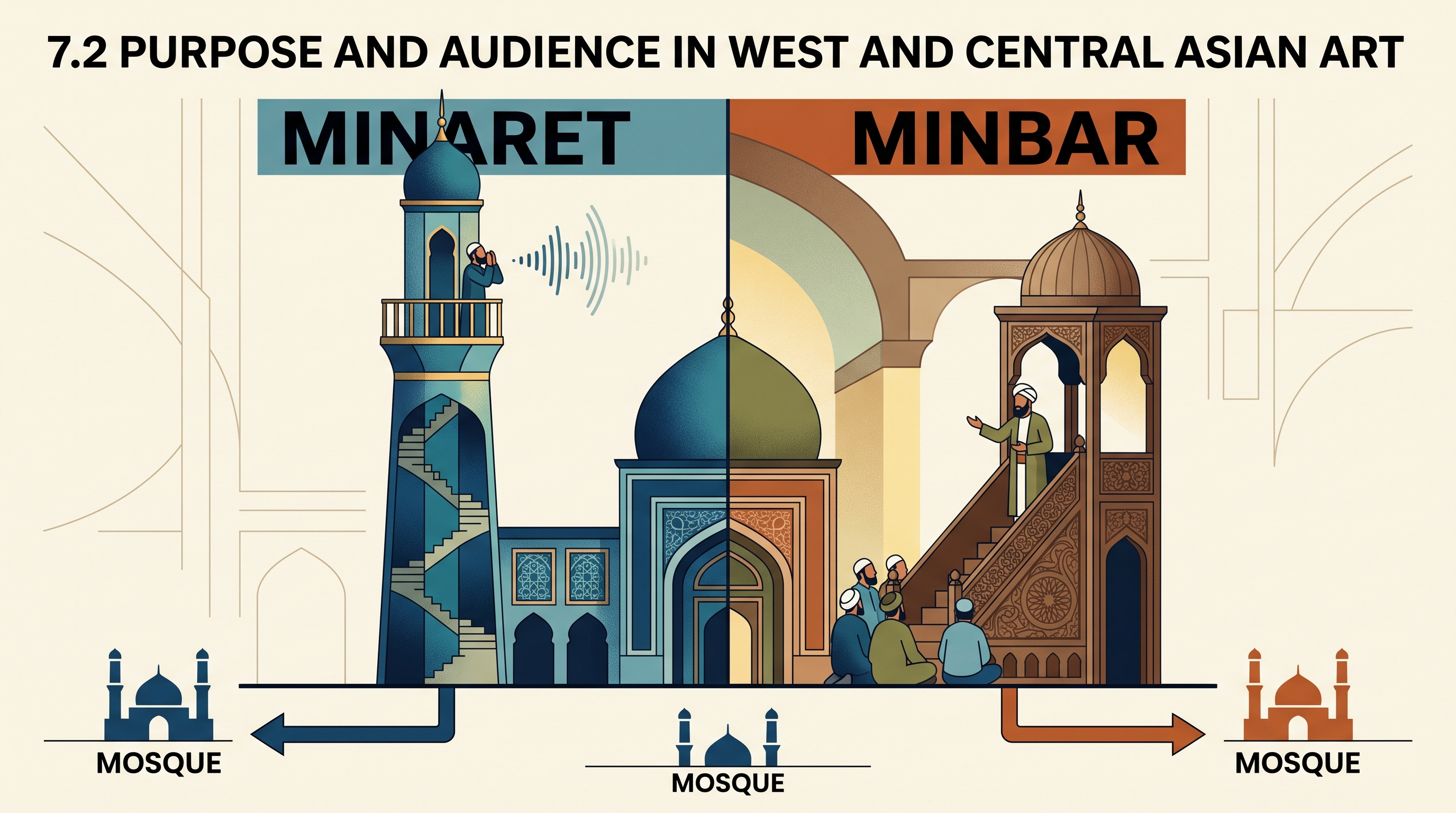
| Minbar | A pulpit from which the imam addresses the congregation |
| Minaret | An architectural feature associated with calling practitioners to prayer |
| Central courtyard | Provides space to gather and accommodate worshippers |
| Nonfigural imagery | Calligraphy and vegetal forms decorate the mosque without relying on figural imagery |
The building therefore performs several roles at once. It directs bodies toward Mecca, provides a place for communal worship, supports religious leadership, and accommodates a congregation. The audience is not a passive viewer standing outside the work; worshippers activate the architecture through movement, prayer, listening, and gathering.
Worked contextual example: reading a mosque as a social system
Imagine identifying a large congregational mosque with an empty niche in one wall, a raised pulpit nearby, a tower rising above the structure, and an open courtyard. Begin with observation, not assumptions: the niche is not a statue, the pulpit is not a throne, and the tower is not merely ornamental.
Next, connect observation to function. The niche is the mihrab, located in the Qibla wall, so it indicates the direction of Mecca. The raised pulpit is the minbar, used by the imam. The minaret and courtyard support the gathering and calling of practitioners for prayer. A strong interpretation would argue that the mosque’s design is shaped by communal religious use, not only by visual decoration.
This example demonstrates Skill 1.A: Describe features of a work of art or architecture, Skill 1.B: Explain how visual characteristics of a work of art or architecture convey meaning, Skill 2.A: Identify a work of art, and Skill 2.B: Explain the context in which a work of art was created. It also uses Skill 7.A: Make a claim about a work of art and Skill 7.B: Support an argument with visual and contextual evidence.
Religious architecture across traditions
Islamic religious architecture in the region also includes commemorative monuments, such as the Kaaba and the Dome of the Rock, as well as tomb architecture. Their purposes differ from the everyday congregation of a mosque: they can commemorate sacred places, preserve religious memory, or mark burial sites.
Central Asia is also recognized for Buddhist cave architecture, where relief carving, constructive sculpture, and wall painting transform caves into religious environments. In Tibetan lands, Buddhist architecture includes stupas—monumental structures associated with Buddhist devotion—and monastic architecture designed for religious communities.
The Jowo Rinpoche, identified as the most sacred image in Tibet, clarifies why audience matters. A sacred image may be encountered by lay practitioners, monks, pilgrims, and patrons, but these viewers do not necessarily approach it in the same way. Its importance depends on religious belief and ritual use, not simply on its materials or visual appeal.
Misconception check: “A minaret is the mosque”
Named misconception — feature substitution: A minaret is not the mosque itself, and it is not equivalent to the minbar. The minaret is an architectural feature associated with calling practitioners to prayer; the minbar is the imam’s pulpit inside the mosque. Confusing these terms can turn an otherwise accurate visual identification into an incorrect functional explanation.
Retrieval check: If a question asks how a mosque’s architecture accommodates communal worship, name two features and explain each function. A complete response might connect the central courtyard to gathering worshippers and the Qibla wall and mihrab to orienting prayer toward Mecca.
Source Materials
- AP Art History Course and Exam Description
- AP Art History Course and Exam Description Clarifications and Corrections
- AP Art History Course Overview
- AP Art History Course at a Glance
- AP Art History Course at a Glance Poster
- Adopt AP Art History
- AP Art History
- AP Art History
- Image Set
- © Peter Willi / Bridgeman Images
- © Fine Art Images/ age fotostock
- Getty Images