From the free course AP Art History on Lykke
1.2 Materials, Processes, and Techniques in Prehistoric Art
Key concepts: Materials · Technique · Artistic decisions about form, style, materials, technique, and/or content · Visual analysis of works of art · Cultural influences on prehistoric art · Contextual elements of a work of art · Attribution of works of art · Art-historical interpretations · Developing art-historically valid arguments · Prehistoric Art unit (30,000–500 BCE)
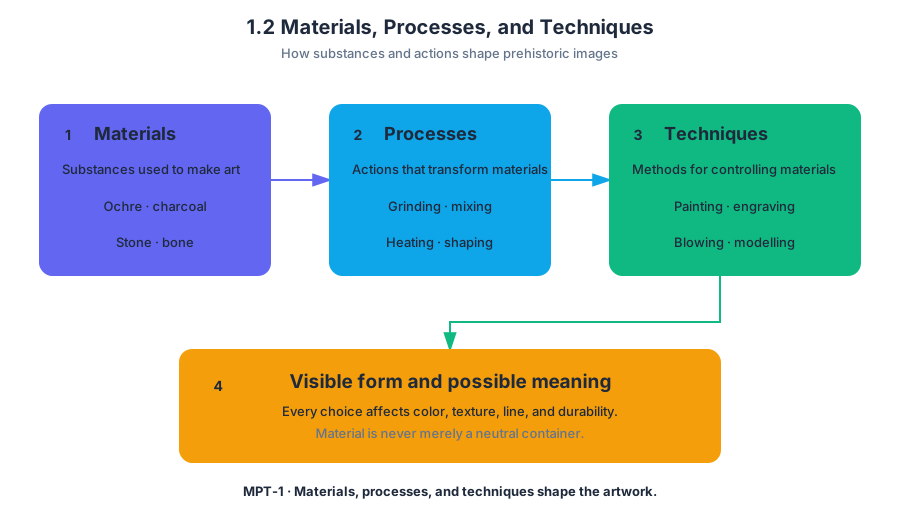
A prehistoric artist’s material is never merely a neutral container: ocher, stone, bone, and charcoal each impose different possibilities on the image, just as watercolor, oil paint, and photography produce different kinds of marks today.
1.2 Materials, Processes, and Techniques in Prehistoric Art
A prehistoric artist’s material is never merely a neutral container: ocher, stone, bone, and charcoal each impose different possibilities on the image, just as watercolor, oil paint, and photography produce different kinds of marks today. Materials are the substances used to make an artwork; processes are the actions that transform those substances; and techniques are the specific methods used to control them.
MPT-1: Materials, processes, and techniques shape both the visible form and the possible meaning of a work of art.
Material becomes meaning through artistic decisions
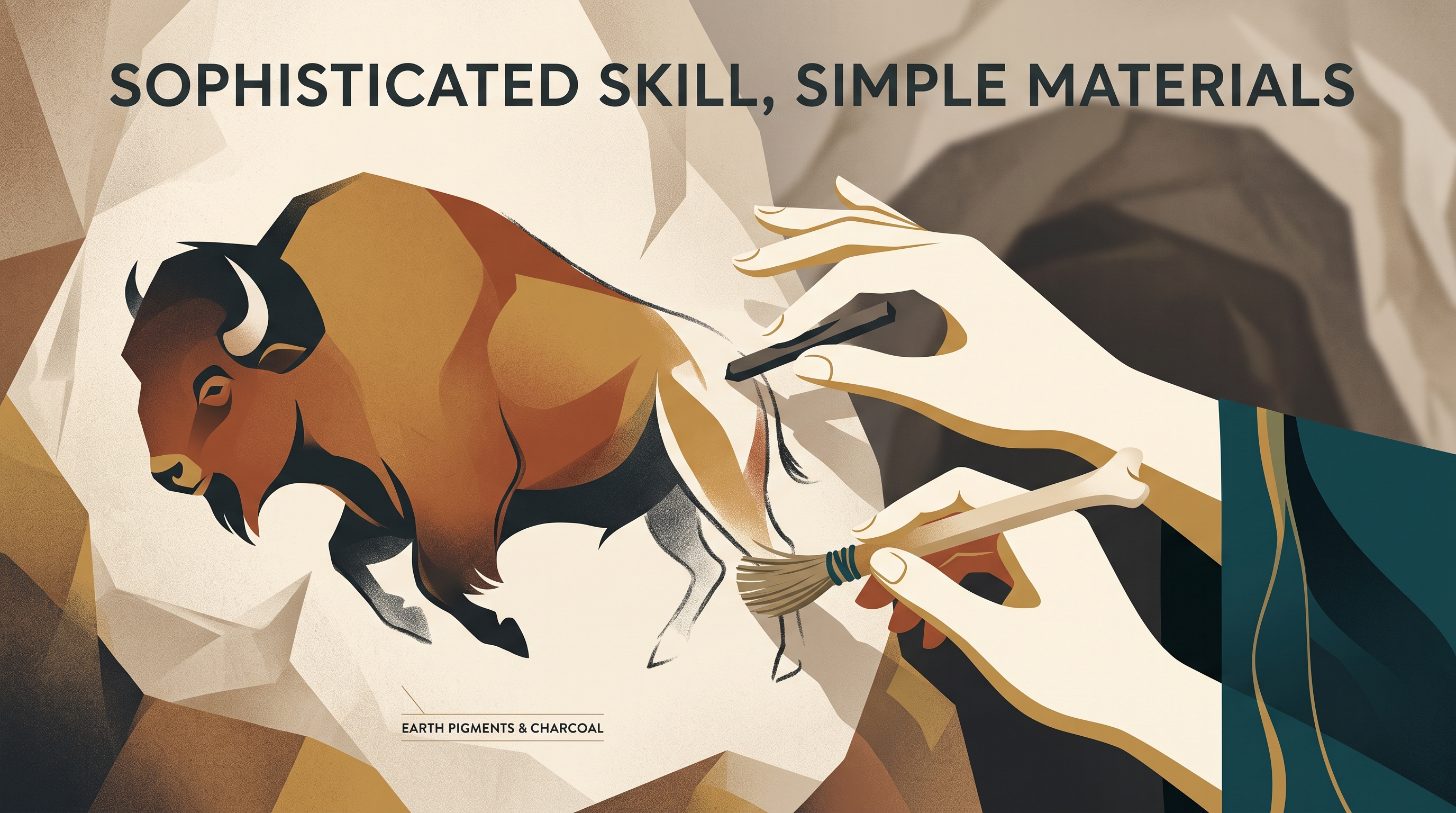
Consider a prehistoric image made with mineral pigment on a cave wall. The artist must select a pigment, grind or prepare it, mix it with a binding substance or water, apply it with a finger, tool, or spray-like breath, and choose whether to paint on a smooth or uneven section of stone. Each decision affects the result: a dry pigment may create a powdery surface, a liquid mixture may produce a stronger contour, and the wall’s natural bulges may become part of the depicted animal’s body.
The work’s form—its shape, line, color, texture, spatial organization, and degree of realism—therefore records the making process. A powerful contour can clarify the animal’s silhouette; layered pigment can suggest volume; a natural ridge can make a body appear to project from the wall. Technique is not an afterthought added after an image has been conceived. It is one of the means by which the image exists.
MPT-1.A connects material choice to interpretation: the physical substance and method of making influence what viewers see and how they understand it. A small carved object made from bone communicates through portability, tactile handling, and three-dimensional form differently from a large image fixed to a cave surface.
Worked visual analysis: from observation to argument
Imagine an image of a bison painted with dark outlines and selectively filled areas of red and brown pigment. Begin with Skill 1.B: Describe visual elements of a work of art (or group of related works of art). An accurate description identifies the animal’s profile, the emphatic contour, the limited palette, the uneven surface, and the relationship between painted areas and the wall’s natural contours. Do not begin by asserting what the image “means”; first establish what is visibly present.
Next apply Skill 1.C: Explain how artistic decisions about form, style, materials, technique, and/or content shape a work of art (or group of related works of art). A strong analysis links evidence to effect: the dark contour separates the animal from the stone; restricted color focuses attention on its body; and the use of the wall’s relief gives the figure a sense of volume. The conclusion should remain appropriately careful: these choices may have encouraged viewers to experience the animal as physically present, but the visual evidence alone does not prove a single ritual purpose.
This is the difference between description and analysis:
| Level | Evidence-based move |
|---|---|
| Description | “The animal has a dark outline and areas of red pigment.” |
| Analysis | “The dark outline increases legibility against the wall, while the red areas emphasize the body’s mass.” |
| Contextual argument | “Because the image is fixed to a cave surface rather than made as a portable object, its experience depended on location, movement, and access.” |
Attribution and unknown works
Skill 5.A: Describe visual elements of a work of art (or group of related works of art) beyond the image set supports analysis of unfamiliar prehistoric objects. Attribution means identifying a work or connecting it to a culture, period, object type, or related group. Do not rely on one clue. Combine material, technique, scale, surface, subject, and setting.
For example, a compact carved animal with incised lines and a polished surface is more plausibly a portable object than a wall painting. That attribution remains a reasoned proposal, not certainty: similar techniques can appear in different cultures, and prehistoric works often lack written records. Contextual evidence—location, archaeological association, date, and comparison with related works—must support the visual evidence.
Misconception check: “simple materials mean simple art”
Named misconception — primitivist simplicity: prehistoric art is not artistically unsophisticated because it uses earth pigments, stone, or bone. Limited materials can demand sophisticated decisions about contour, proportion, surface, and motion. A work may look spontaneous while depending on extensive preparation and technical knowledge.
Interpretation must also remain historically responsible. The preceding cultural analysis supplies possible contextual influences, but material analysis tests how those influences became visible. Avoid claiming that a pigment automatically proves a ritual, hunting, or religious function; instead, develop an art-historical argument using both visual evidence and context.
Retrieval check
A previously unknown prehistoric image shows a deeply incised animal on a portable stone, with polished edges and no surviving pigment. Identify two visual elements, explain one effect of the technique, and propose one contextual question that would help attribute or interpret the object. A complete response might connect incision to linear emphasis and portability to possible movement or handling—while clearly distinguishing evidence from speculation.