From the free course AP Art History on Lykke
4.1 Interactions Within and Across Cultures in Later European and American Art
Key concepts: Cultural interactions within and across Europe and the Americas · Colonialism and European invasions · Indigenous Americas and Indigenous cultural continuity · Cultural exchange and artistic influence · Rapid change and innovation from the mid-1700s to 1980 CE · Influence of ancient Mesoamerican sculpture and architecture · European and American modernist art · Impressionist, Post-Impressionist, and Modernist movements
From the mid-1700s to 1980 CE, Europe and the Americas underwent rapid artistic change because industrialization, urbanization, economic upheaval, migration, war, colonialism, and cultural contact repeatedly altered how people lived and imagined the world.
4.1 Interactions Within and Across Cultures in Later European and American Art
From the mid-1700s to 1980 CE, Europe and the Americas underwent rapid artistic change because industrialization, urbanization, economic upheaval, migration, war, colonialism, and cultural contact repeatedly altered how people lived and imagined the world.
Investigative question: When artists borrow, adapt, or respond to another culture, is the result best understood as exchange, influence, appropriation, resistance—or several of these at once?
A period of accelerated interaction
Artistic change during this period did not happen in isolation. New technologies, expanding cities, political revolutions, imperial systems, and mass movement connected artists to unfamiliar objects, images, and ideas; those encounters could produce admiration, experimentation, unequal appropriation, or deliberate rejection.
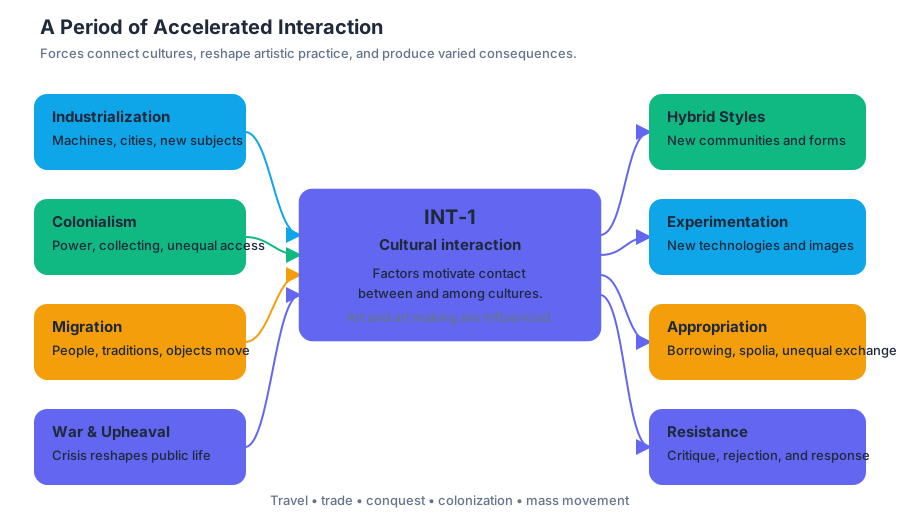
The CED frames this through INT-1: A variety of factors leads to and motivates interaction between and among cultures, and this interaction may influence art and art making. Such interaction can result from travel, trade, war, conquest, and colonization, and may appear through artistic influence, spolia, appropriation, stylistic revival, or other forms of cultural exchange.
| Historical force | What it changes | Artistic consequence |
|---|---|---|
| Industrialization | Production, transportation, and urban life | New subjects, technologies, and visual experiments |
| Colonialism | Political power and access to other cultures | Unequal exchange, collecting, borrowing, and resistance |
| Migration | Where people, traditions, and objects circulate | Hybrid styles and new artistic communities |
| War and economic upheaval | Institutions, identities, and public life | Art that records, critiques, or responds to crisis |
Colonialism and Indigenous cultural continuity
The term Indigenous Americas emphasizes the priority of Indigenous peoples and cultures rather than treating the Americas as spaces defined only by European arrival. European invasions began in $1492$ and prevailed beginning in $1534$ CE, but conquest did not erase the descendants, languages, or cultural practices of ancient Indigenous peoples.
The continued use of Quechua demonstrates this distinction clearly: approximately eight to ten million people still speak the language of the Inka. Indigenous culture is therefore not merely a historical “influence” preserved in museums; it remains a living continuity carried by communities in the present.
Misconception check — “European invasion ended Indigenous culture.”
European invasion profoundly disrupted Indigenous societies and imposed colonial power, but disruption is not disappearance. The survival of Quechua-speaking communities shows why art history must distinguish colonial domination from cultural extinction.
Influence is not a one-way pipeline
European and American artists were affected by exposure to diverse cultures, but influence should be demonstrated through specific visual or formal connections rather than asserted from resemblance alone. A work may borrow a shape, spatial structure, material logic, motif, or abstract vocabulary while transforming its original meaning in a new setting.
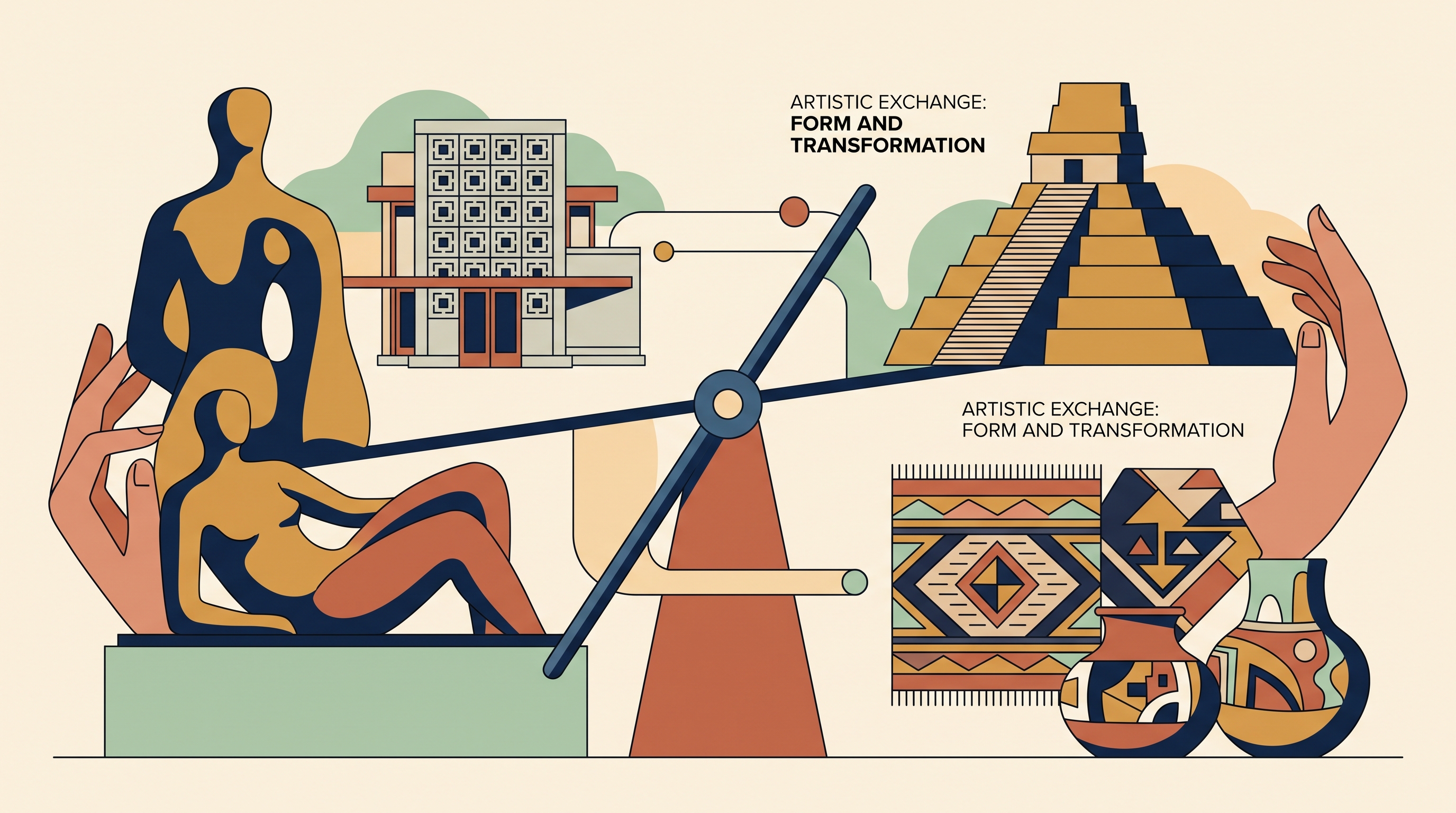
Henry Moore and Frank Lloyd Wright were strongly influenced by the sculpture and architecture of ancient Mesoamerica. Their examples show that ancient Mesoamerican art affected both modern sculpture and modern architecture, expanding the usual narrative that artistic innovation flows only from Europe to the Americas.
Andean art was less familiar to early modern Europe and to later mainstream audiences than Mesoamerican art because of greater geographic and aesthetic distance. Nevertheless, Paul Gauguin, Josef and Anni Albers, and Paul Klee found inspiration in ancient Peruvian textiles and ceramics, while Joaquín Torres García of Uruguay blended Inka art and architecture with modernist theory and style to explore a shared abstract vocabulary.
Worked example: tracing influence through Monet
Claude Monet’s Gare Saint-Lazare offers a useful way to trace artistic influence across movements. Begin with visual evidence: the railway station presents modern industrial space through shifting light, atmospheric steam, fragmented color, and a subject associated with urban modernization rather than traditional heroic or religious history painting.
Next, trace what later artists could take from this approach. Impressionism’s attention to transient perception and modern life helped open possibilities for Post-Impressionist experiments with structure, color, and expression; those experiments, in turn, contributed to Modernist departures from naturalistic representation. The claim is not that Monet single-handedly caused Modernism, but that a specific artwork or related group of works can influence later artistic practices and artmaking.
A strong INT-1.A: Explain how interactions with other cultures affect art and art making response would connect visual evidence to context: the station’s subject reflects industrialization, while its method of depicting light and atmosphere demonstrates formal innovation that later artists could adapt. This is also 4.D: Explain how a specific work or group of related works of art can influence later artistic production within or across cultures.
How to build an AP-quality explanation
Use the sequence contact → transformation → evidence → consequence:
- Identify the interaction: invasion, migration, travel, collecting, trade, or artistic exposure.
- Name what changed: a motif, material, structure, technique, subject, or visual language.
- Cite visible evidence in the artwork.
- Explain the effect on later artmaking or cultural identity.
For example, “Wright was influenced by Mesoamerican architecture” is only an assertion. A stronger explanation identifies a Mesoamerican architectural feature, connects it to a formal decision in Wright’s work, and explains how that decision shows cultural interaction without pretending that the two traditions are identical.
Retrieval check
Why does Quechua matter to an explanation of cultural interaction in later European and American art? A complete answer should state that eight to ten million people still speak the Inka language, demonstrating Indigenous cultural continuity and challenging the misconception that European invasion erased Indigenous peoples and cultures.
Source Materials
- AP Art History Course and Exam Description
- AP Art History Course and Exam Description Clarifications and Corrections
- AP Art History Course Overview
- AP Art History Course at a Glance
- AP Art History Course at a Glance Poster
- Adopt AP Art History
- AP Art History
- AP Art History
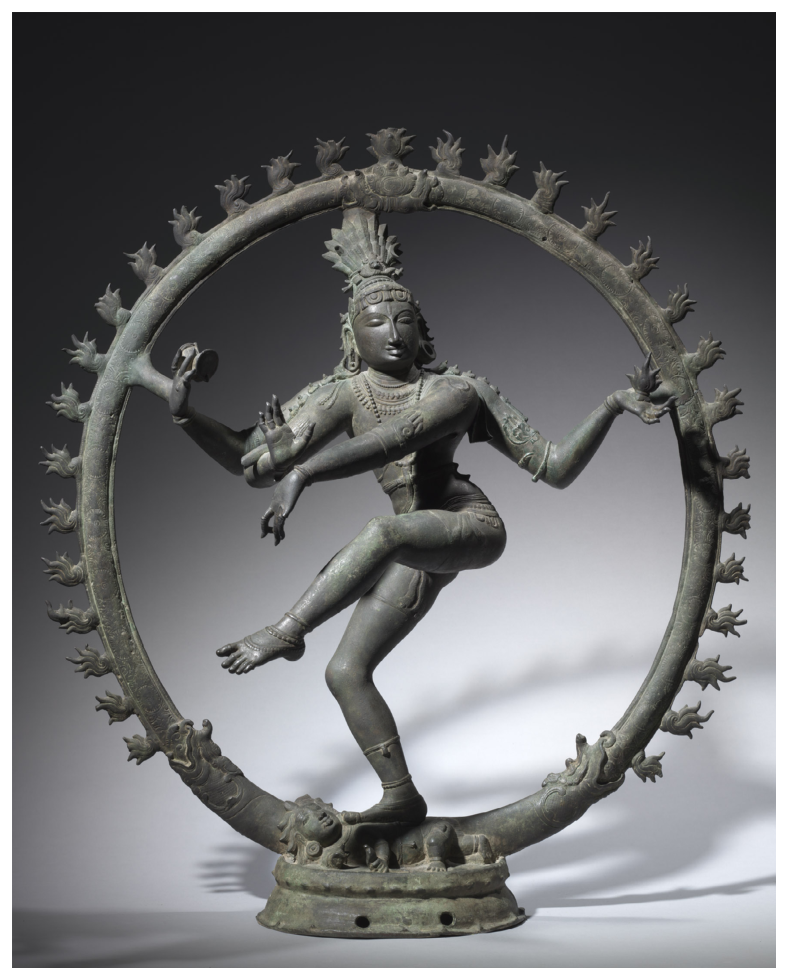
- Purchase from the J. H. Wade Fund 1930.331. Cleveland Museum of Art
- AP Art History-AP Students
- AP/College Art History-Khan Academy
- AP Art History-Wikipedia