From the free course AP Art History on Lykke
10.3 10.3 Interactions Within and Across Cultures in Global Contemporary Art
Key concepts: Cultural interaction and exchange in global contemporary art · The influence of other cultures on art and art making · Global interconnectedness and a shift away from Eurocentric art history · African artistic and cultural contributions across the diaspora · Appropriation and mash-ups in contemporary art · The treatment of culturally sacred objects through revaluation or devaluation · Digital technology’s role in expanding access to artists, artworks, and contextual information · Activism challenging the privileged place of white, heterosexual men in art history · Deconstructionist and feminist theories supporting art-historical activism · Global contemporary art from 1980 CE to the present
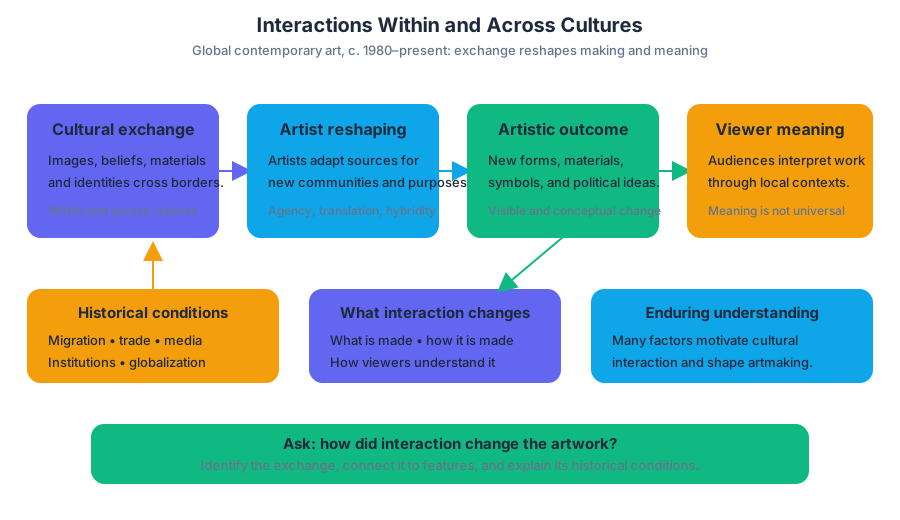
Contemporary art is made inside a web of cultural exchange: images, beliefs, materials, identities, and political ideas move across borders, while artists reshape them for new communities and purposes.
10.3 10.3 Interactions Within and Across Cultures in Global Contemporary Art
Contemporary art is made inside a web of cultural exchange: images, beliefs, materials, identities, and political ideas move across borders, while artists reshape them for new communities and purposes. The Global Contemporary period, approximately $1980$ CE to the present, therefore cannot be understood through an exclusively European or North American storyline.
Enduring Understanding INT-1: A variety of factors leads to and motivates interaction between and among cultures, and this interaction may influence art and art making.
The key question is not simply “Which culture influenced this artwork?” but how did interaction change what was made, how it was made, and how viewers understood it? A useful answer must identify the cultural exchange, connect it to visible or conceptual features, and explain the historical conditions that made the exchange possible.
A global, interconnected art history
Cultural interaction means that artistic ideas, practices, symbols, and beliefs encounter one another and produce effects. The exchange may be voluntary, forced, celebratory, commercial, religious, political, or technologically mediated. It does not automatically create equality: one culture may borrow from another while suppressing, stereotyping, or profiting from the people whose traditions it uses.
The CED learning objective INT-1.A asks students to “Explain how interactions with other cultures affect art and art making.” Its essential knowledge, INT-1.A.18, emphasizes the global circulation of African creative contributions. African people and beliefs have carried artistic practices across locations from Macao to Manaus to Mauritania. These contributions appear in diverse forms, including Santeria, Japanese screens, Renaissance Venetian painting, the literature of Negritude, and the Harlem Renaissance.
This range matters because “African influence” is not limited to a recognizable traditional sculpture or mask. Cultural contributions can appear in religious practice, literature, painting, screen design, performance, music, visual symbolism, and ideas about race and place. The Negritude movement and the Harlem Renaissance, for example, expanded how artists and writers represented Black identity, diaspora, cultural memory, and geographic belonging.
Contemporary African arts have also increased global awareness of the continent’s artistic production. Digital technology intensifies this change by giving viewers greater access to imagery and contextual information about diverse artists and artworks throughout history and across the globe. Access can broaden art history, but it does not eliminate the need to ask who controls the image, who supplies its context, and whose interpretation receives authority.
From Eurocentric history to global interconnectedness
A Eurocentric art history treats European traditions as the central standard and places other cultures at the margins or describes them mainly through European influence. A global approach instead recognizes multiple centers of innovation and examines circulation in more than one direction. Activism, postcolonial critique, deconstructionist theory, and feminist theory have challenged the traditional privileged position of white, heterosexual men in the writing and display of art history.
Deconstructionist theories question apparently stable categories—such as “high art,” “primitive art,” “artist,” or “masterpiece”—by examining the assumptions and power structures behind them. Feminist theories investigate how gender shapes artistic production, authorship, visibility, labor, and interpretation. Together with activism, these approaches have encouraged museums and scholars to reconsider which artists, cultures, and forms of knowledge receive attention.
Appropriation, mash-ups, and sacred meaning
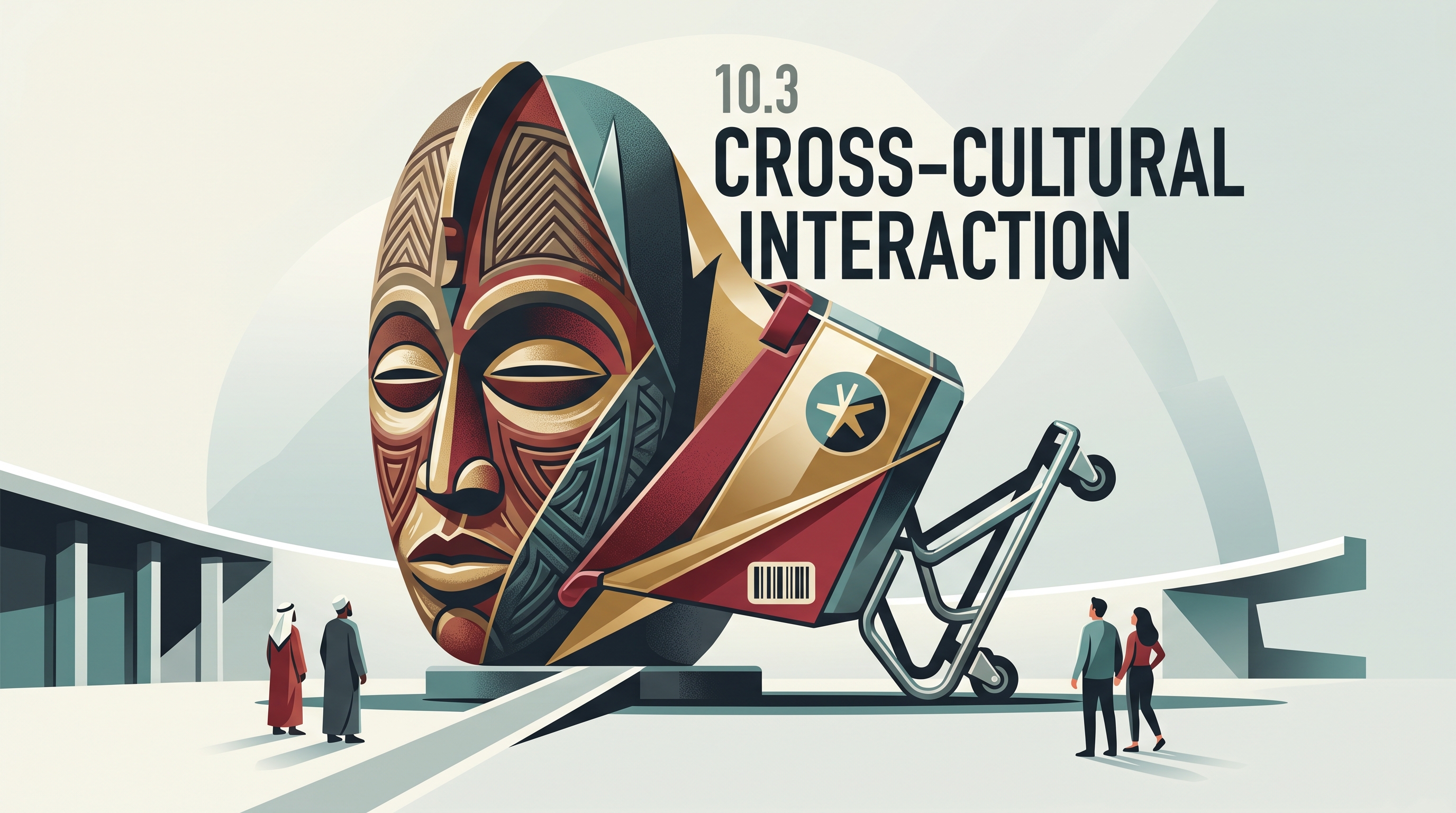
Appropriation is the reuse of an existing image, symbol, object, style, or cultural practice in a new artwork. A mash-up combines elements from different cultural or visual sources. These strategies can revalue a neglected tradition by giving it visibility, or devalue a sacred object by stripping it from its community, ritual, and meaning.
The same visual act can therefore produce competing interpretations. An artist may place a culturally sacred form in a contemporary installation to expose colonial collecting or restore its significance. Another artist—or a commercial institution—may use the same form as decoration, treating a living belief system as an exotic design resource.
Worked contextual example: Imagine a contemporary artist combining a sacred symbol from an African diasporic practice with advertising graphics and digital projections. First, identify the interaction: a religious or culturally specific image is entering a global media environment. Next, identify the artistic effect: the mash-up may make the symbol visible to new audiences and criticize commercialization. Finally, evaluate the ethical tension: if the work supplies cultural context and collaborates with practitioners, it may revalue the tradition; if it removes the symbol from ritual meaning and presents it as exotic decoration, it may devalue it.
Skills in action
This topic most directly activates the suggested Skill 4: Artistic Traditions, especially 4.A, 4.B, and 4.D, which focus on explaining relationships of continuity and change within and across artistic traditions. A strong response does three things: identifies the traditions involved, points to evidence of borrowing or transformation, and explains why the interaction matters in its historical context.
It also draws on Skill 2: Contextual Analysis when connecting an artwork to diaspora, activism, digital circulation, colonial history, religion, or identity; Skill 3: Comparison of Works of Art when distinguishing respectful revaluation from extractive appropriation; and Skill 8: Argumentation when making a defensible claim supported by visual and contextual evidence.
Misconception check: Cultural similarity does not automatically prove direct borrowing. An argument about influence needs evidence of contact, circulation, shared practice, or a historically plausible connection—not merely a resemblance.
Retrieval check
An artist combines a sacred object’s form with consumer imagery. Give one reason the work could revalue the object and one reason it could devalue it. Then name the evidence you would need before deciding which interpretation is stronger.
Source Materials
- AP Art History Course and Exam Description
- AP Art History Course and Exam Description Clarifications and Corrections
- AP Art History Course Overview
- AP Art History Course at a Glance
- AP Art History Course at a Glance Poster
- Adopt AP Art History
- AP Art History
- AP Art History
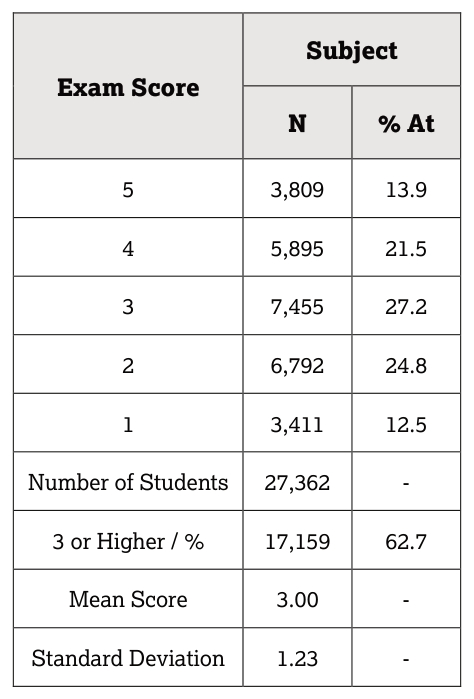
- Figure — Score Distributions (p. 1)