From the free course AP Art History on Lykke
5.3 Purpose and Audience in Indigenous American Art
Key concepts: Purpose and audience in Indigenous American art · Reciprocity and cyclicality rather than individualism · Interaction with challenging environments · Reverence for animal and plant worlds · Shamanistic religion and spiritual practice · Community-centered art making and performance · Gender-based specialization in artistic labor · Patronage by tribal leaders, elders, or family members · Restricted sacred or political audiences · Cultural practices, beliefs, and settings as essential context
Indigenous American art often functioned less like a picture hung for private viewing and more like a participant in a social, religious, or political event.
5.3 Purpose and Audience in Indigenous American Art
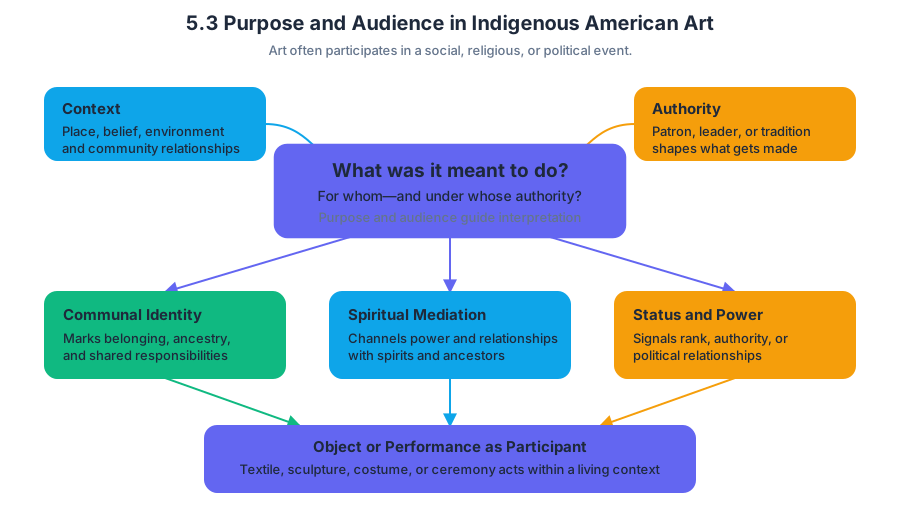
Indigenous American art often functioned less like a picture hung for private viewing and more like a participant in a social, religious, or political event. Its purpose and audience emerge from geography, cultural practice, belief systems, environmental pressures, and relationships among community members.
Learning Objective PAA-1.A: Explain how purpose, intended audience, or patron affect art and art making.
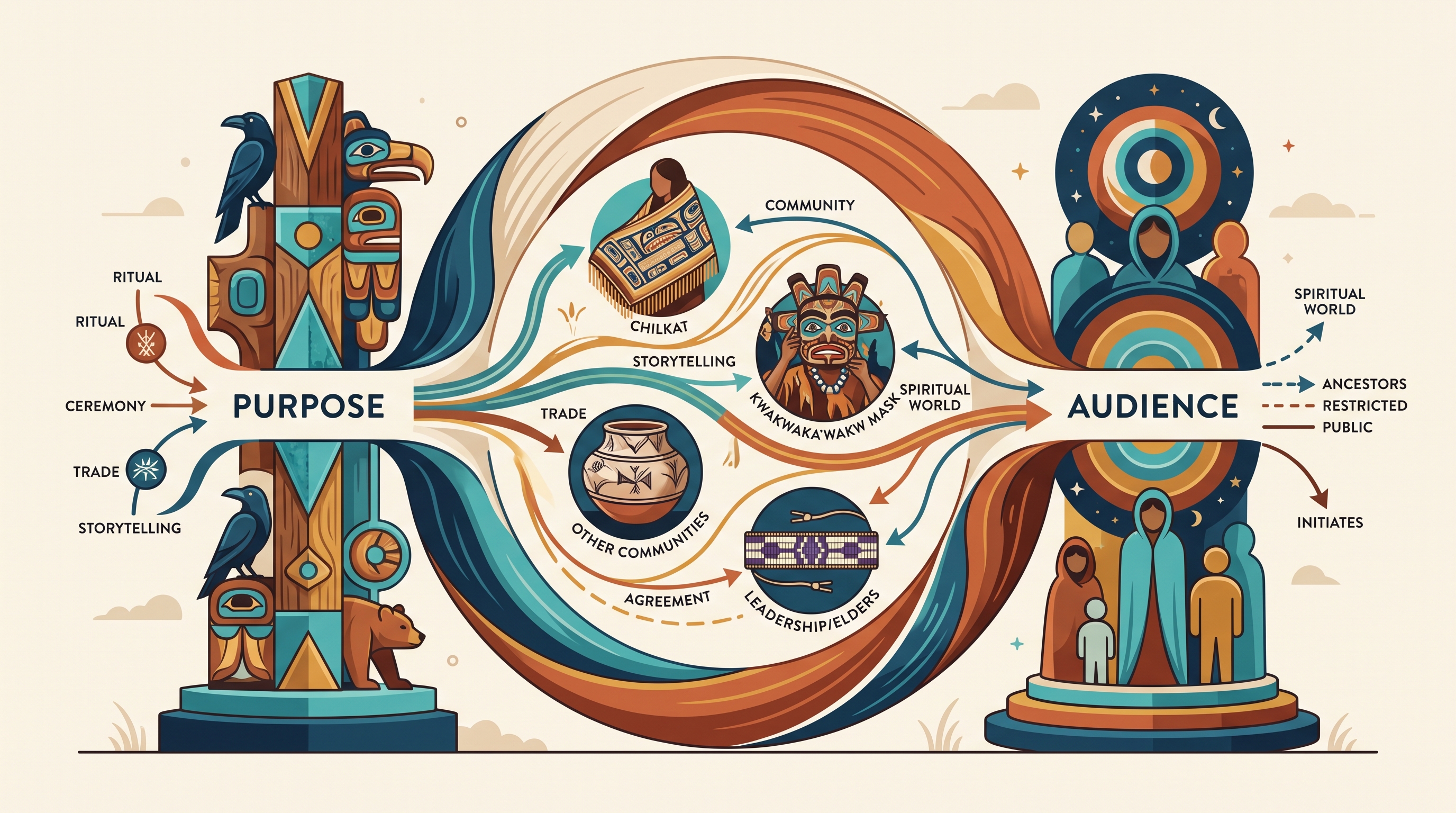
The key question is not simply “What does this object look like?” but “What was it meant to do, for whom, and under whose authority?” A textile, sculpture, costume, or performance may communicate status, channel spiritual power, mark a communal identity, or mediate a relationship with animals, plants, ancestors, and supernatural forces.
Purpose is cultural, not automatically aesthetic
In many Indigenous American contexts, art was created for active use rather than passive appreciation. An artwork could be worn, carried, performed, activated in a ritual, exchanged, or encountered only by people with the appropriate religious or political standing.
This idea connects to PAA-1.A.14, which emphasizes that art may be understood as containing or transferring life force. The object’s significance therefore depends on what happens with it. A ceremonial object removed from its ritual setting may still be visually impressive, but its original purpose cannot be reconstructed from appearance alone.
Environment, reciprocity, and cyclicality
Indigenous American art reflects interaction with particular environments, including the demanding landscapes of Mesoamerica and the Central Andes. CUL-1.A.28 identifies Central Andean cultural similarities such as survival in challenging environments, reciprocal and cyclical relationships with nature rather than individualism, and reverence for animal and plant worlds within shamanistic religious practice.
Reciprocity means a relationship based on mutual exchange: humans depend on the natural world, but humans also have obligations toward it. Cyclicality describes time and existence as recurring processes rather than a one-way progression. Art could therefore support ceremonies intended to renew balance, honor life-giving forces, or acknowledge the continuing power of ancestors and nonhuman beings.
Animal and plant imagery should not automatically be treated as decoration. Within shamanistic religious practice, animals and plants may be revered as powerful beings or as sources of transformation. Mesoamerican art could also depict shamanic transformation, visions, and cosmic realms even when its style remained naturalistic and figural, as noted in CUL-1.A.27.
Community-centered making
Art making frequently occurred through community relationships rather than through the modern idea of the isolated individual artist. Several people might contribute labor, knowledge, ritual authority, or performance. Gender specialization could appear in particular communities—for example, women weaving and men carving—although such patterns describe social organization, not a universal rule for every Indigenous American society.
Patrons could include tribal leaders, elders, or family members. The patron is the person or group that commissions, supports, owns, or authorizes the work. The audience was often the entire community or cultural group, especially when the work participated in a communal ceremony, but some objects and performances had restricted audiences because of their sacred or political nature.
Worked contextual example
Imagine an Andean ceremonial object used during a community performance connected to a difficult mountain environment. Its purpose might be to acknowledge the powers sustaining the community, reinforce reciprocal obligations to the natural world, and make visible the group’s shared identity. The likely audience would be the participating community, while a leader or elder might serve as patron or authorize its use.
Now add a restriction: if the object could be seen only by initiated religious specialists, its audience would not be “everyone,” even if the broader community benefited from the ceremony. The correct interpretation must distinguish public social function from restricted ritual access.
An AP-quality explanation might read: The object’s purpose was shaped by a reciprocal religious relationship with the environment, while its audience was determined by the community’s ritual structure. Its restricted visibility suggests that spiritual or political authority, rather than individual artistic expression, controlled how and by whom it could be encountered. The reasoning links visual or functional evidence to context instead of merely naming a belief.
Misconception check
Misconception: “Indigenous American art was made for the whole community, so every object was publicly accessible.” Correction: community-centered art often served the group, but sacred or political objects and performances could have restricted audiences. Always ask whether the intended audience was communal, elite, familial, initiated, or supernatural.
Misconception: “If an object is beautiful, its main purpose was aesthetic.” Correction: visual appeal may support ritual, political, social, or spiritual purposes. Function and belief determine meaning more reliably than modern museum display.
Skill focus: 2.B
Skill 2.B: Explain how purpose, intended audience, or patron affect art and art making. To apply it, build a chain:
- Identify the object’s likely function or setting.
- Name the relevant patron, such as a leader, elder, or family member.
- Identify the intended audience and any access restrictions.
- Connect those factors to artistic choices, communal labor, ritual performance, or subject matter.
- Support the explanation with cultural and religious context.
Retrieval check: Why would identifying an audience as “the entire community” be incomplete if an object was used by religious specialists? Answer in one sentence: the community may have been the broader beneficiary, but sacred or political rules could restrict who directly saw, handled, or performed with the object.