From the free course AP Art History on Lykke
6.4 6.3 Theories and Interpretations of African Art
Key concepts: Theories and interpretations of art change over time · Visual analysis as a basis for interpreting art · The influence of other disciplines, technology, and available evidence on art-historical interpretation · Outsider collection and classification of African art · Uncertain or unrecorded authorship and dates in African art · Art’s role in supporting and validating leadership and status · Art, identity, and social order · Art in rites of passage and life transitions · The performative and holistic nature of African art · The use of historical skills and case studies such as Great Zimbabwe
A stone wall can preserve political power long after the names of its builders disappear. At Great Zimbabwe, monumental dry-stone architecture once led some outsiders to claim that Africans could not have created it; archaeology, historical research, and reconsideration of colonial assumptions later demonstrated…
6.4 6.3 Theories and Interpretations of African Art
A stone wall can preserve political power long after the names of its builders disappear. At Great Zimbabwe, monumental dry-stone architecture once led some outsiders to claim that Africans could not have created it; archaeology, historical research, and reconsideration of colonial assumptions later demonstrated the achievements of local African communities. The example shows why art-historical interpretation is never based on appearance alone.
THR-1: The study of art history is shaped by different theories and interpretations of art and art making that change over time. These interpretations arise through visual analysis and scholarship, which can be affected by other disciplines, available technology, and the availability of evidence.
The key distinction is between visual analysis, the close study of an artwork’s observable features, and scholarship, the research that places those features into historical, cultural, and intellectual contexts. A wall’s construction, scale, materials, and location may suggest labor organization and authority; archaeology, oral histories, trade records, and scientific dating can then test or revise that interpretation.
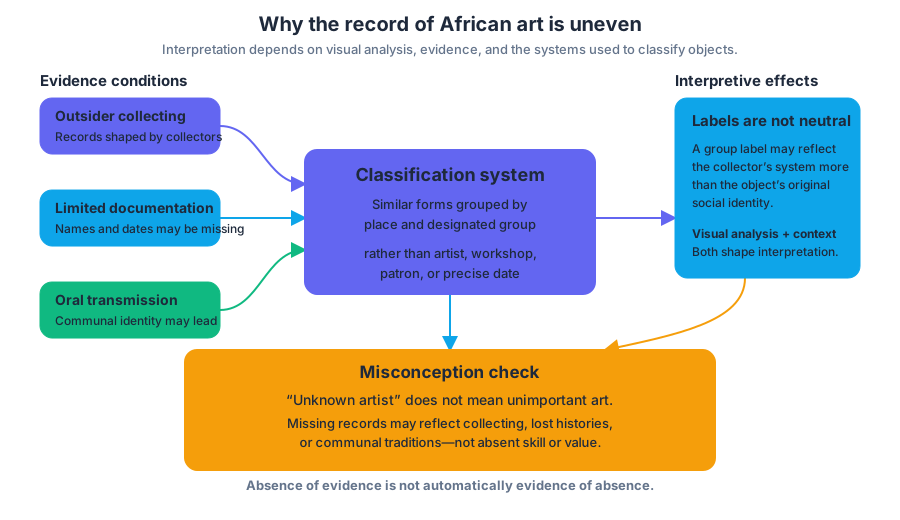
Why the record of African art is uneven
THR-1.A: Explain how theories and interpretations of works of art are shaped by visual analysis as well as by other disciplines, technology, or the availability of evidence.
THR-1.A.19 is essential because many African art objects were traditionally collected by outsiders. Works with similar forms were often grouped according to place of origin and a designated ethnic group rather than identified through individual artists, workshops, patrons, or precise dates. The artist’s name and the date of creation may therefore be unknown or unacknowledged.
That absence is not neutral. Museum classification systems, colonial collecting practices, and limited documentation helped shape the categories through which African art was understood. A label such as “made by Group X” may communicate a collector’s system more clearly than it communicates the object’s original social identity.
Misconception check — “Unknown artist means unimportant art.” Unknown authorship does not mean that a work lacked an artist, skill, audience, patron, or social purpose. It may instead reflect outsider collecting, the loss of records, oral rather than written transmission, or a tradition in which communal identity mattered more than individual fame.
Missing information also does not prove that the people who commissioned, used, or protected an artwork were uninterested in it. An object can be highly valued while its maker’s name remains unrecorded. In interpretation, absence of evidence is not automatically evidence of absence.
Great Zimbabwe: interpretation changes with evidence
Great Zimbabwe is a useful worked example. Begin with visual evidence: enormous, carefully fitted granite walls; multiple enclosures; elevated and restricted spaces; and substantial labor invested without the use of mortar. These features support an interpretation involving organized authority, social differentiation, and a major center rather than an ordinary settlement.
Next add contextual evidence. Archaeological research connects Great Zimbabwe to local southern African communities and to regional trade networks. Imported materials and evidence of exchange indicate long-distance connections, while the monumental architecture demonstrates that African rulers and builders could mobilize labor, resources, and technical knowledge on a large scale.
Earlier colonial interpretations attributed the site to foreign builders. That interpretation was not simply a visual conclusion; it was shaped by racist assumptions about African history and by the limited use—or dismissal—of local evidence. As archaeology, regional history, and more rigorous scholarship expanded the available evidence, interpretation shifted toward recognizing Great Zimbabwe as an achievement of local African societies.
This is the reasoning chain an exam response should make visible:
- Visual evidence: monumental scale and sophisticated dry-stone construction suggest organized power.
- Contextual evidence: settlement, trade, and regional history locate the monument within African societies.
- Interpretive revision: new evidence and more responsible scholarship challenge the earlier foreign-builder theory.
- Historical conclusion: interpretations change when evidence, methods, and scholarly assumptions change.
Art, status, and social order
African art objects can support and validate leadership and status. Aesthetic choices may define identity and rank, while representations of common ancestors can reinforce shared social norms. In this context, an artwork does not merely depict authority; its materials, scale, access, costume, or ceremonial use can help produce authority.
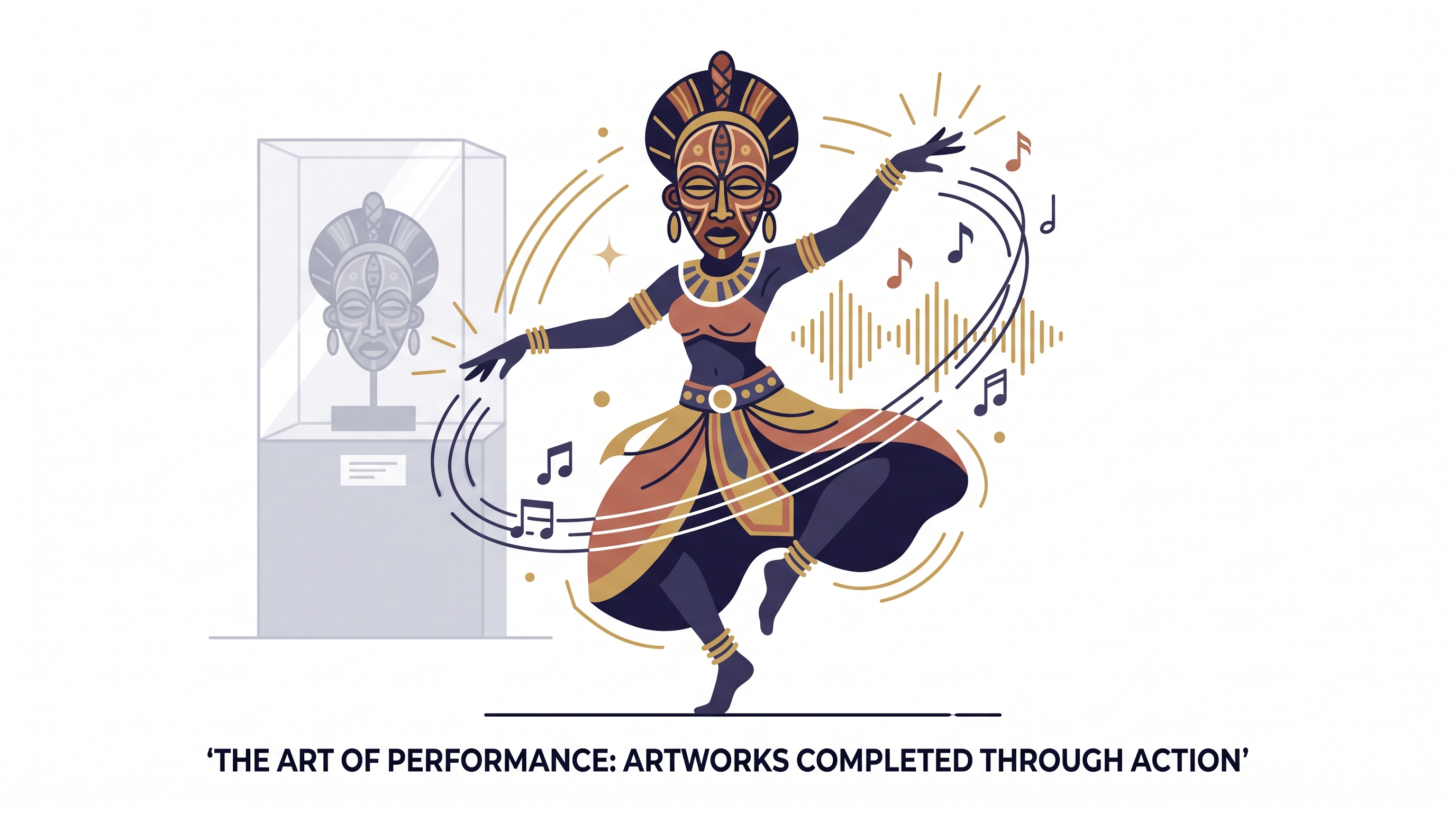
PAA-1.A.22 connects interpretation to function: African histories were often sung or recited by specialists, and art could be sung, danced, and presented in holistic experiences for designated audiences. Performative means that an artwork is completed through action—movement, sound, speech, ritual, and audience response—not only through detached looking.
Education, incorporation into adulthood, and civic responsibility may be marked by the creation, manipulation, and interpretation of art objects. During rites of passage, art can transmit knowledge, establish new social identities, and validate the authority of elders or specialists. A mask, costume, sculpture, or emblem therefore should not be interpreted as an isolated visual object when its meaning depends on performance.
Misconception check — “The object’s museum appearance is its original meaning.” A museum display may freeze an object in silence and stillness, while its original meaning depended on song, dance, recitation, restricted access, movement, or a specific ceremonial outcome. Interpretation must ask what the object did, for whom, and under what conditions.
The AP reasoning move
Use Skill 1: Visual Analysis to identify formal evidence; Skill 2: Contextual Analysis to connect that evidence to social, political, religious, and historical circumstances; Skill 7: Art Historical Interpretations to explain why scholars have disagreed or changed their conclusions; and Skill 8: Argumentation to turn evidence into a defensible claim. A strong response does not merely say that an interpretation changed—it names the evidence or disciplinary development that caused the change.
Retrieval check: Why might Great Zimbabwe’s interpretation change even though the walls themselves remain unchanged? In two sentences, connect one visual feature to one change in evidence, technology, or scholarship. Then explain why identifying an African artwork’s function may require studying performance as well as form.