From the free course AP Art History on Lykke
AP Practice 4
A building can preserve an artistic tradition while radically changing what that tradition means. That tension—continuity alongside change—is the central problem in this original, unofficial AP Art History practice task.
AP Practice 4
A building can preserve an artistic tradition while radically changing what that tradition means. That tension—continuity alongside change—is the central problem in this original, unofficial AP Art History practice task.
Task type: Continuity and Change
This task asks you to connect two works through a historically defensible claim. You must do more than identify shared features: explain what continues, what changes, and why those continuities and changes make sense in context.
Works for analysis
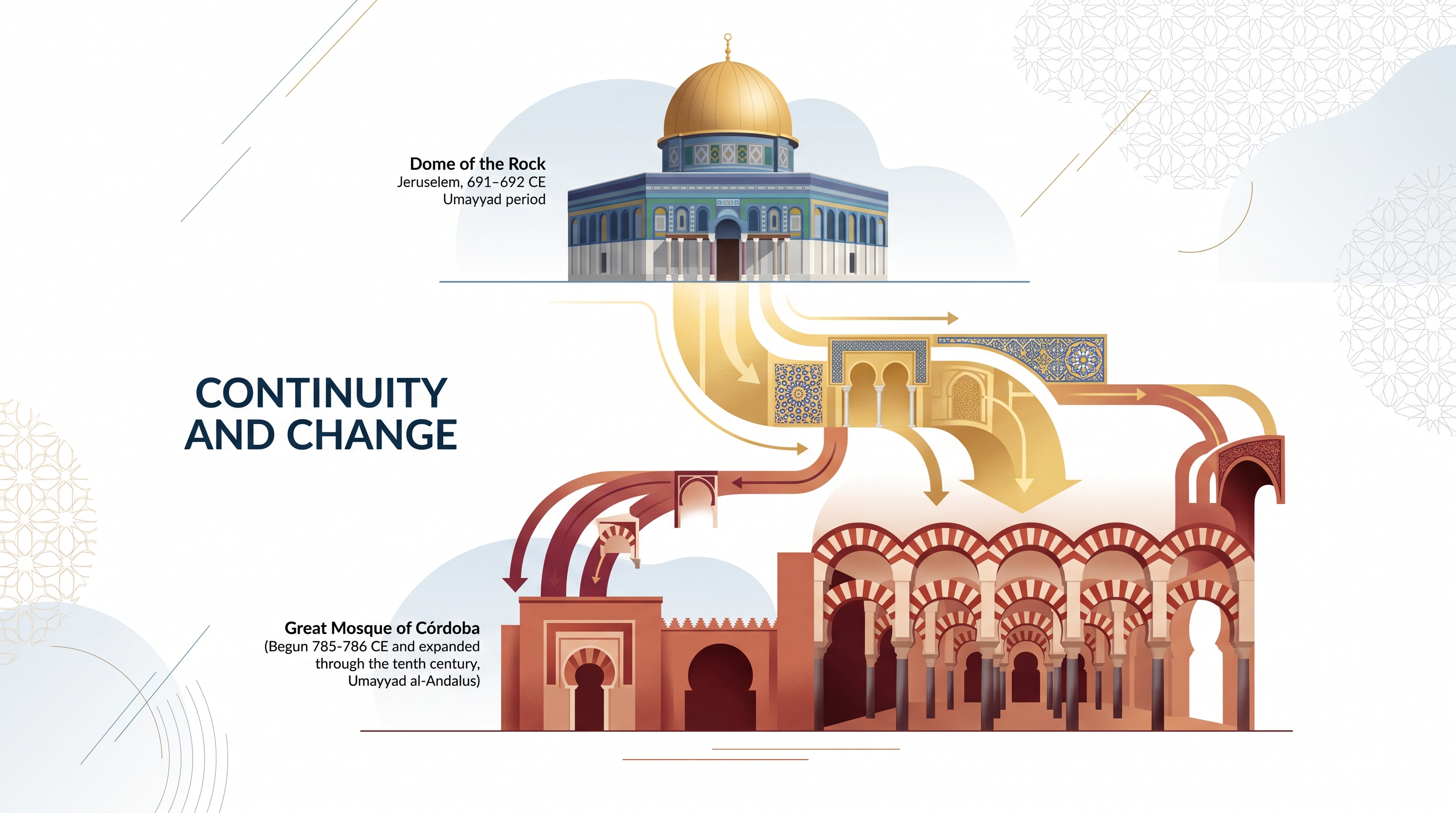
- Dome of the Rock, Jerusalem, completed 691–692 CE, Umayyad period
- Great Mosque of Córdoba, begun 785–786 CE and expanded through the tenth century, Umayyad al-Andalus
Original practice prompt
Using the two works named above, make an argument about how Islamic architectural traditions demonstrate both continuity and change between the late seventh and tenth centuries.
In your response:
- Identify one architectural feature or principle that continues between the works.
- Describe one visual or material similarity that supports your claim.
- Explain one important change in form, function, or audience.
- Connect that change to a specific historical or cultural context.
- Support your argument with evidence from both works.
A visual map before writing
| Analytical lens | Dome of the Rock | Great Mosque of Córdoba |
|---|---|---|
| Form | Centralized octagonal shrine with a prominent dome | Hypostyle congregational mosque with repeated arches and columns |
| Materials and decoration | Stone, mosaic, marble, inscriptions | Stone, brick, marble, mosaics, horseshoe arches |
| Function | Monumental shrine associated with Islamic sacred history | Communal mosque for congregational prayer |
| Audience | Pilgrims, worshippers, and visitors to Jerusalem | Muslim worshippers and the Umayyad community in Córdoba |
| Possible continuity | Monumentality, geometry, costly materials, Qur'anic inscription, sacred authority | Monumentality, geometry, costly materials, Qur'anic inscription, sacred authority |
| Major change | Centralized commemorative structure | Expansive communal prayer space adapted to a western Islamic capital |
Worked reasoning
Step 1: Build a claim, not a list. A weak response says, “Both buildings have domes and decoration.” A stronger claim explains the relationship: Both monuments use geometry, monumental scale, rich surface decoration, and Islamic inscriptions to communicate sacred authority, but the Dome of the Rock presents that authority through a centralized shrine in Jerusalem, while the Great Mosque of Córdoba transforms related visual principles into a large congregational space for an expanding western Islamic society.
Step 2: Use visual evidence precisely. The Dome of the Rock organizes the viewer’s experience around a central plan and elevated dome. Its exterior and interior surfaces use mosaics, marble, and inscriptions to create a highly controlled, luminous environment. The Great Mosque instead emphasizes repetition: rows of columns and two-tiered arches extend across the prayer hall, producing a sense of expansion. Both are visually ordered and monumental, but one concentrates attention while the other distributes it across a communal interior.
Step 3: Explain the historical change. The difference is not merely stylistic. The Dome of the Rock was built in Jerusalem, a city already associated with major Jewish and Christian sacred traditions. Its centralized form and prominent location helped proclaim the presence and authority of the new Islamic faith. The Great Mosque of Córdoba served a Muslim community in al-Andalus and required a spatial arrangement suitable for congregational worship. Its repeated bays could accommodate many worshippers and could be enlarged as the mosque complex developed.
Step 4: Finish the argument with both continuity and change. The continuing use of geometry, precious materials, inscriptions, and monumental scale shows that Islamic patrons used architecture to express religious and political legitimacy. The changed plan and audience show that Islamic architecture was not a fixed formula: it adapted to local histories, political ambitions, available building traditions, and the practical needs of worshippers.
What earns credit
A rubric-aligned response should make the following moves:
- Identification: Correctly name or clearly identify both works.
- Visual description: Describe relevant features rather than merely labeling them.
- Comparison: Explain a meaningful similarity and difference.
- Contextual analysis: Connect the difference to a specific historical, religious, political, or social circumstance.
- Argumentation: Present a defensible claim and use evidence from both works to support it.
The key distinction is between description and explanation. “The Great Mosque has many arches” describes. “The repeated arches help create a large congregational prayer space and distinguish the mosque’s communal function from the Dome of the Rock’s centralized shrine” explains.
Timing and error review
Allow about $15$ minutes: $2$ minutes to identify continuity and change, $3$ minutes to outline visual and contextual evidence, and $10$ minutes to write. Afterward, mark every sentence as identification, visual evidence, context, or argument. If one category is missing—especially context or argument—the response is probably describing the works rather than analyzing them.
Retrieval check
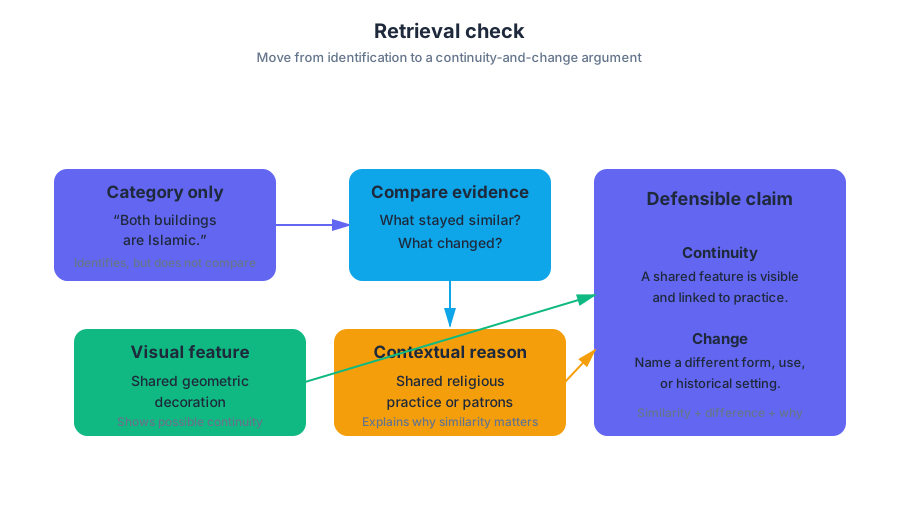
In one sentence, explain why “both buildings are Islamic” is not yet a continuity-and-change argument. Then add one visual feature and one contextual reason that would make the statement defensible.
Source Materials
- AP Art History Course and Exam Description
- AP Art History Course and Exam Description Clarifications and Corrections
- AP Art History Course Overview
- AP Art History Course at a Glance
- AP Art History Course at a Glance Poster
- Adopt AP Art History
- AP Art History
- AP Art History
- AP Art History-AP Students
- AP/College Art History-Khan Academy
- AP Art History-Wikipedia
- AP Art History-Smart History