From the free course AP Art History on Lykke
8.3 8.4 Theories and Interpretations of South, East, and Southeast Asian Art
Key concepts: Interactions within and across cultures in South, East, and Southeast Asian art · Theories and interpretations of Asian art · Cultural influence and adaptation in artistic traditions · The rock garden at Ryoan-ji as evidence of cross-cultural influence · The role of religion and philosophy in artistic practice · The ancient Indic worldview · Hinduism, Buddhism, Jainism, Sikhism, and folk religions · Narrative and iconographic compositions · Diverse media and ceramic techniques · The development and transmission of Buddhist imagery across Asia
A Japanese Zen rock garden can look intensely local while carrying ideas that traveled across Asia. The stones and raked gravel at Ryoan-ji are not simply “Japanese nature”; they are evidence of how artistic traditions are transmitted, selectively adopted, and transformed.
8.3 8.4 Theories and Interpretations of South, East, and Southeast Asian Art
A Japanese Zen rock garden can look intensely local while carrying ideas that traveled across Asia. The stones and raked gravel at Ryoan-ji are not simply “Japanese nature”; they are evidence of how artistic traditions are transmitted, selectively adopted, and transformed.
Culture as influence, adaptation, and transformation
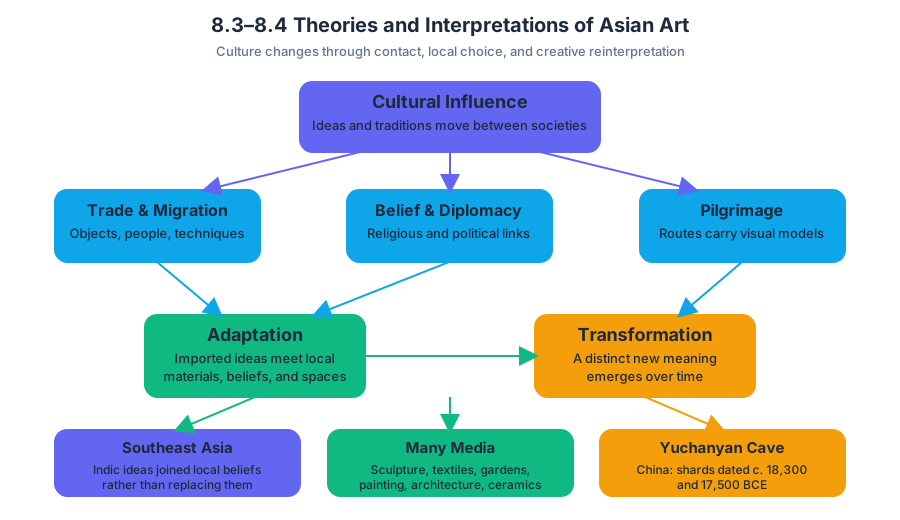
Cultural influence is the effect one society, belief system, or artistic tradition has on another. Influence does not mean that the receiving culture merely copies an outside model. Adaptation occurs when artists reshape imported ideas to fit local materials, beliefs, spaces, and audiences; transformation occurs when the result becomes meaningfully different from its earlier source.
South, East, and Southeast Asian art developed through interactions among many communities. Religious, cultural, and political influence moved through trade, migration, diplomacy, pilgrimage, and local adoption, with substantial regional variation. The Indic worldview, for example, was incorporated into preexisting animistic and popular beliefs in Southeast Asia rather than replacing every local tradition with a single Indian system.
The region’s artistic traditions also extend across many media: sculpture, textiles, wall painting, architecture, gardens, ink painting, and ceramics. Fired ceramic shards from Yuchanyan Cave in China, dated to approximately $18{,}300$ and $17{,}500$ BCE, demonstrate the deep antiquity of ceramic production in East Asia; they are important evidence for the region’s long material history, but their dates alone do not prove a particular cultural exchange.
Worked interpretation: the rock garden at Ryoan-ji
Begin with what can be observed: Ryoan-ji uses carefully arranged rocks set within expanses of raked gravel. The restricted palette, controlled composition, and absence of literal plants or buildings encourage contemplation rather than narrative viewing. Its identity as a Zen rock garden connects it to Buddhist practice and to a specifically Japanese setting.
Now separate evidence from inference. Zen Buddhism developed in East Asia through the broader transmission and reinterpretation of Buddhism, whose imagery and practices spread widely across Asia. The garden therefore reflects cross-cultural influence at the level of religious philosophy and contemplative practice. Yet its particular arrangement, materials, setting, and visual restraint are not a transparent copy of an earlier foreign artwork. They show local adaptation: an imported religious tradition became a Japanese garden form.
A strong argument would therefore claim that Ryoan-ji reflects substantial but transformed cultural influence. Evidence includes its association with Zen Buddhism, its use of a nonfigural environment for spiritual reflection, and its development within Japanese architectural and garden practice. The conclusion should avoid claiming that the garden is either wholly foreign or entirely isolated.
Key distinction: Similarity can suggest influence, but influence becomes more convincing when visual evidence is joined to historical evidence about transmission, shared religious ideas, or sustained contact.
The ancient Indic worldview and artistic practice
The ancient Indic worldview differentiated earthly and cosmic realms, recognized certain beings and places as sacred, and understood time and life as cyclic. This worldview shaped both the subjects artists represented and the forms used to make spiritual realities visible.
Major South Asian religious traditions—including Hinduism, Buddhism, Jainism, Sikhism, and numerous folk religions—developed within or alongside this worldview. These traditions sought spiritual development, spiritual release, or divine union through distinct religious methodologies and social practices. Because religious practice required spaces, images, and objects that could support those aims, it encouraged the development of novel artistic and architectural forms.
| Religious idea or practice | Artistic consequence |
|---|---|
| Sacred beings and teachers | Iconic figural images of divinities and revered teachers |
| Cosmic realms | Conceptual landscapes, ideal Buddhist worlds, and mandalas |
| Ritual and devotion | Shrines, temples, caves, stupas, and monastic complexes |
| Narrative teaching | Elaborate compositions in sculpture, textiles, and wall painting |
| Contemplative practice | Zen rock gardens and Zen ink painting |
These works are not merely illustrations of religious stories. In many settings, images could be venerated in temples or shrines, inhabit imagined cosmic landscapes, or function within mandalas. Buddhist imagery became especially widespread across Asia; the scale and variety of Buddhist art form a major body of religious art, comparable in richness to the Christian imagery of medieval Europe.
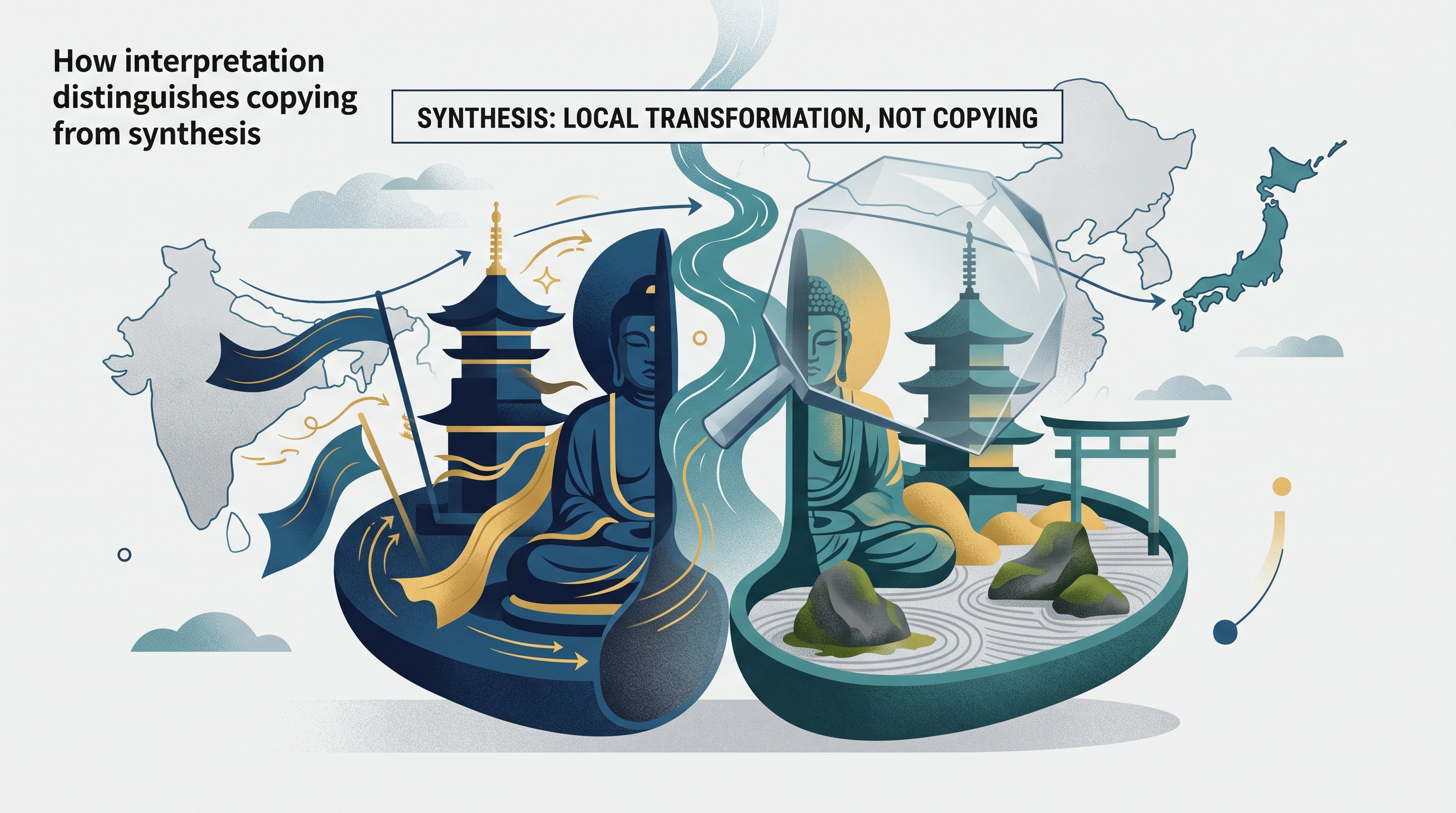
How interpretation distinguishes copying from synthesis
Contextual analysis asks what religious, political, social, and geographic conditions shaped an artwork. Comparison asks which features resemble another tradition and which features differ. Evidence-based interpretation then connects those observations into a defensible claim—for example, that Buddhist imagery traveled across Asia but changed in style, ritual use, and local meaning as communities adopted it.
A common misconception is “cultural influence equals cultural replacement.” Asian art instead often records layered histories: an imported religion may coexist with local beliefs; a foreign visual convention may acquire new symbolism; and an architectural form may be redesigned for a different climate, ritual, or audience. The most persuasive interpretation identifies both the transmitted element and the local transformation.
Misconception check: Calling Ryoan-ji “purely Japanese” ignores the transregional history of Zen Buddhism. Calling it “Chinese art in Japan” ignores the garden’s Japanese materials, composition, setting, and local use. The evidence supports cultural synthesis.
Retrieval check: In two sentences, argue whether Ryoan-ji is best described as borrowed, adapted, or transformed. Name one piece of visual evidence and one contextual piece of evidence. A complete response should identify Zen’s wider Asian transmission while explaining how the Japanese garden form gives that tradition a distinctive local expression.