From the free course AP Art History on Lykke
10.1 Course placement
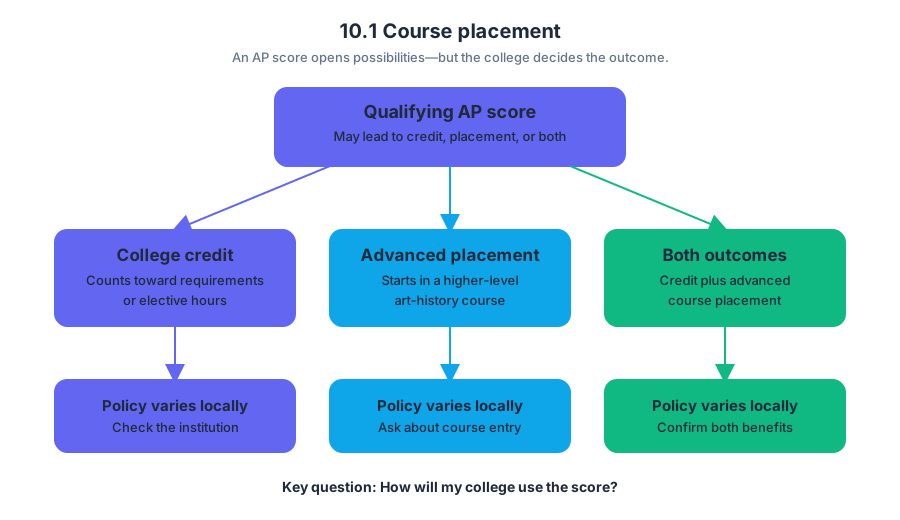
A qualifying AP Art History score may lead to college credit, advanced placement, or both, but the result depends on the policy of the specific college or university—not on the AP score alone.
10.1 Course placement
A qualifying AP Art History score may lead to college credit, advanced placement, or both, but the result depends on the policy of the specific college or university—not on the AP score alone.
The practical question is therefore not simply “What score did I earn?” but “How will my college use that score?” One institution might award course credit, another might place a student into a more advanced art-history course, and a third might grant neither. Placement policies are local decisions made by colleges and universities.
What “course placement” means
Course placement is the use of an AP Exam result to determine where a student begins in a college curriculum. Placement can operate in two different ways:
- Credit: The institution counts the AP result as equivalent to one or more college courses or credits.
- Advanced placement: The institution allows the student to begin in a higher-level course without taking an introductory requirement.
- Both: Some institutions award credit and also permit enrollment in an advanced course.
These outcomes are not interchangeable. A student may receive enough credit to reduce the number of required courses but still need to complete a department-specific art-history requirement. Conversely, a student may be placed into a more advanced course without receiving the same number of transferable credits.
How the decision is made
AP Exams are administered each year in May. After scores are released, colleges interpret them according to their published policies. Those policies commonly specify the minimum score accepted, the amount of credit awarded, and the course or placement level associated with that score.
A useful way to model the process is:
| Evidence | Institutional decision |
|---|---|
| AP Art History score | Whether the score meets the college’s threshold |
| College policy | Number or type of credits awarded |
| Departmental rules | Whether the student may skip an introductory course |
| Degree requirements | Whether the credit satisfies a particular graduation requirement |
The same score can therefore produce different results at two institutions. The AP Program provides score reporting and recommended policy information, but each college establishes its own credit and placement rules.
Worked example: one score, three policies
Imagine a student earns a qualifying score on the AP Art History Exam and applies to three colleges:
- College A awards introductory art-history credit. The student completes fewer total credits but must check whether the awarded credit fulfills a humanities requirement.
- College B grants no direct credit but permits enrollment in an upper-level art-history course. The student begins beyond the introductory course while still completing the department’s required number of courses.
- College C recognizes the score only as elective credit. The student receives credit toward graduation, but the credit may not replace a required course in the major.
The correct conclusion is not that one college is “using the AP score properly” and another is not. Each institution is applying its own academic policy. Students must inspect the policy for the college they plan to attend.
Finding an institution’s policy
The AP Credit Policy Search is the designated place to look up college and university policies. A student should verify at least three details:
- the minimum AP score accepted;
- the amount and kind of credit awarded; and
- whether the result produces advanced placement, course exemption, or both.
Policies can also distinguish among majors, departments, or degree programs. A credit that counts toward general graduation requirements may not automatically substitute for a required course in an art-history major.
Misconception check: “A qualifying score guarantees college credit”
Misconception: Every qualifying AP score automatically earns the same college credit everywhere.
Correction: A qualifying score makes a student typically eligible to receive credit, placement, or both, but the college or university determines the exact outcome. Always treat the institution’s current published policy as the controlling information.
Why the course’s college-level character matters
AP Art History is developed collaboratively by college faculty and experienced AP teachers. These committees help shape the course and exam, establish scoring standards, and connect the course with college-level expectations. College faculty also review AP teacher syllabi.
That structure explains why the exam can function as evidence for placement: students analyze art across cultures and time, investigate history and symbolism, and practice visual analysis and interpretation. The score is not itself a universal college transcript; it is evidence that an institution may evaluate under its own rules.
Retrieval check
A student earns a qualifying AP Art History score. What must the student still determine before assuming the score will replace a college course?
Answer: The student must consult the specific college’s AP credit policy to determine the minimum accepted score, the amount and type of credit, and whether the score provides credit, advanced placement, or both.

Source Materials
- AP Art History Course and Exam Description
- AP Art History Course and Exam Description Clarifications and Corrections
- AP Art History Course Overview
- AP Art History Course at a Glance
- AP Art History Course at a Glance Poster
- Adopt AP Art History
- AP Art History
- AP Art History
- AP Art History-AP Students
- AP/College Art History-Khan Academy
- AP Art History-Wikipedia
- AP Art History-Smart History