From the free course AP Art History on Lykke
1.3 Theories and Interpretations of Prehistoric Art
Key concepts: Theories and interpretations of prehistoric art · Function and meaning of prehistoric art · Artistic expression prior to written records · Art historical interpretation of works of art · Visual analysis of prehistoric artworks · Collaboration between art historians and social and physical scientists · Influence of other disciplines on art-historical scholarship · Impact of available technology on interpretation · Importance of available evidence · Great Hall of the Bulls at Lascaux and Stonehenge as suggested works
A painted animal on a cave wall cannot explain itself in words, yet it can preserve evidence of what mattered to people who left no written records.
1.3 Theories and Interpretations of Prehistoric Art
A painted animal on a cave wall cannot explain itself in words, yet it can preserve evidence of what mattered to people who left no written records. Prehistoric art therefore demands a special kind of reasoning: interpretation built from visible form, archaeological context, scientific evidence, and carefully stated uncertainty.
Enduring Understanding (THR-1): The study of art history is shaped by different theories and interpretations of art and art making that change over time. These interpretations arise from visual analysis and from scholarship influenced by other disciplines, available technology, and the availability of evidence.
The evidence problem: interpreting art without written records
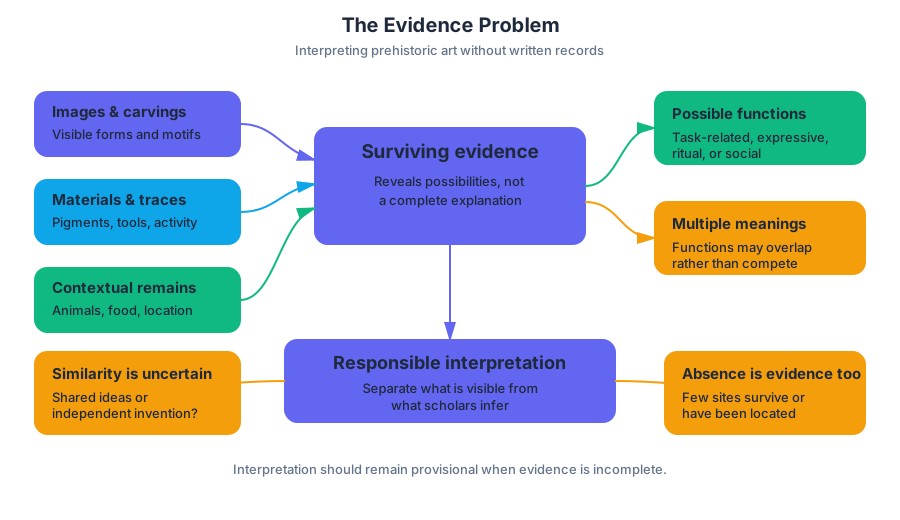
Artistic expression prior to written records survives unevenly. Paintings, carvings, monuments, tools, pigments, animal remains, food sources, and traces of human activity can reveal possibilities, but they rarely provide a complete explanation of function or meaning. The function of an image may have been task-related, expressive, ritual, social, or several of these at once.
The small number of surviving and located prehistoric monuments creates a major limitation: similarity or difference in form may result from shared ideas, independent invention, environmental conditions, or missing evidence. A responsible interpretation distinguishes between what the work visibly demonstrates and what scholars infer from it.
A collaborative method
THR-1.A.1: Over time, knowledge of global prehistoric art has developed through collaboration between art historians and social and physical scientists. Archaeologists study excavation contexts and human activity; physical scientists analyze materials, dates, residues, and environmental evidence; social scientists contribute models for understanding behavior, community, ritual, and cultural transmission.
THR-1.A.2: Ongoing archaeological excavations and the use of carbon-14 dating have illuminated interconnections among prehistoric artworks across the world. Carbon-14 dating estimates the age of once-living organic material, such as charcoal, but it does not automatically explain an image’s meaning. Scientific dating can establish when something was made; visual and contextual analysis must still address why it may have been made.
THR-1.A.3: The function of prehistoric artistic expression can be inferred from evidence of technology, survival strategies, available food sources, cultural development, and humans’ capacity to shape and manage their environment. These clues become more useful when combined rather than treated as isolated proof.
THR-1.A.4: Art historians apply familiar methods to prehistoric art by comparing imagery, materials, and techniques to identify patterns—for example, the recurrence of transformational animal-human imagery—and then considering ethnographic approaches. Ethnography compares cultural practices, but comparisons must be used cautiously: no living society can be treated as a direct, unchanged substitute for a prehistoric one.
Worked interpretation: the Great Hall of the Bulls at Lascaux
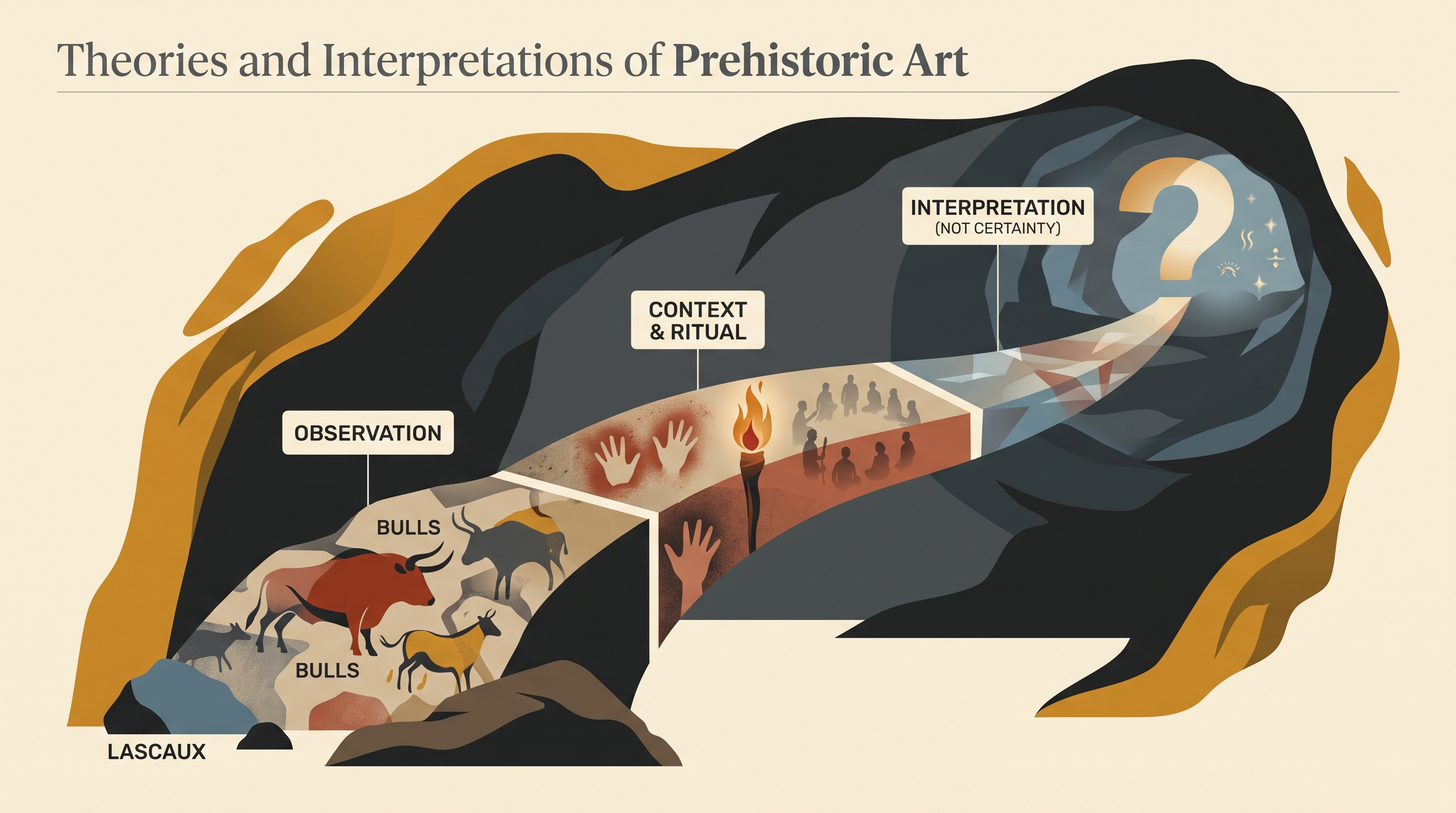
The Great Hall of the Bulls (Lascaux) contains large, overlapping animal images arranged across a cave surface. Visual analysis identifies the dominant content—animals—along with their scale, placement, movement, and relationship to the irregular wall. These features support interpretation, but they do not prove a single purpose.
A scholar might argue that the cave images had expressive or ritual significance because the underground setting, difficult access, and concentration of imagery distinguish them from ordinary task-related marks. Another interpretation might emphasize teaching, storytelling, social identity, or repeated ceremonial use. The strongest claim connects evidence to inference: the setting and visual concentration suggest that the images were more than casual decoration, while the absence of written explanation prevents certainty about the exact ritual or narrative meaning.
This is the complete reasoning chain: observation—large animal figures occupy a cave environment; context—the images survived in a non-domestic underground space; interpretation—the setting may have encouraged collective, ceremonial, or expressive activity; qualification—the evidence cannot establish one universally correct explanation.
Worked interpretation: Stonehenge
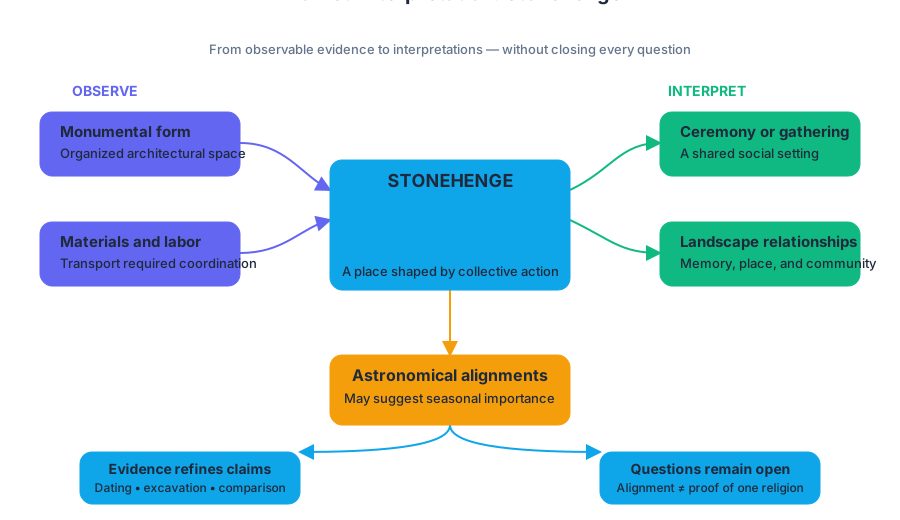
Stonehenge demonstrates why a prehistoric work can be interpreted through form, materials, function, context, reception, and meaning. Its monumental arrangement of stones creates a carefully organized architectural space rather than a portable object. The labor required to transport and position the stones indicates collective planning and social coordination.
Those observations support interpretations involving ceremony, gathering, commemoration, or relationships between communities and the landscape. Astronomical alignments may contribute to interpretations of seasonal or calendrical importance, but alignment alone does not prove a specific religious system. Archaeological evidence, dating, excavation, and comparison with related monuments can refine the argument while leaving some questions unresolved.
The skills that make an interpretation defensible
This topic most directly activates the following official skills: Skill 1: Visual Analysis, identifying form, style, materials, technique, and content; Skill 2: Contextual Analysis, connecting a work to technology, environment, survival, and cultural conditions; Skill 3: Comparison of Works of Art, recognizing patterns and differences among prehistoric works; Skill 7: Art Historical Interpretations, explaining how scholars construct and revise interpretations; and Skill 8: Argumentation, supporting a claim with specific, relevant evidence and acknowledging limits.
A high-quality response does not merely label Lascaux “ritual” or Stonehenge “religious.” It explains which visual or contextual evidence makes that interpretation plausible, identifies what another discipline contributes, and recognizes how new technology or newly discovered evidence could change the conclusion.
Misconception check
Misconception: “If a prehistoric image shows an animal, its meaning is obvious.” Correction: recognizable subject matter is only one part of interpretation. Meaning depends on placement, scale, repetition, materials, access, surrounding evidence, cultural comparison, and the limits of surviving information.
Retrieval check: Explain one interpretation of the Great Hall of the Bulls or Stonehenge. Name two specific pieces of visual or contextual evidence supporting it, then state one reason the interpretation remains conjectural.
Source Materials
- AP Art History Course and Exam Description
- AP Art History Course and Exam Description Clarifications and Corrections
- AP Art History Course Overview
- AP Art History Course at a Glance
- AP Art History Course at a Glance Poster
- Adopt AP Art History
- AP Art History
- AP Art History
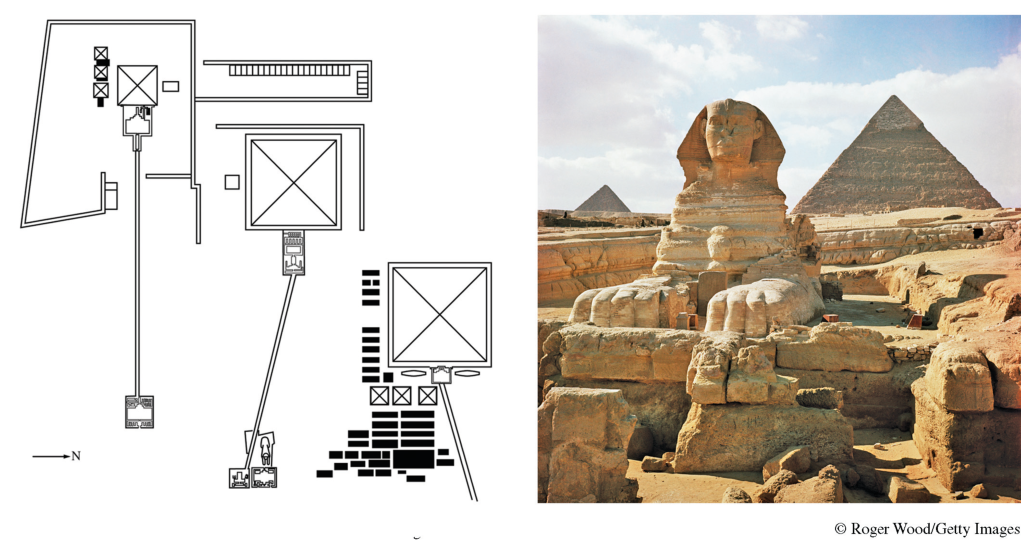
- 4. The images show a plan and a view of the Great Pyramids (Menkaura, Khafre, Khufu) and Great Sphinx of Giza, Egypt, created circa 2550–2490 B.C.E. in Old Kingdom Egypt.