From the free course AP Art History on Lykke
9.3 Theories and Interpretations of Pacific Art
Key concepts: Theories and interpretations of art change over time · Visual analysis as a basis for art-historical interpretation · Scholarship and the influence of other disciplines · Technology and availability of evidence in shaping interpretations · Pacific art as an expression of societal beliefs and social relations · Artworks as essential truths or compendia of information held by designated members of society · Social hierarchy in Pacific art · Ceremonial performance and sensory-rich ceremonial exchange · Systems of exchange and social order · The significance of creation, performance, and destruction of masks and costumes
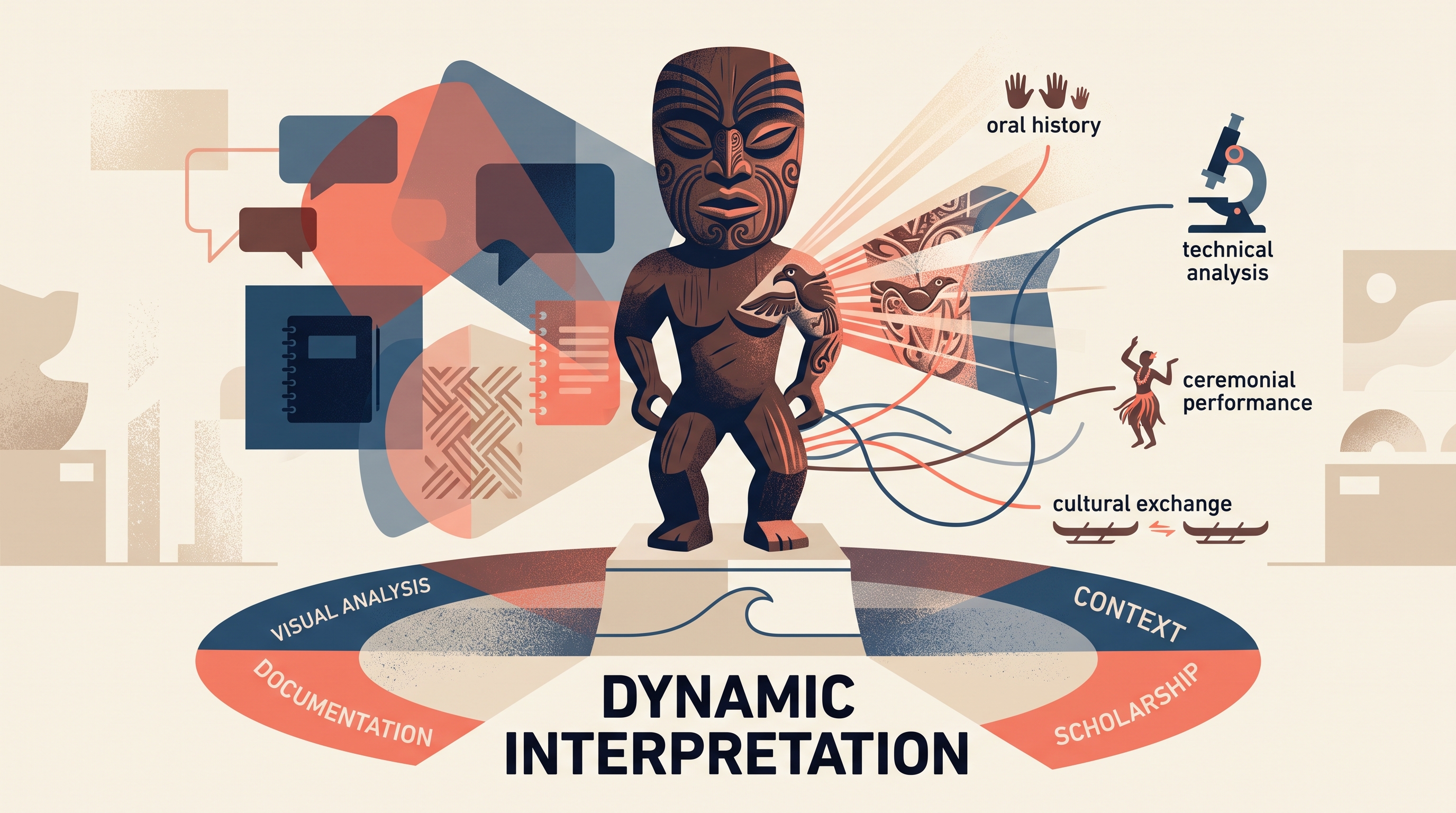
A Pacific mask may be understood not as a permanently complete object but as part of a sequence: its creation, appearance in performance, evocation of ancestral memory, and eventual destruction can all communicate meaning.
9.3 Theories and Interpretations of Pacific Art
A Pacific mask may be understood not as a permanently complete object but as part of a sequence: its creation, appearance in performance, evocation of ancestral memory, and eventual destruction can all communicate meaning. The central question is therefore not only What does this object look like? but also What did it do, for whom, and under what conditions did its meaning become visible?
THR-1.A: Explain how theories and interpretations of works of art are shaped by visual analysis as well as by other disciplines, technology, or the availability of evidence.
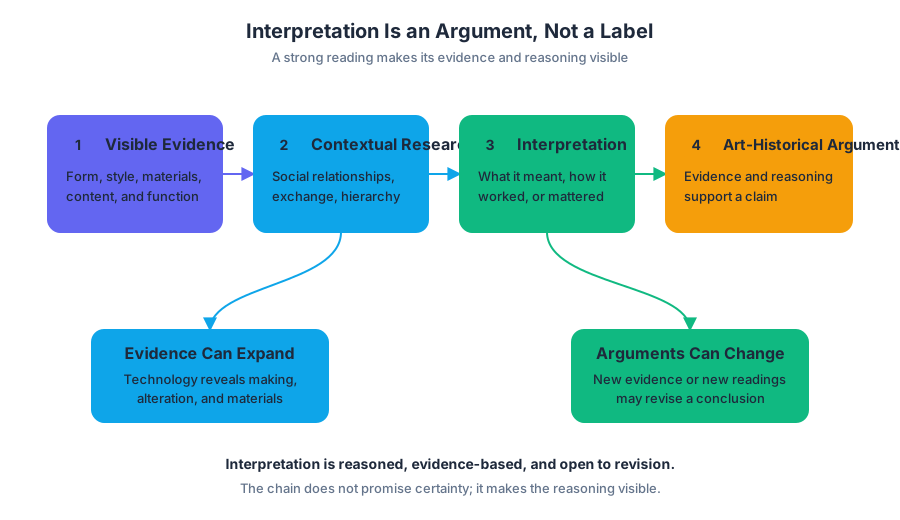
Interpretation is an argument, not a label
An art-historical interpretation is an explanation of what an artwork means, how it functioned, or why it mattered in its society. Interpretations begin with visual analysis—careful attention to form, style, materials, content, and function—but they are also shaped by scholarship from other disciplines, available technology, and the evidence that survives.
A scholar might first observe the repeated forms, materials, or visual signs of a Pacific object. Anthropological research may then clarify social relationships; historical research may identify systems of exchange or ceremonial hierarchy; technological analysis may reveal how the object was made or altered. If new evidence appears—or if older evidence is reinterpreted—the art-historical argument may change.
The reasoning process can be pictured as a chain:
Visible evidence → contextual research → interpretation → art-historical argument
The arrow does not mean that interpretation becomes perfectly certain. It means that a strong interpretation makes its evidence and reasoning visible.
Why interpretations change over time
THR-1.A.26 establishes that theories and interpretations of art and art making change over time. They may be generated through visual analysis and through scholarship, then used, adapted, or even manipulated to make an argument about one work or a group of works.
This change is not automatically a weakness. Earlier scholars may have worked with limited documentation, misunderstood the social role of an object, or treated a performance object as if it were designed only for permanent display. Later researchers may gain access to oral histories, new technical methods, additional comparative evidence, or interpretations from disciplines that were previously absent.
Key distinction: A changed interpretation is not necessarily a changed artwork. The object, performance, or historical event may remain the same while the evidence and questions brought to it change.
Misconception check — “The first interpretation must be the original meaning.” Not necessarily. A modern museum label or early scholarly account is itself an interpretation. Art historians must ask who produced it, what evidence it used, and what evidence may have been unavailable.
Pacific art, social knowledge, and essential truths
Under THR-1.A.26, the arts of the Pacific can express beliefs, social relations, and essential truths. They may also function as compendia of information—concentrated bodies of knowledge—held by designated members of society. Meaning is therefore connected to authority: particular people may be responsible for preserving, interpreting, performing, or transmitting knowledge.
Pacific art is integrated with social hierarchies, ceremonial performances, systems of exchange, and social order. Its purpose and patronage cannot be separated from these relationships. Asking Who commissioned, owned, controlled, performed, or received this work? can reveal why its materials, appearance, and use mattered.
Creation, performance, and destruction
THR-1.A.27 emphasizes that acts of creation, performance, and even destruction can carry meaning. A mask or costume may communicate through its appearance during a ceremony, through the actions of the performer, and through the memories of cultural heroes or ancestors evoked by its forms.
Consider a hypothetical ceremonial mask. Its makers create it for a particular event; a designated performer activates it through movement and appearance; the audience recognizes ancestral or heroic associations; and the mask is later destroyed. The destruction does not simply erase meaning. It can produce a new iteration of memory, because the object’s disappearance becomes part of the cultural event.
The same object could therefore carry different meanings at different moments:
| Moment | What an interpretation must consider |
|---|---|
| Creation | Materials, makers, authority, and intended occasion |
| Performance | Movement, audience, ceremony, and evoked memory |
| Destruction | Ritual purpose, transformation, and the survival of memory |
The crucial caveat is context. Creation, performance, and destruction do not have one universal meaning. Their significance depends on the time, social setting, participants, and purpose of the object’s appearance.
Applying the AP skills
7.A: Describe art-historically relevant interpretations. A strong response identifies an interpretation that explains meaning, function, social relations, or reception—not merely an opinion such as “the mask is interesting.”
7.B: Explain how interpretations are derived from an analysis of a work’s form, style, materials, content, function, context, reception, and/or meaning. This skill requires the connective step: identify evidence, then explain how that evidence supports the interpretation.
For example: The object’s significance may extend beyond its physical form because its performance activates ancestral memory; its meaning is therefore connected to ceremony, designated cultural knowledge, and the social context of its appearance. The sentence earns analytical force by linking interpretation to function, context, and meaning.
Retrieval check
A Pacific object is newly documented through technical evidence and oral testimony. Explain why its interpretation might change, and identify one way its creation, performance, or destruction could communicate meaning. A complete answer should name visual analysis, connect the interpretation to evidence or scholarship, and explain the object’s social or ceremonial context.