From the free course AP Art History on Lykke
AP Practice 6
A strong art-historical argument does more than identify an artwork: it makes a defensible claim and proves that claim with visual and contextual evidence. In the exam’s extended argumentation task, the highest-scoring response behaves like a compact museum-label essay with a thesis, evidence, and reasoning—not a…
AP Practice 6
A strong art-historical argument does more than identify an artwork: it makes a defensible claim and proves that claim with visual and contextual evidence. In the exam’s extended argumentation task, the highest-scoring response behaves like a compact museum-label essay with a thesis, evidence, and reasoning—not a list of memorized facts.
Task: Build an Argument from Multiple Works
Original unofficial practice prompt
Choose two works of art from different cultures or historical periods that demonstrate how art can legitimize political or religious authority. For each work, explain one visual feature and one contextual factor that support your argument. Then explain one important difference in the way the two works communicate authority.
You may use works from the required course content, including the Great Mosque of Córdoba, the Hagia Sophia, the Rani ki Vav, The Augustus of Prima Porta, or another appropriate work you know accurately. Your response should make a claim that connects both works rather than treating them as two unrelated identification exercises.
The reasoning pipeline
| Move | What you do | What it sounds like |
|---|---|---|
| Claim | Answer the prompt directly | “Monumental art legitimizes authority by making power appear permanent and cosmically ordered.” |
| Visual evidence | Point to a visible feature | “The repeated horseshoe arches create a seemingly endless visual rhythm.” |
| Contextual evidence | Explain historical, religious, or political circumstances | “The mosque’s expansion was connected to Córdoba’s status as the capital of the Umayyad caliphate.” |
| Reasoning | Show why the evidence proves the claim | “The scale and repetition make the ruler’s religious and political order seem stable rather than temporary.” |
| Comparison | Explain a meaningful difference | “Unlike the mosque’s repeated spatial rhythm, the Augustus uses a single idealized body to concentrate authority in one ruler.” |
This sequence develops the official art-historical thinking skills 7.A Develop a defensible thesis, 7.B Support an argument using specific evidence, and 7.C Explain how evidence supports an argument. It also draws on 1.B Describe visual elements, 1.C Explain how artistic decisions shape meaning, 2.A Identify contextual elements, 2.B Explain how context shapes meaning, and 4.B Explain relevant similarities and differences among works of art.
Worked example: Córdoba and Augustus
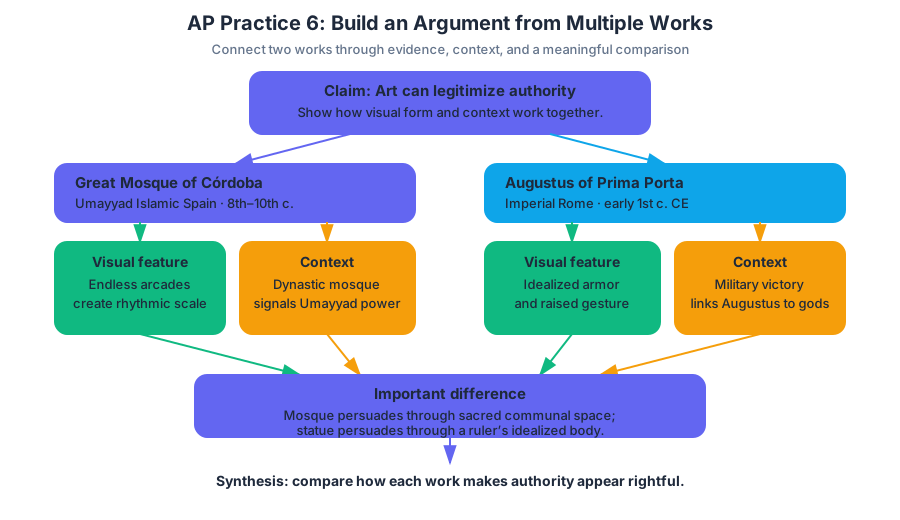
Thesis: The Great Mosque of Córdoba and the Augustus of Prima Porta both legitimize authority by linking political power to an order larger than any individual ruler, but the mosque achieves this through collective sacred space while the Roman statue concentrates authority in the idealized body of one emperor.
The Great Mosque of Córdoba supports this claim visually through its forest of columns and alternating red-and-white voussoirs, or wedge-shaped arch stones. The repeated arches produce a rhythmic interior that seems to continue beyond the viewer’s immediate sight. Contextually, the mosque functioned within Umayyad Córdoba, a major Islamic political and cultural center. Its monumental scale and ordered repetition present religious and dynastic power as expansive, organized, and enduring.
The Augustus of Prima Porta communicates authority differently. Augustus stands in a commanding contrapposto pose and wears decorated armor, while his raised arm suggests public address or command. Cupid at his feet connects the emperor to Venus and therefore to a divine genealogy associated with Julius Caesar and the Julian family. The statue does not make authority feel anonymous or collective; instead, it presents Augustus as the ideal individual whose body, ancestry, military success, and divine associations justify rule.
The difference matters because the two works use different audiences and experiences. A visitor inside the mosque encounters authority through movement, repetition, and communal worship. A viewer facing Augustus encounters authority through a recognizable political body that combines military achievement with divine ancestry. In both cases, artistic form turns power into something that appears natural, ordered, and worthy of obedience.
Why this response earns credit
- Thesis: The opening makes a clear, defensible claim and establishes a difference between the works.
- Specific visual evidence: The response identifies the mosque’s arches, columns, and color pattern, then identifies Augustus’s pose, armor, raised arm, and Cupid.
- Specific contextual evidence: It connects Córdoba to the Umayyad caliphate and Augustus to Roman imperial ideology and Julian divine ancestry.
- Reasoning: Each evidence point is followed by an explanation of how form and context create authority.
- Comparison: The answer explains a consequential difference—collective sacred space versus individualized ruler imagery—rather than merely saying the works are “different.”
A sophisticated response may also acknowledge that authority is not communicated identically to every viewer. The mosque’s meaning depends on religious participation and spatial experience, while Augustus’s message depends more heavily on imperial imagery, public display, and the viewer’s recognition of Roman political symbols.
Common misconception check: “More facts means a stronger argument”
Misconception: A response earns the most credit by naming as many dates, rulers, materials, and religious terms as possible.
Correction: Facts become evidence only when the writer explains their relevance. “Augustus ruled after the Roman Republic” is contextual information; “the statue’s idealized body presents Augustus as permanently youthful, making imperial authority appear stable beyond ordinary human aging” is contextual evidence connected to an argument.
Timing and error review
For a longer argumentation task, reserve approximately 30 minutes: spend 3–4 minutes selecting works and drafting a claim, 20–22 minutes writing, and 4–5 minutes checking evidence and reasoning. Before submitting, underline your thesis mentally, circle each specific visual detail, and ask after every fact: Have I explained how this proves my claim?
Retrieval check: If your thesis says that a work makes authority appear “permanent,” name one visual feature that could support that idea and explain the connection in one sentence. A correct answer must include both the feature and the meaning it produces.

Source Materials
- AP Art History Course and Exam Description
- AP Art History Course and Exam Description Clarifications and Corrections
- AP Art History Course Overview
- AP Art History Course at a Glance
- AP Art History Course at a Glance Poster
- Adopt AP Art History
- AP Art History
- AP Art History
- AP Art History-AP Students
- AP/College Art History-Khan Academy
- AP Art History-Wikipedia
- AP Art History-Smart History