From the free course AP Art History on Lykke
7.3 Interactions Within and Across Cultures in West and Central Asian Art
Key concepts: Cultural interaction and exchange across West and Central Asia · Continuity and change within artistic traditions · Islamic religious art and its shared visual characteristics · Persianate artistic influence · The influence of West and Central Asian art on Ottoman and Mughal art · Trade networks as channels for cultural transmission · Monsoon-based maritime trade across Asia · The relationship between figural art and religious contexts · International trade and cultural influence in Islamic art · Using comparisons and interpretations to make art-historical arguments
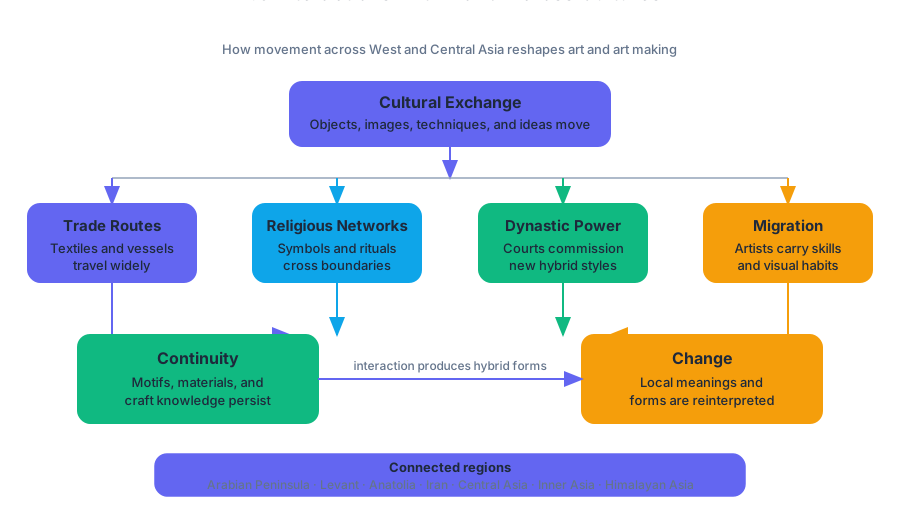
A textile, ceramic vessel, or metal basin could travel farther than the artist who made it. Across West and Central Asia, trade routes, religious networks, dynastic power, and migration carried not only objects but also images, techniques, and ideas.
7.3 Interactions Within and Across Cultures in West and Central Asian Art
A textile, ceramic vessel, or metal basin could travel farther than the artist who made it. Across West and Central Asia, trade routes, religious networks, dynastic power, and migration carried not only objects but also images, techniques, and ideas. The central question is therefore: when an artistic tradition crosses a cultural boundary, what remains continuous—and what changes?
Learning Objective INT-1.A: Explain how interactions with other cultures affect art and art making.
The arts of West and Central Asia connect European and Asian peoples through cultural interchange. This broad zone includes the Arabian Peninsula, the Levant, Anatolia, Greater Iran, Central Asia, Inner Asia, and Himalayan Asia—regions historically linked by routes often associated with the Silk Route.
Islam and shared artistic traditions
Islam originated in West Asia during the seventh century CE and shaped religious arts across traditional Islamic lands. Islamic art is not one uniform style, but works from different regions often share visual characteristics such as calligraphy, geometric pattern, vegetal ornament, emphasis on surface design, and architectural spaces organized for communal worship.
The Great Mosque, or Masjid-e Jameh, is a major example of Islamic religious architecture from West Asia. Its importance lies not simply in its appearance but in how mosque architecture developed through interaction: local building traditions, Islamic religious requirements, regional materials, and changing dynasties all contributed to its form.
Key distinction: Shared characteristics do not prove that every Islamic work was made in the same place or for the same audience. Similarity may result from shared religious practice, trade, political authority, artistic migration, or the adaptation of an older local tradition.
Persianate influence: continuity through adaptation
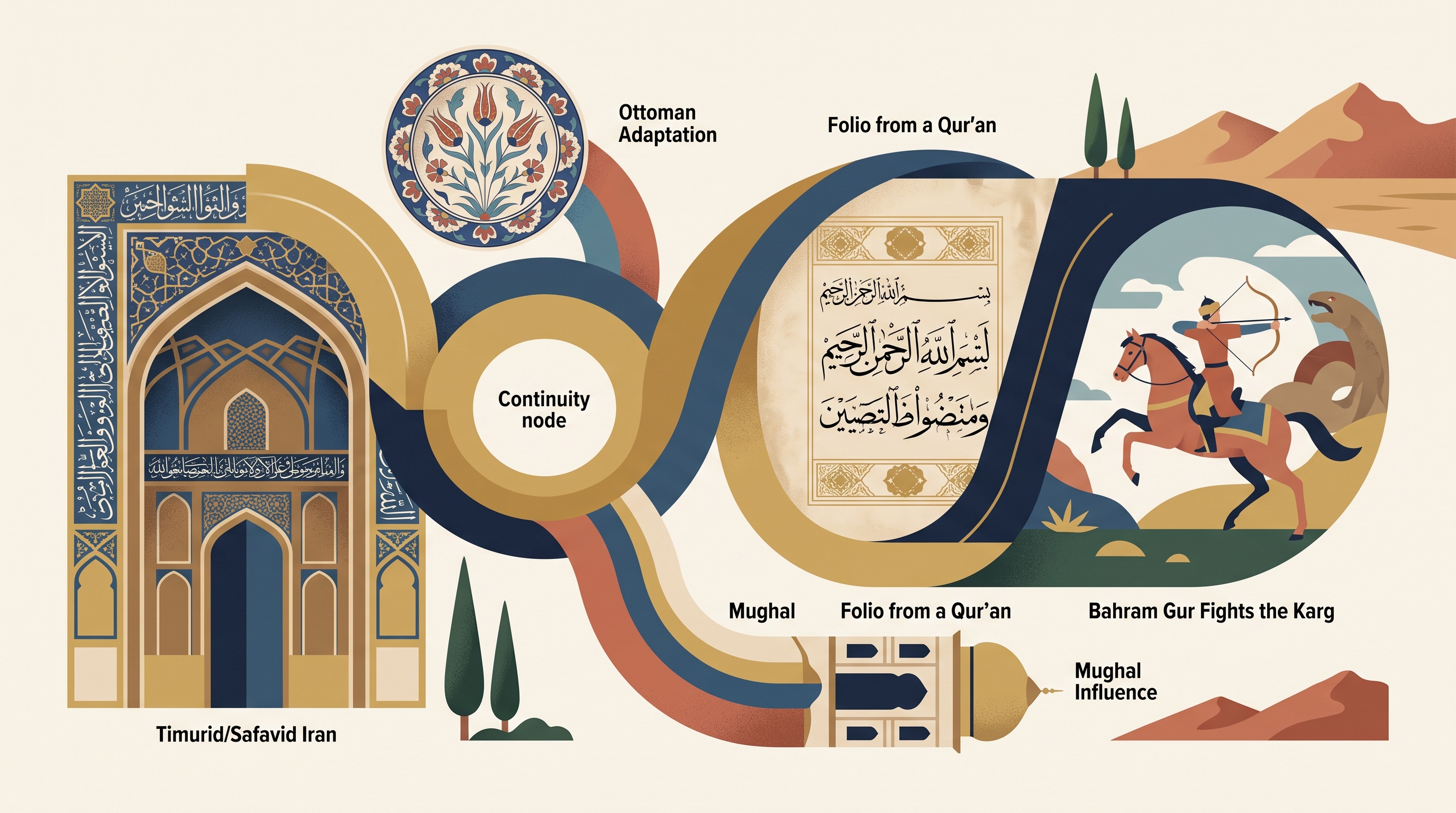
West Asian art found a major source of refinement and international influence in the Persianate arts associated with the Timurid and Safavid dynasties of Iran. These traditions influenced Ottoman arts in Turkey and Mughal arts in India, demonstrating that cultural interaction can preserve an artistic language while changing its setting, users, and meanings.
A useful comparison is between the Folio from a Qur’an and Bahram Gur Fights the Karg. The Qur’an folio emphasizes the sacred power of written language through carefully organized calligraphy and ornament. The Bahram Gur image, by contrast, uses figural representation to narrate a secular or literary episode. Both belong to Persianate visual culture, but their imagery and functions differ.
This contrast corrects a frequent misconception: Islamic art does not universally prohibit figural imagery. The use of figural art varies by tradition and context. Figural imagery is common in secular art across West and Central Asia, while religious contexts may favor calligraphy, ornament, and nonfigural design—or may incorporate figures in particular traditions.
Trade networks as artistic transmission systems
Seasonal monsoon winds connected North Africa, West Asia, South Asia, Southeast Asia, and southern China. These maritime networks moved textiles, ceramics, metalwork, and religious and artistic ideas. Borobudur Temple and Angkor exemplify the broader Asian cultural networks made possible by sustained interaction and exchange.
The source identifies textiles as perhaps the most important traded art form in the region. Islamic metalwork, including objects with figural imagery and even Christian subject matter, also circulated through international trade between Europe and Asia. Turkish Iznik wares provide another example: ceramics became both regional products and globally exchanged objects.
| Transmission channel | Artistic consequence |
|---|---|
| Monsoon-season trade | Movement of objects, techniques, and motifs across Asian ports |
| Silk Route connections | Exchange linking the Greco-Roman world, West Asia, Central Asia, and China |
| Dynastic courts | Refinement and political spread of Persianate styles |
| Religious networks | Repetition and adaptation of mosque forms, calligraphy, and ornament |
| International markets | Production of metalwork, textiles, and ceramics for foreign buyers |
Central Asian styles can be analyzed as either Persianate Islamic styles, which maintain developments from West Asian art, or Indian-inspired styles, characterized by idealized figural traditions from South Asia. This distinction is not a rigid geographic boundary; it is a way to track which visual traditions an artwork adapts.
Worked contextual example: tracing influence
Suppose an unfamiliar court painting combines Persianate courtly refinement with idealized South Asian figures. Begin with visual evidence: identify the delicate line, patterned surface, literary subject, or courtly setting. Then make the contextual argument: the work may reflect the movement of Persianate arts from Timurid or Safavid Iran into Mughal India, where imported conventions were adapted to Indian-inspired figural traditions.
The strongest explanation separates continuity from change: continuity appears in the inherited Persianate style; change appears in the new figures, local context, patronage, or function. Interactions with other cultures therefore affect styles, meanings, and functions—not merely decoration.
Misconception check
Misconception: “Cultural influence means passive copying.” In art history, influence is usually selective. Ottoman and Mughal artists did not simply duplicate Iranian works; they transformed Persianate conventions within their own political, religious, and regional environments.
Retrieval check
A metal vessel with figural imagery is found in a Mediterranean collection. Name two explanations for why it might reflect West and Central Asian cultural interaction, and identify one feature that could distinguish a Persianate Islamic style from an Indian-inspired style. A complete answer should connect visual evidence to trade, dynastic influence, or adaptation—not rely on geography alone.