From the free course AP Art History on Lykke
4.3 Materials, Processes, and Techniques in Later European and American Art
Key concepts: Materials, processes, and techniques · Artistic decisions about form and style · Visual elements, including linear and atmospheric perspective · The effects of technological advances on artmaking · Photography as an artistic medium · The use of new materials and techniques · Collaboration in artistic practice · The relationship between materials, technique, and meaning
A work of art’s material is never merely its substance: marble, steel, film, fiber, wood, and electronic circuitry each make some forms and meanings possible while resisting others.
4.3 Materials, Processes, and Techniques in Later European and American Art
A work of art’s material is never merely its substance: marble, steel, film, fiber, wood, and electronic circuitry each make some forms and meanings possible while resisting others.
MPT-1: Materials, processes, and techniques shape how art is made, what it looks like, and what it can communicate.
The official learning objective MPT-1.A asks you to explain how materials, processes, and techniques affect art and art making. The central AP skill is 1.C: Explain how artistic decisions about form, style, materials, technique, and/or content shape a work of art (or group of related works of art). Attribution also matters: 6.A: Attribute a work of art to a specific artist, culture, art historical style, or object type from the image set, and 6.B: Justify an attribution of a work of art by explaining similarities with work by a specific artist, culture, art historical style, or object type from the image set.
Perspective: technique turns space into an argument
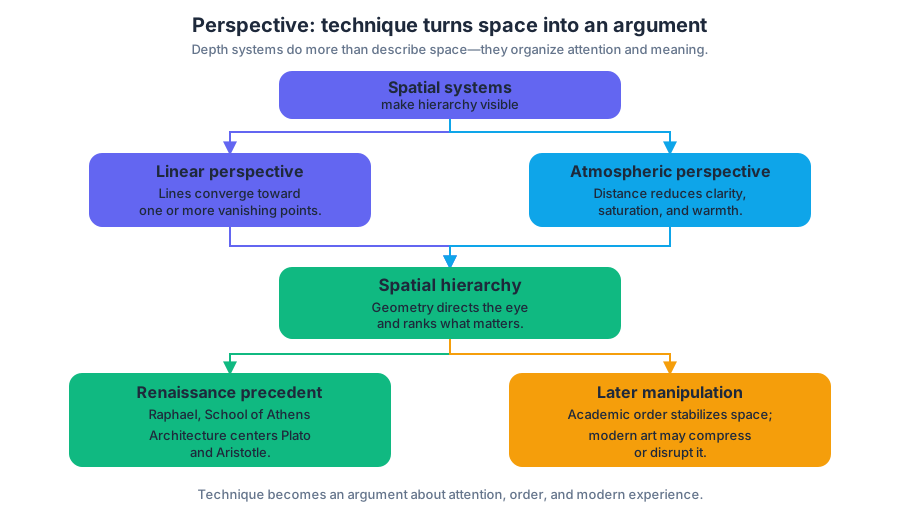
Linear perspective constructs depth through lines that appear to converge toward one or more vanishing points. Atmospheric perspective suggests distance through optical changes: faraway forms become less distinct, less saturated, and often lighter or cooler in color.
Raphael’s School of Athens is a Renaissance precedent rather than a central later-European example, but it makes the technical principle visible: architectural lines organize the figures around a deep, coherent space, while the arrangement directs attention toward Plato and Aristotle. The technique is not decorative; it converts geometry into intellectual hierarchy.
In later European and American art, artists increasingly treated perspective as something to manipulate rather than simply obey. A useful comparison is a nineteenth-century academic image that stabilizes space through orderly recession versus a modern work that compresses, fragments, or flattens space. The exam-worthy claim is not “the artist used perspective,” but how the chosen spatial system changes the viewer’s experience and the work’s meaning.
Photography: technology changes what counts as a visible moment
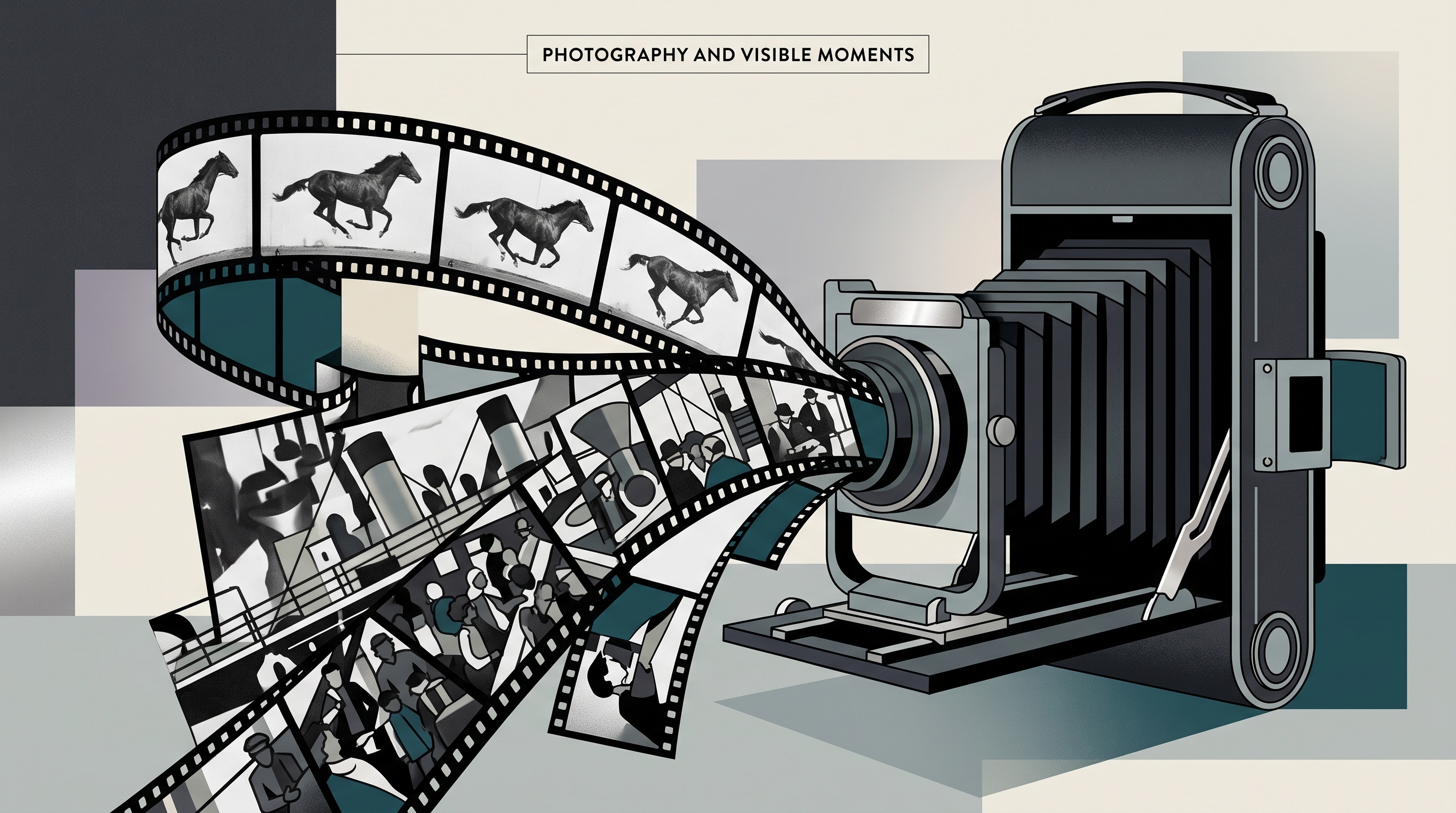
Mid-nineteenth-century technological advances transformed photography by making images faster, more reproducible, and more capable of recording fleeting events. Photography could now investigate movement and modern life rather than merely imitate the stillness of conventional portraiture.
Eadweard Muybridge’s The Horse in Motion uses sequential photographic images to isolate phases of a gallop that the unaided eye cannot clearly separate. The process makes photography an instrument of evidence and analysis: the camera reveals movement by dividing time into visible units.
Alfred Stieglitz’s The Steerage demonstrates a different photographic possibility. Its crowded composition, strong diagonals, and contrasts between passengers on different levels make the arrangement of bodies, machinery, and space visually compelling. Photography here is not only mechanical recording; framing and selection create an artistic form.
Misconception check — “A photograph is objective because a camera made it.”
The camera records light, but the photographer determines position, timing, framing, focus, and what remains outside the image. The Horse in Motion emphasizes sequential analysis; The Steerage emphasizes formal organization and social observation.
Material determines form: sculpture and architecture
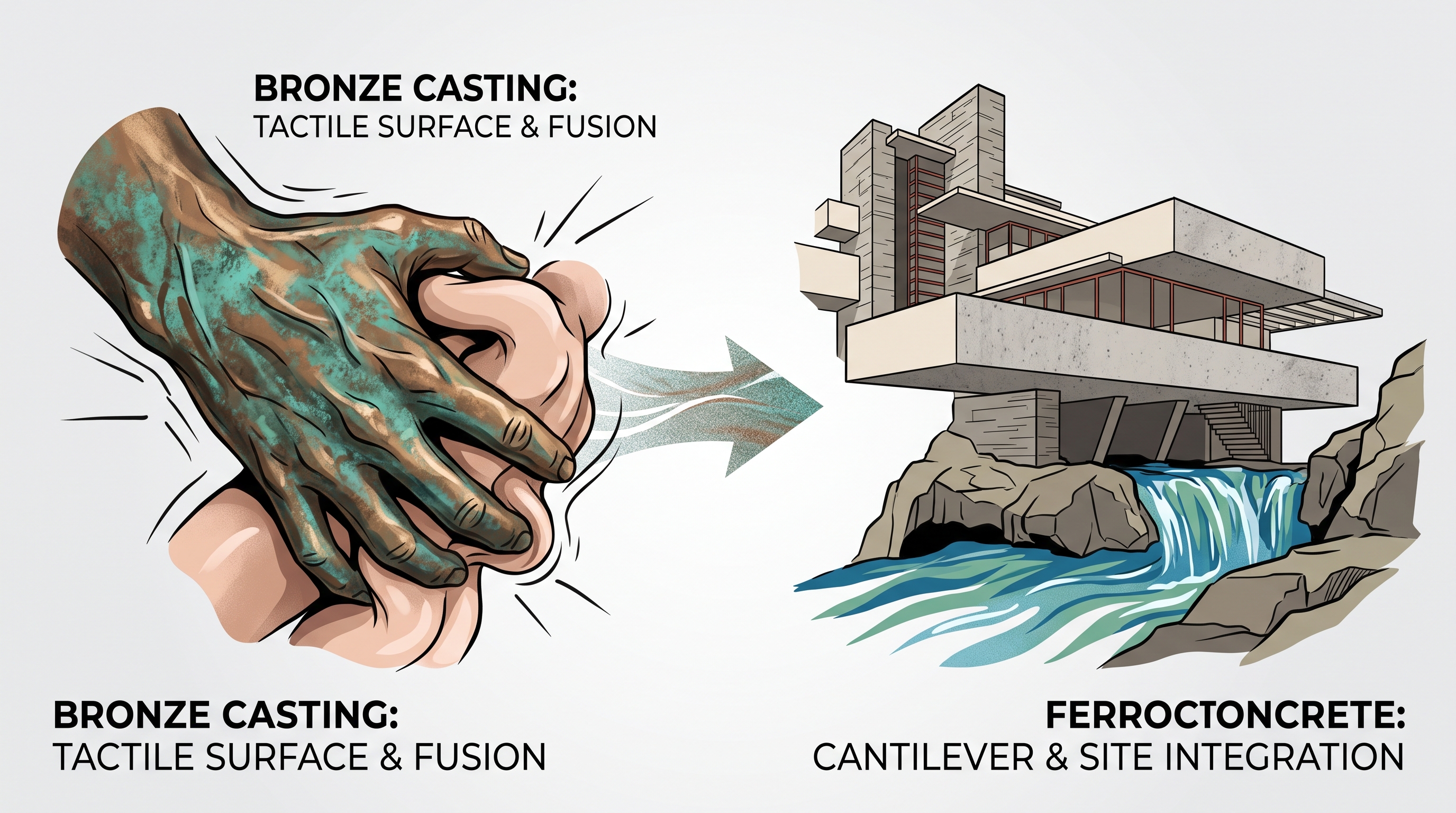
Auguste Rodin’s The Kiss shows how material and technique affect form. Carving requires the artist to remove material from a solid block, while the modeled and cast bronze process allows a surface to preserve gestures, textures, and the evidence of manipulation. The bodies’ interlocking forms and tactile surfaces make physical intimacy feel active rather than diagrammatically perfect.
A strong 1.C response connects the visible effect to the process: the treatment of the surface and the handling of the bodies intensify sensation, while the medium supports a sculptural emphasis on touch, volume, and movement. Do not stop at “it is made of bronze”; explain what the material and technique permit the viewer to see or feel.
Frank Lloyd Wright’s Fallingwater demonstrates the same principle in architecture. Its cantilevered concrete terraces extend over the waterfall, while stone, glass, and concrete coordinate the building with its rocky site. The structure is not simply placed in nature: its materials and construction techniques make the experience of inhabiting the landscape part of the design.
Essential knowledge MPT-1.A.11 connects technological change to architecture: advances such as the steel frame, ferroconcrete construction, and cantilevering hastened building construction, encouraged skyscrapers, and contributed to an international architectural style. The broader lesson is that new structural materials can change not only surface appearance but also the scale, height, and spatial possibilities of buildings.
Manipulated materials and new media
Artists carve, cast, weave, assemble, fire, bend, and otherwise manipulate wood, ivory, metals, ceramic, fiber, and elements of nature. Each process leaves clues: a carved surface records subtraction, a cast object records a mold, fired ceramic records heat, and woven fiber records repeated interlacing. These clues can support 6.A and 6.B attribution when they align with a known artist, culture, style, or object type.
Textiles are not automatically secondary to painting or sculpture. The Bayeux Tapestry is a useful earlier precedent for how fiber, stitching, sequence, and narrative can work together, but later European and American art continues this material logic in modern textile practices. Its inclusion is technical rather than chronological: the medium demonstrates that cloth can construct images, movement, memory, and historical claims.
Electronic media extend this question into the contemporary world. Nam June Paik’s Electronic Superhighway uses television monitors, video signals, electronic components, and spatial installation as artistic materials. The work’s meaning depends on the technology itself: electronic communication becomes both subject and medium, turning a networked image of the United States into an environment the viewer physically encounters.
Worked interpretation
Suppose an unknown work combines steel supports, projecting horizontal planes, glass walls, and a building integrated with a waterfall. Begin with observation, then connect observation to process: the projecting planes suggest cantilevering; the steel or reinforced concrete makes that extension possible; the glass and stone bind the structure to its environment. A defensible conclusion is that the materials and techniques shape an architectural experience of immersion in nature, supporting an attribution to Wright’s Fallingwater.
Retrieval check: Why is The Horse in Motion more than a record of a horse? Name one process-based feature and explain how it changes the meaning of movement. Then identify one material or technique in Fallingwater that directly affects its form.