From the free course AP Art History on Lykke
2.4 Theories and Interpretations of Ancient Mediterranean Art
Key concepts: Theories and interpretations of Ancient Mediterranean art · Visual analysis as a basis for art-historical interpretation · The influence of other academic disciplines on art history · The role of technology in shaping interpretations · The availability of evidence and its effect on scholarship · The changing nature of theories and interpretations over time · Using, adapting, and manipulating interpretations to make art-historical arguments · Art of the Ancient Mediterranean as challenging for audiences · Argumentation supported by specific and relevant evidence · Ancient Greek and Roman art as a foundation for later European and Mediterranean artistic traditions
A single monument can support several defensible interpretations because art-historical meaning depends not only on what viewers see, but also on the evidence, technologies, and scholarly questions brought to that evidence.
2.4 Theories and Interpretations of Ancient Mediterranean Art
A single monument can support several defensible interpretations because art-historical meaning depends not only on what viewers see, but also on the evidence, technologies, and scholarly questions brought to that evidence. THR-1.A asks us to explain how theories and interpretations of works of art are shaped by visual analysis as well as by other disciplines, technology, and the availability of evidence.
From visual observation to interpretation
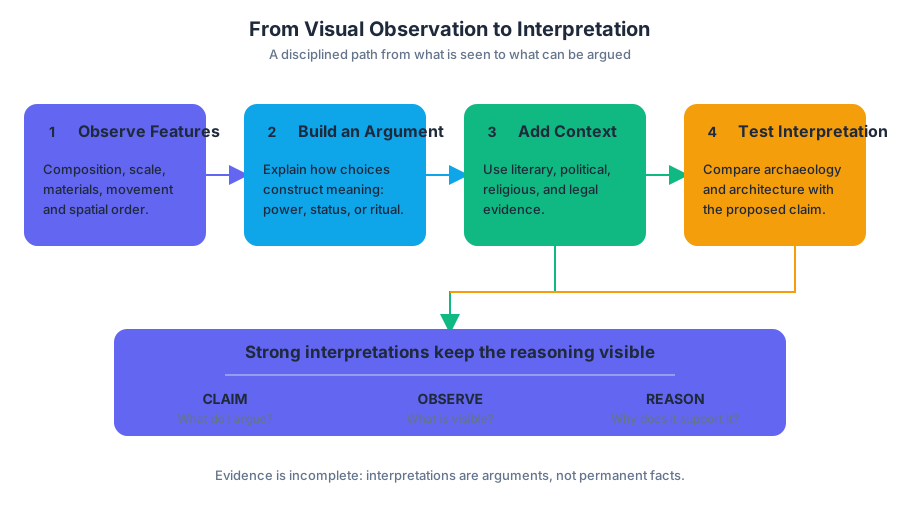
Visual analysis means making a disciplined argument from observable features: composition, scale, materials, movement, figures, spatial organization, and the relationship between parts. It is not simply saying that a work “looks powerful.” A stronger interpretation identifies how power is constructed—for example, through monumental scale, controlled processions, costly materials, or a commanding viewpoint.
Interpretation becomes art history when visual evidence is connected to historical evidence. Literary, political, legal, and religious sources can clarify what an image or building meant, while archaeology and architectural study can reveal how people encountered it. Because evidence is incomplete, interpretations remain arguments rather than permanent facts.
Key insight: An interpretation is strongest when its claim, evidence, and reasoning remain visible: what do I claim, what do I observe, and why does that observation support the claim?
Three monuments, three interpretive problems
The Apadana, Audience Hall of Persepolis can be interpreted through its vast columned space and reliefs of delegations bringing gifts. Visual analysis suggests ordered imperial unity: different peoples remain visually distinct, yet all participate in a carefully controlled procession toward the ruler. Comparative study of political history and architecture can therefore support the claim that the monument represented the Persian Empire as diverse but coordinated.
The House of the Vettii in Pompeii demonstrates how domestic architecture can generate competing interpretations. Its frescoes, mythological imagery, elaborate gardens, and reception spaces may be read as evidence of elite cultural display. Yet the house’s owners were formerly enslaved, reminding scholars that Roman social identity cannot be inferred from decoration alone. Combining wall painting, architecture, inscriptions, and social history produces a more precise argument: the house used expensive visual culture to construct status in a society where status could be acquired, performed, and contested.
The Forum of Trajan invites interpretation at the scale of urban design. Its basilica, libraries, monumental column, and extensive relief program linked military achievement to civic administration and imperial memory. A scholar might argue that the complex transformed conquest into public history: viewers did not encounter war as an isolated event, but as part of an architectural environment presenting the emperor as builder, administrator, and victorious leader.
How scholarship changes what counts as important
Ancient Greek and Roman art later became a foundation for European and Mediterranean artistic traditions. From the eighteenth century onward, European and American observers particularly admired ancient Greek and Roman ethical and governmental systems. That admiration helped prioritize works associated with political elites and cultural capitals such as Rome, while art made for or by provincial populations received less attention.
This history illustrates THR-1.A.6: theories change when scholars change their questions. Earlier scholarship might treat the Forum of Trajan as the central expression of Roman civilization; newer scholarship may also ask how provincial communities, enslaved people, women, artisans, and non-elite viewers experienced Roman visual culture. The shift does not make earlier observations useless, but it exposes the limits of an elite-centered framework.
THR-1.A.7 adds an evidence problem. Some of the earliest surviving written statements about artists and art making come from ancient Greek and Roman worlds, but little survives of the rich Etruscan literary tradition documented by Roman sources. As a result, Etruscan art is often interpreted through objects, excavation, and Roman testimony rather than through Etruscan voices themselves.
Technology and the changing archive
Technology can expand or redirect interpretation. Digital mapping can reconstruct the movement of a viewer through the Forum of Trajan; imaging technologies can reveal damaged or repainted surfaces at Pompeii; databases can compare motifs across distant sites. These tools do not automatically produce meaning. They make new evidence visible, which scholars must still evaluate historically.
Adapting an interpretation without distorting it
A scholar may use, harness, manipulate, or adapt an interpretation as part of an art-historical argument. Consider a traditional claim that the House of the Vettii represents straightforward elite luxury. A defensible revision selects the useful observation—lavish decoration—and reframes it through social history: because the owners were formerly enslaved, the decoration may have functioned not merely as luxury but as a deliberate performance of newly acquired status.
That is legitimate adaptation because the revised claim preserves relevant evidence and adds support from inscriptions, architecture, and social context. Distortion would occur if someone ignored the house’s decoration, invented an owner’s intention, or claimed that every visitor interpreted the paintings identically. Skill 8.A, “Articulate a defensible claim about one or more works of art,” requires specific and relevant evidence—not a clever interpretation detached from the record.
Retrieval check
Choose one monument above and complete the chain: visual feature → outside evidence or discipline → interpretation → defensible claim. Then ask: what new evidence or technology could cause that interpretation to change?
Source Materials
- AP Art History Course and Exam Description
- AP Art History Course and Exam Description Clarifications and Corrections
- AP Art History Course Overview
- AP Art History Course at a Glance
- AP Art History Course at a Glance Poster
- Adopt AP Art History
- AP Art History
- AP Art History
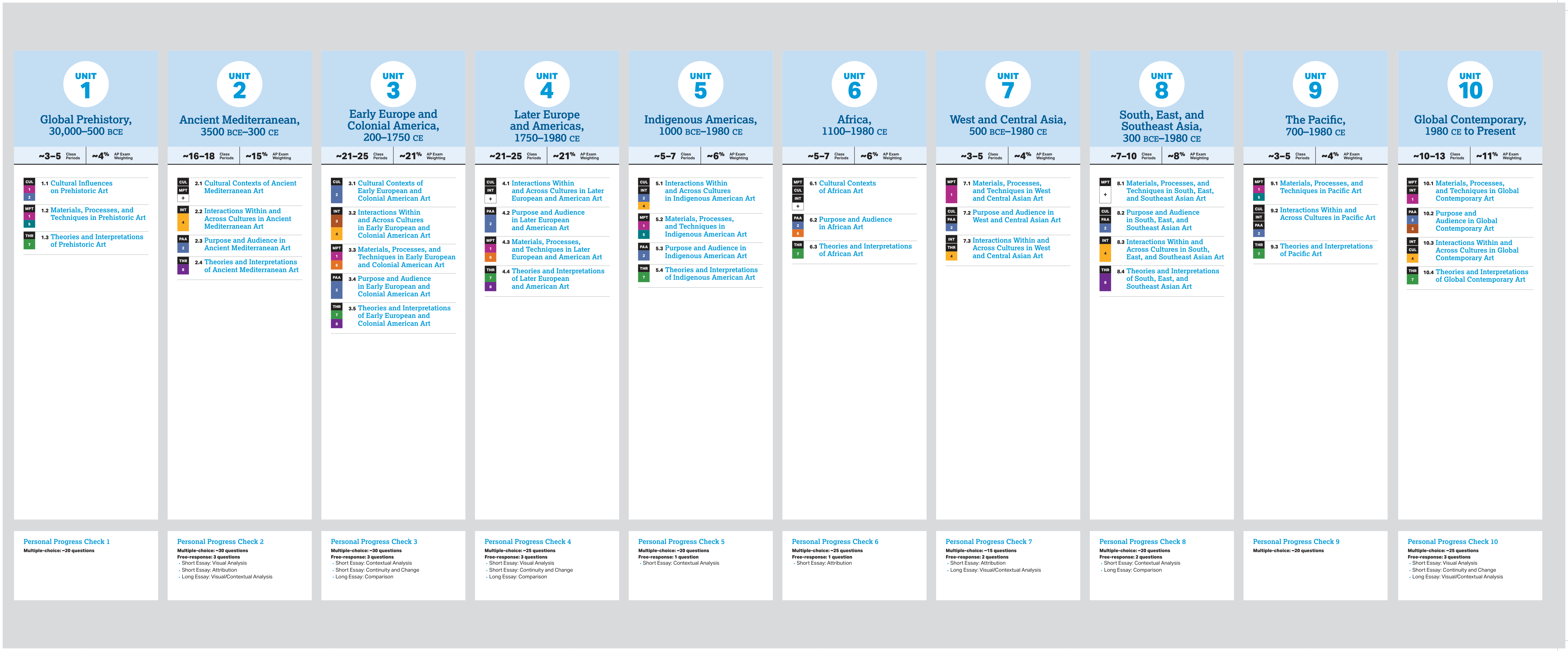
- Figure — AP Art History Course at a Glance Poster (p. 1)
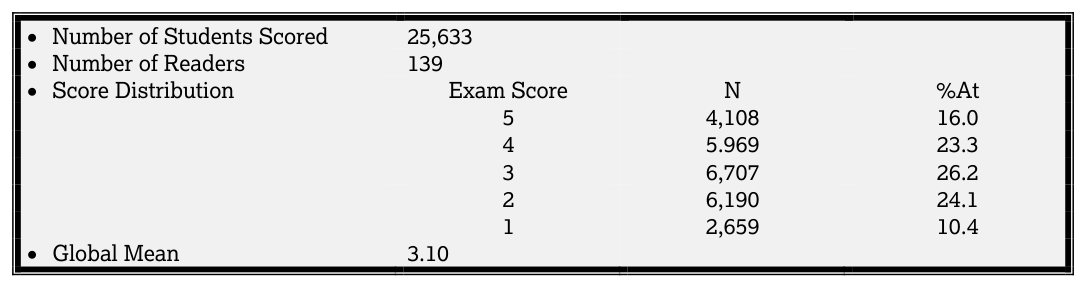
- The following comments on the 2025 free-response questions for AP® Art History were written by the Chief Reader, Sigrid Danielson, Associate Professor, Grand Valley State University, Allendale MI. The