From the free course AP Art History on Lykke
2.3 Purpose and Audience in Ancient Mediterranean Art
Key concepts: Purpose and audience · Artistic intention · Intended audience · Patronage · Function of funerary art · Context and artistic decision-making · Civic ideals · Polytheism and divinities · Continuity and change within artistic traditions · Relationships between works of art and related artistic traditions, styles, or practices
A temple can be a house for a god, a monument to a city, a stage for civic identity, and a political advertisement at the same time.
2.3 Purpose and Audience in Ancient Mediterranean Art
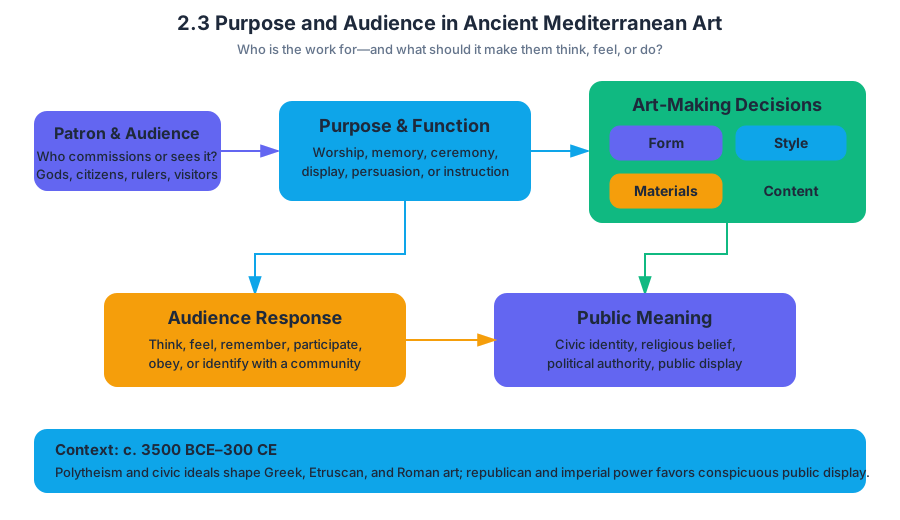
A temple can be a house for a god, a monument to a city, a stage for civic identity, and a political advertisement at the same time. Ancient Mediterranean artists and patrons therefore made decisions about form, style, materials, content, and function in response to a basic question: Who is this work for, and what should it make that audience think, feel, or do?
PAA-1.A — Learning Objective: Explain how purpose, intended audience, or patron affect art and art making.
The period addressed here extends approximately from $3500$ BCE to $300$ CE. Ancient Greek and Roman art is grounded in civic ideals—beliefs about the responsibilities and identity of the community—and polytheism, the worship of multiple gods. Etruscan and Roman works additionally express republican or imperial values, political authority, civic identity, and a preference for conspicuous public display.
A purpose is rarely “just one thing”
A work’s purpose is the goal or job it was meant to serve. Its possible functions include funerary, civic, religious, political, and commemorative purposes. Artistic intention refers to what the maker or patron wanted the work to communicate or accomplish; intended audience means the people expected to see, use, or respond to it; and patronage is the financial, political, or institutional support that makes its production possible.
These variables work together rather than forming a checklist. A patron may commission a monument for religious reasons while also using it to display wealth and civic power. The audience may include ordinary residents, priests, visiting allies, foreign diplomats, or the gods themselves, depending on the work’s setting and cultural assumptions.
| Question | What to investigate | Evidence to use |
|---|---|---|
| Purpose | What job does the work perform? | Location, ritual use, inscription, subject |
| Audience | Who encounters it, and under what conditions? | Scale, access, viewpoint, placement |
| Patron | Who ordered or financed it? | Political setting, dedication, resources |
| Intention | What response seems desired? | Symbolism, style, emphasis, visual rhetoric |
| Changing function | Has its role shifted over time? | Reuse, preservation, relocation, reinterpretation |
Worked example: the Acropolis
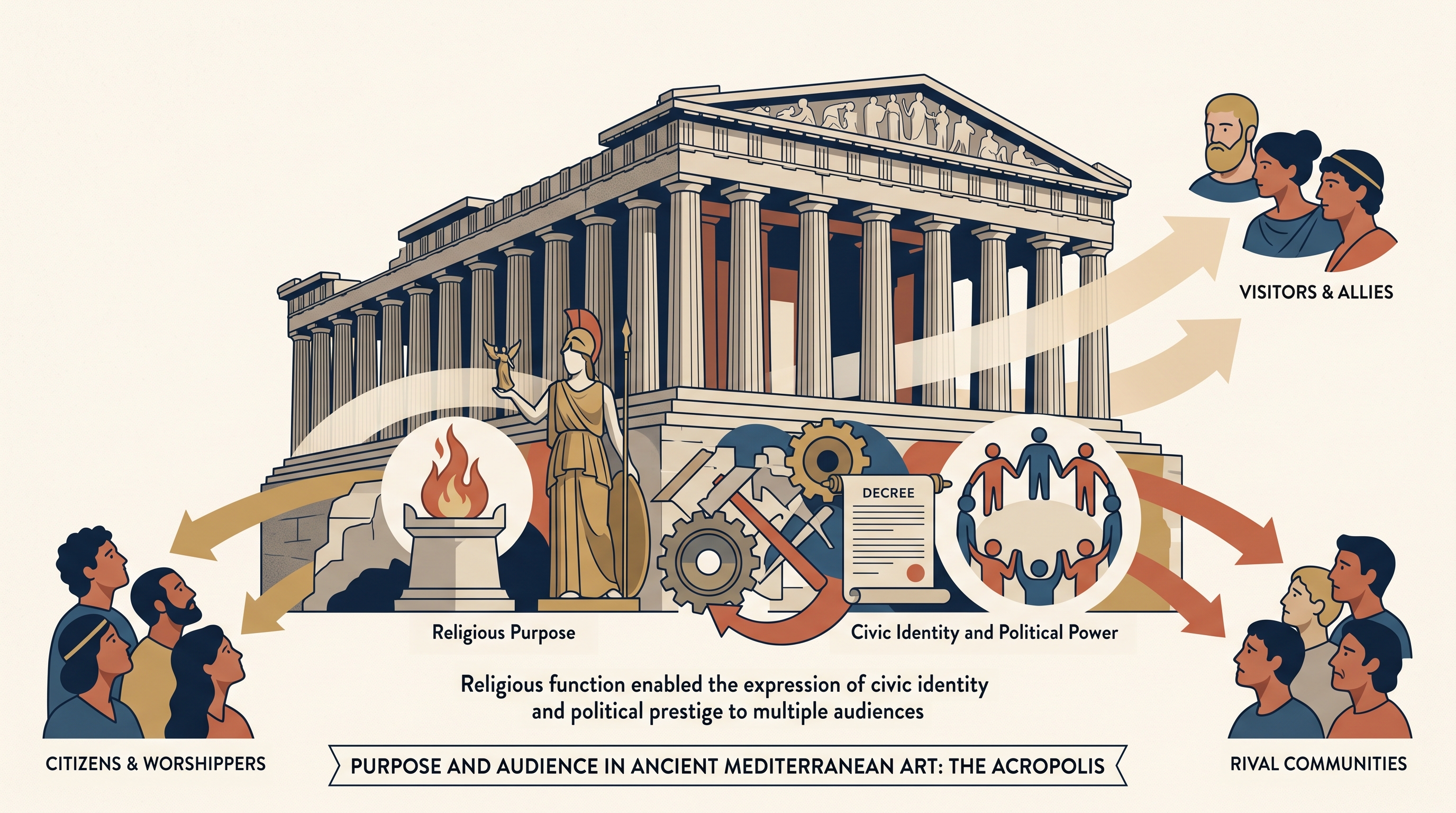
The Acropolis demonstrates how context and artistic decision-making converge. Its monumental buildings served religious purposes connected to the gods, especially Athena, but the elevated and highly visible site also communicated the importance, wealth, and collective identity of Athens. Marble construction, carefully ordered architectural forms, sculptural decoration, and the commanding hilltop location were not neutral choices: they shaped how worshippers, citizens, visitors, and rival communities encountered Athenian power.
A strong analysis connects each visual feature to a contextual reason. The costly materials suggest substantial civic investment; the monumental scale creates an experience of authority; the religious setting connects political identity to divine protection; and public visibility turns sacred architecture into a statement about the city itself. The conclusion should not be “the Acropolis was religious or political,” but rather: its religious function enabled it to express civic identity and political prestige to multiple audiences.
Funerary art: remembrance, ritual, and social identity
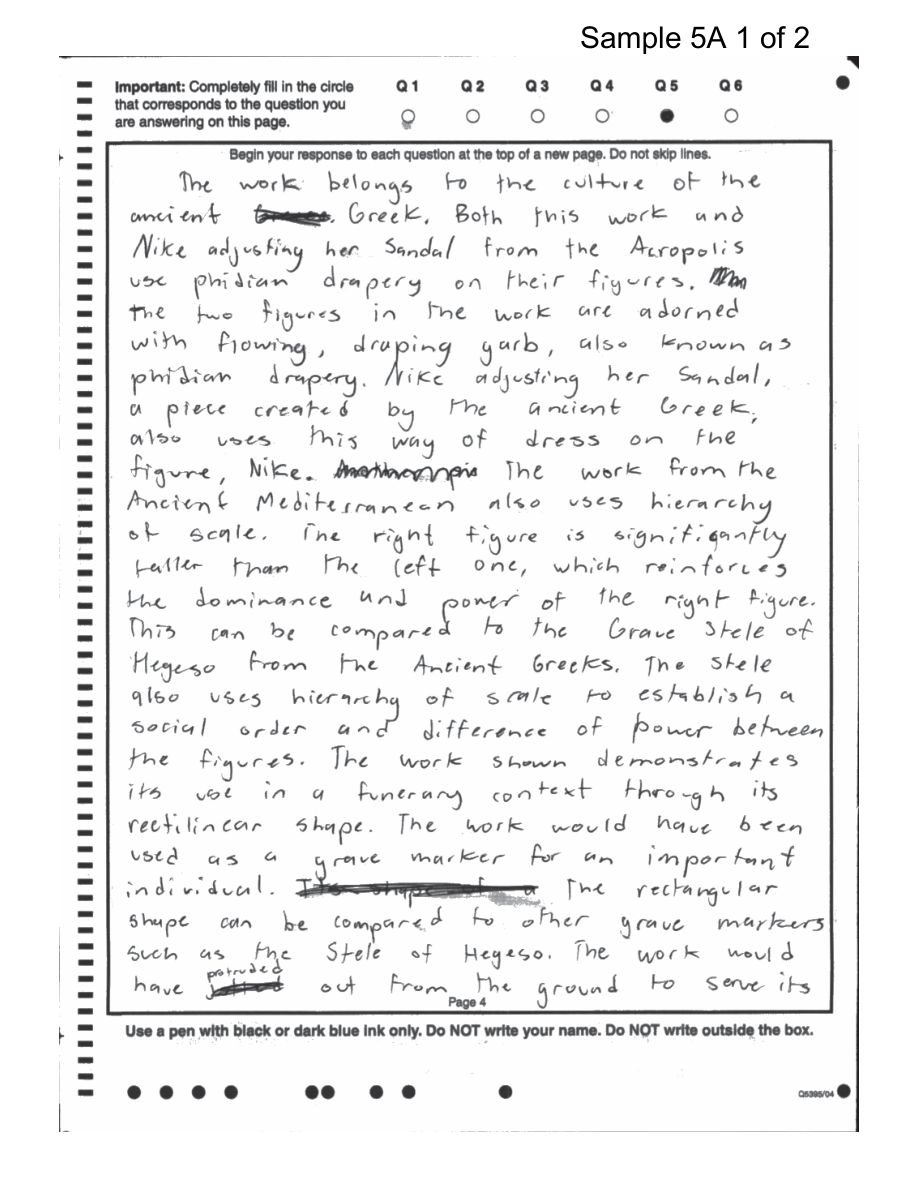
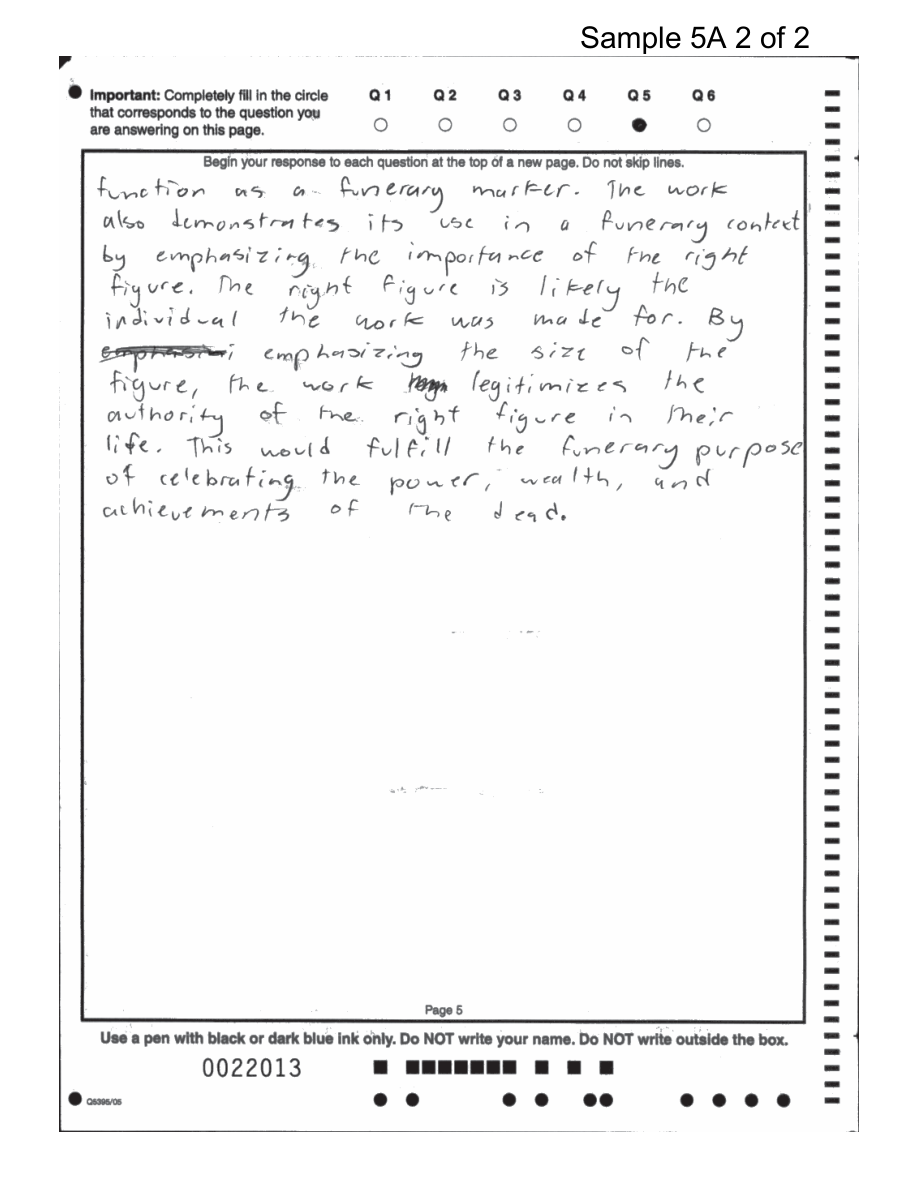
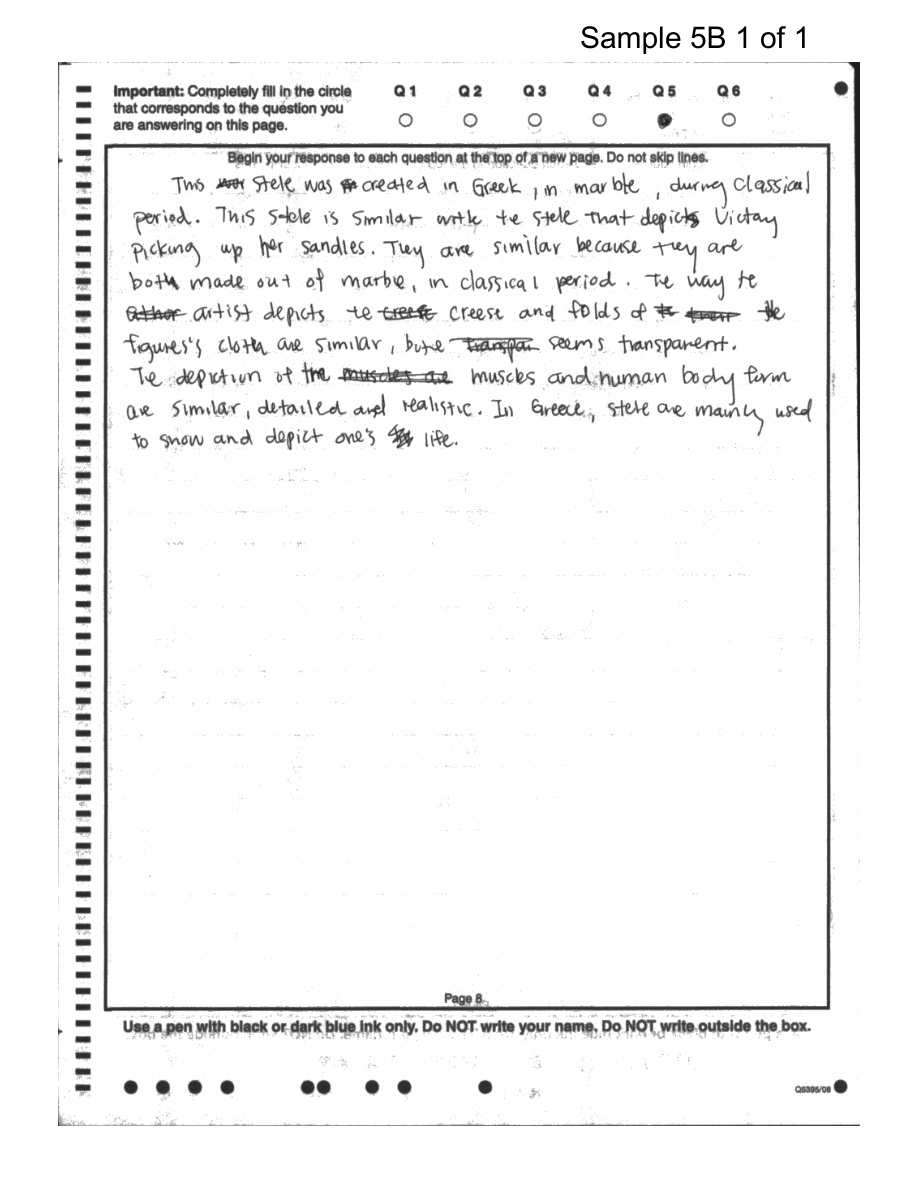
Funerary art often preserves memory, supports rituals, marks a burial place, and presents the deceased according to social expectations. A portrait or tomb monument may therefore function simultaneously as a memorial for family members, a public declaration of status, and a visual claim about the person’s virtues or identity.
The intended audience matters because the same image can communicate differently to different viewers. Family members may read a funerary portrait through personal memory; passersby may read it as evidence of rank, citizenship, military service, or moral character. The work’s meaning is consequently shaped not only by what it depicts but also by where it is placed and who can encounter it.
Context changes artistic decisions—and sometimes meaning
Historical context means the political, social, religious, economic, and cultural circumstances surrounding a work. Context can influence the selection of materials, the scale of a monument, the visibility of an image, the style considered appropriate, and the content chosen for representation.
Function can also change over time. A building originally created for worship might later become a civic landmark, museum, ruin, or symbol of national identity. That change does not erase its original purpose; instead, it adds new layers of reception and meaning. Always distinguish what a work was made to do from what later viewers used it to mean.
Misconception check — “The artist alone determines meaning.”
Ancient art was often shaped by patrons, religious institutions, civic authorities, available resources, and audience expectations. Artistic intention matters, but it is only one part of a larger system of art making and reception.
AP reasoning in action
2.B: Explain how the possible intent, purpose, and/or function shape the creation or meaning of a work of art (or group of related works of art). Do more than label a work “religious” or “political.” Explain how that purpose accounts for a specific choice—such as monumental scale, durable material, public placement, idealized form, or commemorative imagery.
2.D: Explain how artistic decisions about form, style, materials, content, function, and/or context of a work of art (or group of related works of art) elicit a response or shape its reception. A complete response identifies a visual decision, names the likely audience response, and links that response to historical context. This skill also connects with PAA-1.A.4, which identifies Greek and Roman art with civic ideals, polytheism, republican and imperial values, and investment in public architectural works.
A useful sentence pattern is: “Because the patron intended ___ for the audience of ___, the artist used ___, which encouraged viewers to ___.” For the Acropolis: “Because Athenian patrons intended a sacred complex that also embodied civic identity for worshippers and the wider public, they invested in monumental architecture and visible sculpture, encouraging viewers to associate Athens with divine favor, wealth, and collective power.”
Retrieval check
Choose one work such as the Acropolis, the House of the Vettii, the Head of a Roman patrician, or the Forum of Trajan. Identify one purpose, one intended audience, and one artistic decision. Then explain the causal link among them: how did the audience and purpose help produce the work’s form, style, materials, content, or placement?
Source Materials
- AP Art History Course and Exam Description
- AP Art History Course and Exam Description Clarifications and Corrections
- AP Art History Course Overview
- AP Art History Course at a Glance
- AP Art History Course at a Glance Poster
- Adopt AP Art History
- AP Art History
- AP Art History
- Figure — Sample Responses - Q5 (p. 4)
- Figure — Sample Responses - Q5 (p. 5)
- Figure — Sample Responses - Q5 (p. 6)
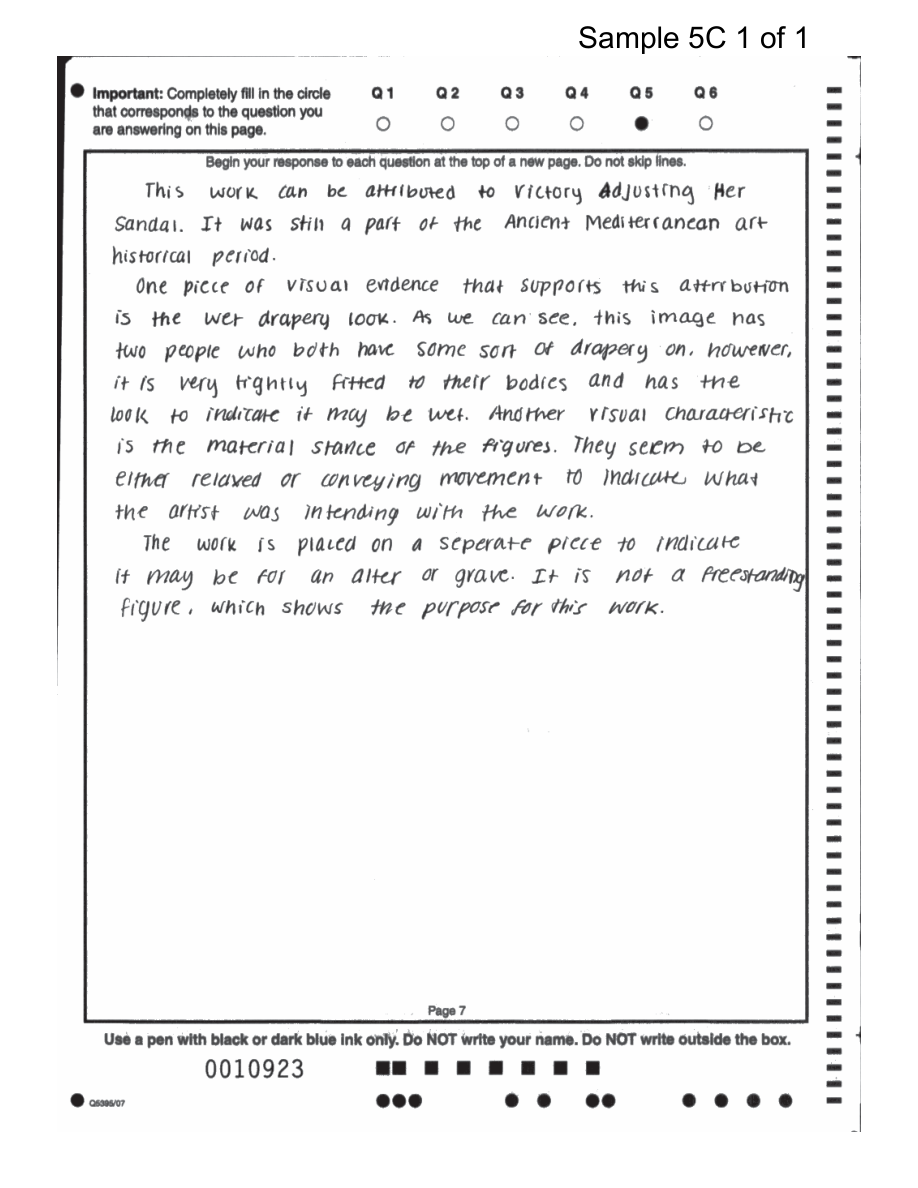
- Figure — Sample Responses - Q5 (p. 7)