From the free course AP Art History on Lykke
AP Practice 3
A strong comparison does more than place two artworks side by side: it explains why their similarities and differences matter. On the AP Art History free-response section, a comparison response must connect visible evidence to cultural context, purpose, materials, audience, or artistic tradition rather than merely…
AP Practice 3
A strong comparison does more than place two artworks side by side: it explains why their similarities and differences matter. On the AP Art History free-response section, a comparison response must connect visible evidence to cultural context, purpose, materials, audience, or artistic tradition rather than merely listing what each work looks like.
Task focus: comparison of two works
This practice uses the comparison task type, which primarily develops Skill 3: Comparison:
- 3.A — Identify similarities and differences between works of art.
- 3.B — Explain the significance of similarities and differences between works of art.
A complete answer also depends on supporting skills:
- 1.B — Describe visual elements of a work of art, using precise evidence rather than vague adjectives.
- 2.A — Identify the cultural practices that a work of art represents.
- 2.B — Explain how possible intent, purpose, and/or function shape the creation or meaning of a work of art.
- 4.C — Explain the influence of a specific work of art within a related artistic tradition, style, and/or practice.
Original practice prompt
Work A: A marble statue of a standing youthful male figure from ancient Greece, shown nude, balanced on one leg with the other leg relaxed, and constructed with carefully calculated proportions.
Work B: A carved wooden royal ancestor figure from the Yoruba tradition of West Africa, shown seated on a stool, wearing elaborate regalia and holding objects associated with authority.
Prompt: Compare Work A and Work B. In your response:
- Present a defensible claim about a significant similarity or difference between the works.
- Describe one relevant visual similarity or difference.
- Explain how the cultural context of each work shaped its appearance or meaning.
- Explain why the comparison is historically or art historically significant.
How to see the comparison
| Comparison lens | Work A | Work B |
|---|---|---|
| Figure | Idealized youthful male body | Royal or ancestral figure with emphasized status |
| Pose | Standing, balanced, physically self-contained | Seated, formally presented, connected to authority |
| Materials | Marble | Wood |
| Meaning emphasized | Bodily proportion, human achievement, and ideal form | Leadership, ancestry, social order, and spiritual authority |
| Viewer relationship | Invites attention to the idealized body | Communicates rank and links the ruler to ancestors |
The most useful comparison is not “both are sculptures.” That observation is true but weak. A stronger comparison recognizes that both works use the human figure to express cultural ideals, while the ideals differ: Work A emphasizes an idealized physical body, whereas Work B makes social and ancestral authority visible through posture, costume, objects, and ceremonial presentation.
Worked response
Claim: Both works use the human figure to communicate an ideal, but Work A presents ideality through bodily proportion and controlled anatomy, while Work B presents ideality through royal status, ritual identity, and connection to ancestors.
Visual evidence: Work A is nude and stands in a balanced pose that distributes the body’s weight across the legs. Its carefully organized proportions direct attention to the human body as a perfected form. Work B instead depicts a seated figure whose authority is communicated through regalia, a formal posture, and objects associated with leadership.
Contextual explanation: The Greek figure reflects an artistic tradition that valued idealized representations of the human body and explored relationships among beauty, order, and physical excellence. The Yoruba figure functions within a context in which royal images can preserve lineage, embody political authority, and connect living leadership with ancestral or spiritual power. The different materials and poses therefore support different meanings: marble helps present the Greek body as an enduring ideal, while carved wood supports a culturally specific image of status and presence.
Significance: The comparison demonstrates that naturalistic or recognizable human imagery does not carry one universal meaning. Similar subject matter—the human figure—can serve different purposes depending on the culture, audience, artistic tradition, and beliefs surrounding the work. Comparing the figures prevents the viewer from treating Greek art as the default model for representing the human body.
Why this earns credit
The response makes a defensible claim rather than repeating the prompt. It gives specific visual evidence—nudity, proportion, pose, regalia, and objects—and then explains how those features relate to cultural context. Most importantly, it addresses 3.B — Explain the significance of similarities and differences between works of art: the difference in meaning is not decorative; it reveals distinct ideas about the body, leadership, ancestry, and social order.
A response that says “Work A is realistic and Work B is symbolic” remains underdeveloped. “Realistic” does not explain what the realism does, and “symbolic” is not meaningful unless the answer identifies the visual features that communicate status or explains the cultural system that gives those features meaning.
Timing and error review
For a short comparison response, spend approximately:
- 1 minute identifying the central comparison
- 2 minutes listing visual evidence for both works
- 4–5 minutes writing the response
- 1 minute checking that every major claim applies to both works
After writing, mark each sentence as V for visual evidence, C for context, or S for significance. If the response contains many V sentences but no C or S sentences, it is describing rather than analyzing. If it contains C sentences without visible evidence, it is making unsupported generalizations.
Misconception check
Misconception: “Comparison means finding only similarities.”
Effective comparison includes similarities, differences, or both. The key requirement is significance: explain what the relationship between the works reveals about artistic purpose, cultural values, materials, audience, or artistic traditions.
Retrieval check
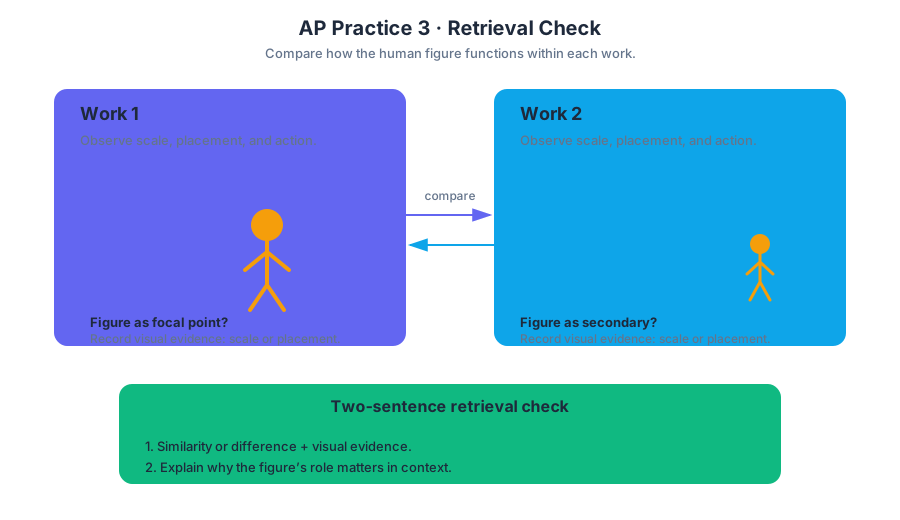
In two sentences, compare the role of the human figure in the two works. Your first sentence should identify a similarity or difference using visual evidence. Your second should explain why that relationship matters in context.

Source Materials
- AP Art History Course and Exam Description
- AP Art History Course and Exam Description Clarifications and Corrections
- AP Art History Course Overview
- AP Art History Course at a Glance
- AP Art History Course at a Glance Poster
- Adopt AP Art History
- AP Art History
- AP Art History
- AP Art History-AP Students
- AP/College Art History-Khan Academy
- AP Art History-Wikipedia
- AP Art History-Smart History