From the free course AP Art History on Lykke
2.2 Interactions Within and Across Cultures in Ancient Mediterranean Art
Key concepts: Cross-cultural interaction and influence in ancient Mediterranean art · Artistic conventions and innovations across cultures · Ancient Near Eastern and dynastic Egyptian art as foundations for later Mediterranean traditions · Greek, Etruscan, and Roman artistic relationships · Visual analysis compared with contextual analysis · The influence of function, context, religion, and social hierarchy on art · Hierarchical proportion and idealization versus naturalism · Attribution through artists, cultures, and styles · Continuity and change within artistic traditions · Using archaeological and historical evidence to interpret art
Ancient Mediterranean art is not a sequence of isolated “styles”; it is a record of ideas moving through travel, trade, conquest, imitation, adaptation, and technical invention.
2.2 Interactions Within and Across Cultures in Ancient Mediterranean Art
Ancient Mediterranean art is not a sequence of isolated “styles”; it is a record of ideas moving through travel, trade, conquest, imitation, adaptation, and technical invention. A Roman building could therefore look Greek, use an Etruscan structural idea, display objects taken from conquered territories, and still communicate specifically Roman power.
Enduring Understanding INT-1: A variety of factors leads to and motivates interaction between and among cultures, and this interaction may influence art and art making.
Learning Objective INT-1.A: Explain how artistic traditions and cultural interactions influence works of art and art making.
From foundation to adaptation
The ancient Near East and dynastic Egypt provide an essential foundation for comparing later Mediterranean traditions. Their innovations and conventions were preserved not only in surviving objects but also through recorded information from their own time. This evidence allows historians to ask not merely whether a later culture “copied” an earlier one, but which visual decisions it retained, transformed, or rejected.
Hierarchical proportion—a system in which a figure’s size reflects social or divine importance—offers a clear Egyptian example. In dynastic Egyptian art, the deified pharaoh could appear larger than attendants or subjects of lower rank. Idealization, or presenting a figure according to an established image of perfection rather than ordinary appearance, reinforced the ruler’s timeless and sacred status.
Egyptian artistic conventions formed a remarkably strict canon, meaning an established set of rules governing representation, materials, and treatment. The canon supported permanence: images of rulers and gods were meant to preserve an ordered world rather than record a fleeting personal moment. Portraiture consequently depended on rank; posture, scale, costume, materials, and degree of naturalism communicated status before a viewer knew the figure’s name.
Greek, Etruscan, and Roman relationships
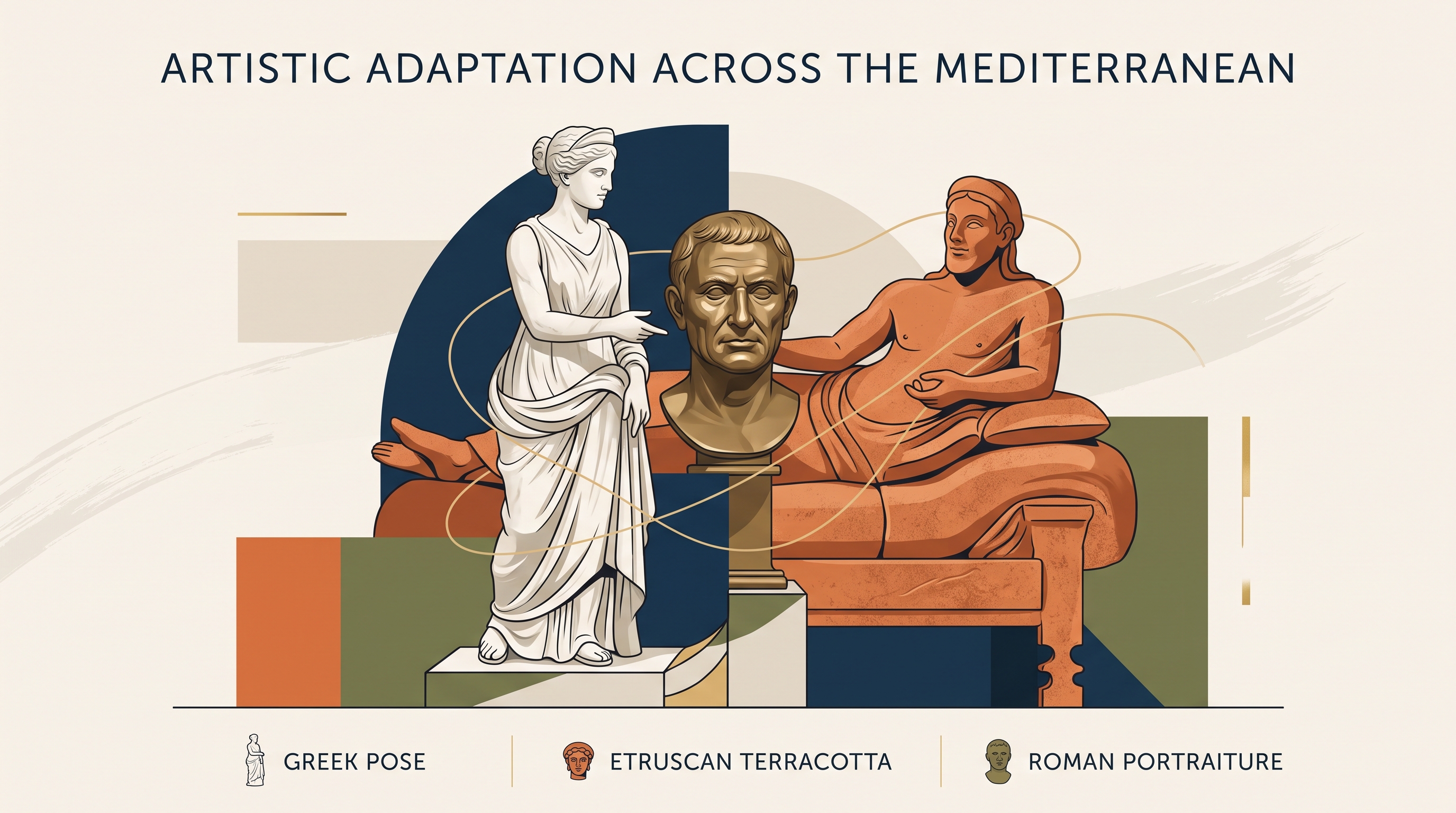
Greek, Etruscan, and Roman artists participated in an active exchange rather than a one-way chain of influence. Etruscan and Roman artists accumulated Greek objects and forms, then creatively adapted them to local tastes for eclecticism—the combination of elements from different sources—and historicism—the deliberate use of earlier styles to evoke authority, prestige, or memory.
The Temple of Minerva at Veii demonstrates this process. Its terracotta sculpture and architectural decoration reveal contact with Greek artistic traditions, but the building is not simply Greek. Etruscan materials, religious practices, roofline, and modes of display shaped the result. The useful comparison is therefore: Greek influence supplied visual resources; Etruscan context determined how those resources functioned.
Roman art generated from Greek and Etruscan techniques as well as from Roman technical innovation. Roman artists might reproduce Greek sculptural types, commission copies of admired works, or combine Greek bodies with Roman portraits. Many works identified as Hellenistic in appearance are Roman in origin, making attribution—the process of connecting a work to a particular artist, culture, or style—especially important.
How to analyze interaction
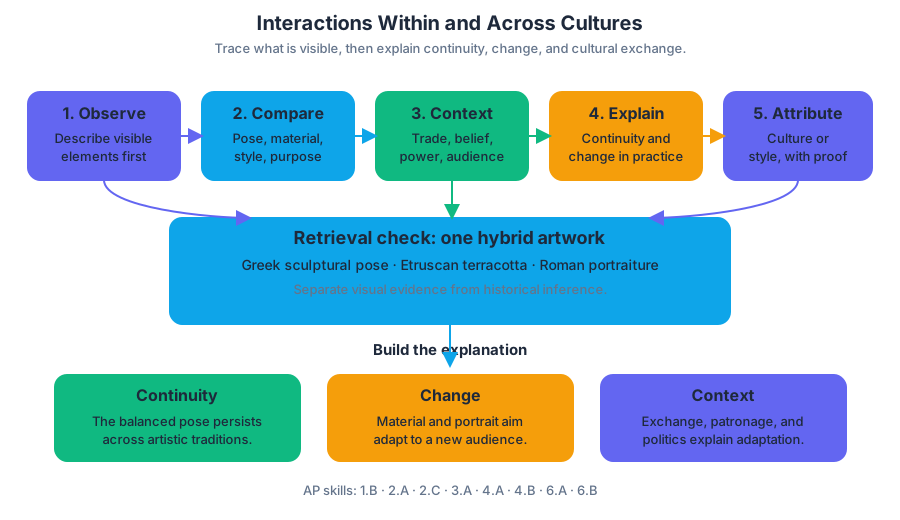
Begin with visual evidence: what can be directly observed in the work. Record pose, proportion, scale, materials, construction, surface treatment, clothing, facial style, spatial organization, and placement. Then add contextual evidence: information about political systems, religion, law, economics, excavation, patronage, or historical contact. Do not treat a contextual claim as if it were visible in the object itself.
| Evidence type | Question to ask | Example |
|---|---|---|
| Visual analysis | What do the forms actually show? | A ruler is larger than attendants; figures use idealized proportions. |
| Contextual analysis | What historical conditions help explain those choices? | Hierarchy and divine kingship made unequal scale meaningful. |
| Comparative analysis | What continues, and what changes? | A Roman work retains a Greek body type but adds an individualized Roman head. |
| Attribution | Which culture or tradition best explains the evidence? | Terracotta roof sculpture and temple form support an Etruscan attribution. |
Greek and Roman art can be studied through literary, political, legal, and economic records as well as archaeological excavations. These sources can reveal who commissioned a work, where it was displayed, how objects moved, and which audiences encountered them. They cannot replace visual analysis: historical records explain circumstances, while the object supplies material and formal evidence.
Worked comparison: continuity and change
Suppose a Roman portrait combines an idealized, muscular body associated with Greek sculpture with the lined face of a recognizable Roman statesman. The visual continuity is the borrowed Greek body type. The visual change is the insertion of individualized features and possibly signs of age. Contextually, the combination could communicate both cultural refinement and Roman civic authority.
A strong explanation would not say simply, “Rome copied Greece.” It would argue: Roman artists adapted Greek idealized forms to serve Roman portraiture, allowing the work to express participation in a prestigious Mediterranean tradition while emphasizing the sitter’s rank, identity, and public role. The claim connects form, cultural interaction, and social hierarchy.
Misconception check — “Influence means imitation.”
Influence does not require exact copying. Adaptation, selective borrowing, technical improvement, and intentional contrast are all forms of interaction. Ask what changed when a form entered a new religious, political, or social setting.
AP skills in action
This topic most directly develops 4.A: Explain how a specific work of art (or group of related works of art) demonstrates continuity and/or change within an artistic tradition, style, or practice and 4.B: Explain why a specific work of art (or group of related works of art) demonstrates continuity and/or change within an artistic tradition, style, or practice. It also relies on 1.B: Describe visual elements, 2.A: Describe contextual elements, 2.C: Explain how and/or why context influences artistic decisions, 3.A: Describe similarities and/or differences between works using points of comparison, 6.A: Attribute a work of art to a specific artist, culture, or style, and 6.B: Justify an attribution by explaining similarities to known styles/cultures.
Retrieval check: An artwork uses a Greek sculptural pose, Etruscan terracotta techniques, and Roman political portraiture. Identify one continuity, one change, and one contextual factor that could explain the adaptation. A complete response must distinguish what is visible from what is historically inferred.


Source Materials
- AP Art History Course and Exam Description
- AP Art History Course and Exam Description Clarifications and Corrections
- AP Art History Course Overview
- AP Art History Course at a Glance
- AP Art History Course at a Glance Poster
- Adopt AP Art History
- AP Art History
- AP Art History
- (c) 2022 Faith Ringgold / Artists Rights Society (ARS), New York, Courtesy ACA Galleries, New York
- Art Resource, NY © 2022 Frank Lloyd Wright Foundation. All Rights Reserved. Licensed by Artists Rights Society.