From the free course AP Art History on Lykke
3.2 3.1 Cultural Contexts of Early European and Colonial American Art
Key concepts: Cultural contexts of art and art making · Cultural practices, belief systems, and physical setting · Stylistic conventions · Early European and Colonial American art, 200–1750 CE · Medieval figurative and aniconic two- and three-dimensional art · Classical models and enhanced naturalism · Christianity and Catholic Counter-Reformation · Formalized artistic training · Change within an artistic tradition, style, or practice · Baroque architecture and painting
Between $200$ and $1750$ CE, European and Colonial American art changed as belief systems, political structures, physical settings, and artistic training changed. A church image, a palace interior, and a still-life painting are not simply different subjects: each reflects the cultural conditions in which it was…
3.2 3.1 Cultural Contexts of Early European and Colonial American Art
Between $200$ and $1750$ CE, European and Colonial American art changed as belief systems, political structures, physical settings, and artistic training changed. A church image, a palace interior, and a still-life painting are not simply different subjects: each reflects the cultural conditions in which it was made and viewed.
The cultural context of art making
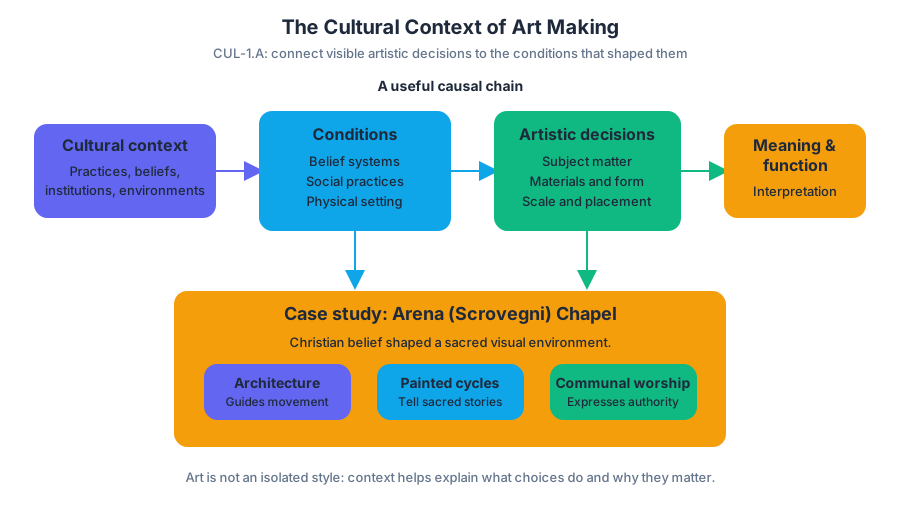
Cultural context means the network of practices, beliefs, institutions, and environments that shapes both the making and interpretation of art. The CED learning objective CUL-1.A: Explain how cultural practices, belief systems, and/or physical setting affect art and art making asks you to connect visible decisions to those conditions rather than treating style as an isolated vocabulary.
A useful causal chain is:
For example, Christianity was a major belief system influencing European art. Religious images, buildings, sculpture, and narrative cycles could communicate sacred stories, support worship, organize communal experience, or express institutional authority. The Arena (Scrovegni) Chapel demonstrates how architecture, painting, religious subject matter, and the movement of viewers through a physical setting work together rather than functioning as separate artistic choices.
Medieval traditions: figurative and aniconic approaches
Medieval artistic traditions include late antique and early Medieval art in Europe, approximately $300$–$1400$ CE, as well as Islamic traditions. These traditions produced both figurative works, which represent recognizable people, animals, or events, and aniconic works, which avoid or minimize figural representation. Aniconism does not mean “no art”; it can redirect visual attention toward geometry, calligraphy, pattern, architecture, or symbolic design.
The key comparison is not “figurative art is advanced, aniconic art is limited.” That is the progress misconception: it imposes a modern hierarchy on traditions with different religious and cultural priorities. Instead, ask what a community considered appropriate, powerful, or meaningful in a particular setting.
| Cultural condition | Possible artistic consequence |
|---|---|
| Christian worship and narrative teaching | Figurative images and cycles of sacred stories |
| Religious traditions favoring nonfigural imagery | Calligraphy, geometry, pattern, and architectural emphasis |
| Monumental or processional settings | Art organized around movement, ritual, and collective viewing |
Stylistic conventions communicate ideas
A stylistic convention is a recurring visual formula that viewers learn to recognize as meaningful. Conventions may include how figures are posed, how space is organized, how bodies are proportioned, or how movement and emotion are represented. Because conventions carry cultural meaning, a work’s style can communicate ideas even before its subject is identified.
From the fifteenth century onward, classical models continued to shape European painting and sculpture. Artists increasingly pursued naturalism, the convincing representation of bodies, space, materials, and human experience. This was not a simple replacement of medieval art: classical principles continued, while artists developed greater attention to observation, narrative complexity, emotional impact, and the relationship between figures and space.
From classical models to theatricality
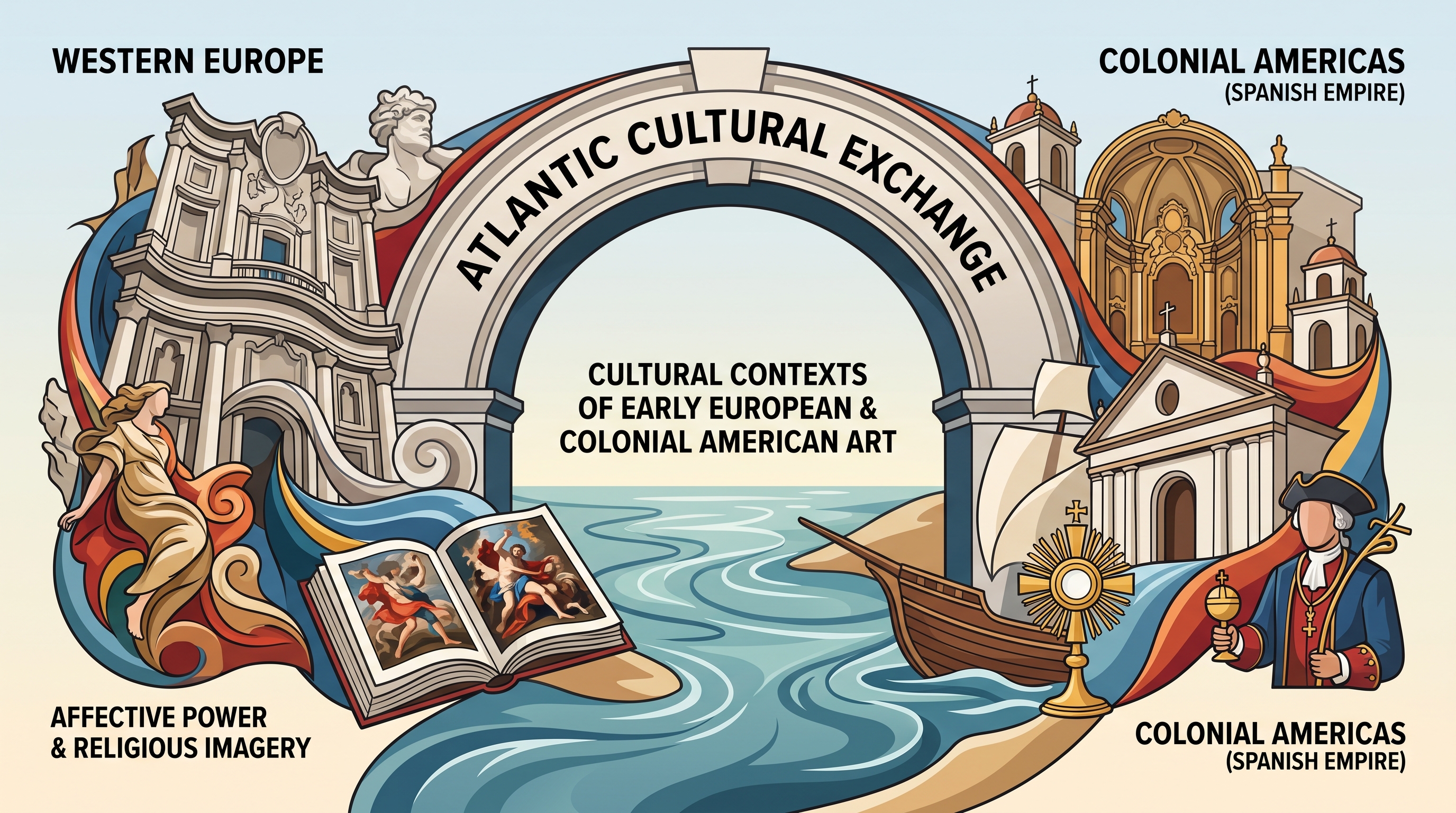
Within the required period of $200$–$1750$ CE, the early modern Atlantic World—especially from approximately $1400$ to $1750$—included Western Europe and territories in the Americas controlled by the Spanish Empire. This setting connected European artistic traditions with colonial institutions, religious missions, political power, and new audiences. The period often called Renaissance and Baroque is therefore best understood through historical conditions, not as a purely European sequence of stylistic “improvements.”
In southern Europe, especially after the Catholic Counter-Reformation, artistic production increasingly emphasized religious imagery and political authority. Painting and sculpture favored heightened naturalism, bold color, dynamic compositions, complex movement, theatricality, and affective power—the capacity to produce an intense emotional response. San Carlo alle Quattro Fontane exemplifies how architectural form can create visual motion and emotional drama.
In northern Europe, the Protestant Reformation and related religious changes contributed to a decline in some forms of religious imagery. Nonreligious genres flourished, including landscape, still life, genre scenes, history, mythology, and portraiture. Fruit and Insects is therefore not merely a collection of attractive objects: still-life imagery belongs to a cultural environment in which artists and patrons valued close observation, material display, and subjects outside traditional religious narrative.
Training and artistic production
Artistic training became increasingly formalized during this period. Organized instruction helped transmit classical principles, technical procedures, compositional formulas, and professional standards. This matters because stylistic change was not only the result of individual creativity; it also emerged through institutions that taught artists what counted as skill, tradition, innovation, and appropriate subject matter.
Misconception check — “style causes culture.” A stronger explanation reverses the direction: cultural practices and beliefs help produce stylistic conventions, while those conventions then reinforce cultural values. For instance, the dramatic movement and emotional intensity associated with Counter-Reformation art can be interpreted as a response to religious and political circumstances, not simply as an artist’s preference for visual excitement.
Retrieval check
Choose one work—The Arena (Scrovegni) Chapel, San Carlo alle Quattro Fontane, or Fruit and Insects. In two sentences, identify one cultural condition, one stylistic convention, and the visible evidence connecting them. A complete response should explain not only what the work looks like, but why those choices made sense in its historical setting.
Source Materials
- AP Art History Course and Exam Description
- AP Art History Course and Exam Description Clarifications and Corrections
- AP Art History Course Overview
- AP Art History Course at a Glance
- AP Art History Course at a Glance Poster
- Adopt AP Art History
- AP Art History
- AP Art History
- Figure — Sample Responses - Q1 (p. 2)
- Figure — Sample Responses - Q1 (p. 3)
- Figure — Sample Responses - Q1 (p. 5)
- Figure — Sample Responses - Q1 (p. 6)