From the free course AP Art History on Lykke
3.3 3.2 Interactions Within and Across Cultures in Early European and Colonial American Art
Key concepts: Cultural interaction shapes artistic forms, functions, techniques, and traditions. · Medieval European art was influenced by Roman, Islamic, and migratory cultures. · European Islamic art was influenced by Roman, migratory, African, and Asian cultures. · Commerce, colonialism, missionary activity, and migration disseminated artistic ideas and practices. · European ideas, forms, and practices spread worldwide through colonization. · Spanish colonial art developed within a Spanish Catholic context. · Colonial art reflects both religious and nonreligious subjects, including portraiture. · Native American participation in global artmaking continued through self-taught and academically trained artists. · Artists may revive ancient traditions or use art for political commentary on racism and injustice. · Long-distance ocean migration enabled the movement of families, communities, and cultural practices across vast distances.
Artistic traditions rarely travel unchanged: they are carried by conquest, commerce, migration, pilgrimage, missionary activity, and materials, then reshaped for new patrons and purposes. Cultural interaction means that contact among peoples changes artistic forms, functions, techniques, subjects, and…
3.3 3.2 Interactions Within and Across Cultures in Early European and Colonial American Art
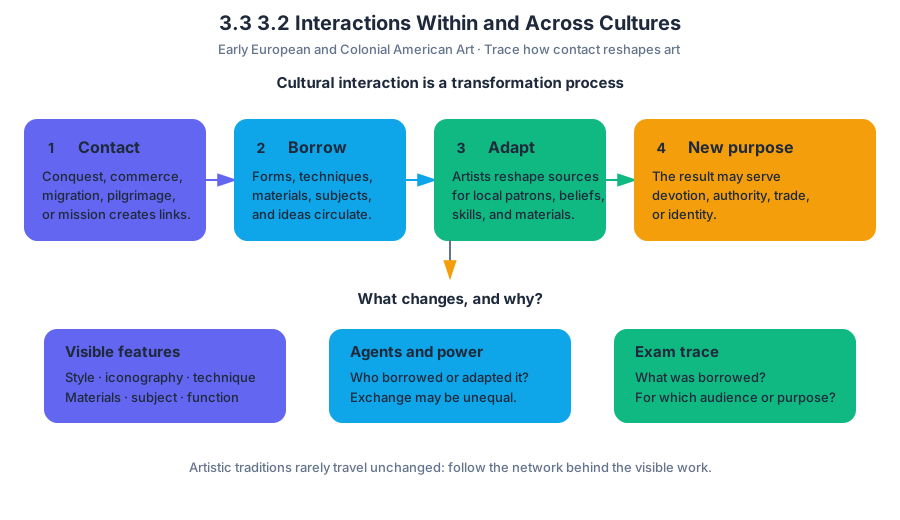
Artistic traditions rarely travel unchanged: they are carried by conquest, commerce, migration, pilgrimage, missionary activity, and materials, then reshaped for new patrons and purposes. Cultural interaction means that contact among peoples changes artistic forms, functions, techniques, subjects, and ideas—sometimes through willing exchange, sometimes through unequal colonial power.
INT-1.A — Explain how interactions with other cultures affect art and art making. The most useful exam habit is to trace a visible feature backward through its networks: What was borrowed? Who adapted it? For what new audience or purpose?
A connected medieval world
The Hagia Sophia in Constantinople, built under the Byzantine emperor Justinian in the sixth century and later converted into a mosque, demonstrates how one monument can accumulate several cultural histories. Its enormous dome and centralized interior belong to Roman engineering traditions; after the Ottoman conquest, Islamic calligraphy, furnishings, and minarets transformed its function and appearance. The building is therefore not simply “Byzantine” or “Islamic”: it records changing political authority, religious use, and artistic adaptation across European, Roman, and Islamic contexts.
Islamic art in Europe also developed through contact among Roman, migratory, African, and Asian cultures. In al-Andalus, the Islamic-ruled Iberian Peninsula, builders reused Roman and Visigothic columns and adapted the horseshoe arch. North African and other migratory communities brought architectural practices across the western Mediterranean, while connections to the eastern Islamic world carried Umayyad, Byzantine, and Asian luxury traditions westward.
The Great Mosque of Córdoba makes this process visible. Its prayer hall uses rows of reused Roman and Visigothic columns, topped by distinctive double-tiered arches: lower horseshoe arches support upper semicircular arches, allowing greater height and visual rhythm. Red-and-white voussoirs, or wedge-shaped arch stones, create a strong surface pattern. Later expansions and the cathedral inserted into the mosque further reveal how architecture can become a record of Islamic, Christian, Roman, North African, and migratory interaction rather than a sealed expression of one culture.
Roman spolia—architectural fragments reused in a later building—was not merely convenient recycling. Reused columns connected Córdoba to the prestige of antiquity, while the mosque’s orientation, prayer function, inscriptions, and decorative program made those inherited materials meaningful within Islamic worship. Borrowing does not erase difference; adaptation creates new meaning.
Networks move materials and styles
Intercultural exchange often begins with an apparently ordinary material. Paper-making traveled westward from China through Central and Islamic Asian networks, making manuscripts and paintings easier to produce and circulate than many earlier writing surfaces. In Islamic lands, paper supported extensive manuscript cultures; through trade, conquest, and scholarly exchange, related practices influenced European book production.
The Mughal courts of South Asia offer another clear example of adaptation. Hindu court architecture, painting, and fashion adopted and reshaped Mughal styles, including imperial forms of court display, manuscript painting, textiles, and ornamental vocabulary. This was not a one-way replacement of Hindu traditions by an “outside” style: court artists and patrons selected, combined, and redirected forms within local religious and political settings.
From the late fifteenth century, ocean-going vessels created transoceanic networks. Families and whole communities could cross vast distances, and passengers could sometimes return to their places of departure. These movements carried artistic ideas, religious images, craft methods, pigments, textiles, metalwork, and decorative motifs. Commerce, colonization, missionary activity, and migration therefore disseminated both objects and skills.
Spanish colonial art: hybrid production under Catholic power
INT-1.A.6 identifies the Age of Exploration as the beginning of global commercial and cultural networks formed through transoceanic trade and colonization. European ideas, forms, and practices spread worldwide through exploration, trade, conquest, and colonization—but the resulting art was not simply European art copied elsewhere.
In the Spanish viceroyalties, INT-1.A.7 describes a hybridization of European and Indigenous ideas, forms, and materials, with African and Asian influences as well. Spanish colonial art developed within a strongly Spanish Catholic context, so religious images, churches, altarpieces, and devotional objects were central. Yet colonial production also included portraiture, allegory, genre scenes, history painting, and decorative arts; “colonial art” does not mean only religious art.
INT-1.A.8 adds an important qualification: Spanish American art paralleled European practice in themes, materials, formal vocabulary, display, and reception, but its Catholic setting made it correspond especially closely to southern European art. A painting or sculpture may therefore show European composition while using Indigenous labor, local materials, African or Asian design influences, and a colonial audience’s specific needs.
Native American art: tradition is not frozen
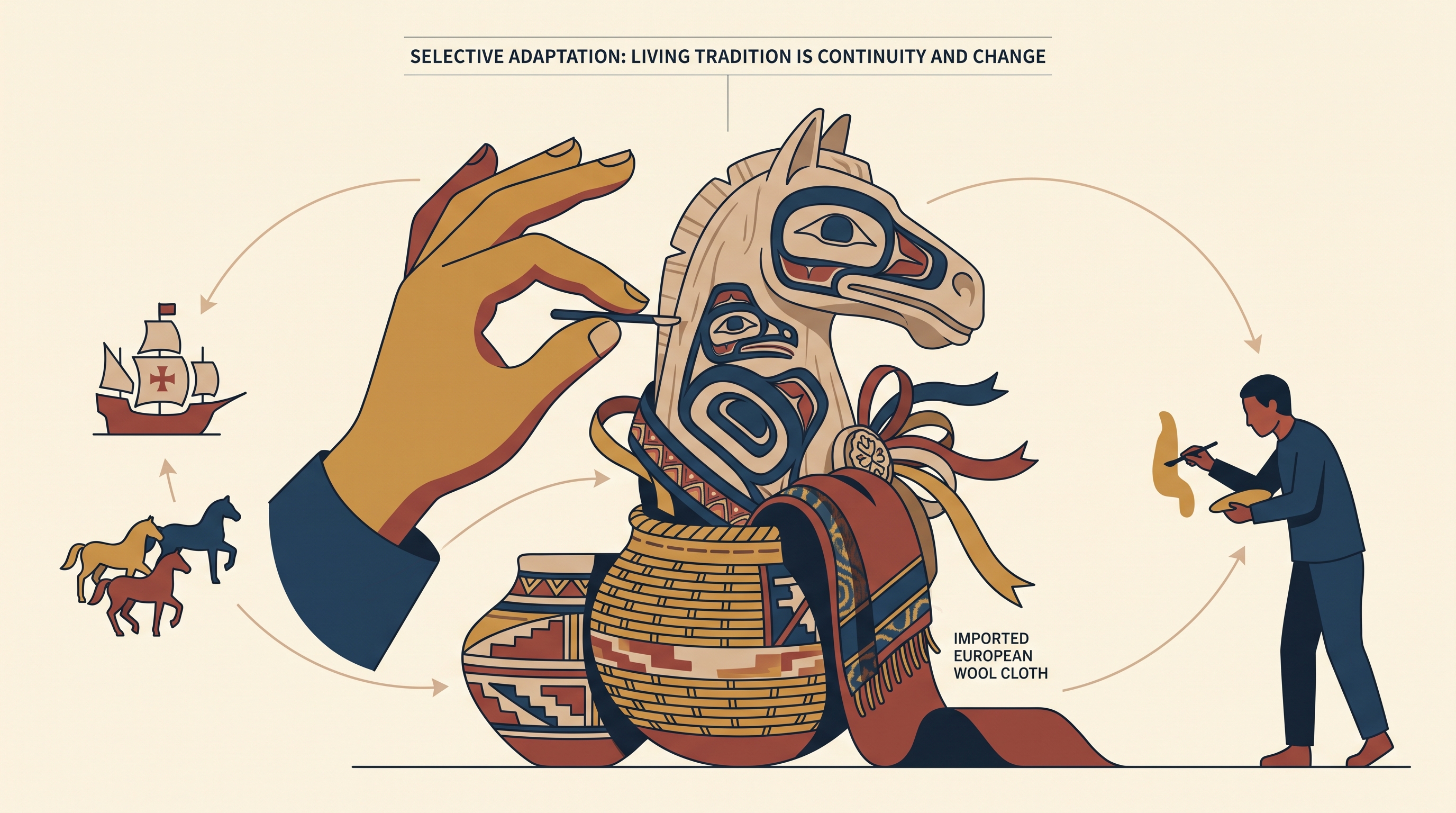
INT-1.A.14 emphasizes that European invasion, disease, genocide, suppression, and forced assimilation devastated Native communities, yet Native American artists maintained cultural identity, renewed ancient traditions, and created new forms within global contemporary art. Self-taught and academically trained artists both sustain Native participation in global artmaking, from the self-conscious revival of ancient arts such as Puebloan pottery to direct political commentary on racism and injustice.
INT-1.A.15 challenges the misconception that “traditional” means untouched by outside influence. Glass beads, machine-made cloth, and ribbon—imported through colonial and migrant contact—can now be traditional materials. The Spanish-introduced horse became an artistic and cultural staple alongside Indigenous buffalo, raven, and bear. Tradition is living and selective, not a timeless category of “authentic” purity.
Misconception check: Cultural interaction does not mean that the less powerful culture disappeared or that every hybrid artwork represents equal exchange. Identify the agents, power relations, materials, and audience before claiming that a work is simply “influenced by another culture.”
Worked interpretation: A Puebloan vessel made in a revived ancestral style may use ancient visual forms, contemporary tools, and a modern political or cultural purpose. Its meaning comes from both continuity and change. The strongest claim is not “the tradition survived unchanged,” but “the artist deliberately reactivates an ancestral practice to assert identity within a globalized art world.”
Retrieval check: Explain one way the Great Mosque of Córdoba shows adaptation rather than simple copying. Then name one imported Native American material that became traditional. A complete answer should connect each example to cultural interaction, visible evidence, and changed meaning.
Source Materials
- AP Art History Course and Exam Description
- AP Art History Course and Exam Description Clarifications and Corrections
- AP Art History Course Overview
- AP Art History Course at a Glance
- AP Art History Course at a Glance Poster
- Adopt AP Art History
- AP Art History
- AP Art History
- continued on next page
- continued on next page
- continued on next page
- continued on next page