From the free course AP Art History on Lykke
1.1 Cultural Influences on Prehistoric Art
Key concepts: Cultural practices · Belief systems · Physical setting · Art making · Art reception · Stylistic conventions · Cultural influences on prehistoric art · Artistic traditions · Historical context · Dynastic Egyptian art
A painted bison deep inside a cave is not simply an ancient picture; its location, subject, style, and survival all record decisions made within a culture.
1.1 Cultural Influences on Prehistoric Art
A painted bison deep inside a cave is not simply an ancient picture; its location, subject, style, and survival all record decisions made within a culture. Cultural influences are the practices, belief systems, and physical settings that shape both the making of art and the ways later communities receive or interpret it. The central question is therefore not only What does this object look like? but also Why was it made there, in that form, for those people?
CUL-1 — Enduring Understanding: Cultural practices, belief systems, and physical setting constitute an important part of art and art making and are often communicated in various stylistic conventions and forms.
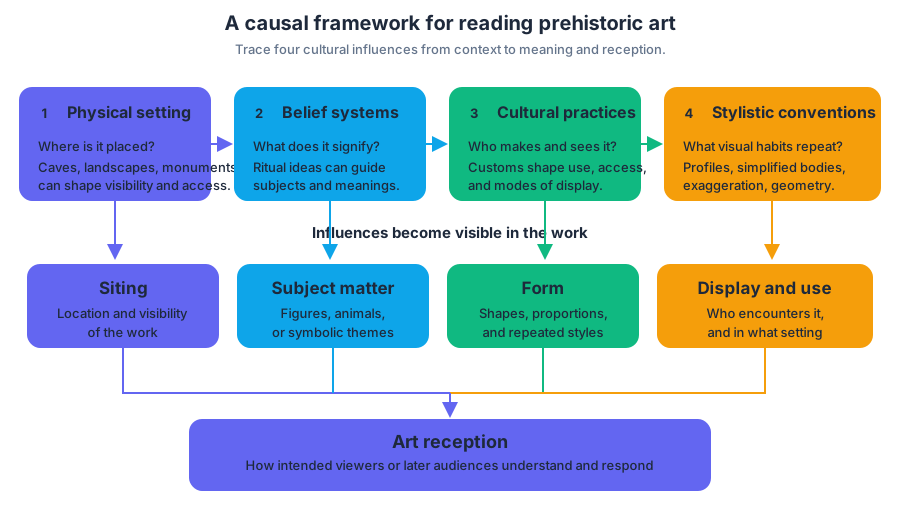
A causal framework for reading prehistoric art
Use this chain when analyzing an unfamiliar work:
Physical setting can determine where an image or monument is placed; belief systems can influence its subject and meaning; cultural practices can establish who makes it, who sees it, and how it is used; and stylistic conventions—repeated visual habits such as simplified bodies, profile views, exaggeration, or geometric pattern—communicate those influences. These factors may affect siting, subject matter, form, and modes of display. They also shape art reception, meaning the way intended viewers or later audiences understand and respond to a work.
Worked example: Paleolithic cave painting
Consider the animal paintings at Chauvet Cave or Lascaux in present-day France. Their deep, difficult-to-reach locations suggest that the physical setting mattered: these images were not created as ordinary outdoor decoration or as art meant for constant public viewing. The cave’s darkness, narrow passages, and uneven surfaces became part of the experience, so the setting may have supported ritual activity, restricted access, or a culturally important encounter with animal imagery.
The repeated presence of bison, horses, aurochs, and other animals connects the images to the lifeways and belief systems of Paleolithic communities. It is tempting to call them “hunting magic,” but that explanation is only one hypothesis, not a proven fact. A stronger contextual claim says that the animals’ prominence reflects a culture in which human survival, animals, and unseen forces were closely connected.
The artists used stylistic conventions that made animals recognizable and energetic: bodies are often shown in profile, contours follow the cave wall, and movement is suggested through overlapping forms or multiple legs. These choices are not evidence of inability. They are cultural and visual decisions that made the animals powerful within their setting. The original reception may have involved torchlight, sound, movement, and selected viewers—conditions very different from a modern museum display.
Other prehistoric forms: monument, figurine, and community
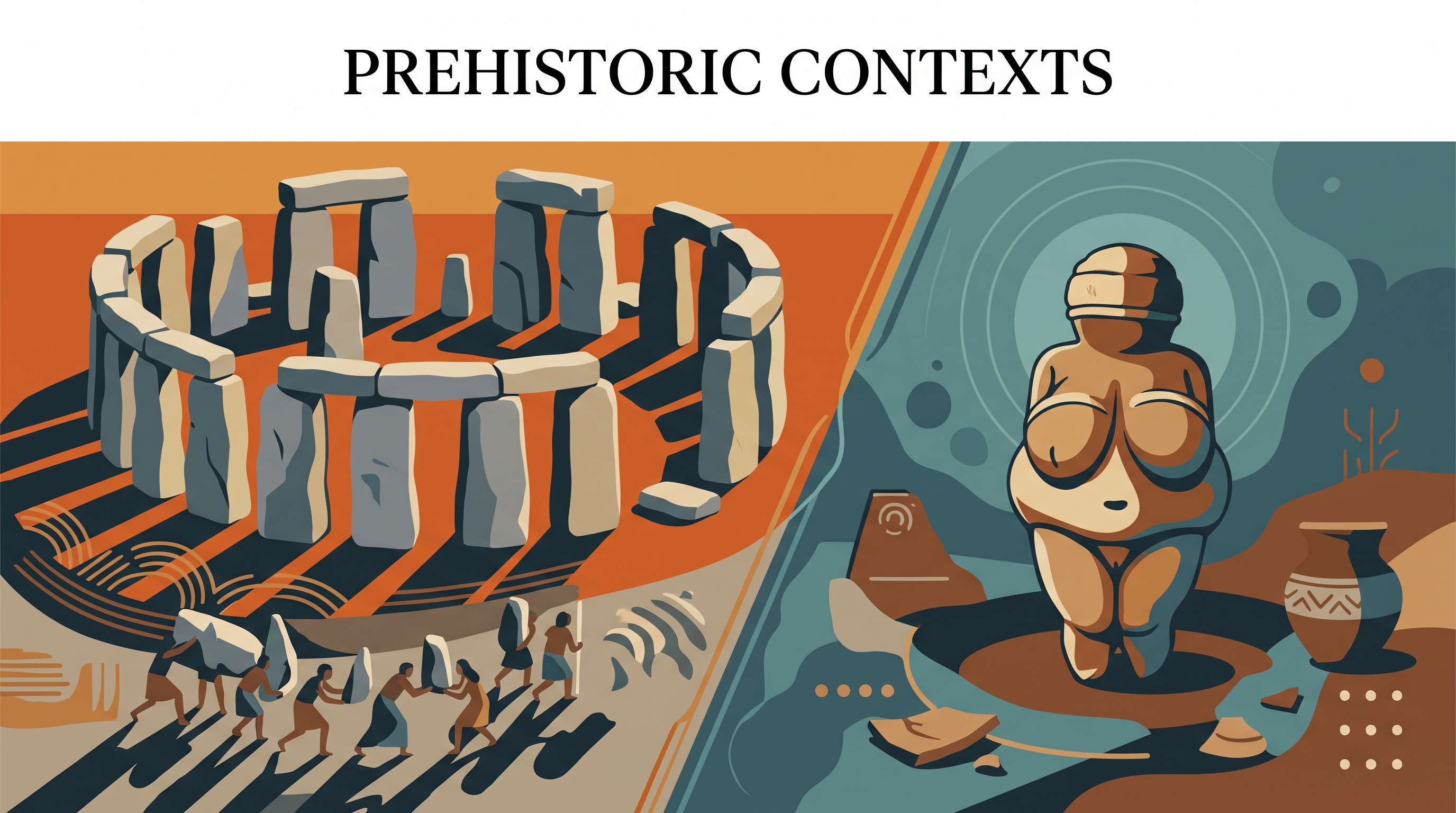
Prehistoric cultural influence is not limited to painting. Stonehenge, a Neolithic and Bronze Age monument in present-day England, demonstrates how physical setting and collective practice can merge. Its enormous stones required coordinated labor, planning, and transport; its circular arrangement created a controlled ceremonial space. The monument’s alignment and changing uses invite connections to seasonal cycles, ancestors, ceremony, or social authority, although its exact meanings remain debated.
A small Neolithic figurine such as the Vessel or a female figurine from prehistoric Europe also shows why interpretation must remain contextual. Its exaggerated body or simplified features may relate to fertility, identity, domestic practice, or another cultural purpose, but the object’s meaning cannot be securely determined from appearance alone. Ask instead how its scale, material, findspot, and repeated form might have affected its use and reception.
Style communicates culture—but not mechanically
A stylistic convention is a recurring way of representing something. Conventions can signal shared cultural values: Egyptian figures often follow established proportions and poses; prehistoric cave artists repeatedly emphasize animal bodies; Neolithic builders use geometry, repetition, and massive scale. Style is therefore not a decorative “look” added after meaning. It can encode ideas about permanence, identity, order, animals, ancestors, or the relationship between humans and the environment.
The art of dynastic Egypt—covering present-day Egypt and Sudan from approximately $3000$ to $30$ BCE—offers a later comparison. Its emphasis on permanence served a culture focused on preserving a cycle of rebirth; the Amarna period’s cultural reform produced a striking stylistic revolution. Likewise, Chartres Cathedral connects architecture to medieval theology, music, and literary and poetic invention; the Alhambra reflects the cultural context of Islamic courtly architecture; The Annunciation with Two Angels and The Birth of Venus show how subject and style depend on Christian and Renaissance cultural settings. These comparisons clarify the prehistoric principle without replacing prehistoric evidence.
Misconception check
Misconception: “Prehistoric art was primitive because it is old.” Age does not measure artistic complexity. The cave paintings’ selective placement, visual conventions, and integration with rock surfaces demonstrate deliberate choices. Also avoid the opposite error—claiming certainty about ritual meaning. Art history distinguishes observable evidence from interpretation.
AP reasoning in action
This topic directly develops CUL-1.A and CUL-1.A.6, which require explaining how cultural practices, belief systems, and/or physical setting affect art and art making. It also activates Skill 2.B, Explain how and/or why context influences artistic decisions about form, style, materials, content, and/or function in the creation or meaning of a work of art, and Skill 4.A, Explain how a specific work of art demonstrates continuity and/or change within an artistic tradition, style, or practice. Begin with visible evidence, connect it to a specific cultural factor, and avoid unsupported certainty.
Retrieval check
A cave animal, a stone circle, and a Neolithic figurine are all prehistoric, but they do not automatically have the same function. Choose one and complete the sentence: “Its physical setting and stylistic conventions suggest __________ because __________.” A defensible answer names visual evidence, identifies a cultural practice or belief system, and distinguishes a plausible interpretation from a proven fact.
Source Materials
- AP Art History Course and Exam Description
- AP Art History Course and Exam Description Clarifications and Corrections
- AP Art History Course Overview
- AP Art History Course at a Glance
- AP Art History Course at a Glance Poster
- Adopt AP Art History
- AP Art History
- AP Art History
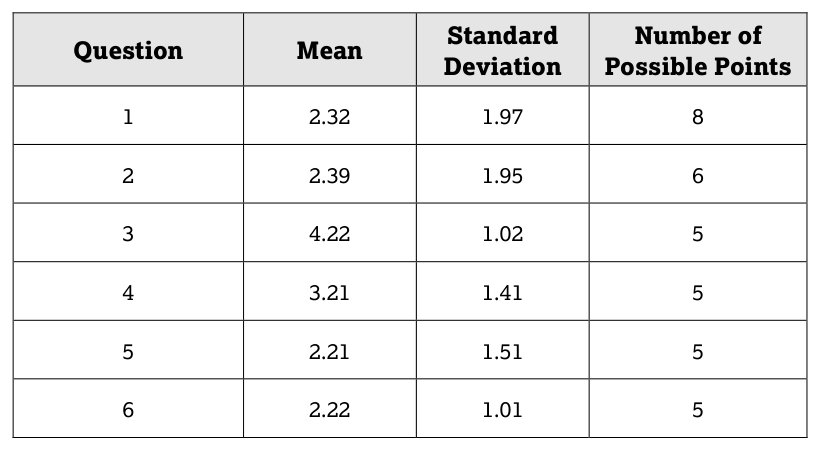
- Figure — Scoring Statistics (p. 1)
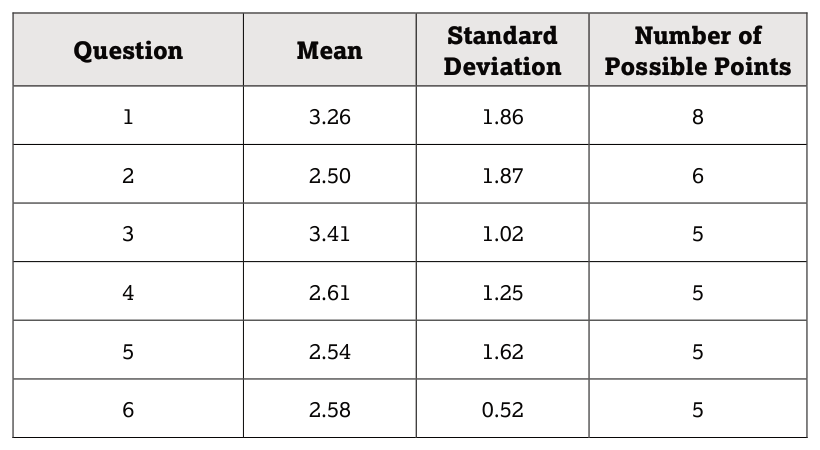
- Figure — Scoring Statistics (p. 1)
- AP Art History-AP Students
- AP/College Art History-Khan Academy