From the free course AP Art History on Lykke
8.2 8.1–8.3 Topic entries
Purpose changes what an artwork does: a Buddhist image may teach devotion, a palace may stage political authority, and a textile may identify community, rank, or ritual belonging.
8.2 8.1–8.3 Topic entries
Purpose changes what an artwork does: a Buddhist image may teach devotion, a palace may stage political authority, and a textile may identify community, rank, or ritual belonging. The same visual feature can therefore mean something different when its intended use and audience change.
Key distinction: Purpose is the work’s intended function or effect; audience is the person or group expected to encounter, use, perform with, or respond to it.
In the Unit 8 outline, the three central topic entries are 8.1 Materials, Processes, and Techniques in South, East, and Southeast Asian Art, 8.2 Purpose and Audience in South, East, and Southeast Asian Art, and 8.3 Interactions Within and Across Cultures in South, East, and Southeast Asian Art. The topic sequence moves from how a work is made, to what it is meant to do and for whom, to how artistic traditions meet and change.
| Topic | Main question | Skills listed in the course outline |
|---|---|---|
| 8.1 Materials, Processes, and Techniques in South, East, and Southeast Asian Art | How do material and process shape meaning and appearance? | 1.C, 3.A, 3.B, 6.A |
| 8.2 Purpose and Audience in South, East, and Southeast Asian Art | What function did the work serve, and who encountered it? | 2.B, 2.C, 2.D |
| 8.3 Interactions Within and Across Cultures in South, East, and Southeast Asian Art | How do cultures influence, adapt, or reinterpret artistic traditions? | 4.A, 4.B, 4.C, 4.D |
Reading purpose through visual evidence
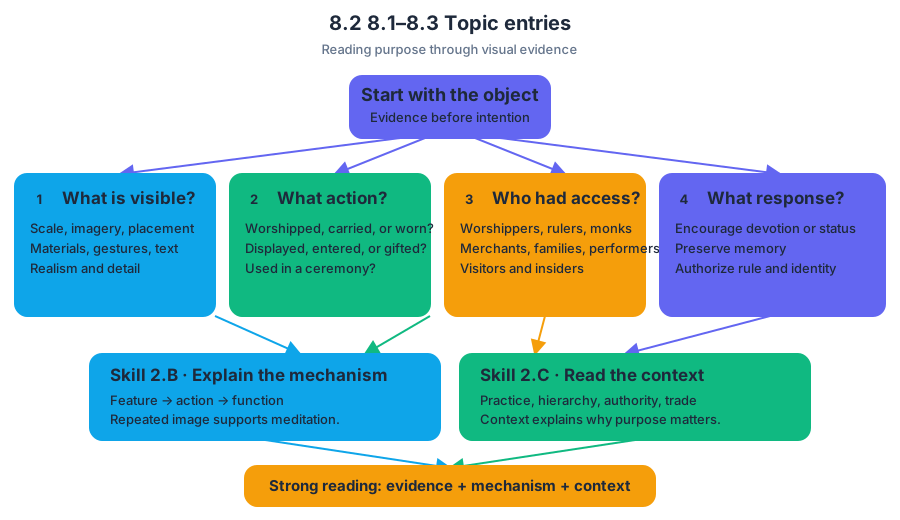
Begin with the object, not with an unsupported guess about intention. Ask four connected questions:
- What is visible? Identify scale, imagery, placement, materials, gestures, inscriptions, and degree of realism.
- What action could the work support? Could it be worshipped, carried, displayed, worn, entered, gifted, or used in a ceremony?
- Who had access to it? Consider worshippers, rulers, monks, merchants, family members, performers, or visitors.
- What response might it produce? A work can encourage devotion, communicate status, preserve memory, authorize rule, or structure communal identity.
Skill 2.B asks you to connect an artwork’s features to its function or purpose. A strong response does not merely label an object “religious” or “political.” It explains the mechanism: a repeated sacred image might support meditation; an imposing scale might make a ruler appear powerful; restricted placement might separate insiders from outsiders.
Skill 2.C asks you to explain how contextual factors shape purpose. Relevant factors may include religious practice, social hierarchy, political authority, economic systems, gender roles, trade networks, or ritual traditions. Context is not a decorative fact added after visual analysis; it explains why those particular visual choices mattered.
Skill 2.D asks you to identify and explain the role of the audience. Audience is more precise than “the public.” A work may address a deity, initiate, royal court, monastic community, household, local worshipper, or distant viewer. Its scale, location, accessibility, and imagery can reveal whom it was designed to reach.
Worked contextual example: purpose is not the same as subject
Imagine an image showing a revered Buddhist figure. Its subject alone does not prove how it functioned. To earn a complete explanation, connect appearance, use, and audience:
- Visual evidence: The figure is presented frontally, calmly, and with recognizable sacred attributes.
- Purpose: These features can make the image a focus for devotion or meditation rather than a record of an ordinary human individual.
- Context: Buddhist practices give images an active role in religious life; the object may help worshippers visualize teachings or approach a sacred presence.
- Audience: If placed in a temple, its immediate audience would include worshippers and monastic communities. If small and portable, it could address an individual devotee in a domestic or traveling setting.
- Argument: The image’s formal stability and sacred attributes support a devotional purpose because they make the figure recognizable and suitable for repeated acts of contemplation.
The reasoning pattern is:
$$ \text{visual feature} \rightarrow \text{function} \rightarrow \text{context} \rightarrow \text{audience} $$
Misconception check: “The audience is whoever sees it today”
Correction: The modern museum visitor is often not the original audience. Ask who could access the work when it was made, where it was placed, and what actions viewers were expected to perform. A sculpture displayed in a museum may originally have been encountered in a shrine, palace, tomb, procession, or household.
How 8.2 connects to the neighboring topics
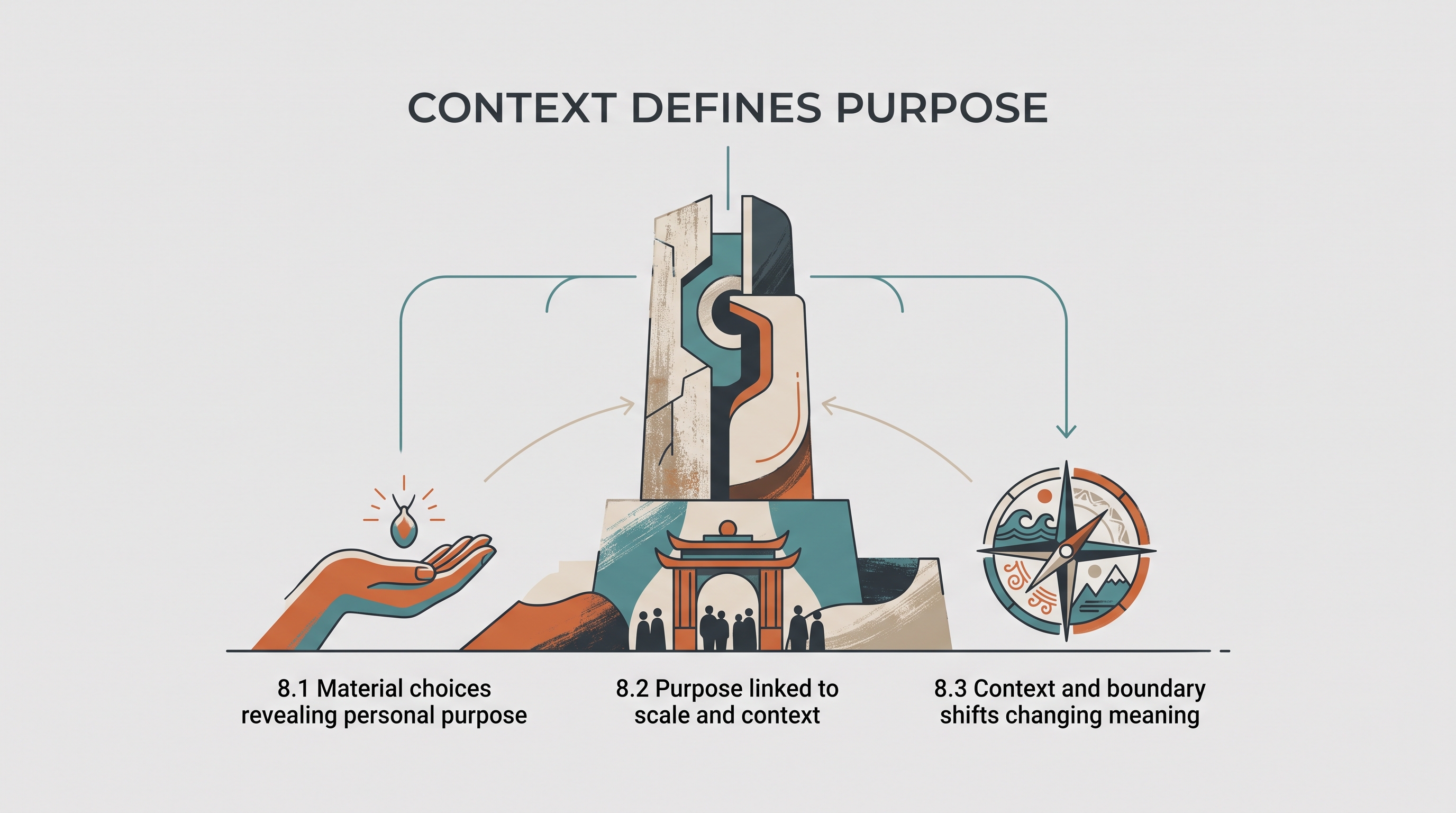
Material choices from 8.1 can reveal purpose: portability may support pilgrimage or personal devotion, while monumental construction may serve public display or political authority. In turn, 8.3 helps explain why a work’s purpose may shift when a form, image, or technique moves across cultural boundaries.
Retrieval check: A work is large, permanently installed, difficult to access, and positioned in a ceremonial setting. Which claim is strongest?
A. Its size proves that it was made by a wealthy artist.
B. Its scale and restricted placement may support a public, political, or ritual function for a selected audience.
C. Its audience must have been modern tourists.
D. Its purpose cannot be inferred from visual evidence.
Answer: B. The claim links observable features to a plausible function and audience without treating one clue as absolute proof.