From the free course AP Art History on Lykke
3.6 3.5 Theories and Interpretations of Early European and Colonial American Art
Key concepts: Theories and interpretations of works of art · Visual analysis as a basis for interpretation · The role of scholarship and other disciplines in shaping interpretations · The influence of technology and availability of evidence · How interpretations affect a work’s reception and meaning over time · Early European and Colonial American art, 200–1750 CE · Art-historical interpretations of related groups of works · Geographic, religious, and linguistic divisions in the study of European medieval art · The Arnolfini Portrait · Frontispiece of the Codex Mendoza
A single artwork can acquire new meanings when new evidence, technologies, or scholarly questions change how viewers see it. Interpretation is an art-historically supported explanation of a work’s meaning, significance, reception, or function—not merely a personal reaction.
3.6 3.5 Theories and Interpretations of Early European and Colonial American Art
A single artwork can acquire new meanings when new evidence, technologies, or scholarly questions change how viewers see it. Interpretation is an art-historically supported explanation of a work’s meaning, significance, reception, or function—not merely a personal reaction.
THR-1: The study of art history is shaped by theories and interpretations of art and art making that change over time. Interpretations may arise from visual analysis and from scholarship influenced by other disciplines, available technology, and the availability of evidence.
How an interpretation is built
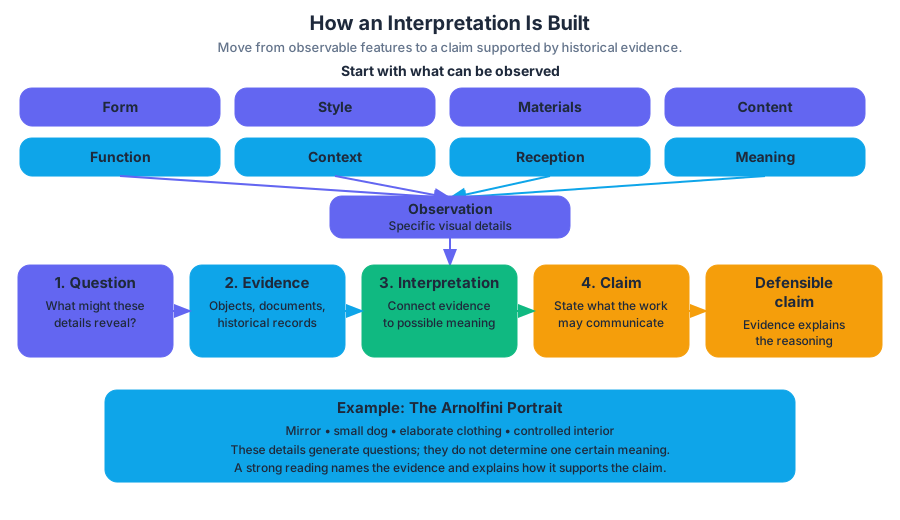
A defensible interpretation begins with what can be observed: form (visual elements and composition), style, materials, content, function, context, reception, and meaning. The art historian then connects those observations to evidence about the work’s historical world.
The reasoning chain is:
Observation → historical question → evidence → interpretation → defensible claim
For example, The Arnolfini Portrait contains carefully rendered objects, a convex mirror, a small dog, elaborate clothing, and a controlled interior setting. These details do not automatically produce one certain meaning. They generate questions: Who are the figures? What social values do the objects communicate? Why might the mirror and its reflected figures matter? A strong interpretation identifies specific visual evidence and explains how that evidence supports a claim.
The painting’s reception demonstrates why interpretation is not fixed. Viewers and scholars have proposed different explanations of the scene, including interpretations centered on marriage, status, identity, or symbolic meaning. The important AP distinction is not choosing the most dramatic theory; it is explaining how a theory is derived from visible evidence and relevant context.
Scholarship changes what viewers can know
Art history is interdisciplinary: its interpretations may draw on religious studies, history, anthropology, language, architecture, social history, conservation science, and archaeology. Technology can enlarge details, reveal underdrawings, identify pigments, compare images across collections, or preserve evidence that is difficult to see with the naked eye. New evidence may strengthen an earlier interpretation, qualify it, or make it less persuasive.
European medieval art must therefore be studied with attention to geography, religion, and language. A medieval work may reflect the traditions of a particular region while also participating in broader Christian, Jewish, or Islamic visual and intellectual networks. Byzantine, Islamic, and Christian forms, motifs, texts, and religious traditions moved across medieval regions through travel, trade, pilgrimage, political contact, and translation. Language matters because an inscription, title, or textual source can change how an image is identified and understood.
The Frontispiece of the Codex Mendoza makes this problem especially visible. Its imagery belongs to a colonial context in which Indigenous Mexican history and systems of knowledge were recorded through a manuscript made after the Spanish conquest. Interpreting the page requires visual analysis, attention to Indigenous pictorial conventions, knowledge of colonial power, and sensitivity to the languages and translation systems through which its meanings were transmitted.
Interpretations shape reception
An interpretation does not simply describe a work’s meaning; it can influence how museums display it, how textbooks explain it, which histories receive attention, and how later audiences value or misunderstand it. A theory may be harnessed, manipulated, or adapted to make an art-historical argument. Because interpretations affect reception, scholars must distinguish between what the work visibly supports and what an audience has projected onto it.
Misconception check: “If scholars disagree, every interpretation is equally valid.”
Correction: Interpretations can differ while still being evaluated. An art-historically valid interpretation uses relevant visual and contextual evidence, acknowledges uncertainty, and explains its reasoning.
Formal discussion: turning evidence into argument
A precise discussion avoids unsupported phrases such as “the artist wanted” or “this symbolizes” unless evidence justifies them. Use a three-part structure:
- Claim: State an interpretation clearly.
- Evidence: Identify a specific formal, material, contextual, or historical feature.
- Reasoning: Explain why that feature supports the interpretation, while noting a limitation or alternative when appropriate.
This directly develops 7.B — Explain how one or more art historically valid interpretations of a work of art (or group of related works of art) are derived from an analysis of its form, style, materials, content, function, context, reception, and/or meaning. It also develops 8.A — Articulate a defensible claim about one or more works of art (or group of related works of art) and 8.B — Using specific and relevant evidence, support an argument about works of art.
In discussion, distinguish observation from inference: “The mirror reflects additional figures” is observation; “the mirror expands the social space of the scene” is interpretation. Invite corroboration—“Which detail supports that?”—and qualification—“What evidence might complicate it?”—rather than treating disagreement as a contest of opinions.
Retrieval check: Why might a new technical examination change an interpretation of The Arnolfini Portrait or the Frontispiece of the Codex Mendoza? Answer in one sentence using both evidence and interpretation. A strong answer explains that newly visible, newly identified, or newly contextualized evidence can support, revise, or challenge an existing art-historical claim.