From the free course AP Art History on Lykke
AP Practice 5
A convincing attribution does not begin with “I recognize this image.” It begins with a testable question: Which visual, material, and contextual clues make one attribution more plausible than another?
AP Practice 5
A convincing attribution does not begin with “I recognize this image.” It begins with a testable question: Which visual, material, and contextual clues make one attribution more plausible than another? In AP Art History, attribution means assigning an unknown work to an artist, culture, period, workshop, region, or artistic tradition by using evidence rather than visual resemblance alone.
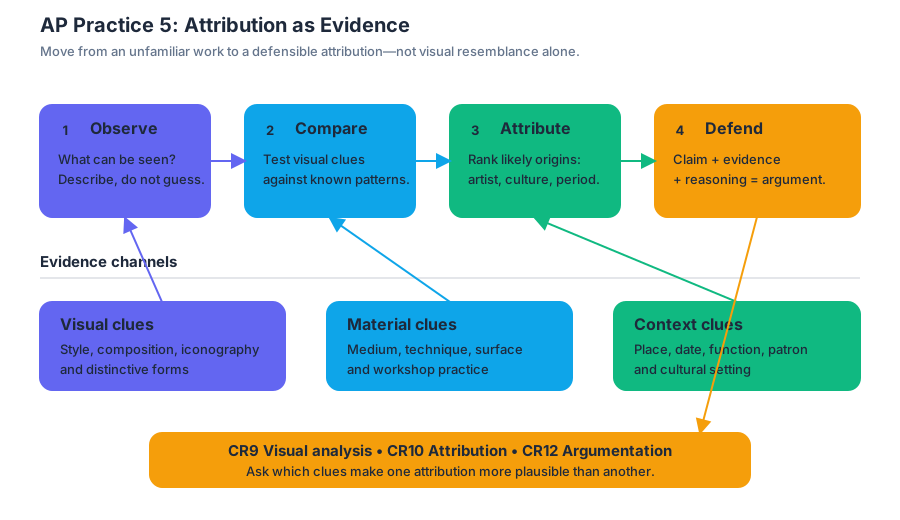
This practice set focuses on the attribution task type: analyzing an unfamiliar work and defending a conclusion about its origin. It exercises the art-historical thinking skills identified in the course materials, especially CR9: Visual analysis of unknown works, CR10: Attribution of unknown works, and CR12: Argumentation using claims and evidence.
A reliable attribution pipeline
Use the sequence below when the image is unfamiliar. The order matters: description supplies evidence; interpretation explains what the evidence may mean; attribution comes only after those steps.
- Inventory visible evidence. Record pose, scale, composition, facial features, clothing, gestures, symbols, inscriptions, materials, and surface treatment.
- Separate observation from inference. “The figure holds a staff” is observation. “The staff identifies a ruler” is interpretation.
- Generate two or three plausible possibilities. Consider region, period, function, and cultural tradition rather than jumping to a famous artist.
- Test each possibility against multiple clues. A strong attribution explains several features at once.
- Make a qualified claim. State what is most likely and identify the evidence that supports it.
- Address uncertainty. Explain what additional evidence—provenance, scientific testing, inscription, or comparison—could confirm or weaken the claim.
Original practice prompt
Image description: An unfamiliar sculpture shows a standing human figure carved from dark wood. The figure has an enlarged head, sharply angular shoulders, long narrow legs, and hands held close to the abdomen. The surface is polished on the torso but roughened in selected areas of the hair and clothing. Small metal elements are attached near the chest and waist. The figure appears designed to be viewed from the front, although the back is also carved. No artist’s name or inscription is visible.
Task: Attribute the work to the most plausible artistic tradition or cultural context. Support your attribution with two specific visual or material features and explain how each feature contributes to your conclusion. Then identify one piece of additional evidence that would help verify the attribution.
Worked reasoning
Begin with a claim that is specific but not overconfident: The sculpture is most plausibly associated with an African ritual or devotional tradition in which a carved figure could operate as more than a purely naturalistic portrait. This claim does not depend on treating “African art” as a single style; it identifies a broad context while leaving room for a more precise regional attribution.
The first supporting clue is the figure’s frontality and enlarged head. A rigid frontal stance can direct attention toward the figure’s presence and function rather than toward an ordinary moment of movement. The enlarged head may emphasize thought, spiritual force, identity, or status, but the answer should not claim one meaning without contextual evidence.
The second clue is the combination of wood carving and attached metal elements. The contrast between organic wood and added metal suggests that the object’s meaning may depend on its materials as well as its appearance. Metal could mark protection, power, offerings, or later alteration; therefore, the strongest response describes the clue and presents its possible significance cautiously.
A useful verification step would be provenance research: documentation showing where the sculpture was collected, who used it, or which community recognized it. Technical analysis of the wood and metal could also help, but scientific testing alone would not establish the object’s ritual function or cultural meaning.
What earns credit
A high-scoring response follows the logic of claim → evidence → explanation. It does not earn strength merely by naming a region. The attribution must be connected to observable features, and each feature must be explained rather than listed.
| Response move | What the examiner needs to see |
|---|---|
| Attribution claim | A plausible cultural, regional, chronological, or traditional identification |
| Visual evidence | Specific features such as frontality, proportion, surface, pose, or attached materials |
| Reasoning | An explanation of why those features support the attribution |
| Qualification | Recognition that attribution is an evidence-based probability, not a guess |
| Verification | A relevant source of confirmation, such as provenance, inscription, comparison, or material analysis |
Weak: “This is African because it has an unusual shape and looks spiritual.”
Stronger: “The frontal stance, emphasized head, and combination of carved wood with attached metal support an attribution to a ritual sculpture tradition in which material presence and spiritual efficacy may be important. Provenance or comparison with documented works from a specific community would be needed to narrow the attribution.”
Misconception check: style is not a fingerprint
A common error is style-as-fingerprint reasoning: assuming that one visual feature proves an origin. Enlarged heads, abstraction, dark wood, or frontal poses occur across many cultures and periods. Attribution becomes persuasive only when several clues converge and the answer acknowledges alternative explanations.
Timed attempt and error review
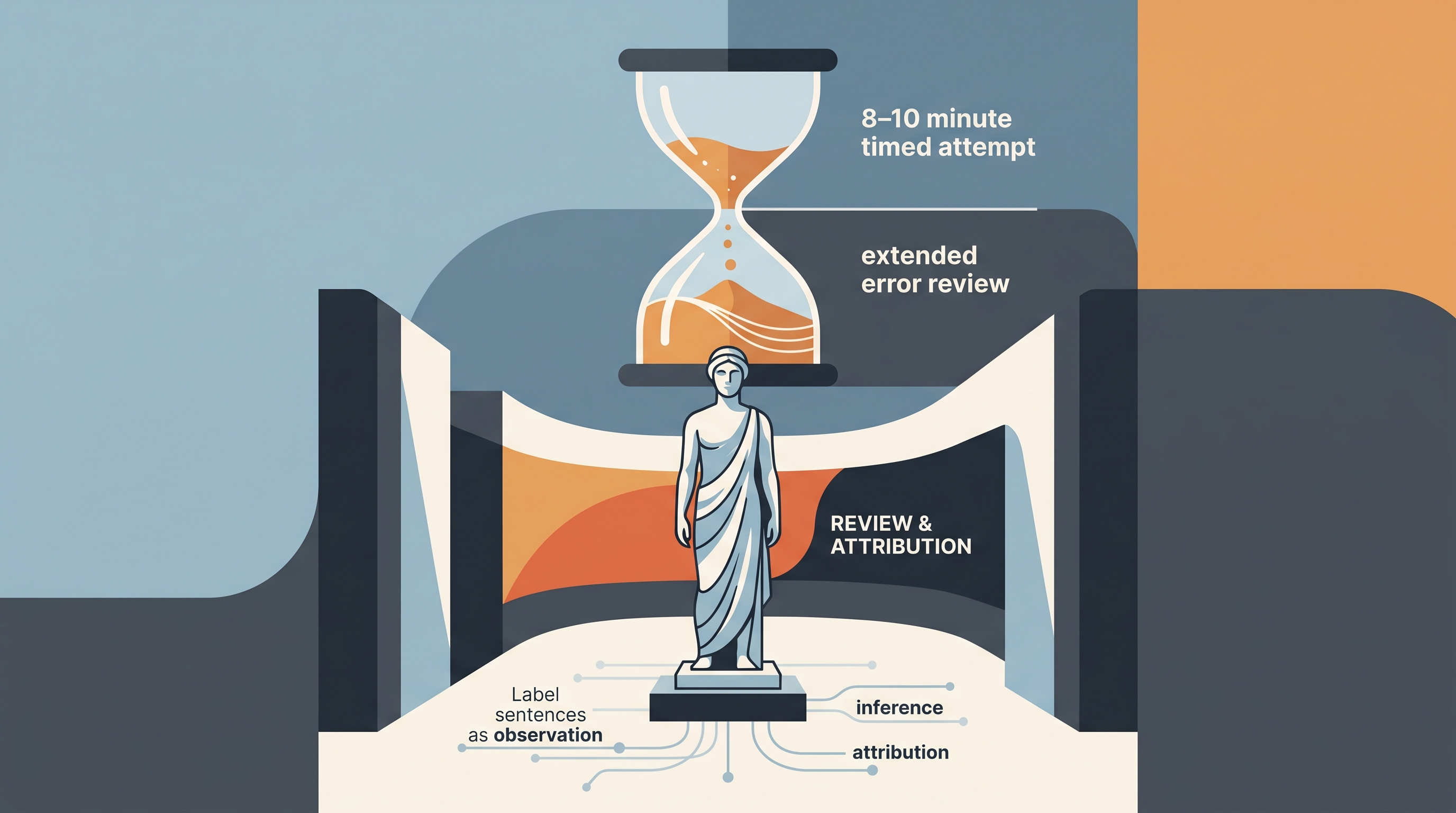
Allow approximately 8–10 minutes for this task: one minute to inspect, four minutes to build evidence-based reasoning, three minutes to write, and one or two minutes to check whether every claim has support. Afterward, label each sentence in your response as observation, inference, or attribution. If an attribution has no preceding observation, it is probably a guess.
Retrieval check: Why is “the sculpture has a frontal pose” stronger evidence than “the sculpture looks spiritual”? The first is directly observable; the second is an interpretation that requires cultural and functional support.
Source Materials
- AP Art History Course and Exam Description
- AP Art History Course and Exam Description Clarifications and Corrections
- AP Art History Course Overview
- AP Art History Course at a Glance
- AP Art History Course at a Glance Poster
- Adopt AP Art History
- AP Art History
- AP Art History
- AP Art History-AP Students
- AP/College Art History-Khan Academy
- AP Art History-Wikipedia
- AP Art History-Smart History