From the free course AP Art History on Lykke
3.1 Course placement
Key concepts: Interaction with work · Restricted access · Growing up · Those that are considered
Art does not exist outside time, place, or systems of access: a work’s meaning changes when it moves from a ritual setting into a museum, from a private collection into public view, or from one culture into another interpretive framework.
3.1 Course placement
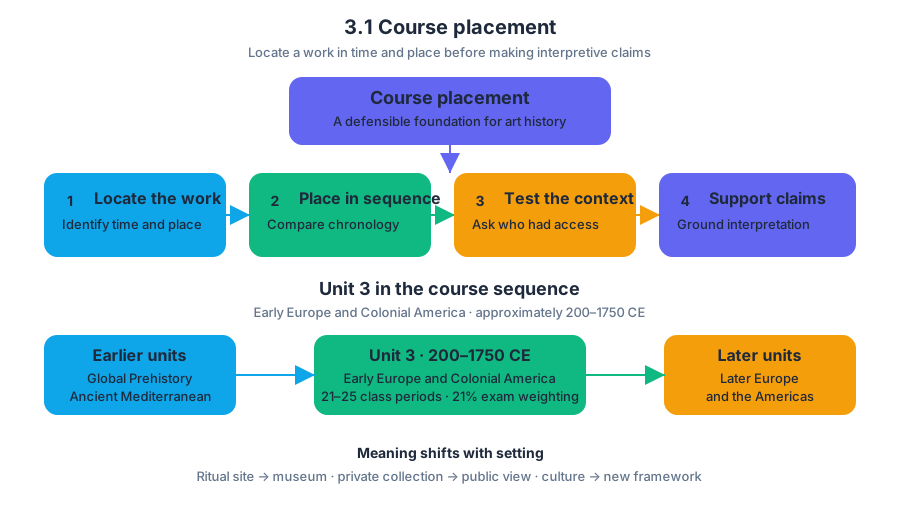
Art does not exist outside time, place, or systems of access: a work’s meaning changes when it moves from a ritual setting into a museum, from a private collection into public view, or from one culture into another interpretive framework. Course placement is the act of locating a work within the chronological and geographic structure of art history so that later claims about its culture, purpose, materials, and interpretation have a defensible foundation.
Unit 3 places Early Europe and Colonial America between approximately $200$ and $1750$ CE. In the larger sequence, it follows Global Prehistory and the Ancient Mediterranean and precedes Later Europe and the Americas. Its published guidance is approximately $21$–$25$ class periods and about $21%$ of the AP Exam weighting, making it one of the course’s most substantial units.
What “placement” actually establishes
Placement answers four basic questions before interpretation begins:
- When was the work made? A date prevents anachronism—the mistake of explaining an earlier work through ideas, technologies, or identities that developed later.
- Where was it made or used? Geographic placement identifies the cultural networks, political structures, religions, and artistic traditions that shaped it.
- Which historical unit contains it? Unit 3 emphasizes Europe and the colonial Americas during a period of religious transformation, imperial expansion, global exchange, and changing systems of patronage.
- What evidence supports the placement? Style, materials, inscriptions, provenance, architectural setting, and historical records can all contribute.
This is not merely memorizing a date. It is more like placing a puzzle piece before deciding what image it forms: the surrounding historical conditions limit which interpretations are plausible.
Placement is not the same as meaning
A work’s placement provides context, but it does not automatically reveal its purpose. Two objects made in the same century and region may have completely different audiences or functions. Likewise, an object can interact with several cultures without belonging equally to all of them.
For example, when analyzing a work associated with colonial America, a strong response should distinguish between its location of production, its intended audience, and the communities that later encountered it. Access may have been restricted by class, gender, race, religious status, or physical location. A work displayed in a church, palace, court, or private household did not communicate identically to everyone who could—or could not—enter that space.
Key distinction: Context explains the conditions surrounding a work; visual evidence explains how the work itself communicates within those conditions.
Interaction, access, and the “outsider” problem
The surviving notes associated with this topic emphasize interaction with the work, restricted access, growing up, and those considered outsiders. These ideas matter because art history studies not only objects but also the people permitted to see, handle, commission, inherit, interpret, or reject them.
Interaction with the work can mean physical contact, ritual use, movement around an architectural space, or intellectual interpretation. A sculpture intended to be approached from multiple sides functions differently from a painting designed for a distant altar. A work’s original placement therefore matters: moving it after the first week, especially because of dust or safety concerns, could alter viewing conditions and audience behavior even if the object itself remained unchanged.
Restricted access is evidence, not a minor logistical detail. If only priests, monarchs, initiates, household members, or selected viewers could encounter a work, that limitation helps explain its scale, imagery, materials, and message. The phrase “outsiders” must also be handled carefully: it may describe a community’s social boundary, but it should not be treated as a neutral or universal label. Ask who created the boundary, who benefited from it, and who was excluded?
A worked placement example
Imagine an unfamiliar European work dated near $1600$ and originally installed in a religious interior. Begin with observable evidence: its subject, scale, materials, viewpoint, and relationship to surrounding architecture. Then establish placement: the date places it within Unit 3, while the religious setting suggests that patronage, ritual practice, and audience access may be central contextual questions.
Next, separate evidence from inference. You can claim that the original placement shaped viewing because the work was designed for a particular architectural environment. You should not claim that every person in the society experienced it identically unless evidence supports that conclusion. This movement—from visual observation to historically bounded interpretation—is the core habit of course placement.
Misconception check
Misconception: “Course placement means labeling a work with a date and region.” Correction: placement is the beginning of reasoning, not the endpoint. A precise answer connects chronology and geography to access, interaction, audience, cultural contact, and the evidence visible in the work.
This topic activates CR5: Visual analysis, CR6: Contextual analysis, CR7: Comparison of works of art, CR8: Artistic traditions, CR9: Visual analysis of unknown works, CR10: Attribution of unknown works, CR11: Art historical interpretations, and CR12: Argumentation using claims and evidence. In practice, the most immediate skills are visual analysis, contextual analysis, attribution, and argumentation: identify what you see, locate it historically, test competing explanations, and support the strongest claim with evidence.
Retrieval check: If a work was moved from its original setting because of dust or safety concerns, what might change even if its materials and imagery stayed the same? Name one change in audience interaction and one contextual question that would follow.

Source Materials
- AP Art History Course and Exam Description
- AP Art History Course and Exam Description Clarifications and Corrections
- AP Art History Course Overview
- AP Art History Course at a Glance
- AP Art History Course at a Glance Poster
- Adopt AP Art History
- AP Art History
- AP Art History
- AP Art History-AP Students
- AP/College Art History-Khan Academy
- AP Art History-Wikipedia
- AP Art History-Smart History