From the free course AP Art History on Lykke
3.5 3.4 Purpose and Audience in Early European and Colonial American Art
Key concepts: Purpose, patron, and intended audience · Function and context of art · Reception of works of art · Artistic decisions about form, materials, content, and function · Changing functions over time · Influence of differing situations and contexts · Corporate and private patronage · Academies and centralized art training · Juried salons · Artist identity and professionalization
A work of art is never only an image: it is also a commissioned object, a functional object, a public statement, or a private encounter shaped by purpose, patron, and intended audience.
3.5 3.4 Purpose and Audience in Early European and Colonial American Art
A work of art is never only an image: it is also a commissioned object, a functional object, a public statement, or a private encounter shaped by purpose, patron, and intended audience. The same object can produce different responses when its location, users, or function changes.
Enduring Understanding PAA-1: A variety of purposes may affect art and art making, including intended audience, patron, artistic intention, and function. Differing situations and contexts may influence the artist, patron, or intended audience; functions may also change over time, altering a work’s interpretation and reception.
For Topic 3.4 Purpose and Audience in Early European and Colonial American Art, the central analytical tools are 2.B: Explain how the possible intent, purpose, and/or function shape the creation or meaning of a work of art (or group of related works of art) and 2.D: Explain how artistic decisions about form, style, materials, content, function, and/or context of a work of art (or group of related works of art) elicit a response or shape its reception. The relevant framework identifier is PAA-1.A, including PAA-1.A.35, which connects diverse art forms to their perceived purposes and functions.
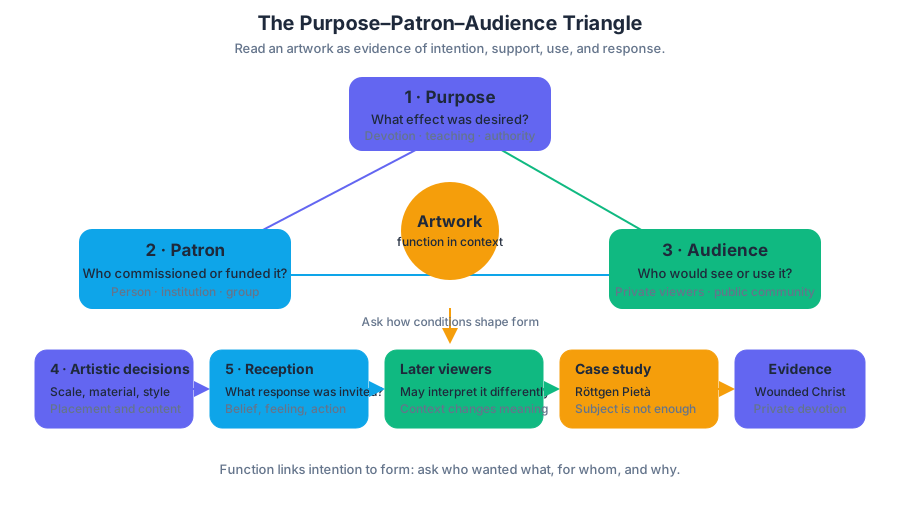
The purpose–patron–audience triangle
A patron is the person, institution, or group that commissions, funds, owns, or otherwise supports a work. The intended audience is the group for whom the work is designed, while function means what the work is meant to do—such as inspire devotion, commemorate authority, teach doctrine, persuade viewers, or serve a ritual purpose.
Use the triangle as a chain of evidence:
- Purpose: What effect or action was desired?
- Patron: Who requested or financed the work?
- Audience: Who was expected to see, use, or interpret it?
- Artistic decisions: How do form, materials, content, scale, placement, and style serve those conditions?
- Reception: What response did the work invite, and how might later viewers respond differently?
The Röttgen Pietà demonstrates why analyzing an artwork requires more than identifying its subject. Its intensely wounded Christ and emotionally forceful form could support private devotional use by encouraging meditation on suffering. The work’s purpose helps explain why its exaggerated physical details are not simply “bad anatomy”: they are artistic decisions designed to elicit a powerful devotional response.
Function changes, and reception changes with it
The Isenheim altarpiece was made for the Antonine monastery at Isenheim and served a specialized religious and therapeutic context. Its imagery of Christ’s suffering could speak directly to patients suffering from disease, while its movable wings revealed different scenes for different liturgical occasions. Form, content, location, and changing display conditions worked together to shape the original audience’s experience.
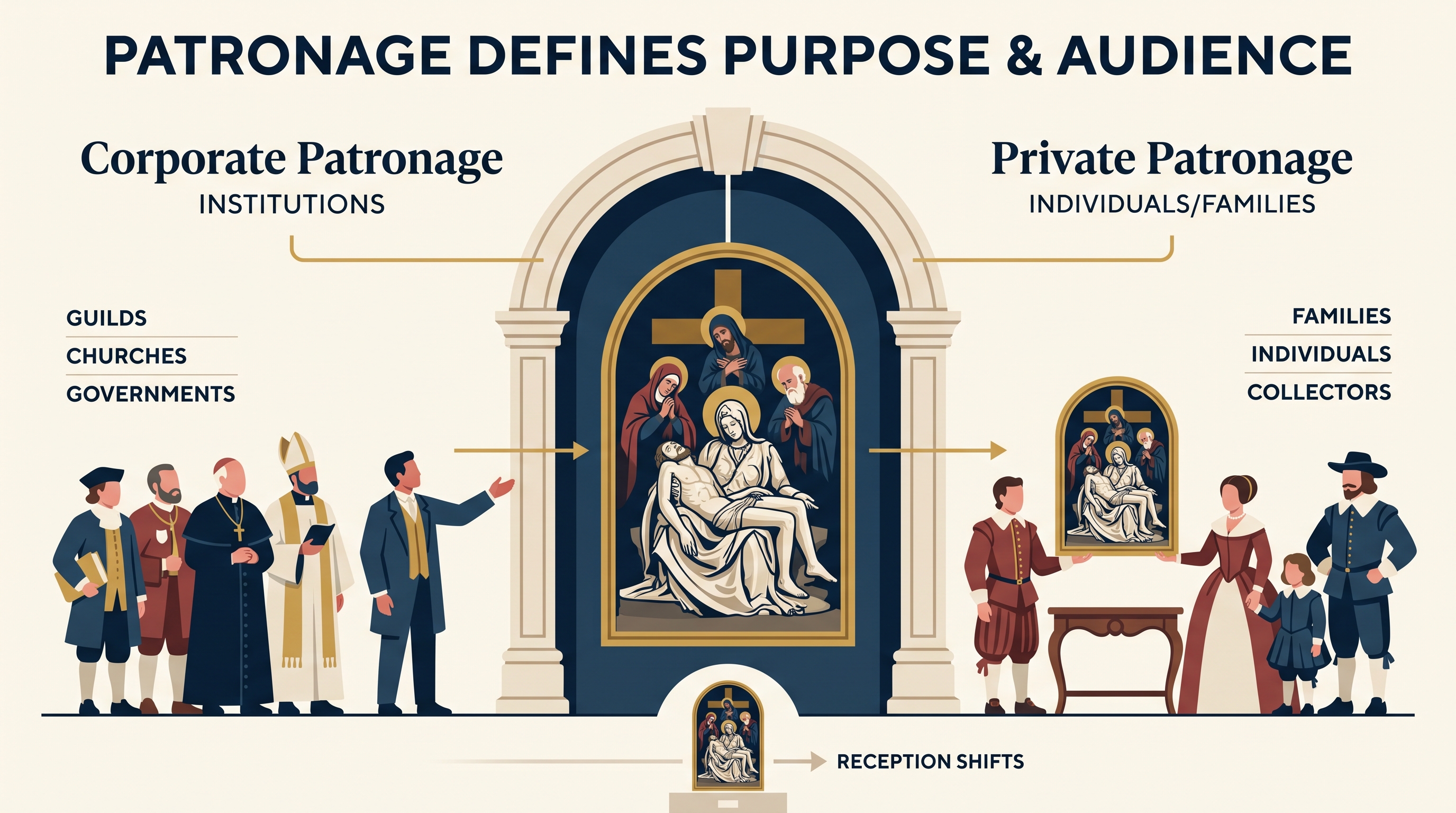
A work’s reception is the way viewers respond to and interpret it. Reception is not fixed: when an object moves from a chapel, palace, or civic setting into a museum, its audience and function may change. The work may become an art-historical example rather than a devotional, political, or communal instrument.
Misconception check — “The subject determines the meaning.”
A painting of the Virgin, Christ, or a ruler does not have one automatic meaning. Ask who commissioned it, where it was displayed, what viewers were expected to do, and which material or formal choices directed their response.
Art, power, and political audiences
Leonardo’s The Last Supper was created for the refectory of the Dominican convent of Santa Maria delle Grazie in Milan. Its placement among the monks’ communal meals made the subject functionally immediate: the friars encountered Christ and the apostles in a space devoted to eating together. Leonardo’s arrangement of figures, gestures, and emotional reactions directs attention toward Christ while making the sacred narrative relevant to the viewers’ daily setting.
In Henri IV Receives the Portrait of Marie de’ Medici, Rubens presents dynastic marriage as a political achievement. The patron, Marie de’ Medici, needed a visual program that affirmed legitimacy and royal continuity; the intended audience included the French court and later political viewers. Allegory, lavish materials, theatrical movement, and imperial scale transform a personal marriage into a public statement about monarchy.
Institutions reshape the artist’s identity
The emergence of sanctioned academies changed how art was taught and how artists were understood. Academies organized artists within centralized educational institutions and provided structured, theoretical curricula, often emphasizing drawing, classical models, anatomy, perspective, and accepted hierarchies of subject matter. The artist increasingly appeared not merely as a craftsperson but as an educated intellectual whose status depended on institutional recognition.
Artists pursued inclusion in juried salons, official exhibitions in which committees selected works for public display. Salon systems could shape careers by determining visibility, reputation, sales, and critical reception. A work’s reception therefore depended not only on its visual qualities but also on institutional gatekeeping: who was allowed to exhibit, where the work appeared, and which audiences encountered it.
Patronage beyond the court
Corporate patronage comes from institutions such as churches, monasteries, guilds, governments, academies, or businesses. Private patronage comes from individuals or families. Both forms connect production to purpose and audience: a church commission may prioritize ritual and instruction, while a private commission may emphasize family identity, status, devotion, or collecting.
Worked interpretation: Suppose a question presents an altarpiece with dramatic religious imagery. A weak response says, “The artist used emotion to show Christianity.” A stronger 2.B and 2.D response explains that a religious patron commissioned the work for a devotional setting; the altarpiece’s subject, scale, placement, and emotional intensity addressed a particular audience and encouraged a specific response. If the work later enters a museum, its function changes, so its reception changes as well.
Retrieval check: For the Röttgen Pietà, identify one likely purpose, one audience, and one artistic decision that supports your claim. Then explain how moving the work from a devotional setting to a museum could alter its interpretation. A complete answer must connect purpose or function to visible form and then to audience response.