From the free course AP Art History on Lykke
5.4 Theories and Interpretations of Indigenous American Art
Key concepts: Theories and interpretations of Indigenous American art · Pattern identification in art-historical analysis · Transformational animal-human iconography · Ethnographic approaches · Shamanic interpretations of iconography · Cross-cultural analysis · Archaeological, written, oral, and scientific evidence · Changing interpretations through new evidence and interdisciplinary research · Persecution, genocide, and marginalization in Indigenous American history · Contemporary Indigenous identity and artistic expression
Indigenous American art often preserves ideas that cannot be recovered from written records alone, so interpretation begins with a difficult question: How can scholars explain an image when its original makers left no written explanation of it?
5.4 Theories and Interpretations of Indigenous American Art
Indigenous American art often preserves ideas that cannot be recovered from written records alone, so interpretation begins with a difficult question: How can scholars explain an image when its original makers left no written explanation of it? The answer is not to guess from appearance, but to build, test, and revise interpretations from multiple kinds of evidence.
THR-1 states that art history is shaped by changing theories and interpretations derived from visual analysis and diverse scholarly disciplines. The learning objective THR-1.A asks students to explain how interpretations are shaped by visual analysis, other disciplines, technology, and the availability of evidence. For Topic 5.4, the associated Suggested Skill 7.B: Explain how evidence supports interpretations of works of art is the central reasoning process.
From visual pattern to historical hypothesis
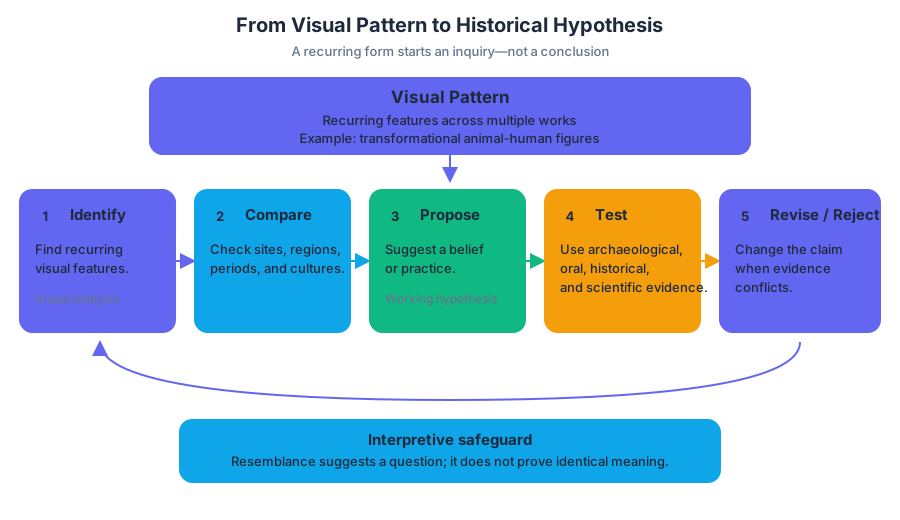
A pattern is a recurring visual feature identified across multiple works. For example, art historians may notice a prevalence of transformational animal-human iconography: figures that combine human and animal characteristics or appear to change between those states. Identifying the pattern is visual analysis; explaining what the pattern may have meant requires contextual and interdisciplinary evidence.
A useful interpretive sequence is:
- Identify a recurring form: What features repeatedly appear?
- Compare examples: Does the pattern occur across one site, region, period, or several cultures?
- Propose a hypothesis: What belief or practice might explain the recurrence?
- Test the hypothesis against archaeological, historical, oral, and scientific evidence.
- Revise or reject it if conflicting evidence appears.
This sequence prevents a common error: treating visual resemblance as proof of identical meaning. A repeated animal-human form may suggest a shared concern with transformation, but it does not automatically establish a single universal religion or artistic purpose.
Ethnography and the shamanic hypothesis
Ethnographic approaches use the study of living or historically documented communities to develop hypotheses about cultural practices and meanings. Applied carefully, ethnography can help scholars ask whether transformational imagery relates to ritual specialists, altered states of consciousness, healing, or communication with supernatural forces.
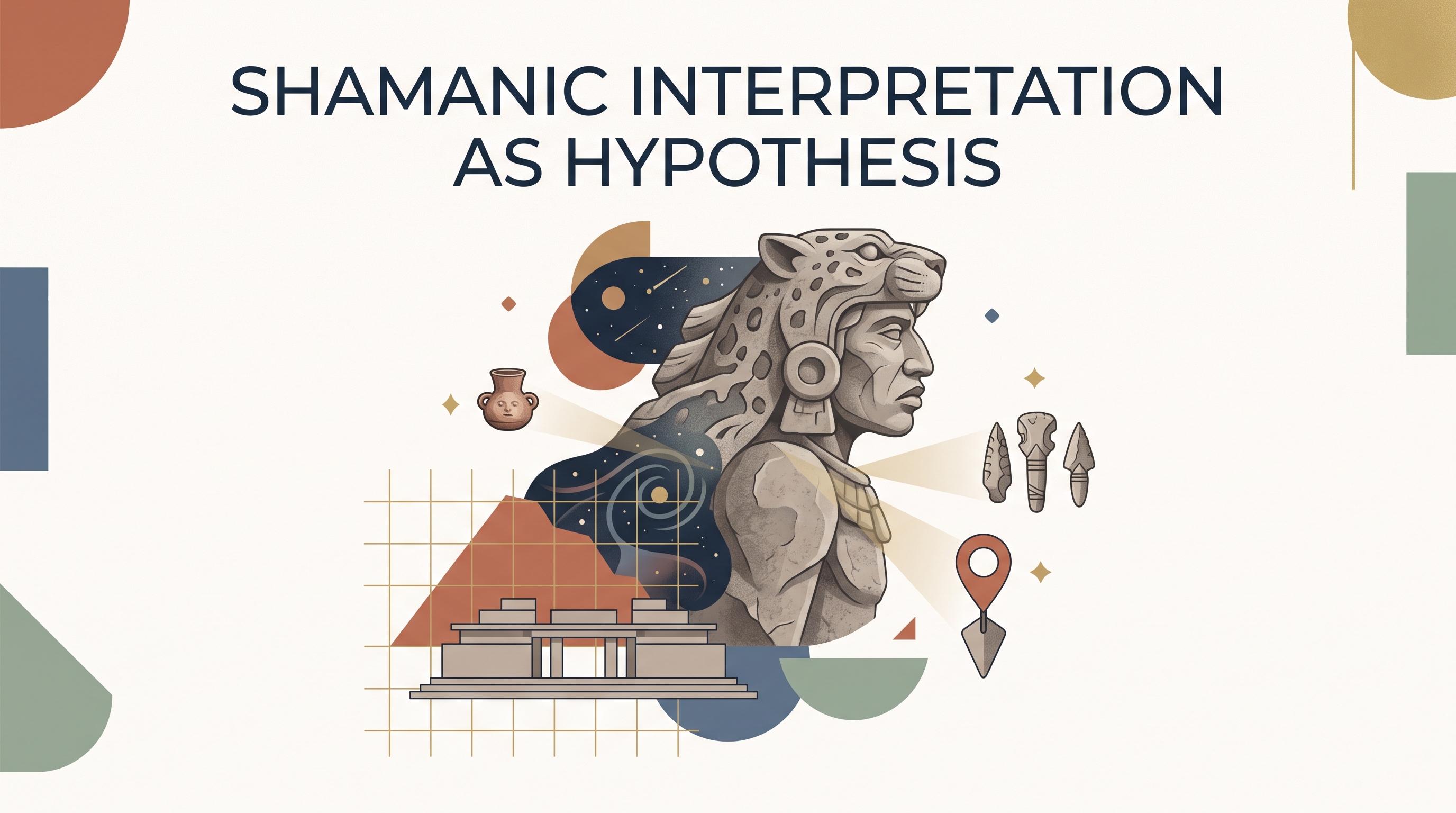
One proposed interpretation is that certain animal-human iconography may be shamanic in nature. Here, “shamanic” functions as a hypothesis about ritual transformation or visionary experience—not as a label that automatically explains every ambiguous image. The interpretation becomes stronger only when visual evidence aligns with independent evidence about ritual practice, belief, place, or material use.
Key distinction: A shamanic interpretation is an evidence-based proposal, not a certainty produced by the presence of an animal-human figure.
Worked example — Chavín de Huántar: A scholar could begin by identifying hybrid or transformational imagery at the site, then examine its placement, archaeological context, associated objects, and evidence for ceremonial activity. If those forms occur in spaces connected with ritual performance, an interpretation involving transformation or visionary practice may become plausible; if other evidence contradicts that reading, the theory must be refined or abandoned.
Evidence is a network, not a single clue
Interpretations of Indigenous American art should draw on several evidence types:
| Evidence | What it can contribute |
|---|---|
| Archaeological data | Site placement, objects, chronology, and patterns of use |
| Written records | Observations, descriptions, and historical changes, when available |
| Oral histories | Community-held accounts, meanings, and cultural memory |
| Scientific fields such as botany | Evidence about plants, medicines, foodways, or ritual substances |
| Visual analysis | Form, imagery, composition, scale, and recurring motifs |
These forms of evidence can be diverse and sometimes conflicting. A written account may reflect a colonizer’s assumptions; an archaeological discovery may challenge an earlier interpretation; botanical evidence may alter what scholars understand about ritual or subsistence. Consequently, theories can change as new evidence and cross-disciplinary research become available.
Cross-cultural comparison: useful, but limited
Cross-cultural analysis compares works or practices from different societies to identify broader patterns. Rock and cave expressions from South African, Asian, and Indigenous American peoples, for instance, can be compared as evidence of a wider visionary aesthetic. The comparison may establish a general similarity in human artistic behavior without proving that the cultures shared the same beliefs.
Misconception check — “same image, same meaning”: Similar imagery does not guarantee cultural contact or identical interpretation. Cross-cultural comparison is strongest when it distinguishes visual resemblance from demonstrated historical connection and explains both similarities and differences.
Colonial violence and interpretation
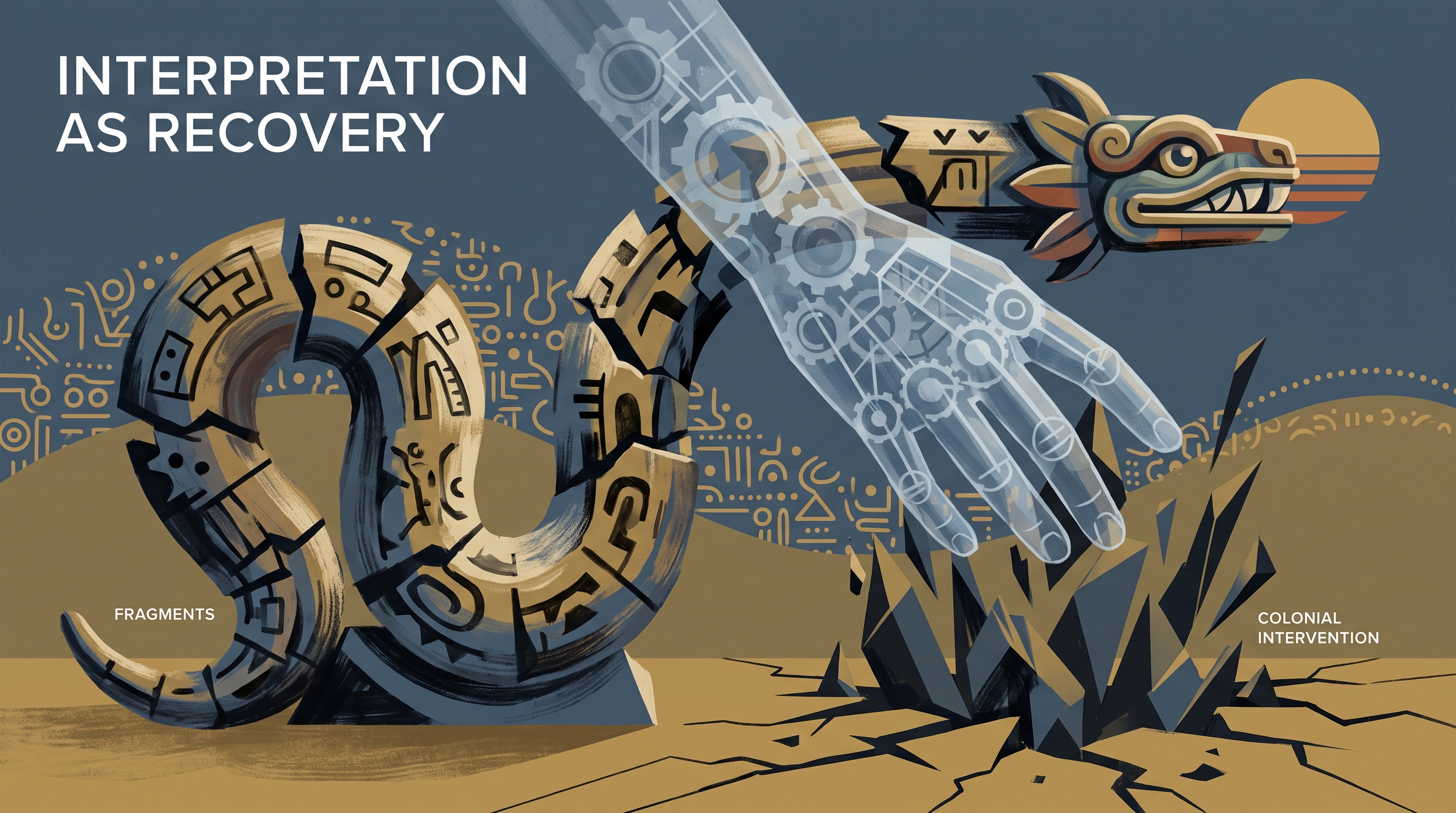
Interpretation must also account for historical conditions that shaped which artworks survived, how they were recorded, and how Indigenous peoples are represented today. Persecution, genocide, and marginalization have shaped the current identity and artistic expression of Amerindian survivors; these forces also affected the evidence available to scholars and the categories outsiders used to describe Indigenous art.
Great Serpent Mound demonstrates why interpretation requires more than visual description. Its massive serpentine form invites pattern recognition, but archaeological context, Indigenous histories, changing scholarly theories, and the effects of colonial marginalization all influence what claims can responsibly be made about its meaning.
Retrieval check
A scholar sees recurring animal-human imagery and proposes a shamanic interpretation. What would Suggested Skill 7.B require next? The strongest answer is: identify the visual evidence, connect it to archaeological, oral, written, or scientific evidence, acknowledge uncertainty, and explain how confirming or conflicting evidence could change the interpretation.