From the free course AP Microeconomics on Lykke
6.3 Public and Private Goods** `[POL]`
Key concepts: Public goods · Private goods · Rivalry · Excludability · Free-rider problem · Open-access resources · Externalities · Private costs and benefits versus social costs and benefits · Government provision of public goods · Policies for addressing externalities
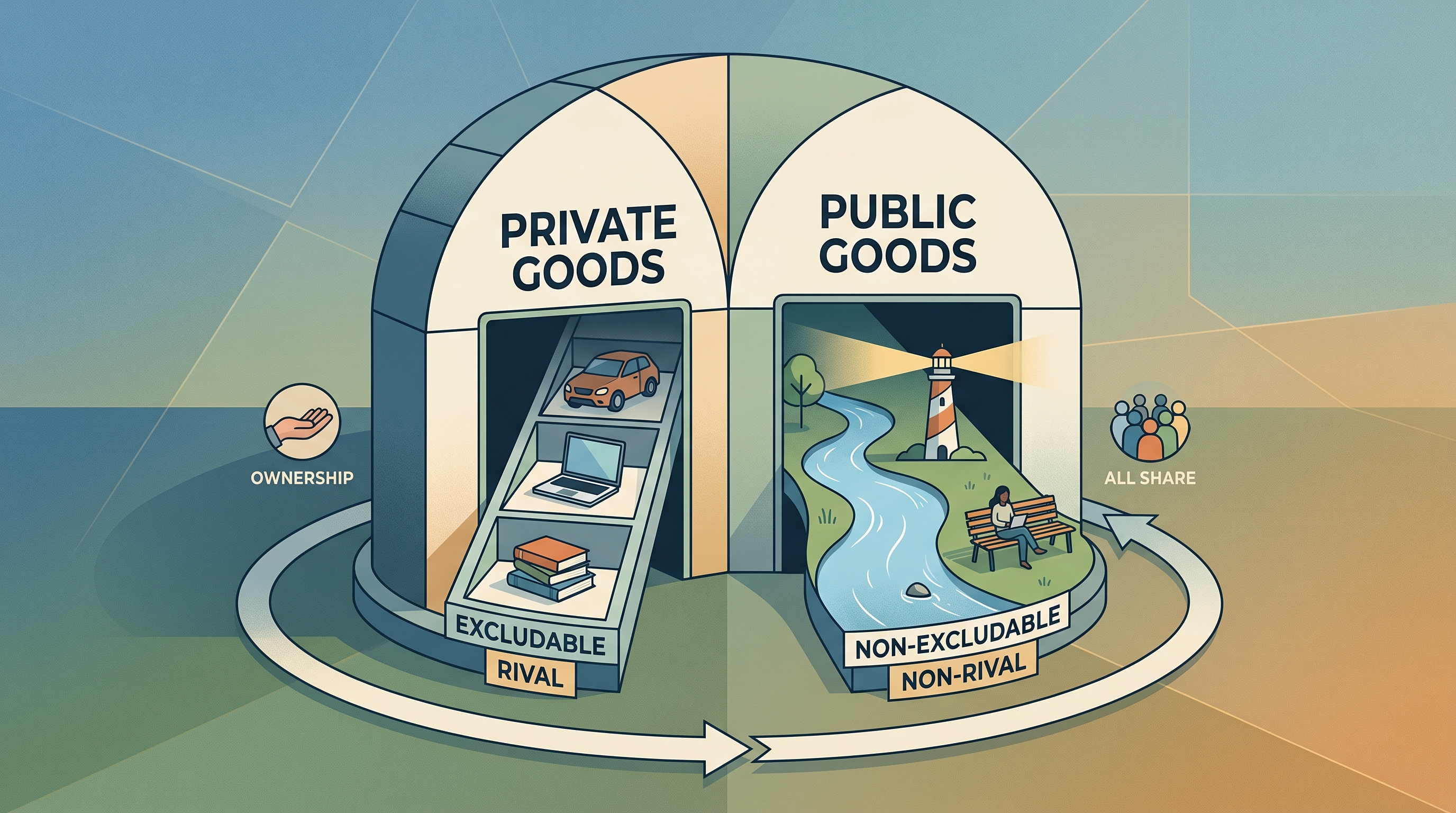
A private good can be used by one person while others are prevented from using it; a public good can be shared without reducing anyone else’s use and cannot easily be withheld from nonpayers.
6.3 Public and Private Goods** [POL]
A private good can be used by one person while others are prevented from using it; a public good can be shared without reducing anyone else’s use and cannot easily be withheld from nonpayers. The decisive questions are not whether government supplies the good, but whether the good itself is rival and excludable.
The two tests: rivalry and excludability
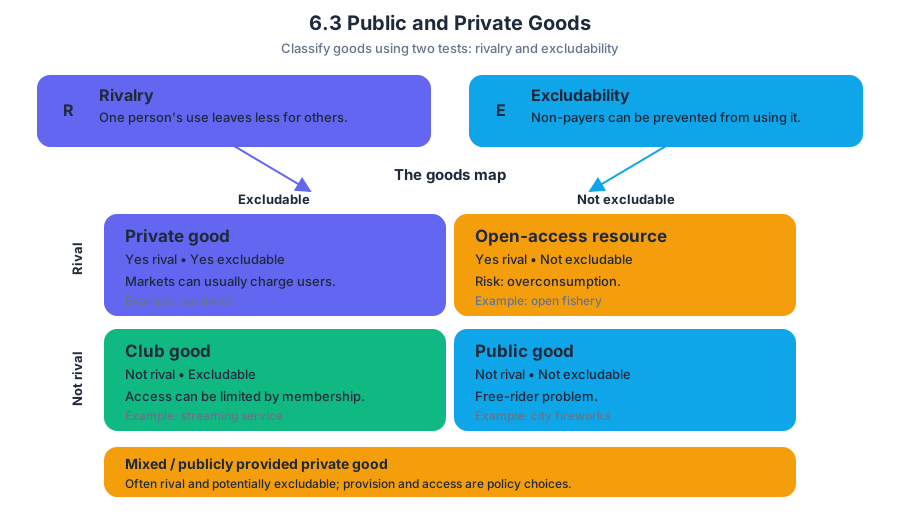
Rivalry means that one person’s consumption leaves less of the good available for someone else. Excludability means that a seller or owner can prevent people who do not pay from consuming the good.
| Type of good | Rival? | Excludable? | Typical incentive problem |
|---|---|---|---|
| Private good | Yes | Yes | Markets can usually charge users |
| Public good | No | No | Free-rider problem |
| Open-access resource | Yes | No | Overconsumption |
| Mixed or publicly provided private good | Often yes | Potentially yes | Provision and access are policy choices |
A sandwich is a private good: if one person eats it, nobody else can eat that same sandwich, and a shop can refuse service without payment. A city fireworks display is public: one additional viewer usually does not diminish other viewers’ experience, and excluding every nonpayer is difficult.
Public goods and the free-rider problem
POL-3.C.1: Private goods are rival and excludable, while public goods are non-rival and non-excludable. A free rider is someone who receives the benefit of a good without paying for it.
Suppose ten households would each value neighborhood flood-warning sirens at $30, so the total marginal social benefit of the system is $300. If installation costs $200, the system is socially worthwhile. Yet each household may reason, “The sirens will protect me even if I contribute nothing.” Because the good is non-excludable, private producers may be unable to collect enough revenue.
POL-3.C.2 identifies the resulting market failure: private individuals usually lack the incentive to produce public goods, leaving government as the only producer in the simplified model. Government can tax many residents and provide the good to everyone, turning individually voluntary contributions into collective financing.
Key distinction: A good’s economic nature is different from its provider. Government may provide a public good, but government provision does not automatically make a good public.
POL-3.C.3: Governments sometimes produce private goods, such as educational services, and allow free access to them. A classroom seat may be rival when capacity is limited, even if the government provides it without charging students directly.
Open-access resources: rival but non-excludable
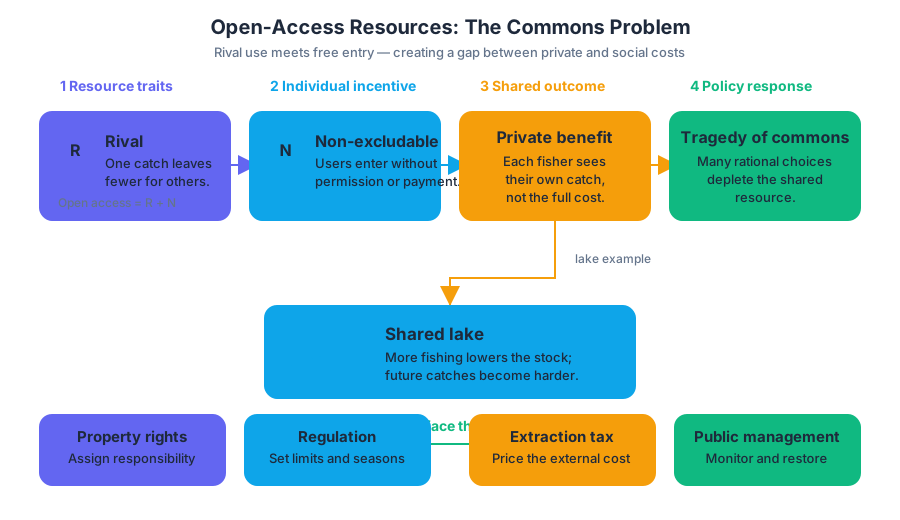
An open-access resource is rival and non-excludable. Because users can enter without paying or receiving permission, each person considers the private benefit of taking one more unit but may ignore the reduction imposed on everyone else.
Consider a lake open to every fisher. The first few fishing trips may impose little cost on others, but as the fish population falls, each additional catch makes future catches harder. Individually rational fishers therefore continue entering, while the group experiences inefficient overconsumption—often called the tragedy of the commons.
POL-3.C.4: Natural resources can be non-excludable and rival, making them open access; private individuals inefficiently overconsume them. Assigning property rights, regulating use, taxing extraction, or providing public management can make users account for costs that private decisions otherwise omit.
Connecting goods to externalities and policy
The externality framework supplies the efficiency test: the socially optimal quantity occurs where marginal social benefit equals marginal social cost, $MSB = MSC$, maximizing total economic surplus (POL-3.A.1). Rational agents normally respond to private costs and benefits rather than external costs and benefits (POL-3.A.3), so markets may produce too little of a good with positive spillovers or too much of a good with negative spillovers.
Policies listed in POL-3.B.1 include taxes, subsidies, environmental regulation, public provision, and the assignment or reassignment of property rights. The appropriate remedy depends on the failure: subsidies or public provision can encourage beneficial goods, while taxes, regulation, or enforceable ownership can limit harmful use.
Misconception check
Misconception: “Anything government provides is a public good.” False. Classification depends on rivalry and excludability, not on whether the provider is a government, nonprofit, or firm. A government-funded meal remains rival and excludable in its physical nature; a privately funded radio broadcast may be non-rival and difficult to exclude listeners from.
AP reasoning in action
This topic activates Skill Category 1: Principles and Models when defining rivalry, excludability, and the free-rider problem; Skill Category 2: Interpretation when explaining why individuals overconsume open-access resources; Skill Category 3: Manipulation when predicting the effect of a tax, subsidy, regulation, or property-right assignment; and Skill Category 4: Graphing and Visuals when showing how private and social marginal costs or benefits differ.
Retrieval check: A resource is rival and non-excludable. What category is it, and what behavior should you predict? The answer is an open-access resource, with a tendency toward inefficient private overconsumption because users cannot easily be excluded and each user imposes costs on others.
Source Materials
- AP Microeconomics Course and Exam Description
- AP Microeconomics Course and Exam Description Clarifications and Corrections
- AP Microeconomics Course Overview
- AP Microeconomics Course at a Glance
- AP Microeconomics Course at a Glance Poster
- AP Microeconomics
- AP Microeconomics
- AP Microeconomics Sample Syllabus 1