From the free course AP Microeconomics on Lykke
3.1 The Production Function** `[PRD]`
Key concepts: Production function · Inputs and outputs · Short run · Long run · Marginal product · Average product · Factors of production · Accounting profit · Economic profit · Implicit costs
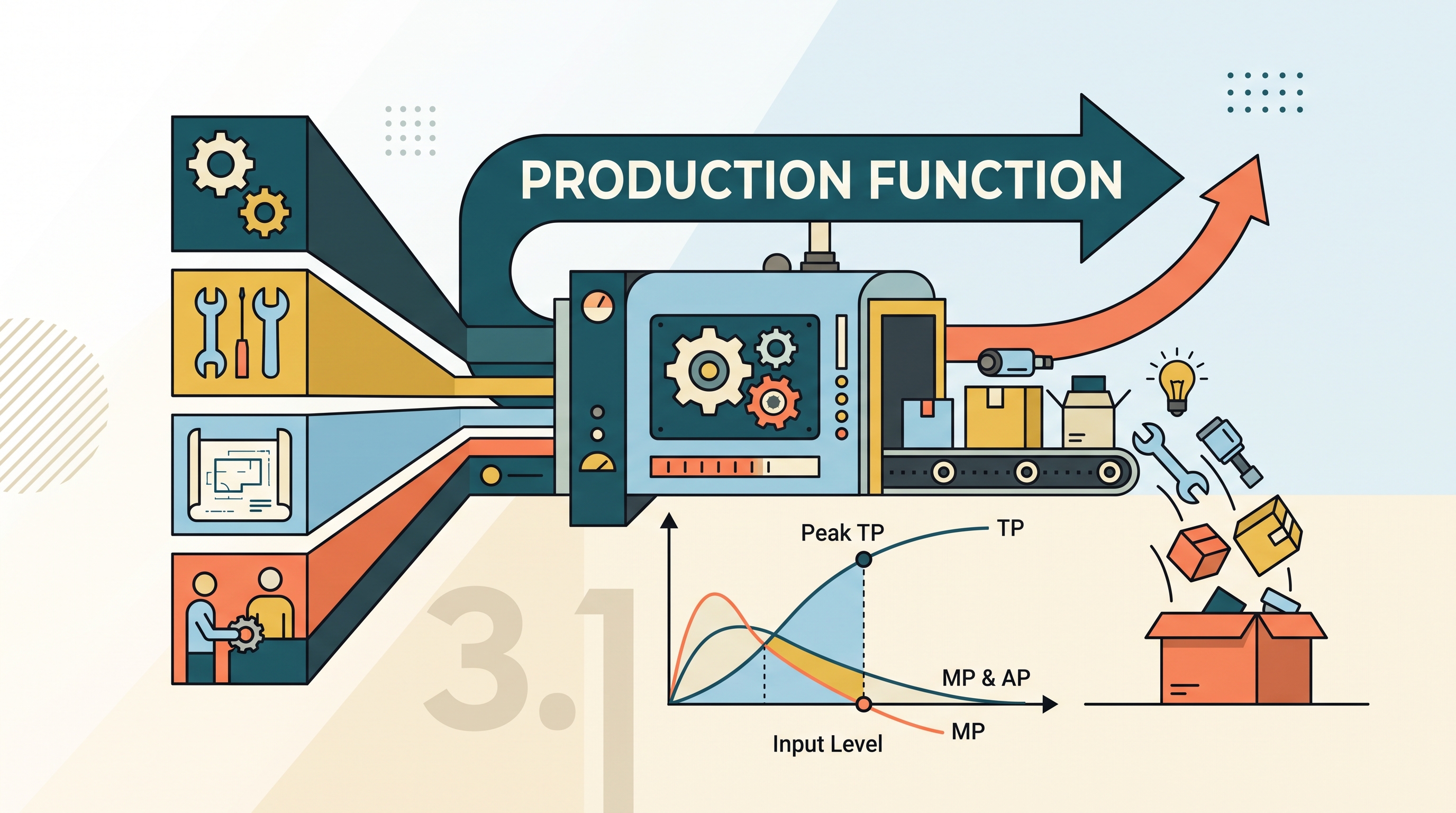
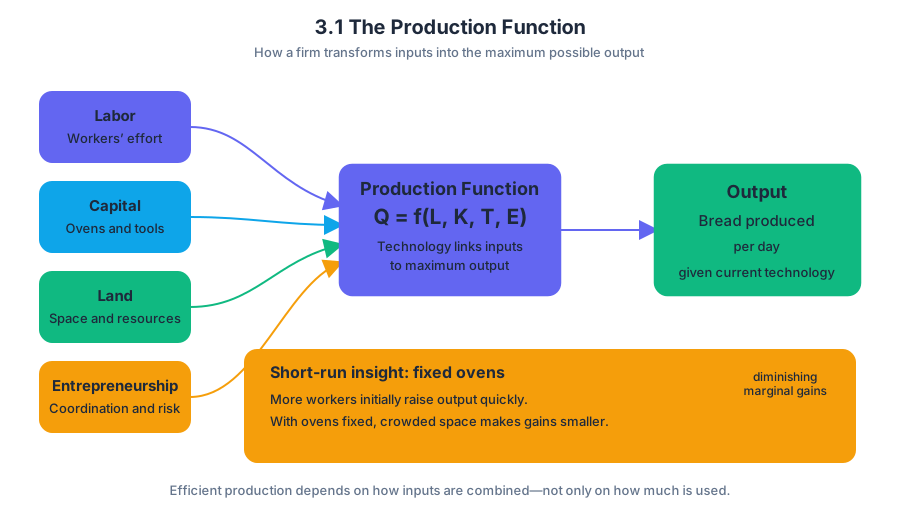
A bakery can produce more bread by hiring workers, adding ovens, or changing both—but the output depends on how those inputs are combined. The production function describes that relationship: it shows the maximum output a firm can produce from particular quantities of inputs, given its technology.
3.1 The Production Function** [PRD]
A bakery can produce more bread by hiring workers, adding ovens, or changing both—but the output depends on how those inputs are combined. The production function describes that relationship: it shows the maximum output a firm can produce from particular quantities of inputs, given its technology.
Production function: the relationship between inputs—such as labor, capital, land, and entrepreneurship—and the resulting output.
For example, a bakery’s daily output depends on workers and ovens. If the bakery adds workers while keeping the number of ovens fixed, output may initially rise quickly, then rise more slowly as the workspace becomes crowded. This connection between input use and output is the foundation for analyzing a firm’s production choices and efficiency.
Inputs, outputs, and the time horizon
An input is a resource used to produce a good or service; output is the quantity produced. Inputs may include labor, physical capital, raw materials, land, and entrepreneurial ability. The production function can be represented as:
$$Q = f(L,K)$$
Here, $Q$ is output, $L$ is labor, and $K$ is capital. The function does not merely list resources; it describes how different combinations of resources translate into output.
The distinction between the short run and the long run is based on whether inputs can be changed, not on a fixed number of calendar months.
| Time horizon | Meaning | Bakery example |
|---|---|---|
| Short run | At least one input is fixed | The bakery can hire workers but cannot immediately expand its building or install another oven |
| Long run | All inputs are variable | The bakery can change its workforce, building size, ovens, and production process |
In the short run, a firm makes production decisions around a fixed input. In the long run, the firm can alter the entire scale of operation. This distinction matters because increasing labor in a small kitchen is fundamentally different from expanding the kitchen and purchasing additional ovens.
Marginal product and average product
The marginal product of an input is the additional output produced by using one more unit of that input while holding other inputs constant:
$$MP_L = \frac{\Delta Q}{\Delta L}$$
The average product of labor is output per worker:
$$AP_L = \frac{Q}{L}$$
Consider this short-run production schedule for a bakery with one fixed oven:
| Workers, $L$ | Total output, $Q$ | Marginal product, $MP_L$ | Average product, $AP_L$ |
|---|---|---|---|
| $0$ | $0$ | — | — |
| $1$ | $12$ | $12$ | $12$ |
| $2$ | $28$ | $16$ | $14$ |
| $3$ | $40$ | $12$ | $13.33 |
| $4$ | $48$ | $8$ | $12 |
| $5$ | $52$ | $4$ | $10.4 |
For the third worker,
$$MP_L = \frac{40-28}{3-2}=12$$
The worker adds $12$ loaves. At four workers, total output is $48$ loaves, so:
$$AP_L=\frac{48}{4}=12$$
The table also illustrates diminishing marginal returns: as more workers are added to the fixed bakery and oven, marginal product eventually falls. Diminishing marginal returns do not mean total output immediately decreases. They mean output continues to increase at a decreasing rate.
Productivity and efficiency
A factor of production is more productive when it generates more output from the same amount of resources. Better worker training, improved equipment, or superior technology can raise marginal product and average product. Higher productivity allows a firm to produce more output without proportionally increasing input use, improving productive efficiency.
Misconception check: “Diminishing marginal returns means the firm should stop producing.”
Not necessarily. Diminishing marginal returns describe the pattern of additional output. A firm should continue adding an input whenever the additional revenue generated by that input exceeds its additional cost—a marginal decision developed in later production and cost analysis.
Accounting profit versus economic profit
Accounting profit subtracts explicit costs—actual monetary payments such as wages, rent, electricity, and ingredients—from total revenue:
$$\text{Accounting profit}=\text{Total revenue}-\text{Explicit costs}$$
Economic profit also subtracts implicit costs, the opportunity costs of resources owned and supplied by the firm’s decision-maker:
$$\text{Economic profit} =\text{Total revenue}-\text{Explicit costs}-\text{Implicit costs}$$
Suppose Maya leaves a job paying $36,000 per year to operate a bakery. The bakery earns $120,000 in revenue and pays $70,000 in explicit costs.
$$\text{Accounting profit}=120{,}000-70{,}000=$50{,}000$$
Maya’s forgone salary is an implicit cost of $36,000:
$$\text{Economic profit}=120{,}000-70{,}000-36{,}000=$14{,}000$$
Maya earns both accounting and economic profit because revenue exceeds explicit and implicit costs. If revenue were $95,000, accounting profit would still be $25,000, but economic profit would be negative:
$$95{,}000-70{,}000-36{,}000=-$11{,}000$$
The bakery would show an accounting profit but an economic loss. That result means Maya earns less than she could have earned in her next-best alternative.
AP reasoning in this topic
PRD-1.A.1 states that the production function explains the relationship between inputs and outputs in both the short run and the long run. PRD-1.A.2 emphasizes that marginal product and average product change as input use changes, changing total product. PRD-1.A.3 identifies diminishing marginal returns when more of one input is employed while other inputs remain constant.
The relevant skill is 1.A: Define economic concepts, principles, or models, including defining production functions, marginal product, average product, implicit costs, and economic profit. The topic also calls for 2.A: Explain economic concepts, principles, or models by connecting a changing input to output, productivity, and profit. When a prompt supplies a production table, use 3.A: Determine outcomes of specific economic situations to calculate marginal product and interpret the result; use 4.A: Draw and label graphs or visual representations when representing the production relationship.
Retrieval check: A worker increases output from $40$ units to $48$ units when the workforce rises from $3$ to $4$. What is the worker’s marginal product? If the firm earns accounting profit but has a negative economic profit, what implicit cost must be responsible?
Source Materials
- AP Microeconomics Course and Exam Description
- AP Microeconomics Course and Exam Description Clarifications and Corrections
- AP Microeconomics Course Overview
- AP Microeconomics Course at a Glance
- AP Microeconomics Course at a Glance Poster
- AP Microeconomics
- AP Microeconomics
- AP Microeconomics Sample Syllabus 1
- AP Microeconomics-AP Students-College Board
- AP/College Microeconomics-Khan Academy
- AP Microeconomics Exam Questions-AP Central-College Board
- AP Microeconomics Practice FRQ Questions-ReviewEcon