From the free course AP Microeconomics on Lykke
3.6 Firms’ Short-Run Decisions to Produce and Long-Run Decisions to Enter or Exit a Market** `[PRD]`
Key concepts: Marginal analysis · Short-run production decision · Long-run entry and exit · Profitability and economic profit · Fixed versus variable inputs · Perfect competition · Price-taking behavior · Allocative efficiency · Productive efficiency · Increasing-, decreasing-, and constant-cost industries
A firm can lose money today and still keep producing—but it cannot remain in that situation forever. The key distinction is the time horizon: in the short run, some inputs are fixed; in the long run, all inputs can change, so firms may enter or leave a market.
3.6 Firms’ Short-Run Decisions to Produce and Long-Run Decisions to Enter or Exit a Market** [PRD]
A firm can lose money today and still keep producing—but it cannot remain in that situation forever. The key distinction is the time horizon: in the short run, some inputs are fixed; in the long run, all inputs can change, so firms may enter or leave a market.
Learning Objective PRD-2.A: Explain how firms make short-run decisions to produce output and long-run decisions to enter or exit a market based on profitability.
Short-run operation: produce or shut down?
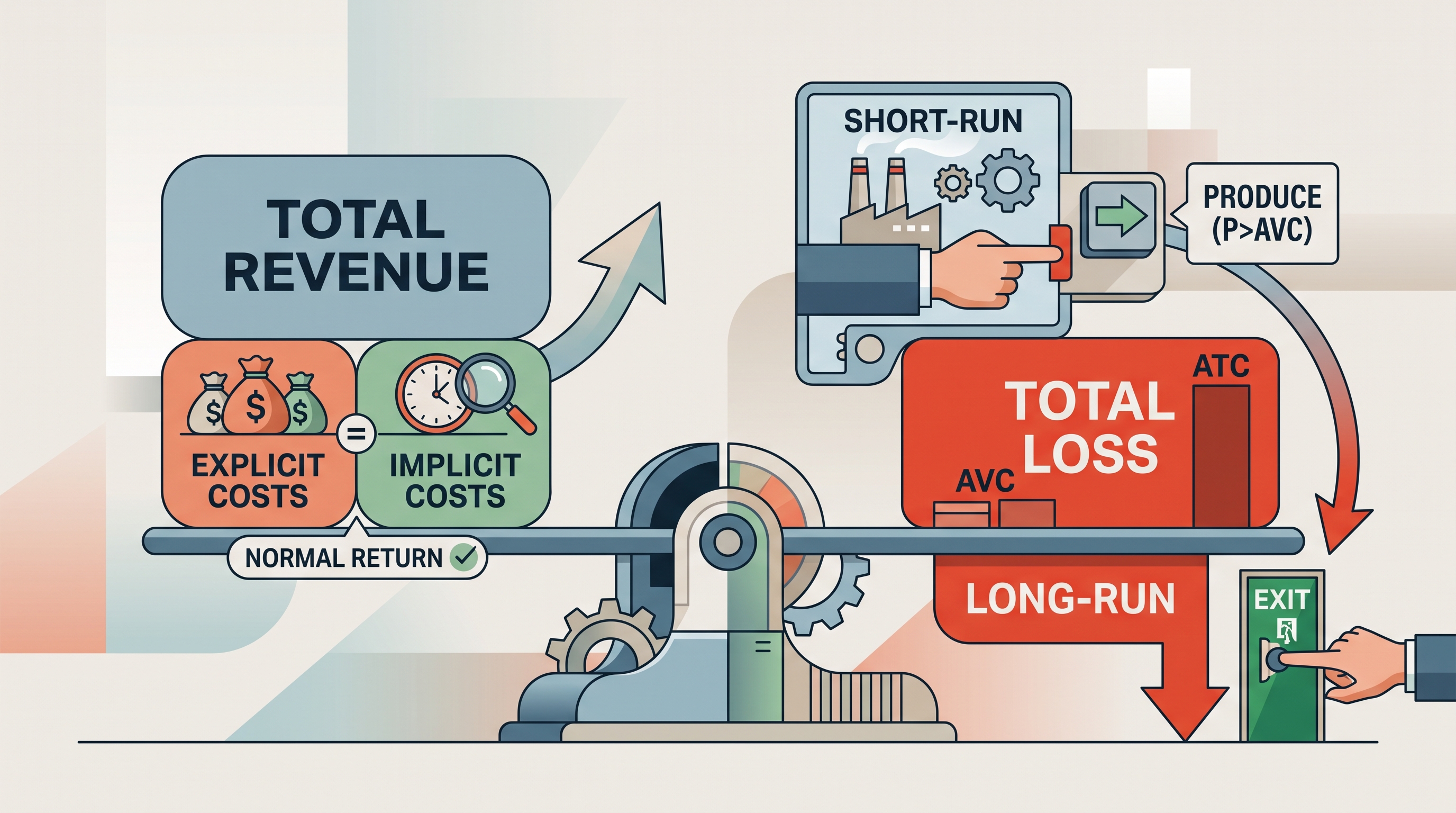
In the short run, a firm must decide whether to operate and produce a positive quantity. At least one factor of production—such as a building, specialized machine, or lease—remains fixed. Because the firm must pay its fixed cost whether it produces or shuts down, the immediate decision compares revenue with variable cost, the cost that changes with output.
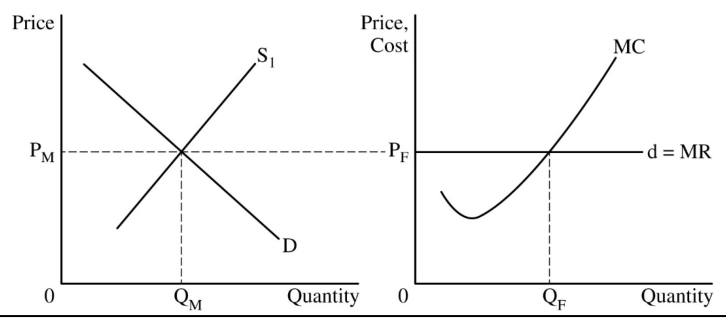
For a perfectly competitive firm, price is both average revenue and marginal revenue:
$$ P = AR = MR $$
The firm produces the quantity where its marginal-cost condition is satisfied, then asks whether the resulting revenue covers its variable costs.
| Short-run comparison | Firm’s decision |
|---|---|
| $TR > TVC$, or equivalently $P > AVC$ | Produce the profit-maximizing positive output |
| $TR = TVC$, or equivalently $P = AVC$ | Indifferent between producing and shutting down |
| $TR < TVC$, or equivalently $P < AVC$ | Shut down temporarily and produce zero output |
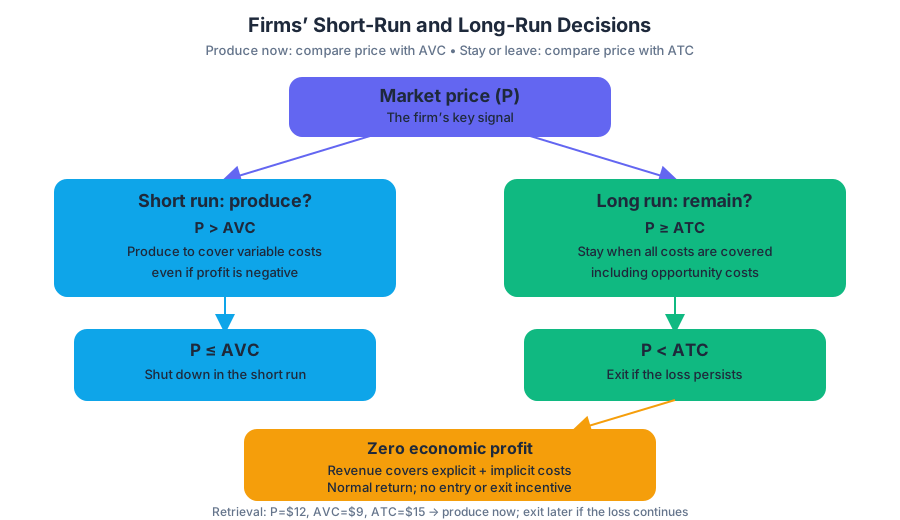
This is the shutdown rule. A shutdown is temporary: the firm remains in the industry but produces no output. It still pays fixed costs, so shutting down does not necessarily eliminate an economic loss; it prevents the firm from making an even larger loss by producing.
Worked example: why a loss-making firm may produce
Suppose a competitive bakery sells each cake for $20. At its chosen output, it earns total revenue of $2,000 and has total variable cost of $1,500. Its fixed cost is $800.
$$ TR - TVC = $2{,}000 - $1{,}500 = $500 $$
Because revenue covers variable cost, the bakery should continue operating. Its economic profit is:
$$ \pi = TR - TC = $2{,}000 - ($1{,}500+$800) = -$300 $$
The bakery loses $300, but shutting down would leave it paying the entire $800 fixed cost. Producing reduces the loss from $800 to $300. The common mistake is to say, “Any economic loss means shut down.” The correct question is whether revenue covers variable, not total, cost.
Long-run entry and exit
In the long run, inputs that were fixed in the short run become variable. A firm can expand its facility, replace equipment, change its organizational structure, or close entirely. When barriers to entry and exit are absent, firms respond to expected economic profit or loss:
- Firms enter a market when existing firms earn positive economic profit.
- Firms exit a market when they anticipate persistent economic losses.
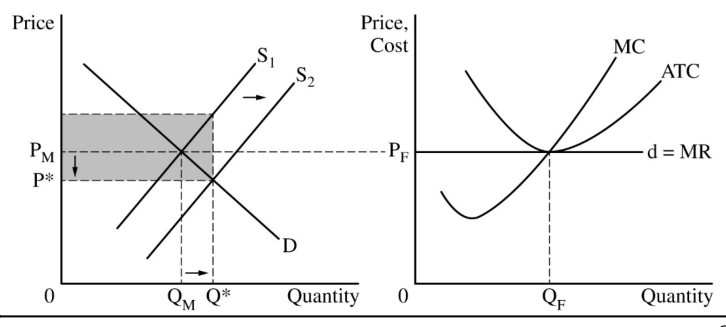
- Entry increases market supply and tends to lower market price.
- Exit decreases market supply and tends to raise market price.
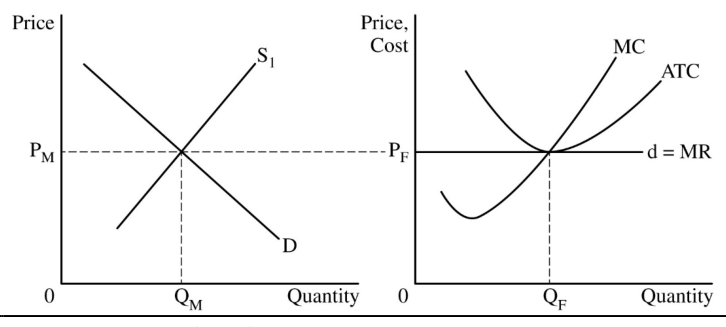
A short-run competitive equilibrium may therefore have a price above or below the long-run competitive level. Positive economic profit attracts entry; losses motivate exit. These changes move market price and quantity toward long-run equilibrium, where operating firms earn zero economic profit—a normal return that covers both explicit costs and implicit opportunity costs.
Perfect competition and long-run efficiency
A perfectly competitive firm is a price taker: it is too small relative to the market to influence price and can sell all of its output at the market price. The market supplies the price; the firm chooses its output using marginal analysis.
Two efficiency conditions emerge in long-run competitive equilibrium:
$$ P = MC $$
This is allocative efficiency. The price paid for the last unit equals the buyer’s private marginal benefit, while the firm’s marginal cost measures the private marginal cost of producing that unit. Resources therefore produce the quantity consumers value at the margin.
$$ P = MC = \min ATC $$
This is productive efficiency. Each operating firm produces at its efficient scale—the output that minimizes average total cost—and earns zero economic profit.
Specialization and the division of labor can reduce marginal cost by allowing workers and equipment to become more focused and productive. When technology, input prices, or production organization changes, the firm’s cost curves can shift, changing its short-run output decision and possibly encouraging entry or exit.
Industry cost conditions
Long-run market price depends partly on how industry expansion affects firms’ costs:
| Industry type | Effect of entry on firms’ costs | Long-run price tendency |
|---|---|---|
| Constant-cost industry | Costs remain unchanged | Price returns to the original long-run level |
| Increasing-cost industry | Input prices or operating costs rise | Long-run price increases |
| Decreasing-cost industry | Expansion lowers firms’ costs | Long-run price decreases |
Thus, perfectly competitive markets are allocatively and productively efficient in long-run equilibrium, but the adjustment path matters: firms may earn profits or losses in the short run while entry and exit reshape the market.
Misconception check and retrieval
Misconception: “Zero economic profit means the firm receives no revenue.”
Correction: Zero economic profit means total revenue exactly covers explicit costs and implicit opportunity costs. The owner receives a normal return, so there is no incentive to enter or exit.
Retrieval check: A firm faces $P=$12$, $AVC=$9$, and $ATC=$15$ at its chosen output. Should it produce in the short run? Should it remain in the industry in the long run if the loss persists? Answer: Produce now because $P>AVC$; exit in the long run if the economic loss continues because $P<ATC$.

Source Materials
- AP Microeconomics Course and Exam Description
- AP Microeconomics Course and Exam Description Clarifications and Corrections
- AP Microeconomics Course Overview
- AP Microeconomics Course at a Glance
- AP Microeconomics Course at a Glance Poster
- AP Microeconomics
- AP Microeconomics
- AP Microeconomics Sample Syllabus 1
- Figure — Sample Responses Q3 - Set 1 (p. 4)
- Figure — Sample Responses Q1 - Set 2 (p. 2)
- Figure — Sample Responses Q1 - Set 2 (p. 2)
- State that Deskward’s profit-maximizing quantity will not change in the short run and explain that a change in a fixed cost does not affect the firm’s marginal cost or marginal revenue.