From the free course AP Microeconomics on Lykke
4.3 Price Discrimination** `[PRD]`
Key concepts: Perfect price discrimination · Lowest price charged under perfect price discrimination · Graph-based analysis of price discrimination · Arzeye Pharma pricing example
Perfect price discrimination occurs when a firm with market power charges each consumer the highest price that consumer is willing to pay for each unit purchased.
4.3 Price Discrimination** [PRD]
Perfect price discrimination occurs when a firm with market power charges each consumer the highest price that consumer is willing to pay for each unit purchased. Instead of posting one price for everyone, the firm converts consumers’ willingness to pay into revenue, increasing profit or capturing consumer surplus under certain conditions.
Essential knowledge —
PRD-3.B.8: A firm with market power can engage in price discrimination to increase its profits or capture additional consumer surplus under certain conditions.
Perfect price discrimination: one consumer, one maximum price
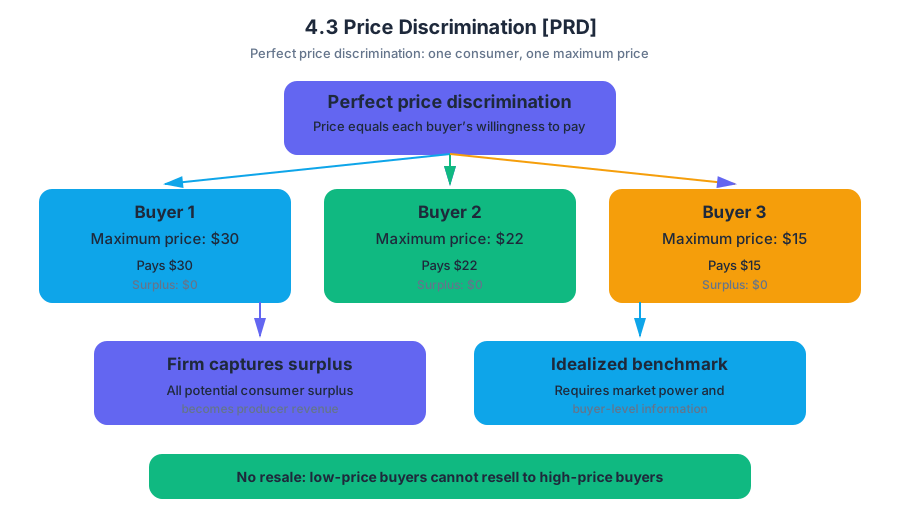
Imagine Arzeye Pharma sells a medication to three patients. One patient would pay up to $30, another up to $22, and another up to $15. A single-price firm might charge $15, selling to all three; under perfect price discrimination, it charges $30, $22, and $15 respectively. Each transaction occurs because the price equals that buyer’s maximum willingness to pay.
The firm therefore captures the entire area that would otherwise be consumer surplus. A consumer who pays exactly their willingness to pay receives no surplus: the difference between willingness to pay and price is zero.
Perfect price discrimination is an idealized benchmark. It requires the firm to have market power, to distinguish consumers or units according to willingness to pay, and to prevent resale between consumers. If a low-price buyer could resell to a high-price buyer, the firm could no longer maintain separate prices.
The lowest price under perfect price discrimination
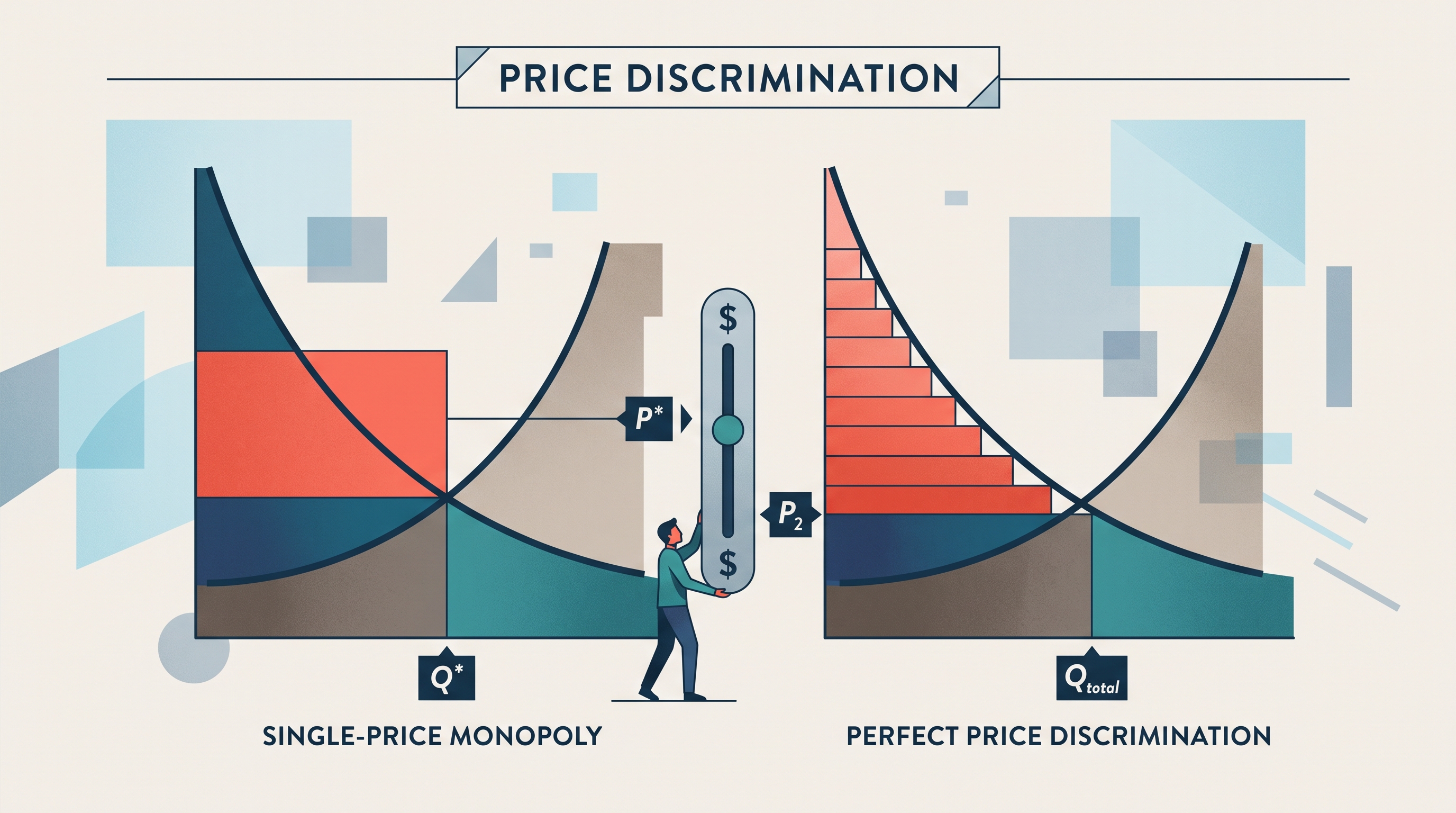
The lowest price Arzeye Pharma charges is not found at the single-price monopoly quantity. It is found at the final unit the firm is willing to sell: the quantity where the Demand curve intersects the Marginal Cost curve. That intersection identifies the last buyer whose willingness to pay still covers the cost of producing the unit.
On the required graph, label the price at this intersection $P_2$. Thus, $P_2$ is the lowest price charged under perfect price discrimination. The firm charges higher prices to earlier units and gradually lowers the price for later units as consumers’ willingness to pay falls.
Key graph rule: Under perfect price discrimination, output expands until $D = MC$, and the lowest price is the price on the demand curve at that output, labeled $P_2$.
Graph-based comparison
Using the existing monopoly graph, compare the single-price outcome at $MR=MC$ and $(P^,Q^)$ with perfect price discrimination at $D=MC$. The single-price monopolist restricts output because it must charge one price to every buyer; perfect price discrimination allows the firm to sell every unit for which willingness to pay is at least marginal cost.
A correct Arzeye Pharma graph should include:
- a downward-sloping Demand ($D$) curve;
- a downward-sloping Marginal Revenue ($MR$) curve below $D$;
- an upward-sloping Marginal Cost ($MC$) curve;
- a U-shaped Average Total Cost ($ATC$) curve;
- the single-price monopoly labels $P^$ and $Q^$;
- the zero-marginal-revenue quantity $Q_R$, if shown; and
- a horizontal dashed line from the intersection of $D$ and $MC$ to the price axis, labeled $P_2$.
The graph from part (a) is the controlling evidence for the later response. Do not draw a disconnected second diagram or identify $P_2$ from the $MR=MC$ point. Locate the $D$–$MC$ intersection on the original graph, project horizontally to the vertical axis, and label that price $P_2$.
What happens to consumer surplus?
Under perfect price discrimination, consumer surplus decreases to $0. The reason is not merely that the firm charges “higher prices”; it is that each consumer is charged their maximum willingness to pay, leaving no gap between willingness to pay and the price paid.
For Arzeye Pharma, the firm captures the surplus that would have appeared beneath the demand curve and above the single monopoly price $P^*$. Because output expands to the $D=MC$ quantity, the market may also avoid the output loss associated with uniform monopoly pricing, but the consumers receive none of the surplus created by their willingness to pay.
Misconception check
Misconception: “The lowest price under perfect price discrimination is $P^*$.”
Correction: $P^$ is the one-price monopoly price read from the demand curve at $Q^$. The lowest discriminatory price is $P_2$, read from the $D$–$MC$ intersection. Confusing these points earns the wrong graph-based conclusion.
Skill focus and retrieval check
Suggested skill — Graphing and Visuals (Skill Category 4; specifically 4.A, create representations of economic concepts): Draw the curves with correct slopes, place $P^$ and $Q^$ at the single-price outcome, then add $P_2$ at the $D=MC$ intersection. The graph must communicate the reasoning, not merely contain labeled curves.
Quick check: If Arzeye’s demand curve intersects marginal cost at a price of $15, while the single-price monopoly price is $24, which price is the lowest price under perfect price discrimination? Answer: $P_2 = $15$, because it is the price corresponding to the final unit where $D=MC$.
Source Materials
- AP Microeconomics Course and Exam Description
- AP Microeconomics Course and Exam Description Clarifications and Corrections
- AP Microeconomics Course Overview
- AP Microeconomics Course at a Glance
- AP Microeconomics Course at a Glance Poster
- AP Microeconomics
- AP Microeconomics
- AP Microeconomics Sample Syllabus 1