From the free course AP Microeconomics on Lykke
2.9 International Trade and Public Policy** `[POL]`
Key concepts: Government policies and market outcomes · International trade policies · Consumer and producer behavior · Domestic price and quantity effects · Government revenue · Market efficiency · Social benefits and social costs · Supply and demand graph analysis · Marginal benefit and marginal cost · Total revenue
International trade can lower a country’s domestic price by allowing consumers to buy from the world market, but a tariff or quota can reverse that benefit by restricting imports.
2.9 International Trade and Public Policy** [POL]
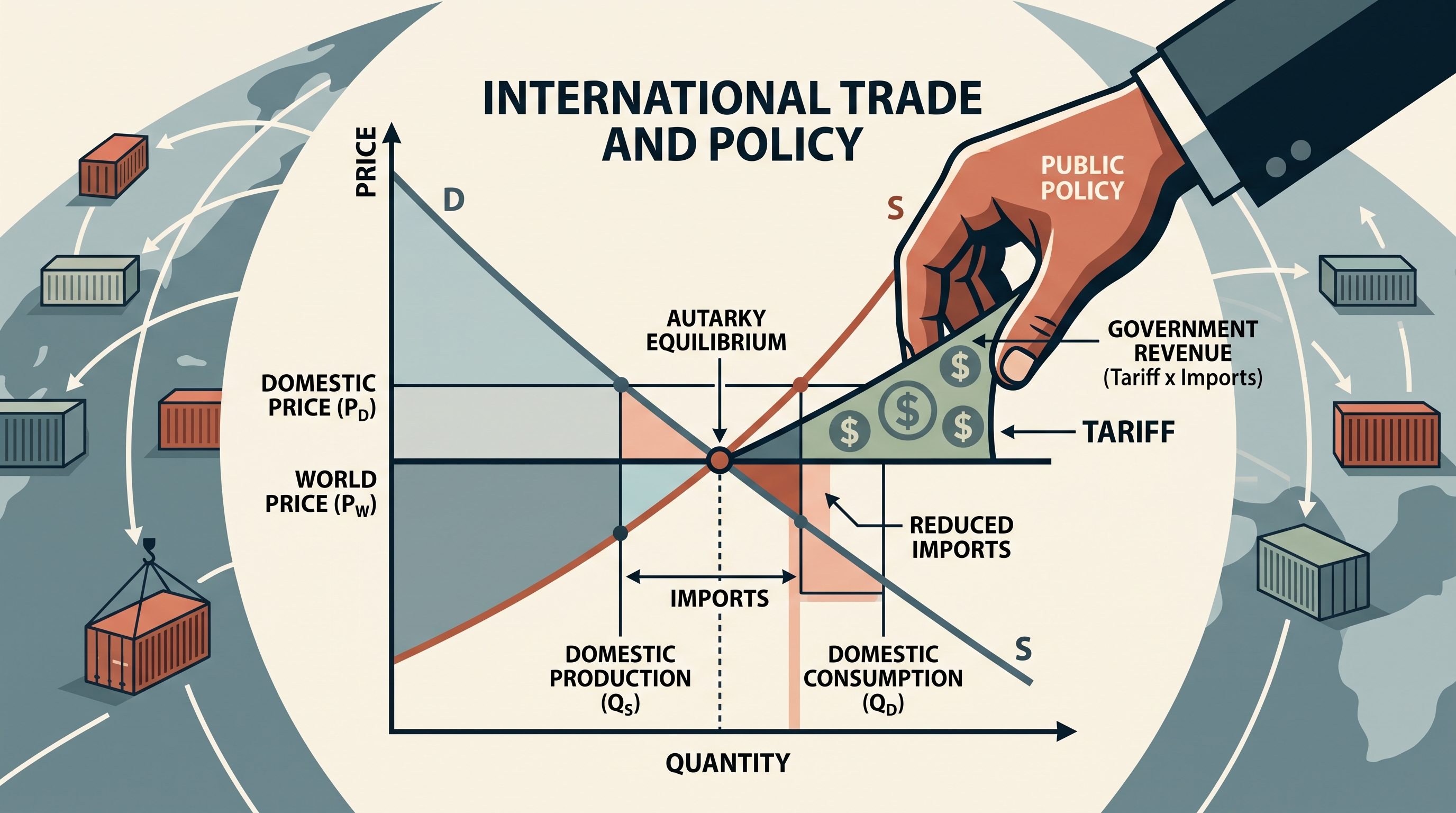
International trade can lower a country’s domestic price by allowing consumers to buy from the world market, but a tariff or quota can reverse that benefit by restricting imports. The central policy question is: who gains, who loses, and what happens to total economic surplus?
POL-1: Government policies influence consumer and producer behavior and therefore affect market outcomes.
Trade changes the domestic equilibrium
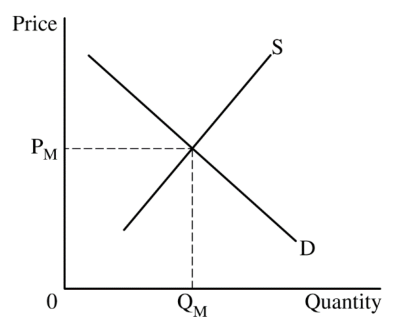
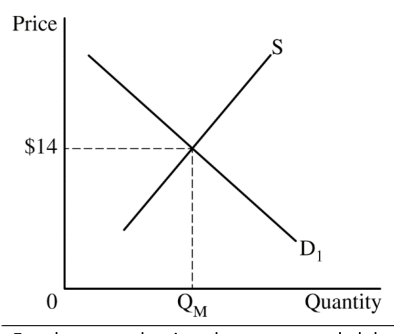
In a competitive domestic market, equilibrium occurs where Supply, representing marginal cost or $MC$, intersects Demand, representing marginal benefit or $MB$. The equilibrium price is labeled $P_e$, and quantity is measured on the horizontal axis.
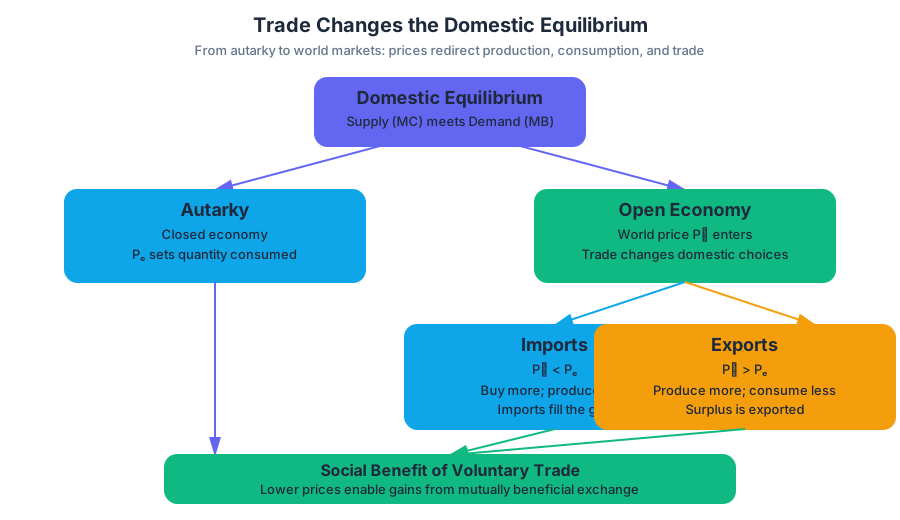
When an economy is closed to international trade—an outcome called autarky—domestic producers supply the entire quantity consumed. Opening the economy to trade introduces the world price, $P_W$.
- If $P_W < P_e$, the country imports the product. Consumers buy more at the lower world price, domestic producers supply less, and imports fill the gap between domestic quantity demanded and domestic quantity supplied.
- If $P_W > P_e$, the country exports the product. Domestic producers supply more than domestic consumers purchase, and the surplus is exported.
The lower price created by voluntary trade is a social benefit: consumers gain access to mutually beneficial purchases that would not occur at the higher autarky price. Domestic producers may lose some surplus when imports compete with them, but the gains to consumers can exceed those losses, increasing total economic surplus.
Tariffs: a tax on imported goods
A tariff is a tax imposed on imported goods. It raises the domestic price above the world price when it is binding. The new domestic price becomes:
$$ P_D = P_W + t $$
where $t$ is the tariff per imported unit.
At the higher domestic price, consumers respond by purchasing less, while domestic producers respond by producing more. Imports therefore decrease:
$$ \text{Imports} = Q_D - Q_S $$
The tariff changes several market outcomes at once:
| Outcome | Effect of a binding tariff |
|---|---|
| Domestic price | Increases |
| Quantity demanded | Decreases |
| Quantity supplied domestically | Increases |
| Imports | Decrease |
| Consumer surplus | Decreases |
| Producer surplus | Increases |
| Government revenue | Increases |
| Total economic surplus | Usually decreases |
Government tariff revenue is not domestic price multiplied by domestic quantity. It is the tariff collected on each imported unit:
$$ \text{Government tariff revenue}
(P_D-P_W)\times \text{imports}
t\times \text{imports} $$
For example, if the tariff is $\$2$ per unit and 40 units are imported, government revenue is:
$$ $2\times 40=$80 $$
By contrast, $TR=P\times Q$ is generally a firm’s total sales revenue. If a firm sells 50 units at $\$5$ per unit:
$$ TR=$5\times 50=$250 $$
That $250 is sales revenue, not automatically government tariff revenue.
Quotas: a quantity limit on imports
A quota is a legal limit on the quantity of a good that may be imported. Like a tariff, a binding quota reduces imports, raises the domestic price, increases domestic production, and decreases domestic consumption.
A quota can create a price difference between the domestic price and the world price. Whoever receives permission to import may capture this difference as quota rent:
$$ \text{Quota rent}
(P_D-P_W)\times \text{quota quantity} $$
Unlike tariff revenue, quota rent does not necessarily go to the government. It may go to domestic import-license holders or foreign exporters, depending on how the permits are allocated.
Efficiency: gains and losses from policy
Voluntary trade can increase total economic surplus because it permits additional mutually beneficial trades at the world price. A tariff or quota blocks some of those trades. The resulting lost gains are a social cost of restricting trade and appear as deadweight loss.
The policy may redistribute surplus even while reducing total surplus:
- Consumers lose because they pay a higher price and purchase fewer units.
- Domestic producers gain because they receive a higher price and sell more.
- The government may gain tariff revenue.
- Import-license holders may gain quota rent.
- Society loses the surplus from trades that would have benefited both buyers and sellers.
Efficiency is restored when social benefits are aligned with social costs: the market produces and consumes every unit for which marginal benefit is at least marginal cost. Trade restrictions move the outcome away from that condition by preventing some lower-cost world production from serving domestic consumers.
Misconception check
A tariff does not simply “help the economy” because it helps domestic producers. It helps domestic producers and generates government revenue, but it harms consumers and creates lost mutually beneficial trades. The correct overall judgment requires comparing all changes in consumer surplus, producer surplus, government revenue, and total economic surplus.
AP skill focus: Graphing and Visuals 4.C
For 4.C: Demonstrate the effect of a change in an economic situation on an accurately labeled graph or visual, begin with a domestic demand-and-supply graph. Label the vertical axis Price, the horizontal axis Quantity, the curves $D$ and $S$, the autarky equilibrium, and the world price $P_W$. For a tariff, draw the higher domestic price $P_D$, show the increase in domestic quantity supplied, the decrease in quantity demanded, and the smaller import gap.
Retrieval check: A country imports a good at a world price below its autarky price. A binding tariff is imposed. What happens to domestic price, domestic production, domestic consumption, imports, and total economic surplus? Explain the government-revenue formula and identify the social cost created by the policy.
Source Materials
- AP Microeconomics Course and Exam Description
- AP Microeconomics Course and Exam Description Clarifications and Corrections
- AP Microeconomics Course Overview
- AP Microeconomics Course at a Glance
- AP Microeconomics Course at a Glance Poster
- AP Microeconomics
- AP Microeconomics
- AP Microeconomics Sample Syllabus 1
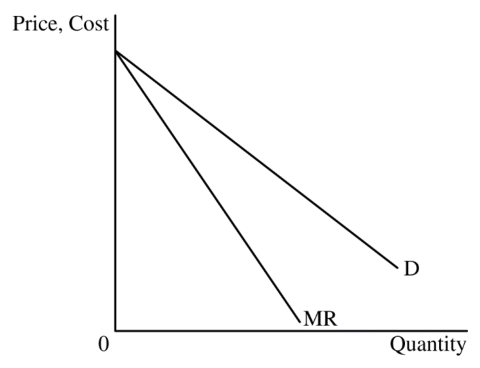
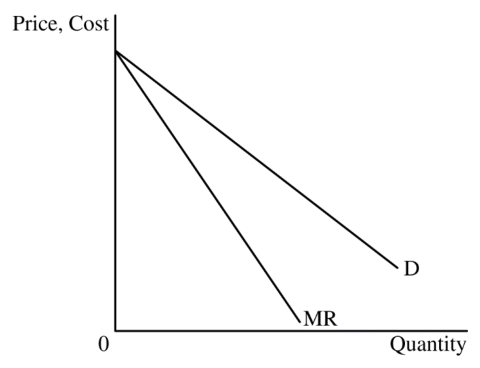
- For the second point, the graph must show a marginal cost (MC) curve and the profit-maximizing quantity, labeled QM, where MR = MC.
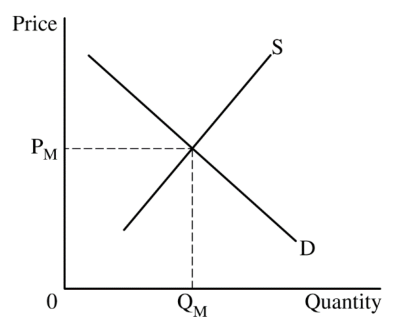
- For the second point, draw a correctly labeled graph for the firm and show the firm’s horizontal demand and marginal revenue (d=MR) curve extended from the market equilibrium price (PM), and label the