From the free course AP Microeconomics on Lykke
4.1 Introduction to Imperfectly Competitive Markets** `[PRD]`
Key concepts: Imperfectly competitive markets · Monopoly · Oligopoly · Monopolistic competition · Monopsony in factor markets · Market structure and profit-maximizing behavior · Nash equilibrium · 2×2 payoff matrices · Producer surplus, profit, and loss · Deadweight loss and market inefficiency
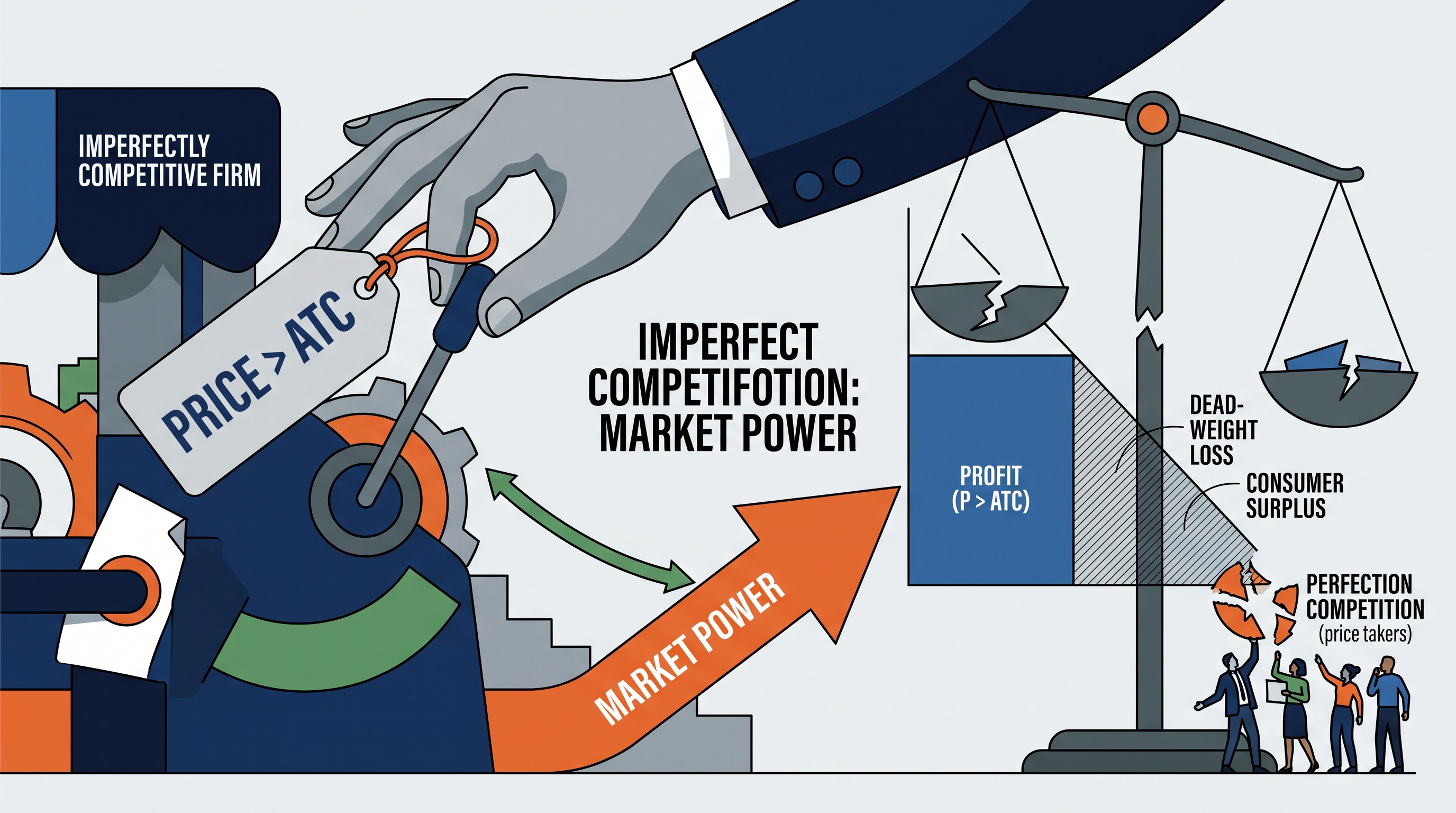
A market becomes imperfectly competitive when at least one participant has enough market power to influence the price, quantity, or terms of exchange rather than simply accepting a market-determined price.
4.1 Introduction to Imperfectly Competitive Markets** [PRD]
A market becomes imperfectly competitive when at least one participant has enough market power to influence the price, quantity, or terms of exchange rather than simply accepting a market-determined price. The central puzzle is this: if every firm wants to maximize profit, why do firms in different markets produce different outcomes?
Enduring Understanding PRD-3: Even with a common goal of profit-maximization, market structure constrains and influences prices, output, and efficiency.
The four imperfectly competitive structures
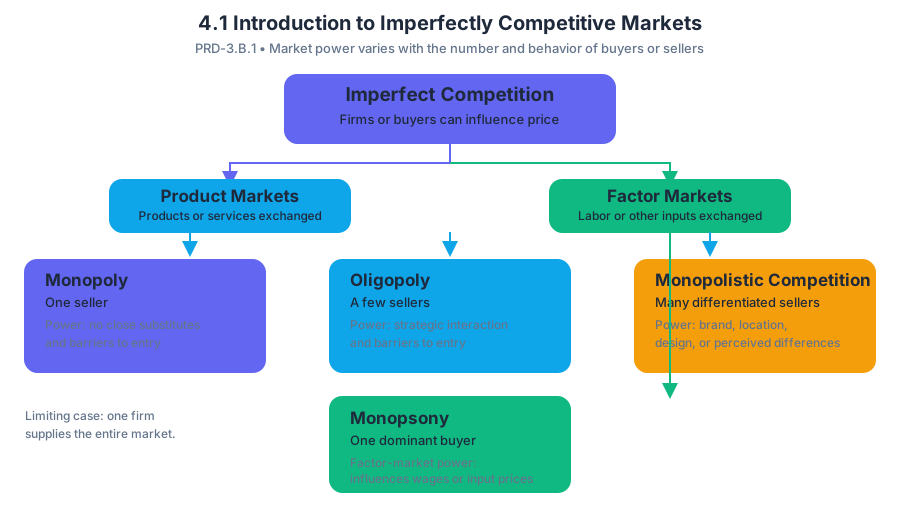
Essential Knowledge PRD-3.B.1 identifies imperfectly competitive markets as including monopoly, oligopoly, and monopolistic competition in product markets, and monopsony in factor markets.
| Market structure | What is being exchanged? | Number and behavior of buyers or sellers | Source of market power |
|---|---|---|---|
| Monopoly | Product or service | One seller | No close substitutes, barriers to entry |
| Oligopoly | Product or service | A few interdependent sellers | Strategic interaction and barriers to entry |
| Monopolistic competition | Product or service | Many sellers offering differentiated products | Brand, location, design, or perceived differences |
| Monopsony | Factor, such as labor | One dominant buyer | Buyer controls or strongly influences the factor price |
A monopoly is the limiting case: one firm supplies the entire market. An oligopoly has only a few significant firms, so each firm must consider how rivals may respond. Monopolistic competition has many firms, but their products are differentiated—for example, restaurants selling distinct dining experiences rather than identical meals. A monopsony occurs in a factor market when one buyer, such as a dominant employer in a small town, has substantial influence over the wage or other factor price.
Market structure changes the profit-maximizing decision
All firms compare the additional revenue from one more unit with the additional cost of producing it. However, market structure determines the shape of the relevant revenue curve and the constraints surrounding the decision. A perfectly competitive firm takes price as given, while an imperfectly competitive firm faces a downward-sloping demand curve or exercises buying power in a factor market.
For an imperfectly competitive product firm, the profit-maximizing output is generally found where:
$$MR = MC$$
The firm then uses its demand curve to determine the price consumers will pay. Profit or loss is measured by comparing price with average total cost at the chosen quantity:
$$\text{Economic profit} = (P - ATC)\times Q$$
If $P>ATC$, the firm earns positive economic profit. If $P<ATC$, it experiences an economic loss. If $P=ATC$, it earns zero economic profit, which still includes a normal return to the owner’s resources.
Worked graph interpretation
Suppose a differentiated smoothie shop chooses output $Q^$ where its marginal revenue curve intersects marginal cost. At $Q^$, the demand curve indicates a price of $P^$, while the average total cost curve indicates $ATC^$. If $P^>ATC^$, draw a rectangle with height $P^-ATC^$ and width $Q^*$ to represent profit.
The same graph can show producer surplus, the area above the firm’s supply-relevant marginal cost curve and below the price received for units sold. In imperfect competition, do not automatically equate producer surplus with profit: producer surplus reflects revenue minus variable cost, whereas profit subtracts both variable and fixed costs.
Why imperfect competition can be inefficient
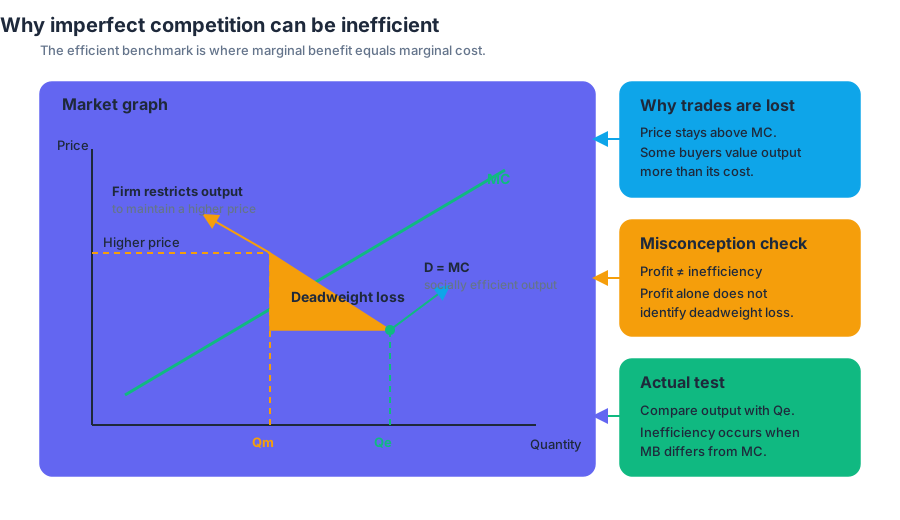
The socially efficient output occurs where consumers’ marginal benefit equals producers’ marginal cost. On a standard market graph, this is represented by the intersection of demand and marginal cost:
$$D = MC$$
An imperfectly competitive firm commonly restricts output below this socially efficient level in order to maintain a higher price. The mutually beneficial trades between the firm’s chosen output and the efficient output do not occur. The resulting deadweight loss is the triangular area between the demand and marginal cost curves over those unrealized units.
This explains why prices in imperfectly competitive markets cannot always coordinate the actions of all possible market participants: the price may remain above marginal cost, preventing some buyers who value the product more than its production cost from purchasing it.
Misconception check — “Any economic profit is inefficiency.”
Economic profit by itself does not identify deadweight loss. Inefficiency arises when output differs from the quantity where marginal benefit equals marginal cost. Profit may accompany inefficiently low output, but the two concepts are not identical.
Strategic behavior and Nash equilibrium
In an oligopoly, each firm’s best choice depends partly on the rival’s choice. A Nash equilibrium is a combination of strategies in which no player can improve its payoff by changing strategy alone, given the other player’s strategy.
Consider this original $2\times2$ payoff matrix. Each ordered pair lists the payoffs for Firm A and Firm B.
| Firm B: High price | Firm B: Low price | |
|---|---|---|
| Firm A: High price | $(8,8)$ | $(3,10)$ |
| Firm A: Low price | $(10,3)$ | $(5,5)$ |
If Firm B chooses a high price, Firm A prefers low price because $10>8$. If Firm B chooses a low price, Firm A again prefers low price because $5>3$. Low price is therefore Firm A’s dominant strategy; the same reasoning applies to Firm B. The Nash equilibrium is $(\text{Low price},\text{Low price})$, even though both firms would prefer the joint outcome $(\text{High price},\text{High price})$.
Entry incentives and excess capacity
Positive economic profit attracts new firms. Entry increases competition and may reduce each existing firm’s demand, while losses encourage exit. Barriers to entry—such as legal restrictions, control of essential resources, large startup costs, or strong brand loyalty—can weaken this adjustment and allow profits to persist.
In monopolistic competition, differentiated firms may earn positive, negative, or zero economic profit in the short run. Advertising can strengthen product differentiation and reduce the immediate pressure of competition. Over time, however, free entry and exit tend to drive economic profit toward zero; firms may still operate with excess capacity because output is below the quantity that minimizes average total cost.
AP skill lens
- Skill Category 1: Principles and Models — 1.A Define economic principles and models; 1.B Explain economic principles and models. Use these to classify market structures and connect profit maximization to market power.
- Skill Category 2: Interpretation — 2.A Define economic concepts; 2.B Explain economic outcomes. Use these to interpret payoff matrices, profit rectangles, producer surplus, and deadweight loss.
- Skill Category 3: Manipulation — 3.A Determine outcomes using economic concepts; 3.B Calculate economic outcomes. Use these to identify Nash equilibrium and calculate areas or profit with graph data.
- Skill Category 4: Graphing and Visuals — 4.A Draw graphs; 4.B Demonstrate understanding of a specific economic situation on an accurately labeled graph or visual. Label axes, curves, quantities, prices, and shaded areas clearly.
Retrieval check: A firm chooses $Q^$ where $MR=MC$, receives price $P^$, and faces $ATC^$ with $P^>ATC^$. What area represents profit, and what condition identifies socially efficient output? Answer: Profit is the rectangle $(P^-ATC^)\times Q^$; social efficiency is identified where demand, or marginal benefit, equals marginal cost.
Source Materials
- AP Microeconomics Course and Exam Description
- AP Microeconomics Course and Exam Description Clarifications and Corrections
- AP Microeconomics Course Overview
- AP Microeconomics Course at a Glance
- AP Microeconomics Course at a Glance Poster
- AP Microeconomics
- AP Microeconomics
- AP Microeconomics Sample Syllabus 1
- AP Microeconomics-AP Students-College Board
- AP/College Microeconomics-Khan Academy
- AP Microeconomics Exam Questions-AP Central-College Board
- AP Microeconomics Practice FRQ Questions-ReviewEcon