From the free course AP Microeconomics on Lykke
3.4 Types of Profit** `[CBA]`
Key concepts: Accounting profit · Economic profit · Normal profit · Total benefits and total costs · Marginal benefits and marginal costs · Rational economic agents · Profit opportunities · Opportunity costs · Principles and Models · Quantitative economic analysis
A business can report a profit and still be earning less than it could elsewhere. The difference depends on whether costs include only explicit payments or also the value of opportunities the owner gives up.
3.4 Types of Profit** [CBA]
A business can report a profit and still be earning less than it could elsewhere. The difference depends on whether costs include only explicit payments or also the value of opportunities the owner gives up.
Two meanings of profit
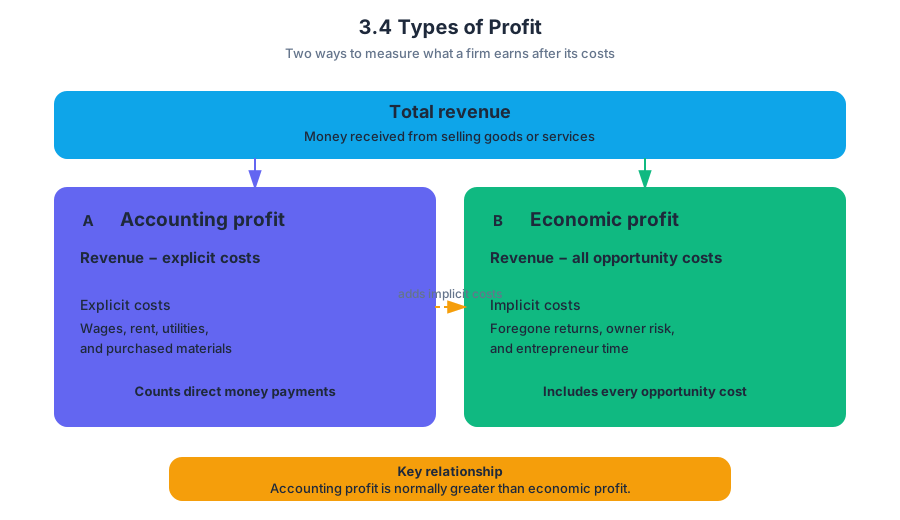
Accounting profit is total revenue minus explicit costs—direct money payments such as wages, rent, utilities, and purchased materials.
$$ \text{Accounting profit}=\text{Total revenue}-\text{Explicit costs} $$
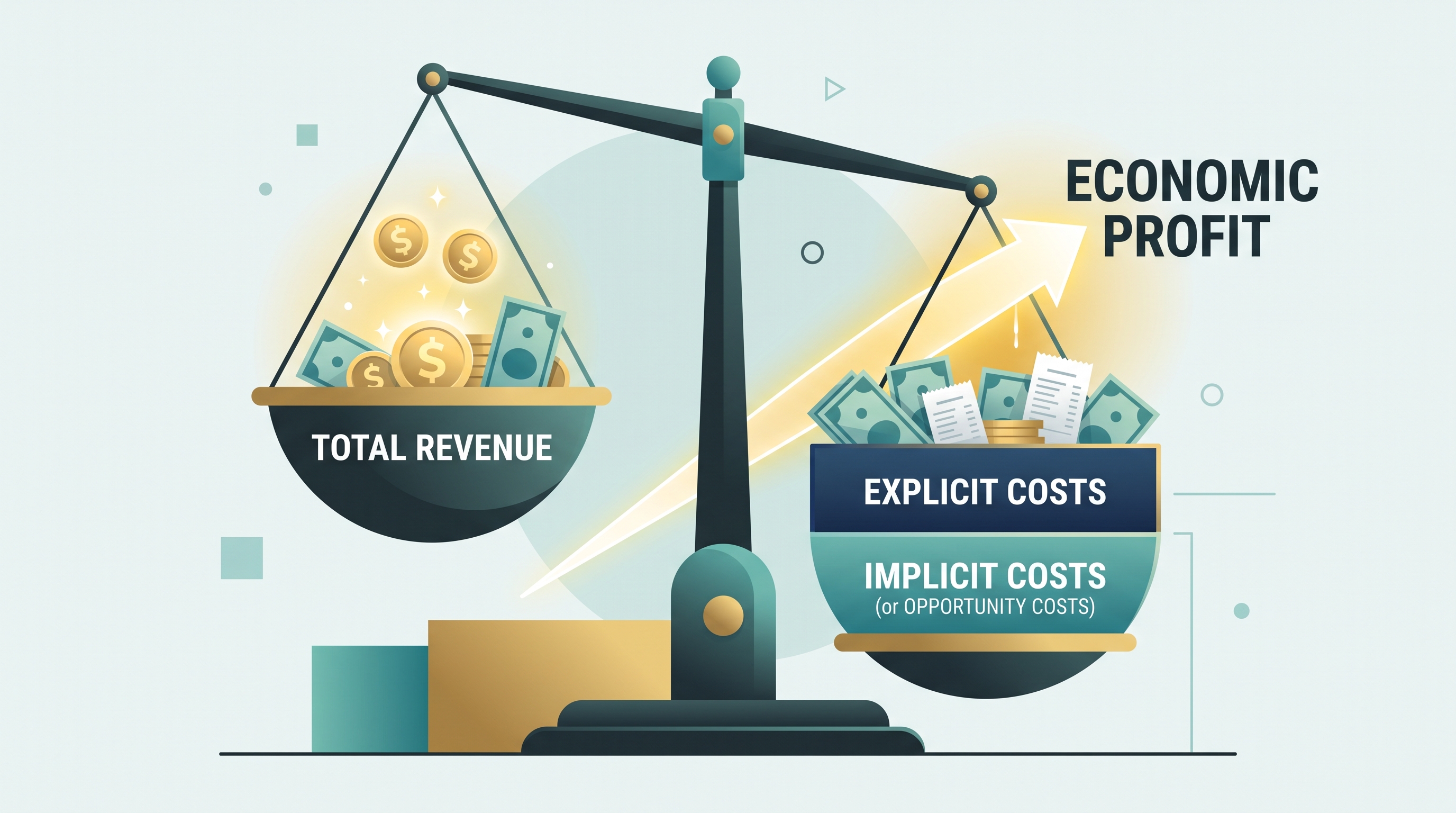
Economic profit subtracts both explicit costs and implicit costs, the opportunity costs of resources already owned or supplied by the firm’s owners. These include the return the firm’s financial capital could have earned elsewhere, compensation for risk, and the entrepreneur’s forgone time.
$$ \text{Economic profit}=\text{Total revenue}-\text{Explicit costs}-\text{Implicit costs} $$
Because implicit costs are included in economic cost, accounting profit is normally greater than economic profit for the same firm.
Economic cost includes every opportunity cost of operating the firm—not merely the bills the firm pays.
Anderson Company: the same revenue, different profit
Suppose Anderson Company earns total revenue of $$200{,}000$. It pays $$120{,}000$ in explicit costs. The owner also uses $$50{,}000$ of personal savings that could have earned interest elsewhere and contributes labor worth $$20{,}000$ in the next-best opportunity.
The calculations are:
$$ \text{Accounting profit}=$200{,}000-$120{,}000=$80{,}000 $$
$$ \text{Economic profit}=$200{,}000-$120{,}000-$50{,}000-$20{,}000=$10{,}000 $$
Therefore, Anderson Company’s accounting profit must be greater than its economic profit when positive implicit costs exist. The firm appears to earn $$80{,}000$ in accounting profit, but only $$10{,}000$ remains after compensating all economic costs.
Normal profit is not zero success
Normal profit is the return that exactly compensates the firm for all explicit and implicit economic costs. Economic profit is then zero, but the owner is still receiving the opportunity-cost return necessary to remain in the business.
$$ \text{Normal profit}\Longleftrightarrow \text{Total revenue}=\text{Total economic cost} $$
For example, if Anderson’s total revenue were $$190{,}000$ while its total economic cost remained $$190{,}000$, its economic profit would be $$0$. That does not mean the owner earns nothing: the owner’s capital, risk, and time are fully compensated.
Misconception check — “Zero economic profit means the firm is failing.”
Not necessarily. Zero economic profit means the firm earns normal profit. A firm exits when it expects a better return elsewhere, which requires comparing its current economic return with its opportunity costs.
Rational decisions: compare the next benefit with the next cost
The enduring idea CBA-2 is that rational economic agents determine the optimal activity level by comparing marginal benefit—the additional benefit from one more unit—with marginal cost—the additional cost of one more unit.
$$ \text{Proceed with an additional unit if } MB>MC $$
A firm should continue expanding an activity when the additional revenue or benefit exceeds the additional economic cost. It should stop increasing the activity when the next unit’s marginal cost is greater than its marginal benefit. Total benefits must exceed total costs for the activity to be worthwhile overall, but the marginal comparison determines whether expansion should continue.
How firms respond to profit opportunities
Under CBA-2.C.1, firms respond to economic profit or loss, not accounting profit alone. A positive economic profit signals that revenue exceeds all economic costs, including the owner’s opportunity costs. Other firms have an incentive to enter or expand in that activity; existing firms may increase production, acquire resources, or remain in the market.
An economic loss means total revenue is less than total economic cost. Firms may reduce activity, redirect resources, or exit if the loss persists. A firm earning accounting profit can still face economic loss if its implicit costs are larger than its accounting profit.
AP skill connection
The learning objective CBA-2.C requires students to define profit types, explain firm responses to profit opportunities, and calculate profit or loss. Essential Knowledge CBA-2.C.1 establishes that firms respond to economic profit or loss rather than accounting profit. Essential Knowledge CBA-2.C.2 establishes that accounting profit omits implicit costs such as financial capital, risk compensation, and entrepreneurial time; fully compensating those costs produces normal profit.
This topic is assessed through Skill Category 1: Principles and Models, especially 1.C: Identify an economic concept, principle, or model using quantitative data or calculations. On a table or numerical prompt, identify the relevant costs first, classify them as explicit or implicit, and then calculate the requested profit.
Retrieval check
A café earns revenue of $$90{,}000$, pays $$55{,}000$ in explicit costs, and has $$35{,}000$ in implicit costs. What are its accounting profit and economic profit, and what does an economic profit of zero mean?
Answer: Accounting profit is $$35{,}000$; economic profit is $$0$. The café earns normal profit because all explicit and implicit economic costs are fully compensated.
Source Materials
- AP Microeconomics Course and Exam Description
- AP Microeconomics Course and Exam Description Clarifications and Corrections
- AP Microeconomics Course Overview
- AP Microeconomics Course at a Glance
- AP Microeconomics Course at a Glance Poster
- AP Microeconomics
- AP Microeconomics
- AP Microeconomics Sample Syllabus 1