From the free course AP Microeconomics on Lykke
4.5 Oligopoly and Game Theory** `[PRD]`
Key concepts: Oligopoly · Game theory · Payoff matrices · Strategic interdependence · Dominant strategies · Best responses · Collusion and cartels · Marginal thinking in microeconomics · Combined profits from mergers · Efficient and inefficient markets
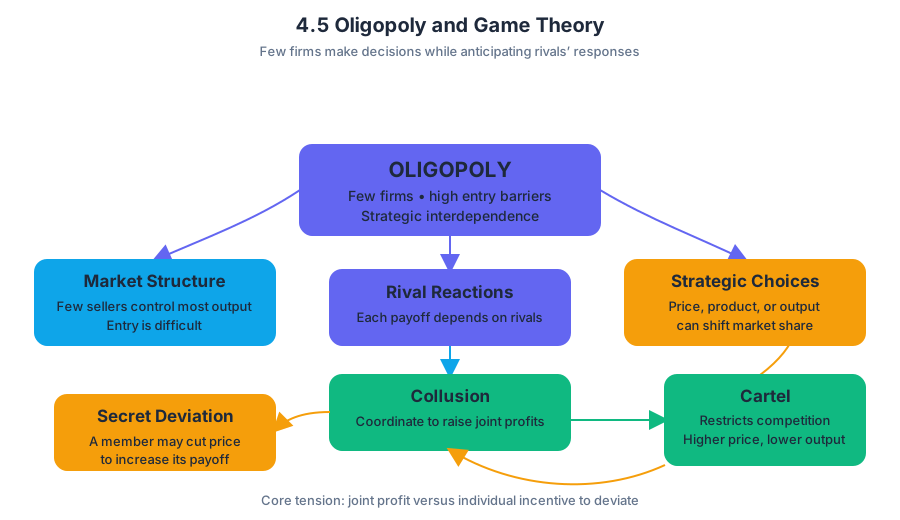
An oligopoly is a market with a few firms, high barriers to entry, and strategic interdependence: each firm’s payoff depends not only on its own decision but also on the decisions of its rivals.
4.5 Oligopoly and Game Theory** [PRD]
An oligopoly is a market with a few firms, high barriers to entry, and strategic interdependence: each firm’s payoff depends not only on its own decision but also on the decisions of its rivals. A price cut, product change, or production increase can improve one firm’s position while reducing the profits of another.
PRD-3.C.1: An oligopoly is an inefficient market structure with high barriers to entry, where there are few firms acting interdependently.
Because firms recognize their mutual dependence, they have an incentive to collude—coordinate decisions to raise joint profits—and form a cartel, an agreement among firms to restrict competition. The cartel may imitate a monopoly by charging a higher price and producing a lower quantity than perfect competition, but each member has a reason to secretly deviate if deviation increases its own payoff.
Games, strategies, and payoff matrices
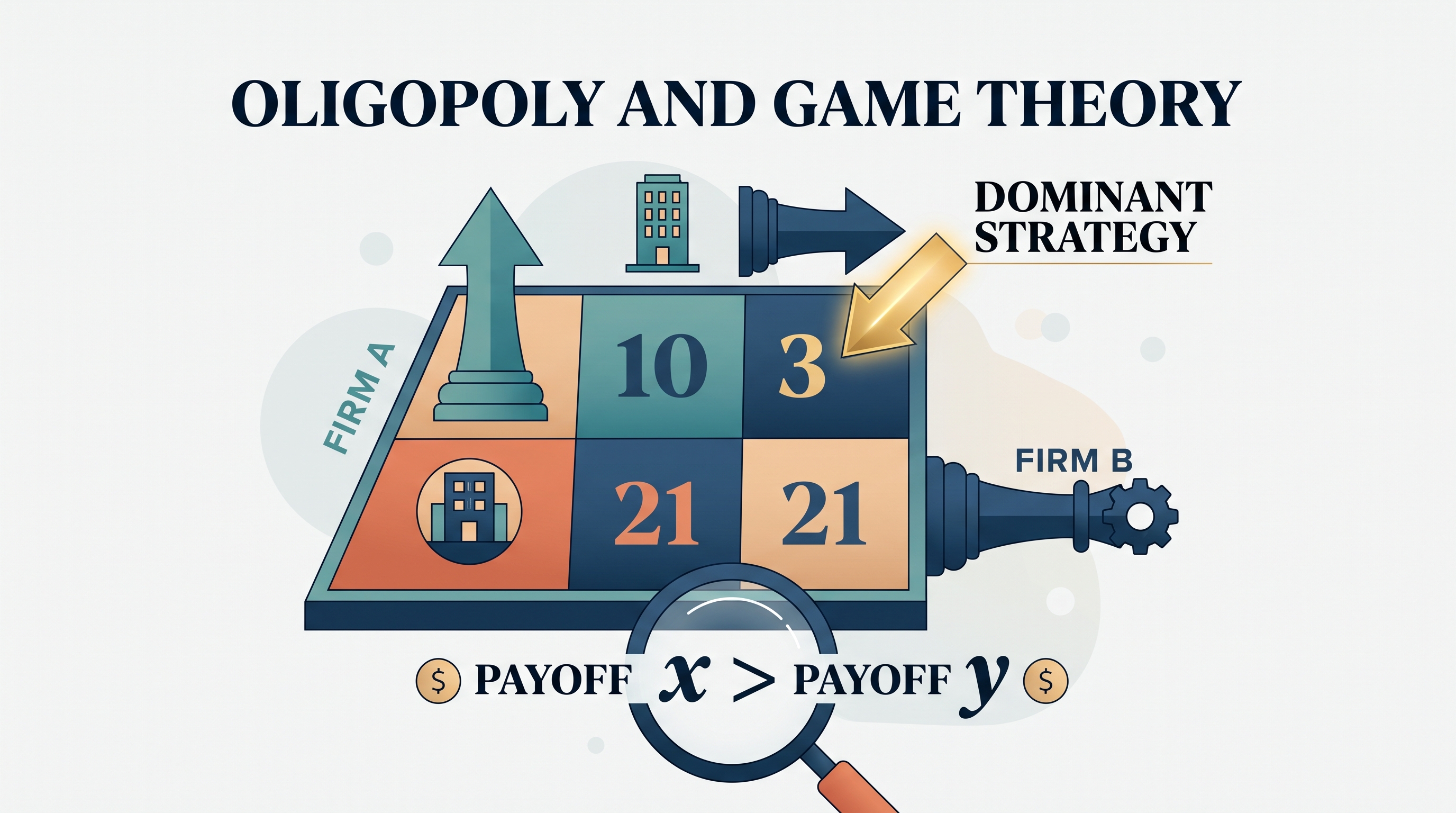
A game is a situation in which players choose actions and each player’s payoff depends on both their own action and the other player’s action. A strategy is a complete plan of action for playing the game. In the AP model, the relevant games have exactly two players and two actions per player.
PRD-3.C.3: A game is a situation in which a number of individuals take actions, and the payoff for each individual depends directly on both the individual's own choice and the choices of others.
A payoff matrix—also called a normal-form model—displays the payoff received by each player for every combination of strategies. In each cell, the first number belongs to the row player and the second number belongs to the column player.
PRD-3.C.4: A strategy is a complete plan of actions for playing a game; the normal form model of a game shows the payoffs that result from each collection of strategies.
The standard two-player structure can be read as follows:
| Ocel: Sheets | Ocel: Beams | |
|---|---|---|
| Feram: Truck | Feram payoff, Ocel payoff | Feram payoff, Ocel payoff |
| Feram: Rail | Feram payoff, Ocel payoff | Feram payoff, Ocel payoff |
To analyze the Feram–Ocel game, hold Ocel’s column fixed and compare Feram’s two payoffs. Then hold Feram’s row fixed and compare Ocel’s two payoffs. The question is never “Which cell looks best overall?” It is “Which action gives this particular player the greater payoff, given the other player’s action?”
Best responses and dominant strategies
A best response is the action that gives a player the highest payoff given the other player’s selected action. If Ocel chooses Sheets, Feram compares its Truck payoff in the Sheets column with its Rail payoff in the Sheets column. If Truck pays more, Truck is Feram’s best response to Sheets. Repeat the comparison when Ocel chooses Beams.
A dominant strategy produces a higher payoff regardless of what the other player does.
PRD-3.C.5: A player has a dominant strategy when the payoff to a particular action is always higher independent of the action taken by the other player.
For example, if Tony’s Trinkets earns $20 from Unique jewelry when Bitaly’s Bracelets produces Silver jewelry, but earns $21 from Typical jewelry in that same situation, Unique is not Tony’s best response because $21 > $20. To test whether Typical is dominant, compare Typical with Unique in both of Bitaly’s possible columns. Typical is dominant only if it pays more in both comparisons.
Marginal decisions and cartel instability
Game theory uses the same marginal logic developed earlier: choose an action when the additional benefit exceeds the additional cost. Suppose a cartel agreement gives Tony an extra $2 million if it keeps output restricted, but secretly increasing output would add $5 million in revenue and only $3 million in additional cost. The marginal payoff from deviating is
$$ \text{Marginal benefit} - \text{Marginal cost} = $5\text{ million} - $3\text{ million} = $2\text{ million}. $$
Because the incremental payoff is positive, deviation is privately attractive even though both firms might earn more if they cooperated. In a payoff matrix, that same reasoning appears as a higher payoff in the “deviate” cell. Thus, collusion can maximize combined profit while remaining unstable for each individual firm.
Nash equilibrium and cooperative profit
A Nash equilibrium is a combination of strategies in which neither player would improve their payoff by changing actions alone. Locate every cell in which the row player is choosing a best response to the column player and the column player is choosing a best response to the row player. A game may have more than one Nash equilibrium.
When firms merge, evaluate the decision differently: add the two firms’ payoffs in each cell, then select the cell with the largest combined profit. In the Tony’s Trinkets and Bitaly’s Bracelets example, the maximum combined profit is $39 million because the relevant cell gives
$$ $20\text{ million}+$19\text{ million}=$39\text{ million}. $$
Do not add the totals from all four cells. The merged firm chooses one strategy combination, so it compares the combined payoff of each possible cell and selects the maximum.
In the Field Cruiser–Nice Ride game, when Nice Ride chooses to improve safety, compare Field Cruiser’s payoffs for Power and the alternative strategy in that row or column. The required conclusion is that Power is most profitable. At the Nash equilibrium, Nice Ride earns $30 million and Field Cruiser earns $40 million, for a combined profit of $70 million.
AP reasoning and scope
These problems primarily assess Skill Category 1: Principles and Models, especially defining oligopoly, strategy, payoff, and dominant strategy; Skill Category 2: Interpretation, by explaining what numerical payoffs imply in context; and Skill Category 3: Manipulation, by determining how much a payoff must change to make another strategy dominant. Skill Category 4: Graphing and Visuals is less central here because the normal-form matrix itself is the required visual model.
For an incentive question, compare the proposed strategy with its rival’s payoff in every relevant cell. The increase must be large enough to make the proposed strategy strictly higher in the least favorable comparison. Games with more than two players, more than two actions, mixed strategies, or extensive-form decision trees are beyond the AP scope.
Retrieval check: If Bitaly chooses Silver and Tony earns $20 with Unique but $21 with Typical, what is Tony’s best response, and why? Tony should choose Typical, because its payoff is higher: $21 > $20.
Source Materials
- AP Microeconomics Course and Exam Description
- AP Microeconomics Course and Exam Description Clarifications and Corrections
- AP Microeconomics Course Overview
- AP Microeconomics Course at a Glance
- AP Microeconomics Course at a Glance Poster
- AP Microeconomics
- AP Microeconomics
- AP Microeconomics Sample Syllabus 1